Indigenous Australians are the various Aboriginal Australian peoples of Australia, and the ethnically distinct people of the Torres Strait Islands. The terms Aboriginal and Torres Strait Islander peoples, First Nations of Australia, First Peoples of Australia, and First Australians are also common. Many Indigenous Australians prefer to identify with their specific cultural group.
Estimates from the 2021 Australian census show that there were almost one million Indigenous Australians, representing 3.8% of the Australian population. About 92% of Indigenous Australians identified as Aboriginal, 4% identified as Torres Strait Islander and 4% identified with both groups. About 84% spoke English at home and 9% spoke an Aboriginal or Torres Strait language at home. Just over half hold secular or other spiritual beliefs or no religious affiliation; about 40% are Christian; and about 1% adhere to a traditional Aboriginal religion.
The ancestors of Aboriginal Australians moved into what is now the Australian continent about 50,000 to 65,000 years ago, during the last glacial period, arriving by land bridges and short sea crossings from what is now Southeast Asia. The ancestors of today's Torres Strait Islanders arrived from what is now Papua New Guinea around 2,500 years ago and settled the islands on the northern tip of the Australian landmass.

Aboriginal Australians were complex hunter-gatherers with diverse economies and societies. There were about 600 tribes or nations and 250 languages with various dialects. Certain groups engaged in fire-stick farming and fish farming and built semi-permanent shelters. The extent to which some groups engaged in agriculture is controversial. Torres Strait Islanders were seafarers and obtained their livelihood from seasonal horticulture and the resources of their reefs and seas. They also developed agriculture on some of their islands. Villages had appeared in their areas by the 14th century.
The Indigenous population prior to British settlement in 1788 has been estimated from 318,000 to more than 3,000,000. A population collapse, principally from new infectious diseases, followed British colonisation in 1788. Massacres, frontier armed conflicts and competition over resources with British settlers also contributed to the decline of the Aboriginal population.
From the 1930s, the Indigenous population began to recover and Indigenous communities founded organisations to advocate for their rights. From the 1960s Indigenous people won the right to vote in federal and state elections, and some won the return of parts of their traditional lands. In 1992 the High Court of Australia, in the Mabo Case, found that Indigenous native title rights existed in common law. By 2021 Indigenous Australians had exclusive or shared title to about 54% of the Australian land mass. Since 1995 the Australian Aboriginal flag and the Torres Strait Islander flag have been official flags of Australia.

From the 19th to the mid-20th century, government policy removed many mixed heritage children from Aboriginal communities, with the intent to assimilate them to what had become the majority white culture. In 1997 the Australian Human Rights Commission found that the policy constituted genocide.
Terminology
Variations
There are a number of contemporary appropriate terms to use when referring to Indigenous peoples of Australia. In contrast to when settlers referred to them by various terms, in the 21st century there is consensus that it is important to respect the "preferences of individuals, families, or communities, and allow them to define what they are most comfortable with" when referring to Aboriginal and Torres Strait Islander people.
The word aboriginal has been in the English language since at least the 16th century to mean "first or earliest known, indigenous". It comes from the Latin ab (from) and origo (origin, beginning). The term was used in Australia as early as 1789 to describe its Aboriginal peoples. It became capitalised and was used as the common term to refer to both Aboriginal and Torres Strait Islanders. Today, the latter peoples are not included in this term. The term "Aborigine" (as opposed to "Aboriginal") is often disfavoured, as it is regarded as having colonialist connotations.
While the term "Indigenous Australians" has grown in popularity since the 1980s, many Aboriginal and Torres Strait Islander peoples dislike it. They feel that it is too generic and removes their distinct clan and people identity. However, many people think that the term is useful and convenient, and can be used where appropriate.
In recent years, terms such as "First Nations", "First Peoples" and "First Australians" have become more common.
Being as specific as possible, for example naming the language group (such as Arrernte), or demonym relating to geographic area (such as Nunga), is preferred as a way to affirm and maintain a sense of identity.

Terms "Black" and "Blackfella"
British colonists from their early settlement used the term "Black" to refer to Aboriginal Australians and later Torres Strait Islanders. While the term originally related to skin colour and was often used pejoratively, today the term is used to indicate Aboriginal or Torres Strait Islander heritage or culture in general. It refers to any people of such heritage regardless of their level of skin pigmentation.
In the 1970s, with a rise in Aboriginal activism, leaders such as Gary Foley proudly embraced the term "Black". For example, writer Kevin Gilbert's book of that time was entitled Living Black. The book included interviews with several members of the Aboriginal community, including Robert Jabanungga, who reflected on contemporary Aboriginal culture. Living Black is also the name of an Australian TV news and current affairs program covering "issues affecting Aboriginal and Torres Strait Islander Australians". It is presented and produced by Karla Grant, an Arrernte woman.
Use of the term "Black" varies depending on context, and its use may be deemed inappropriate. Furthermore, the term sometimes causes confusion as it can refer to Indigenous Australians, other groups such as African Australians and Melanesian Australians (South Sea Islanders, Papua New Guinean Australians and Fijian Australians), or all Black people.

A significant number of Aboriginal and Torres Strait Islander people use the term "Blackfella" and its associated forms to refer to Aboriginal Australians.
"Blak"
The term blak is sometimes used as part of a wider social movement (seen in terms such as "Blaktivism" and "Blak History Month"). The term was coined in 1991 by photographer and multimedia artist Destiny Deacon, in an exhibition entitled Blak lik mi. For Deacon's 2004 exhibition at the Museum of Contemporary Art, blak was defined in a museum guide as: "a term used by some Aboriginal people to reclaim historical, representational, symbolical, stereotypical and romanticised notions of Black or Blackness. Often used as ammunition or inspiration." Deacon said that removing the c from black to "de-weaponise the term 'black cunt'" was "taking on the 'colonisers' language and flipping it on its head".
Contemporary Aboriginal arts in the 21st century are sometimes referred to as a "Blak" arts movement, expressed in names such as BlakDance, BlakLash Collective, and the title of Thelma Plum's song and album, Better in Blak. Melbourne has an annual Blak & Bright literary festival, Blak Dot Gallery, Blak Markets, and Blak Cabaret.

Aboriginal Australians
"Aboriginal Australians" refers to the various peoples indigenous to mainland Australia and associated islands, excluding the Torres Strait Islands.
The term Aboriginal Australians includes many regional groups that may be identified under names based on local language, locality, or what they are called by neighbouring groups. Groups can overlap, contain sub-groups. Groups can also evolve over time, and significant changes have occurred since colonisation. The word "community" is often used to describe groups identifying by kinship, language, or belonging to a particular place or "country". An individual community may identify itself by many names, each of which can have alternative English spellings.
Throughout the history of the continent, there have been many different Aboriginal groups, each with its own individual language, culture, and belief structure. At the time of British settlement, there were over 200 distinct languages.
Torres Strait Islanders
Torres Strait Islanders are the Indigenous Melanesian people of the Torres Strait Islands, which are part of the state of Queensland. They are ethnically distinct from the Aboriginal peoples of the rest of Australia. Six percent of Indigenous Australians identify fully as Torres Strait Islanders. A further 4% of Indigenous Australians identify as having both Torres Strait Islander and Aboriginal heritage.
The Torres Strait Islands comprise over 100 islands, which were annexed by Queensland in 1879.
Other groupings
Aboriginal and Torres Strait Islander people also sometimes refer to themselves by descriptions that relate to their ecological environment, such as saltwater people for coast-dwellers (including Torres Strait Islander people), freshwater people, rainforest people, desert people, or spinifex people, (the latter referring to the Pila Nguru of Western Australia).
History
Migration to Mainland Australia and Torres Strait Islands
The ancestors of Aboriginal Australians moved into what is now Oceania about 50,000 to 65,000 years ago, during the last glacial period, arriving by land bridges and short sea crossings from what is now Southeast Asia.
The first phase of occupation of the Torres Strait Islands began about 4,000 years ago. By 2,500 years ago more of the islands were occupied and a distinctive Torres Strait Islander maritime culture emerged. Agriculture also developed on some islands and by 700 years ago villages appeared.
Several settlements of humans in Australia have been dated around 49,000 years ago. Luminescence dating of sediments surrounding stone artefacts at Madjedbebe, a rock shelter in northern Australia, indicates human activity as early as 65,000 years BP. Genomic studies, however, suggest that the main wave of modern humans into Australia ancestral to Aboriginal Australians happened as recently as 37,000 to 50,000 years ago. Accordingly, earlier groups either went extinct or contributed around ~2% ancestry to modern Aboriginal Australians. Indigenous Australians and other Oceanians were probably part of the same southern route dispersal as the ancestors of Ancient Ancestral South Indians, Andamanese, and East Asians.
The earliest anatomically modern human remains found in Australia (and outside of Africa) are those of Mungo Man; they have been dated at 42,000 years old. The initial comparison of the mitochondrial DNA from the skeleton known as Lake Mungo 3 (LM3) with that of ancient and modern Aboriginal peoples indicated that Mungo Man is not related to Australian Aboriginal peoples. The sequence has been criticised as there has been no independent testing, and it has been suggested that the results may be due to posthumous modification and thermal degradation of the DNA. Although the contested results seem to indicate that Mungo Man may have been an extinct subspecies that diverged before the most recent common ancestor of contemporary humans, the administrative body for the Mungo National Park believes that present-day local Aboriginal peoples are descended from the Lake Mungo remains.
It is generally believed that Aboriginal people are the descendants of a single migration into the continent, a people that split from the ancestors of East Asians.
Recent work with mitochondrial DNA suggests a founder population of between 1,000 and 3,000 women to produce the genetic diversity observed, which suggests that "initial colonisation of the continent would have required deliberate organised sea travel, involving hundreds of people". Aboriginal people seem to have lived a long time in the same environment as the now extinct Australian megafauna.
Genetics
Genetic studies have suggested that Aboriginal Australians largely descended from an Eastern Eurasian population wave during the Initial Upper Paleolithic, and are most closely related to other Oceanians, such as Melanesians. The Aboriginal Australians also show affinity to Ancient Ancestral South Indians, the Andamanese people, as well as to East Asian peoples. Phylogenetic data suggests that an early initial eastern non-African (ENA) or East-Eurasian meta-population trifurcated, and gave rise to Australasians (Oceanians), the Ancient Ancestral South Indians, Andamanese and the East/Southeast Asian lineage including the ancestors of Native Americans, although Papuans may have also received some geneflow from an earlier group (xOOA) as well, around 2%, next to additional archaic admixture in the Sahul region.
Rasmussen et al. 2011 shows that Aboriginal Australians have a lower proportion of European alleles compared to Asians, which they believe is indicative of a multiple dispersal model. Genetically, while Aboriginal Australians are most closely related to Melanesian (including Papuan) people, McEvoy et al. 2010 believed there is also another component that could indicate Ancient Ancestral South Indian admixture or more recent European influence. Research indicates a single founding Sahul group with subsequent isolation between regional populations which were relatively unaffected by later migrations from the Asian mainland, which may have introduced the dingo 4,000–5,000 years ago. The research also suggests a divergence from the Papuan people of New Guinea and the Mamanwa people of the Philippines about 32,000 years ago, with a rapid population expansion about 5,000 years ago. A 2011 genetic study found evidence that the Aboriginal, Papuan and Mamanwa peoples carry some of the alleles associated with the Denisovan peoples of Asia, (not found amongst populations in mainland Asia) suggesting that modern and archaic humans interbred in Asia approximately 44,000 years ago, before Australia separated from New Guinea and the migration to Australia. A 2012 paper reports that there is also evidence of a substantial genetic flow from India to northern Australia estimated at slightly over four thousand years ago, a time when changes in tool technology and food processing appear in the Australian archaeological record, suggesting that these may be related. Bergström et al 2016 and Nagle et al 2016 could not replicate the 2012 study, noting that Indigenous Australians split from mainland Asia 50,000 years ago. Mallick et al. 2016 and Mark Lipson et al. 2017 study found that the bifurcation of Eastern Eurasian and Western Eurasian dates back to least 45,000 years ago, with Australasians nested inside the Eastern Eurasian clade. Vallini et al. 2024 noted that the divergence between Ancient East Eurasians and West Eurasians most likely occurred on the Persian Plateau >48,000 years ago, with East Eurasians dispersing throughout the Asia-Pacific region >45,000 years ago.
Uniparentals
Aboriginal Australian men have haplogroup C-M347 in high frequencies with peak estimates ranging from 60.2% to 68.7%. In addition, the basal form K2* (K-M526) of the extremely ancient haplogroup K2 – whose subclades haplogroup R, haplogroup Q, haplogroup M and haplogroup S can be found in the majority of Europeans, South Asians, Native Americans and the Indigenous peoples of Oceania – has only been found in living humans today amongst Aboriginal Australians. 27% of them may carry K2* and approximately 29% of Aboriginal Australian males belong to subclades of K2b1, also known as M and S.
Aboriginal Australians possess deep rooted clades of both mtDNA haplogroup M and haplogroup N.
Before European contact
Aboriginal people
Aboriginal people lived as foragers and hunter-gatherers. Although Aboriginal society was generally mobile, or semi-nomadic, moving according to the changing food availability found across different areas as seasons changed, the mode of life and material cultures varied greatly from region to region. The greatest population density was to be found in the southern and eastern regions of the continent, the River Murray valley in particular.
There is some evidence that, before outside contact, some groups of Aboriginal Australians had a complex subsistence system that was only recorded by the first European explorers. One early settler took notes on the life styles of the Wathaurung people whom he lived near in Victoria. He saw women harvesting murnong tubers, a native yam that is now almost extinct. However, the area that they were harvesting from was already cleared of other plants, making it easier to harvest murnong (also known as yam daisy) exclusively.
Along the northern coast of Australia, parsnip yams were harvested by leaving the bottom part of the yam still stuck in the ground so that it would grow again in the same spot. Aboriginal peoples used slash-and-burn techniques to enrich the nutrients of their soil. However, sheep and cattle later brought over by Europeans would ruin this soil by trampling on it. They deliberately exchanged seeds to begin growing plants where they did not naturally occur. Norman Tindale was able to draw an Aboriginal grain belt, detailing the specific areas where plants were once produced.
In terms of aquaculture, explorer Thomas Mitchell noted large stone fish traps on the Darling River at Brewarrina. Each trap covers a pool, herding fish through a small entrance that would later be shut. Traps were created at different heights to accommodate different water levels during floods and droughts.
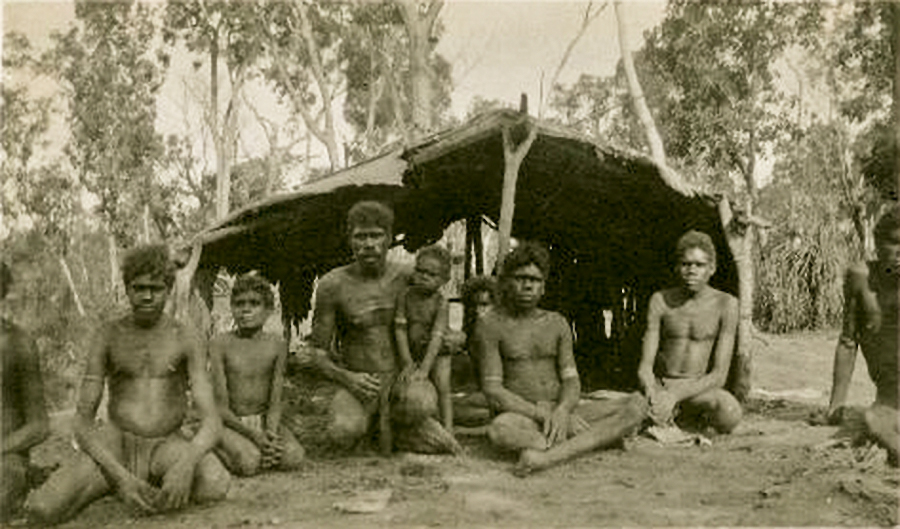
Technology used by Indigenous Australian societies before European contact included weapons, tools, shelters, watercraft, and the message stick. Weapons included boomerangs, spears (sometimes thrown with a woomera) with stone or fishbone tips, clubs, and (less commonly) axes. The Stone Age tools available included knives with ground edges, grinding devices, and eating containers. Fibrecraft was well-developed, and fibre nets, baskets, and bags were used for fishing, hunting, and carrying liquids. Trade networks spanned the continent, and transportation included canoes. Shelters varied regionally, and included wiltjas in the Atherton Tablelands, paperbark and stringybark sheets and raised platforms in Arnhem Land, whalebone huts in what is now South Australia, stone shelters in what is now western Victoria, and a multi-room pole and bark structure found in Corranderrk. A bark tent or lean-to is known as a humpy, gunyah, or wurley. Clothing included the possum-skin cloak in the southeast, buka cloak in the southwest and riji (pearl shells) in the northeast.
There is evidence that some Aboriginal populations in northern Australia regularly traded with Makassan fishermen from Indonesia before the arrival of Europeans.
Population
The Indigenous population prior to British settlement has been estimated from 300,000 to more than 3,000,000. Recent archaeological finds suggest that a population of 500,000 to 750,000 could have been sustained, with some ecologists estimating that a population of one million to two million people was possible.
The geographic distribution of the pre-contact population is a matter of academic debate. Pardoe argues that the distribution was similar to that of the current Australian population, the majority living in the south-east, centred along the Murray River. However, Evans suggests that the area which is now Queensland was the most densely populated.
In 2011, Ørsted-Jensen proposed the following distribution of the pre-contact population:
Torres Strait Island people
The Torres Strait peoples' fishing economy relied on boats, which they built themselves. There is also evidence of the construction of large, complex buildings on stilts and domed structures using bamboo, with thatched roofs, which catered for extended family members living together.
British colonisation
First contact
British exploration of the Australian coastline began with the buccaneer William Dampier in 1688 and 1699. Dampier was impressed neither by the country nor the people of the west Australian coast. Almost a century later, the explorer James Cook mapped the east coast of Australia and claimed the territory for Britain in the name of King George III. Cook was impressed both by the land and the people whom he encountered, writing in his journal: "From what I have said of the Natives of New Holland they may appear to some to be the most wretched people upon Earth, but in reality they are far more happier than we Europeans; being wholy unacquainted not only with the superfluous but the necessary conveniencies so much sought after in Europe, they are happy in not knowing the use of them. They live in a Tranquillity which is not disturb'd by the Inequality of Condition".