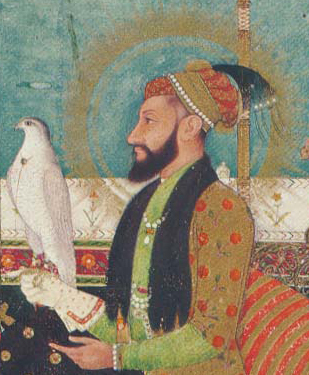
Alamgir I (Muhi al-Din Muhammad; 3 November 1618 – 3 March 1707), commonly known by the title Aurangzeb, was the sixth Mughal emperor, reigning from 1658 until his death in 1707. Under his reign, the Mughal Empire reached its greatest extent, with territory spanning nearly the entirety of the Indian subcontinent.
Aurangzeb and the Mughals belonged to a branch of the Timurid dynasty. He held administrative and military posts under his father Shah Jahan (r. 1628–1658) and gained recognition as an accomplished military commander. Aurangzeb served as the viceroy of the Deccan in 1636–1637 and the governor of Gujarat in 1645–1647. He jointly administered the provinces of Multan and Sindh in 1648–1652 and continued expeditions into the neighbouring Safavid territories. In September 1657, Shah Jahan nominated his eldest and liberalist son Dara Shikoh as his successor, a move repudiated by Aurangzeb, who proclaimed himself emperor in February 1658. In April 1658, Aurangzeb defeated the allied army of Shikoh and the Kingdom of Marwar at the Battle of Dharmat. Aurangzeb's decisive victory at the Battle of Samugarh in May 1658 cemented his sovereignty and his suzerainty was acknowledged throughout the Empire. After Shah Jahan recovered from illness in July 1658, Aurangzeb declared him incompetent to rule and imprisoned his father in the Agra Fort. Following this, Aurangzeb had Dara Shikoh executed by beheading and his head was placed in a box and presented to their imprisoned father.
Aurangzeb's reign is characterised by a period of rapid military expansion, with several dynasties and states being overthrown by the Mughals. The Mughals also surpassed Qing China as the world's largest economy and biggest manufacturing power. The Mughal military gradually improved and became one of the strongest armies in the world. A staunch Muslim, Aurangzeb is credited with the construction of numerous mosques and patronising works of Arabic calligraphy. He successfully imposed the Fatawa-i Alamgiri as the principal regulating body of the empire and prohibited religiously forbidden activities in Islam. Although Aurangzeb suppressed several local revolts, he maintained cordial relations with foreign governments.

His empire was also one of the largest in Indian history. However, his emperorship has a complicated legacy. He is often criticized for his actions against non-Muslims, including his ordering of the demolition of non-Muslim schools and temples and the reimposition of the jizya, a tax on non-Muslims, which had been suspended for the previous 100 years by his great-grandfather Akbar. He has also been criticized for his conservative view of Islam, with some arguing that he abandoned the legacy of pluralism and tolerance of the earlier Mughal emperors.
Early life
Aurangzeb was born in Dahod on 3 November 1618. He was the sixth child of Shah Jahan and Mumtaz Mahal. Aurangzeb was a patrilineal descendent of Timur.
In June 1626, after an unsuccessful rebellion by his father, eight-year-old Aurangzeb and his brother Dara Shikoh were sent to the Mughal court in Lahore as hostages of their grandfather Jahangir and his wife, Nur Jahan, as part of their father's pardon deal. After Jahangir died in 1627, Shah Jahan emerged victorious in the ensuing war of succession to the Mughal throne. Aurangzeb and his brother were consequently reunited with Shah Jahan in Agra in 1628. Aurangzeb's daily allowance was fixed at 500 rupees.

As a Mughal prince, Aurangzeb received an education covering subjects like combat, military strategy, and administration. His curriculum also included areas like Islamic studies, Turkic and Persian literature. Aurangzeb grew up fluent in the Hindustani language. He was also fluent in his ancestral language of Chagatai Turkic, but similar to his predecessors, he preferred to use Persian. He had mastered the Quran and the hadith.
On 28 May 1633, a war elephant stampeded through the Mughal imperial encampment. Aurangzeb rode against the elephant and threw his spear at its head. He was unhorsed but escaped death. For his courage, Aurangzeb's father conferred on him the title of Bahadur (brave) and presented him with gifts. When chided for his recklessness, Aurangzeb replied:
If the fight had ended fatally for me it would not have been a matter of shame. Death drops the curtain even on emperors; it is no dishonor. The shame lay in what my brothers did!

Historians have interpreted this as an unjust taunt with cowardice against his brothers. Shuja had also faced the elephant and wounded it with his spear. Dara had been too far away to come to their assistance.
Three days later Aurangzeb turned fifteen. Shah Jahan weighed him and presented him 5,000 mohars, the elephant named Sudhakar, along with other presents worth 200,000 rupees. His bravery against the elephant was documented in Persian and Urdu verses.
Ancestry
Career as prince
In December 1634, he was assigned to his first post with the rank of ten thousand horse and four thousand troopers, also was allowed to use the royal prerogative of red tent. Aurangzeb was nominally in charge of the force sent to Bundelkhand with the intent of subduing the rebellious ruler of Orchha, Jhujhar Singh, who had attacked another territory in defiance of Shah Jahan's policy and had refused to atone for his actions. By arrangement, Aurangzeb stayed in the rear, away from the fighting, and took the advice of his generals as the Mughal Army gathered and commenced the siege of Orchha in 1635. The campaign was successful and Singh was removed from power.

First Deccan governorate (1636–1644)
Aurangzeb was appointed viceroy of the Deccan in 1636. After Shah Jahan's vassals had been devastated by the alarming expansion of Ahmednagar during the reign of the Nizam Shahi boy-prince Murtaza Shah III, the emperor dispatched Aurangzeb, who in 1636 brought the Nizam Shahi dynasty to an end. The Mughal provinces of Deccan at that time were Khandesh, Berar, Telangana and Daulatabad. The entire region with 64 forts, were in charge of Aurangzeb, while ten more forts had yet to be conquered by the Mughals. In 1637, Aurangzeb married the Safavid princess Dilras Banu, posthumously known as Rabia-ud-Daurani. She was his first wife and chief consort as well as his favourite. He also had an infatuation with a slave girl, Hira Bai, whose death at a young age greatly affected him. In his old age, he was under the charms of his concubine, Udaipuri Mahal. The latter had formerly been a companion to Dara Shukoh.
In the same year, 1637, Aurangzeb was placed in charge of annexing the small Rajput kingdom of Baglana, which he did with ease. In 1638, Aurangzeb married Nawab Bai, later known as Rahmat an-Nisa. That same year, Aurangzeb dispatched an army to subdue the Portuguese coastal fortress of Daman, however his forces met stubborn resistance and were eventually repulsed at the end of a long siege. At some point, Aurangzeb married Aurangabadi Mahal, who was a Circassian or Georgian.
Aurangzeb arrived in Agra on 2 May 1644 to see his sister Jahanara who was severely burnt in an accident two months prior. Shah Jahan was outraged to see Aurangzeb enter the interior palace compound in military attire and immediately dismissed him from his position of viceroy of the Deccan; Aurangzeb was also no longer allowed to use red tents or to associate himself with the official military standard of the Mughal emperor. Other sources state that Aurangzeb was dismissed from his position because Aurangzeb left the life of luxury and became a faqir.

Aurangzeb's first viceroyalty of the Deccan lasted eight years from 14 July 1636 to 28 May 1644 before his dismissal.
Governor of Gujarat (1645–1647)
In 1644–45, he was barred from the court for seven months. It is reported that he mentioned his grief about this to fellow Mughal commanders. Thereafter, Shah Jahan appointed him governor of Gujarat. His tenure in Gujarat was marked with religious disputes but he was rewarded for bringing stability. In September 1646, Shah Jahan called Aurangzeb off from Gujarat, assigning the charge to Shaista Khan. On 20 January 1647, he met the emperor at Lahore, where he was promoted as the chief commander of Balkh and Badakhshan.
Governor of Balkh (1647–1648)
In 1647, Shah Jahan transferred Aurangzeb from Gujarat to Balkh, replacing a younger son, Murad Baksh, who had proved ineffective there. The area was under attack from Uzbek and Turkmen tribes. The Mughal artillery and muskets were offset by the skirmishing skills of their opponents which led to a stalemate. Aurangzeb discovered that his army could not live off the land, which was devastated by war. It is recorded that during the battle against the Uzbeks during this campaign, Aurangzeb dismounted from his elephant ride to recite prayer to the surprise of the opposing force commander.

With the onset of winter, he and his father had to make an unsatisfactory deal with the Uzbeks. Mughals had to give away territory in exchange for nominal recognition of Mughal sovereignty. The Mughal force suffered still further with attacks by Uzbeks and other tribesmen as it retreated during the snowfall to Kabul. By the end of this two-year campaign, into which Aurangzeb had been plunged at a late stage, a vast sum of money had been expended for little gain.
Governor of Multan and Sindh (1648–1652)
Further unsuccessful military involvements followed, as Aurangzeb was appointed governor of Multan and Sindh. His efforts in 1649 and 1652 to dislodge the Safavids at Kandahar which they had recently retaken after a decade of Mughal control ended in failure as winter approached. The logistical problems of supplying an army at the extremity of the empire, combined with the poor quality of armaments and the intransigence of the opposition have been cited by John Richards as the reasons for failure. A third attempt in 1653, led by Dara Shikoh, met with the same outcome.
Second Deccan governorate (1653–1658)
On 17 July 1652, Aurangzeb became viceroy of the Deccan again after he was replaced by Dara Shikoh in the attempt to recapture Kandahar. Aurangzeb's two jagirs (land grants) were moved there as a consequence of his return. Deccan was a relatively impoverished area, which caused him to lose out financially. The area required grants were required from Malwa and Gujarat in order to maintain the administration. The situation caused ill-feeling between him and his father Shah Jahan who insisted that things could be improved if Aurangzeb made efforts to develop cultivation.
Aurangzeb appointed Murshid Quli Khan to extend the zabt revenue system used in northern India to the Deccan. Murshid Quli Khan organised a survey of agricultural land and a tax assessment on what it produced. To increase revenue, Murshid Quli Khan granted loans for seed, livestock, and irrigation infrastructure. This led the Deccan region to return to prosperity.
Aurangzeb proposed to resolve financial difficulties by attacking the dynastic occupants of Golconda (the Qutb Shahis) and Bijapur (the Adil Shahis). This proposal would also extend Mughal influence by accruing more lands. Aurangzeb advanced against the Sultan of Bijapur and besieged Bidar. The Kiladar (governor or captain) of the fortified city, Sidi Marjan, was mortally wounded when a gunpowder magazine exploded. After twenty-seven days of fighting, Bidar was captured by the Mughals, and Aurangzeb continued his advance. Aurangzeb would go on to successfully capture the fort of Kalyani two months after the capitulation of Bidar, but his invasion of Bijapur would be cut short by a peace treaty negotiated by Shah Jahan with Bijapur which ceded Bidar, Parenda, and Kalyani. Aurangzeb suspected Dara had exerted influence on his father. He believed that he was on the verge of victory in both instances, and was frustrated that Shah Jahan chose then to settle for negotiations with the opposing forces rather than pushing for complete victory.
War of succession
The four sons of Shah Jahan all held governorships during their father's reign. The emperor favoured the eldest, Dara Shikoh. This had caused resentment among the younger three, who sought at various times to strengthen alliances between themselves and against Dara. There was no Mughal tradition of primogeniture, the systematic passing of rule, upon an emperor's death, to his eldest son. Instead it was customary for sons to overthrow their father and for brothers to war to the death among themselves.
Historian Satish Chandra says that "In the ultimate resort, connections among the powerful military leaders, and military strength and capacity [were] the real arbiters". The contest for power was primarily between Dara Shikoh and Aurangzeb because, although all four sons had demonstrated competence in their official roles, it was around these two that the supporting cast of officials and other influential people mostly circulated. There were ideological differences – Dara was an intellectual and a religious liberal in the mould of Akbar, while Aurangzeb was much more conservative – but, as historians Barbara D. Metcalf and Thomas R. Metcalf say, "To focus on divergent philosophies neglects the fact that Dara was a poor general and leader. It also ignores the fact that factional lines in the succession dispute were not, by and large, shaped by ideology."
Marc Gaborieau, professor of Indian studies at l'École des Hautes Études en Sciences Sociales, explains that "The loyalties of [officials and their armed contingents] seem to have been motivated more by their own interests, the closeness of the family relation and above all the charisma of the pretenders than by ideological divides." Muslims and Hindus did not divide along religious lines in their support for one pretender or the other, nor, according to Chandra, is there much evidence to support the belief that Jahanara and other members of the royal family were split in their support. Jahanara, certainly, interceded at various times on behalf of all of the princes and was well-regarded by Aurangzeb even though she shared the religious outlook of Dara.
In 1656, a general under Qutb Shahi dynasty named Musa Khan led an army of 12,000 musketeers to attack Aurangzeb, who was besieging Golconda Fort. Later in the same campaign, Aurangzeb, in turn, rode against an army consisting of 8,000 horsemen and 20,000 Karnataki musketeers.
After making clear his desire for his son Dara to take over after him, Shah Jahan fell ill with strangury in 1657. He was kept in seclusion and cared for by Dara in the newly built city of Shahjahanabad (Old Delhi). Rumours spread that Shah Jahan had died, which led to concerns among his younger sons. These younger sons took military actions seemingly in response, but it is not known whether these preparations were made in the mistaken belief that the rumours of death of Shah Jahan were true and that Dara might be hiding it for political gain, or whether the challengers were taking advantage of the situation.
In Bengal, Shah Shuja who he had been governor there since 1637 crowned himself king. He brought his cavalry, artillery and river flotilla upriver towards Agra. Near Varanasi his forces confronted a defending army sent from Delhi under the command of Prince Sulaiman Shikoh, the son of Dara Shikoh, and Raja Jai Singh. Murad did the same at Gujarat, as did Aurangzeb in the Deccan.
After regaining some of his health, Shah Jahan moved to Agra and Dara urged him to send forces to challenge Shah Shuja and Murad, who had declared themselves rulers in their respective territories. While Shah Shuja was defeated at Varanasi in February 1658, the army sent to deal with Murad discovered to their surprise that he and Aurangzeb had combined their forces, the two brothers having agreed to partition the empire once they had gained control of it.
The two armies clashed at Dharmat in April 1658, with Aurangzeb being the victor. Shuja was chased through Bihar. The victory of Aurangzeb proved this to be a poor decision by Dara Shikoh, who now had a defeated force on one front and a successful force unnecessarily pre-occupied on another. Realising that his recalled Bihar forces would not arrive at Agra in time to resist the emboldened Aurangzeb's advance, Dara scrambled to form alliances in order but found that Aurangzeb had already courted key potential candidates.
When Dara's disparate, hastily assembled army clashed with Aurangzeb's well-disciplined, battle-hardened force at the battle of Samugarh in late May, neither Dara's men nor his generalship were any match for Aurangzeb. Dara had also become over-confident in his own abilities and, by ignoring advice not to lead in battle while his father was alive, he cemented the idea that he had usurped the throne. "After the defeat of Dara, Shah Jahan was imprisoned in the fort of Agra where he spent eight long years under the care of his favourite daughter Jahanara."
Aurangzeb then broke his arrangement with Murad Baksh, which probably had been his intention all along. Instead of looking to partition the empire between himself and Murad, he had his brother arrested and imprisoned at Gwalior Fort. Murad was executed on 4 December 1661, ostensibly for the murder of the diwan of Gujarat. The allegation was encouraged by Aurangzeb, who caused the diwan's son to seek retribution for the death under the principles of Sharia law.
Meanwhile, Dara gathered his forces, and moved to the Punjab. The army sent against Shuja was trapped in the east, its generals Jai Singh and Dilir Khan submitted to Aurangzeb, but Dara's son, Suleiman Shikoh, escaped. Aurangzeb offered Shah Shuja the governorship of Bengal. This move had the effect of isolating Dara Shikoh and causing more troops to defect to Aurangzeb. Shah Shuja, who had declared himself emperor in Bengal began to annex more territory and this prompted Aurangzeb to march from Punjab with a new and large army. In the battle of Khajwa, Shah Shuja and his chain-mail armoured war elephants were routed by the forces loyal to Aurangzeb. Shah Shuja then fled to Arakan (in present-day Burma), where he was executed by the local rulers.
With Shuja and Murad disposed of, and with his father immured in Agra, Aurangzeb pursued Dara Shikoh, chasing him across the north-western bounds of the empire. Aurangzeb claimed that Dara was no longer a Muslim and accused him of poisoning the Mughal Grand Vizier Saadullah Khan. After a series of battles, defeats and retreats, Dara was betrayed by one of his generals, who arrested and bound him. In 1658, Aurangzeb arranged his formal coronation in Delhi.
On 10 August 1659, Dara was executed on grounds of apostasy and his head was sent to Shah Jahan. This was the first prominent execution of Aurangzeb based on accusations of being influenced by Hinduism, however some sources argue it was done for political reasons. Aurangzeb had his allied brother Prince Murad Baksh held for murder, judged and then executed. Aurangzeb was accused of poisoning his imprisoned nephew Sulaiman Shikoh. Having secured his position, Aurangzeb confined his frail father at the Agra Fort but did not mistreat him. Shah Jahan was cared for by Jahanara and died in 1666.
Reign
Full title
The epithet Aurangzeb means 'Ornament of the Throne'. His chosen title Alamgir translates to Conqueror of the World.
Aurangzeb's full imperial title was:
Al-Sultan al-Azam wal Khaqan al-Mukarram Hazrat Abul Muzaffar Muhy-ud-Din Muhammad Aurangzeb Bahadur Alamgir I,
Badshah Ghazi,
Shahanshah-e-Sultanat-ul-Hindiya Wal Mughaliya.
Aurangzeb had also been attributed various other titles including Caliph of The Merciful, Monarch of Islam, and Living Custodian of God.
Bureaucracy
Aurangzeb's imperial bureaucracy employed significantly more Hindus than that of his predecessors.
Between 1679 and 1707, the number of Hindu officials in the Mughal administration rose by half to 31.6% due to an increased recruitment of Marathas for the purpose of Deccan campaign. In the second half of his rule, the Marathas outnumbered Rajputs in his administration. Nevertheless, he tried to decrease the number of non-Muslim nobles in his court and encouraged high ranking Hindu officials to convert to Islam.
Economy
Under his reign, the Mughal Empire contributed to the world's GDP by nearly 25%, surpassing Qing China. This made it the world's largest economy and biggest manufacturing power. At the time, it was more than the entirety of Western Europe, and signalled proto-industrialisation.
Religious policy
Aurangzeb was an orthodox Muslim ruler. Subsequent to the policies of his three predecessors, he endeavoured to make Islam a dominant force in his reign. However, several groups were opposed to these policies. Aurangzeb was a follower of the Mujaddidi Order and a disciple of the son of the Punjabi saint, Ahmad Sirhindi. He sought to establish Islamic rule as instructed and inspired by him.