
The Arsenal Football Club is a professional football club based in Islington, North London, England. They compete in the Premier League, the top tier of English football. Domestically, Arsenal have won 14 league titles (including one unbeaten), a record 14 FA Cups, 2 League Cups, 17 FA Community Shields and a Football League Centenary Trophy. In European football, they have won one European Cup Winners' Cup and one Inter-Cities Fairs Cup. In terms of trophies won, it is the third-most successful club in English football, and one of the most successful clubs in world football.
Arsenal was the first club from southern England to join the Football League in 1893, officially joining the First Division in 1904. Arsenal carries the longest active streak continuously in the top division (over 105 years and counting) and completed the 20th century with the highest average league position of any club. Arsenal has won the second-most top-flight matches in English football history. In the 1930s, Arsenal won five League Championships and two FA Cups, with another FA Cup and two more Championships coming after the war. In 1970–71, it won its first League and FA Cup double. Between 1989 and 2005, the club won five league titles and five FA Cups, including two more doubles. Between 1998 and 2017, Arsenal qualified for the UEFA Champions League for an English football record of nineteen consecutive seasons. The club finished as Champions League runners-up in 2006 and 2026.
In 1886, munitions workers at the Royal Arsenal in Woolwich founded the club as Dial Square. In 1913, the club crossed the city to the Arsenal Stadium in Highbury, becoming close neighbours of Tottenham Hotspur, thus creating the North London derby. Herbert Chapman won the club its first silverware, and his legacy enabled a trophy-laden period in the 1930s. He helped introduce the WM formation, floodlights, and shirt numbers; he also added the white sleeves and brighter red to the club's jersey. Arsène Wenger was the club's longest-serving manager and won the most trophies. He won a record seven FA Cups, and his third and final title-winning team set an English record for the longest top-flight unbeaten league run at 49 games between 2003 and 2004, receiving the nickname "The Invincibles".

In 2006, the club moved to the nearby Emirates Stadium. With an annual revenue of £616.6m in the 2023–24 season, Arsenal was estimated to be worth US$3.4 billion by Forbes, making it the world's eighth-most valuable football club, while also being one of the most followed sport teams in the world on social media. The motto of the club is Victoria Concordia Crescit, Latin for "Victory Through Harmony".
History
1886–1912: Dial Square to Royal Arsenal
In October 1886, Scotsman David Danskin and fifteen fellow munitions workers in Woolwich formed the Dial Square Football Club, named after a workshop at the heart of the Royal Arsenal complex. Each member contributed sixpence, and Danskin also added three shillings to help form the club. Dial Square played their first match on 11 December 1886 against the Eastern Wanderers and won 6–0. The club had been renamed Royal Arsenal by January 1887, and its first home was Plumstead Common, though they spent most of their time playing at the Manor Ground. Their first trophies were the Kent Senior Cup and London Charity Cup in 1889–90 and the London Senior Cup in 1890–91; these were the only county association trophies Arsenal won during their time in South East London. In 1891, Royal Arsenal became the first London club to turn professional.
Royal Arsenal was renamed for the second time upon becoming a limited liability company in 1893. They registered their new name, Woolwich Arsenal, with the Football League when the club ascended later that year. Woolwich Arsenal was the first southern member of the Football League, starting out in the Second Division and reaching the First Division in 1904. Falling attendances, due to financial difficulties among the munitions workers and the arrival of more accessible football clubs elsewhere in the city, led the club close to bankruptcy by 1910. Businessmen Henry Norris and William Hall became involved in the club, and sought to move them elsewhere.

1912–1925: Bank of England club
In 1913, soon after relegation back to the Second Division, the club moved across the river to the new Arsenal Stadium in Highbury. In 1919, the Football League controversially voted to promote The Arsenal, instead of relegated local rivals Tottenham Hotspur, into the newly enlarged First Division, despite only finishing fifth in the Second Division's last pre-war season of 1914–15. Later that year, The Arsenal started dropping "The" in official documents, gradually shifting its name for the final time towards Arsenal, as it is generally known today.
With a new home and First Division football, attendances were more than double those at the Manor Ground, and Arsenal's budget grew rapidly. With record-breaking spending and gate receipts, Arsenal quickly became known as the Bank of England club.
1925–1934: Herbert Chapman's legendary Gunners
Arsenal's location and record-breaking salary offer lured star Huddersfield Town manager Herbert Chapman in 1925. Over the next five years, Chapman built a revolutionary new Arsenal. Firstly, he appointed an enduring new trainer, Tom Whittaker who would one day rise to become a fabled Arsenal manager himself. With the help of player Charlie Buchan, implemented the nascent WM formation which would serve as a stable bedrock to his outfit. He also captured generational young talents such as Cliff Bastin and Eddie Hapgood, whilst also lavishing Highbury's high income on stars such as David Jack and Alex James.
Transformed, Chapman's Arsenal claimed their first national trophy, the FA Cup in 1930, and League Championships followed in 1930–31 and 1932–33. Chapman also presided over off-pitch changes: white sleeves and shirt numbers were added to the kit; a Tube station was named after the club; and the first of two opulent Art Deco stands was completed, with some of the first floodlights in English football. Suddenly, in the middle of the 1933–34 season, Chapman died of pneumonia.
1934–1947: Shaw, Allison and the Second World War
Chapman's death meant work was left to his colleagues Joe Shaw and George Allison, with both proving to be shrewd and consummate custodians of Chapman's excellent Arsenal team, seeing out a hat-trick of league wins with the 1933–34, 1934–35, and 1937–38 titles, and then furthermore winning the 1936 FA Cup.
World War II meant the Football League was suspended for seven years. While Arsenal were paraded by the nation as a symbol of solidarity with war efforts, the war took a huge toll on the team as the club had had more players killed than any top flight club. Furthermore, debt from reconstructing an ambitious North Bank Stand redevelopment greatly bled Arsenal's resources.

1947–1962: Tom Whittaker's meteoric Gunners
Despite this period of turbulence and churn, Arsenal returned to win the league in the second post-war season of 1947–48. This was Tom Whittaker's first season as manager, and meant the club equalled the champions of England record. Whittaker, despite his disarming humble and modest disposition, was oft-referred to as the "brains" behind charismatic Chapman's legendary Arsenal side. He gathered a successful and highly skilled Arsenal side in spite of greatly limited resources, with a fiery and expansive style that drove great fanfare at the time.
They won a third FA Cup in 1950, and then won a record-breaking seventh championship in 1952–53, making Arsenal the most successful team in English history at the time.
1962–1984: Billy Wright, Bertie Mee and Terry Neill's cohorts
Arsenal were not to win the League or the FA Cup for another 18 years. The '53 Champions squad had aged, and the club failed to attract strong enough replacements. Although Arsenal were competitive during these years, their fortunes had waned; the club spent most of the 1950s and 1960s in mid-table mediocrity. Even former England captain Billy Wright could not bring the club any success as manager, in a stint between 1962 and 1966.

Arsenal tentatively appointed club physiotherapist Bertie Mee as acting manager in 1966 to incredulity by fans, sportsmedia press. With new assistant Don Howe and new players such as Bob McNab and George Graham, Mee led Arsenal to their first League Cup finals, in 1967–68 and 1968–69. Next season saw a breakthrough, with Arsenal's first competitive European trophy, the 1969–70 Inter-Cities Fairs Cup. The season after, Arsenal achieved an even greater triumph with their first League and FA Cup double, and a new champions of England record. This marked a premature high point of the decade; the Double-winning side was soon broken up and the rest of the decade was characterised by a series of near misses, with Arsenal finishing as FA Cup runners up in 1972, and First Division runners-up in 1972–73.
Former player Terry Neill succeeded Mee in 1976. At the age of 34, he became the youngest Arsenal manager to date. With new signings like Malcolm Macdonald and Pat Jennings, and a crop of talent in the side like Liam Brady and Frank Stapleton, the club reached a trio of FA Cup finals (1978 FA Cup, 1979 FA Cup and 1980 FA Cup), and lost the 1980 European Cup Winners' Cup Final on penalties. The club's only trophy during this time was the 1979 FA Cup, achieved with a last-minute 3–2 victory over Manchester United, in a final is widely regarded as a classic.
1984–1996: George Graham's Arsenal
One of Mee's double winners, George Graham, returned as manager in 1986, with Arsenal winning their first League Cup in 1987, Graham's first season in charge. New signings Nigel Winterburn, Lee Dixon and Steve Bould had joined the club by 1988 to complete the "famous Back Four", led by homegrown player Tony Adams. Graham's credo of prioritising defensive excellence seemingly clashed with the club's traditionally expansive motifs in approaching football, and many had scepticism whether it would work with the young squad at the club in that time period; however, his methods quickly gained a cult following after initial successes.
The side immediately won the 1988 Football League Centenary Trophy, and followed it with the 1988–89 Football League title, snatched with a last-minute goal in the final game of the season against fellow title challengers Liverpool. Graham's Arsenal won another title in 1990–91, losing only one match, won the FA Cup and League Cup double in 1993, the European Cup Winners' Cup in 1994, and also participated and was defeated in the 1994 European Super Cup final by European champions AC Milan. Graham's reputation was tarnished when he was found to have taken kickbacks from agent Rune Hauge for signing certain players, and he was dismissed in February 1995. His replacement, Bruce Rioch, lasted for only one season, taking the side to the second European Cup Winners' Cup final in a row, lost against Real Zaragoza, but he left the club after a dispute with the board of directors.
1996–2018: Arsène Wenger revolution
The club metamorphosed during the tenure of French manager Arsène Wenger, who was appointed in October 1996. Attacking football, an overhaul of dietary and fitness practices, and elite scouting defined his reign. Accumulating key players from Wenger's homeland, such as Patrick Vieira and Thierry Henry, Arsenal won a second League and Cup double in 1997–98 and a third in 2001–02. In addition, the club reached the final of the 1999–2000 UEFA Cup, were victorious in the 2003 and 2005 FA Cup finals, and won the Premier League in 2003–04 without losing a single match, an achievement which earned the side the nickname "The Invincibles". This feat came within a run of 49 league matches unbeaten from 7 May 2003 to 24 October 2004, a national record.
Arsenal finished in either first or second place in the league in eight of Wenger's first nine seasons at the club, although they never won the title in two consecutive seasons. The club had never progressed beyond the quarter-finals of the Champions League until 2005–06; in that season, they became the first club from London to reach the final in the competition's fifty-year history, but were beaten 2–1 by Barcelona. In July 2006, they moved into the Emirates Stadium, after 93 years at Highbury. Arsenal reached the finals of the 2007 and 2011 League Cups, losing 2–1 to Chelsea and Birmingham City respectively. The club had not gained a trophy since the 2005 FA Cup until, spearheaded by club record acquisition Mesut Özil, Arsenal beat Hull City in the 2014 FA Cup Final, coming back from a 2–0 deficit to win the match 3–2. A year later, Arsenal completed another victorious FA Cup campaign, and became the most successful club in the tournament's history by winning their 13th FA Cup in 2016–17. However, in that same season Arsenal finished fifth in the league, the first time they had finished outside the top four since before Wenger arrived in 1996. In his 21st and final season, Arsenal under Arsène Wenger finished sixth and won the FA Community Shield. Wenger departed Arsenal following the end of the season on 13 May 2018.
2018–2019: Post-Wenger evolution
After conducting an overhaul in the club's operating model to coincide with Wenger's departure, Spaniard Unai Emery was named as the club's new head coach on 23 May 2018. He became the club's first ever 'head coach' and second manager from outside the United Kingdom. In Emery's first season, Arsenal finished fifth in the Premier League and as runner-up in the Europa League. On 29 November 2019, Emery was dismissed as manager and former player and assistant first team coach Freddie Ljungberg was appointed as interim head coach.
2019–: Mikel Arteta era
On 20 December 2019, Arsenal appointed former club captain Mikel Arteta as the new head coach. Arsenal finished the 2019–20 season in eighth, their lowest finish since 1994–95, but beat Chelsea 2–1 to earn a record-extending 14th FA Cup win. After the season, Arteta's title was changed from head coach to manager. On 18 April 2021, Arsenal were announced as a founding club of the breakaway European competition The Super League; they withdrew from the competition two days later amid near-universal condemnation. Arsenal finished the 2020–21 season in eighth place once again, not qualifying for a European competition for the first time in 26 years. The season after (2021–22), Arteta had assembled the youngest outfit in the Premier League with an average starting age of 24 years and 308 days – more than a whole year younger than the next team. They finished in fifth in the Premier League that year, and qualified for next season's UEFA Europa League.
By the 2022–23 season, Arsenal returned to the Champions League by coming second to Manchester City, setting a record for most time spent on top of the table without actually winning the league, ending on 84 points. In the 2023–24 season, Arsenal beat Manchester City to claim their 17th FA Community Shield, they finished second in the Premier League to Manchester City with an improved 89 points from their previous campaign. In the 2024–25 UEFA Champions League, they reached the semi-finals only to lose to PSG 3–1 on aggregate. For the third season in a row Arsenal finished second, this time behind Liverpool, amassing a points tally of 74 in the 2024–25 Premier League season.
On 19 May 2026, in the 2025–26 season, Arsenal secured its 14th league title and its first since the 2003–04 season with one game to spare, by virtue of AFC Bournemouth's 1–1 draw against Manchester City. The title was Arsenal's first Premier League title under manager Mikel Arteta. In the same season, Arsenal reached the UEFA Champions League final for the second time in the club's history but lost to Paris Saint-Germain 4–3 on penalties after a 1–1 draw following extra time at the Puskás Aréna in Budapest.
Crest
Unveiled in 1888, Royal Arsenal's first crest featured three cannons viewed from above, pointing northwards, similar to the coat of arms of the Metropolitan Borough of Woolwich (nowadays transferred to the coat of arms of the Royal Borough of Greenwich). These can sometimes be mistaken for chimneys, but the presence of a carved lion's head and a cascabel on each are clear indicators that they are cannons. This was dropped after the move to Highbury in 1913, only to be reinstated in 1922, when the club adopted a crest featuring a single cannon, pointing eastwards, with the club's nickname, The Gunners, inscribed alongside it; this crest only lasted until 1925, when the cannon was reversed to point westward and its barrel slimmed down.
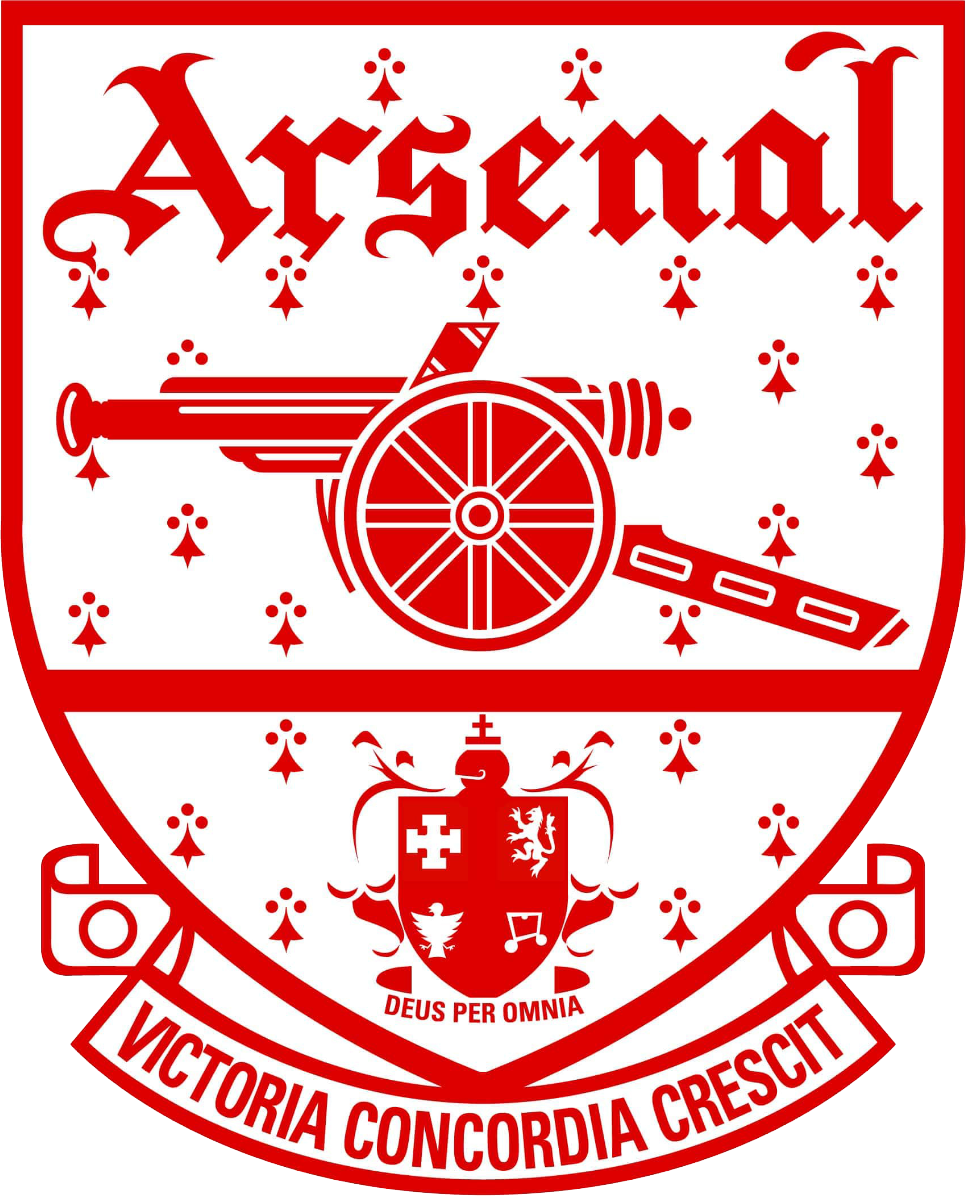
In 1949, the club unveiled a modernised crest featuring the same style of cannon below the club's name, set in blackletter typography, and above the coat of arms of the Metropolitan Borough of Islington and a scroll inscribed with the club's newly adopted Latin motto, Victoria Concordia Crescit (VCC) – "victory comes from harmony" – coined by the club's programme editor Harry Homer. For the first time, the crest was rendered in colour, which varied slightly over the crest's lifespan, finally becoming red, gold and green. Because of the numerous revisions of the crest, Arsenal were unable to copyright it. Although the club had managed to register the crest as a trademark, and had fought (and eventually won) a long legal battle with a local street trader who sold "unofficial" Arsenal merchandise, Arsenal eventually sought a more comprehensive legal protection. Therefore, in 2002 they introduced a new crest featuring more modern curved lines and a simplified style, which was copyrightable.
The cannon once again faces east, and the club's name is written in a sans-serif typeface above the cannon. Green was replaced by dark blue. The new crest was criticised by some supporters; the Arsenal Independent Supporters' Association claimed that the club had ignored much of Arsenal's history and tradition with such a radical modern design, and that fans had not been properly consulted on the issue.
Until the 1960s, a badge was worn on the playing shirt only for high-profile matches such as FA Cup finals, usually in the form of a monogram of the club's initials in red on a white background.
The monogram theme was developed into an Art Deco-style badge on which the letters A and C framed a football rather than the letter F, the whole set within a hexagonal border. This early example of a corporate logo, introduced as part of Herbert Chapman's rebranding of the club in the 1930s, was used not only on Cup Final shirts but as a design feature throughout Highbury Stadium, including above the main entrance and inlaid in the floors.
From 1967, a white cannon was regularly worn on the shirts, until replaced by the club crest, sometimes with the addition of the nickname "The Gunners", in the 1990s.
In the 2011–12 season, Arsenal celebrated their 125th anniversary. The celebrations included a modified version of the current crest worn on their jerseys for the season. The crest was all-white, surrounded by 15 oak leaves to the right and 15 laurel leaves to the left. The oak leaves represent the 15 founding members of the club who met at the Royal Oak pub. The 15 laurel leaves represent the design detail on the six pence pieces paid by the founding fathers to establish the club. The laurel leaves also represent strength. To complete the crest, 1886 and 2011 are shown on either sides of the motto "Forward" at the bottom of the crest.
Starting in the 2021–22 season, Adidas reintroduced the cannon-only crest on that season's away kit. It was the first time it had been seen on an Arsenal shirt since 1991. It would remain in use on the away kit in 2022–23 and in 2023–24 would be added to the third kit as well, before being used on all three kits in 2024–25 – marking the first time the crest would not be seen on an Arsenal kit since its introduction in 2002.
Colours
For much of Arsenal's history, their home colours have been bright red shirts with white sleeves and white shorts, though this has not always been the case. The choice of red is in recognition of a charitable donation from Nottingham Forest, soon after Arsenal's foundation in 1886. Two of Dial Square's founding members, Fred Beardsley and Morris Bates, were former Forest players who had moved to Woolwich for work. As they put together the first team in the area, no kit could be found, so Beardsley and Bates wrote home for help and received a set of kit and a ball. The shirt was redcurrant, a dark shade of red, and was worn with white shorts and socks with blue and white hoops.
In 1933, Herbert Chapman, wanting his players to be more distinctly dressed, updated the kit, adding white sleeves and changing the shade to a brighter pillar box red. Two possibilities have been suggested for the origin of the white sleeves. One story reports that Chapman noticed a supporter in the stands wearing a red sleeveless sweater over a white shirt; another was that he was inspired by a similar outfit worn by the cartoonist Tom Webster, with whom Chapman played golf. Regardless of which story is true, the red-and-white shirts have come to define Arsenal, and the team have worn that combination ever since that time, aside from two seasons. The first was 1966–67, when Arsenal wore all-red shirts; this proved unpopular, and the white sleeves returned the following season. The second was 2005–06, the last season that Arsenal played at Highbury, when the team wore commemorative redcurrant shirts similar to those worn in 1913, their first season in the stadium; the side reverted to their normal colours at the start of the next season. In the 2008–09 season, Arsenal replaced the traditional all-white sleeves with red sleeves that bore a broad white stripe.
Arsenal's home colours have been the inspiration for at least three other clubs. In 1909, Sparta Prague adopted a dark red kit like the one Arsenal wore at the time; in 1938, Hibernian adopted the design of the Arsenal shirt sleeves in their own green-and-white strip. In 1941, Luis Robledo, an England-schooled founder of Santa Fe and a fan of Arsenal, selected the main colours for his newly created team. In 1920, Sporting Clube de Braga's manager returned from a game at Highbury and changed his team's green kit to a duplicate of Arsenal's red-with-white-sleeves-and-shorts, giving rise to the team's nickname of Os Arsenalistas. These teams still wear those designs to this day.
For many years Arsenal's away colours were white or navy blue. However, in 1968 the FA banned navy shirts (they looked too similar to referees' black kit), so in the 1969–70 season Arsenal introduced an away kit of yellow shirts with blue shorts. This kit was worn in the 1971 FA Cup Final when Arsenal beat Liverpool to secure the double for the first time in their history. The yellow and blue strip became almost as famous as their iconic red-and-white home kit. Arsenal reached the FA Cup final again the following year wearing the red-and-white home strip and were beaten by Leeds United. Arsenal then competed in three consecutive FA Cup finals between 1978 and 1980 wearing their "lucky" yellow and blue strip, which remained the club's away strip until the release of a green and navy away kit in 1982–83. The following season, Arsenal returned to the yellow and blue scheme, albeit with a darker shade of blue than before.
When Nike took over from Adidas as Arsenal's kit provider in 1994, Arsenal's away colours were again changed to two-tone blue shirts and shorts. Since the advent of the lucrative replica kit market, the away kits have been changed regularly, with Arsenal usually releasing both away and third choice kits. During this period the designs have been either all blue designs, or variations on the traditional yellow and blue, such as the metallic gold and navy strip used in the 2001–02 season, the yellow and dark grey used from 2005 to 2007, and the yellow and maroon of 2010 to 2013.
Until 2014, the away kit was changed every season, and the outgoing away kit became the third-choice kit if a new home kit was being introduced in the same year.
After Puma began manufacturing Arsenal's kits in 2014, new home, away and third kits were released every season. In the 2017–18 season, Puma released a new colour scheme for the away and third kits. The away kit was a light blue, which faded to a darker blue near the bottom, while the third kit was black with red highlight. Puma returned to the original colour scheme for the 2018–19 season. From the 2019–20 season Arsenal's kits are manufactured by Adidas.
Kit suppliers and shirt sponsors
Stadiums
Before joining the Football League, Arsenal played briefly on Plumstead Common, then at the Manor Ground in Plumstead, then spent three years between 1890 and 1893 at the nearby Invicta Ground. Upon joining the Football League in 1893, the club returned to the Manor Ground and installed stands and terracing, upgrading it from just a field. Arsenal continued to play their home games there for the next twenty years (with two exceptions in the 1894–95 season), until the move to north London in 1913.
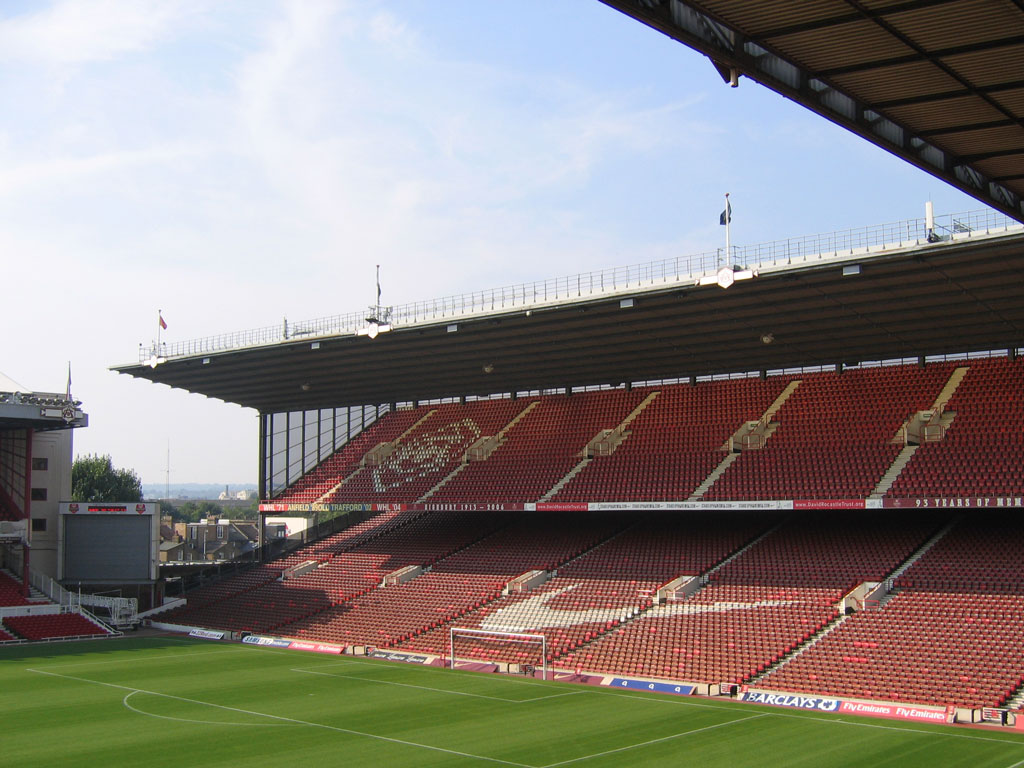
Widely referred to as Highbury, Arsenal Stadium was the club's home from September 1913 until May 2006. The original stadium was designed by the renowned football architect Archibald Leitch, and had a design common to many football grounds in the UK at the time, with a single covered stand and three open-air banks of terracing. The entire stadium was given a massive overhaul in the 1930s: new Art Deco West and East stands were constructed, opening in 1932 and 1936 respectively, and a roof was added to the North Bank terrace, which was bombed during the Second World War and not restored until 1954.
Highbury could hold more than 60,000 spectators at its peak, and had a capacity of 57,000 until the early 1990s. The Taylor Report and Premier League regulations obliged Arsenal to convert Highbury to an all-seater stadium in time for the 1993–94 season, thus reducing the capacity to 38,419 seated spectators. This capacity had to be reduced further during Champions League matches to accommodate additional advertising boards, so much so that for two seasons, from 1998 to 2000, Arsenal played Champions League home matches at Wembley, which could house more than 70,000 spectators.
Expansion of Highbury was restricted because the East Stand had been designated as a Grade II listed building and the other three stands were close to residential properties. These limitations prevented the club from maximising matchday revenue during the 1990s and first decade of the 21st century, putting them in danger of being left behind in the football boom of that time. After considering various options, in 2000 Arsenal proposed building a new 60,361-capacity stadium at Ashburton Grove, since named the Emirates Stadium, about 500 metres south-west of Highbury. The project was initially delayed by red tape and rising costs, and construction was completed in July 2006, in time for the start of the 2006–07 season. The stadium was named after its sponsors, the airline company Emirates, with whom the club signed the largest sponsorship deal in English football history, worth around £100 million. Some fans referred to the ground as Ashburton Grove, or the Grove, as they did not agree with corporate sponsorship of stadium names. The stadium will be officially known as Emirates Stadium until at least 2028, and the airline will be the club's shirt sponsor until at least 2024. From the start of the 2010–11 season on, the stands of the stadium have been officially known as North Bank, East Stand, West Stand and Clock end. The capacity of the Emirates now stands at 60,704.
Arsenal's players train at the Shenley Training Centre in Hertfordshire, a purpose-built facility which opened in 1999. Before that, the club used facilities on a nearby site owned by the University College of London Students' Union. Until 1961 they had trained at Highbury. Arsenal's Academy under-18 teams play their home matches at Shenley, while the reserves play their games at Meadow Park, which is also the home of Boreham Wood. Both the academy under-18 team and the reserves occasionally play their big games at the Emirates in front of a crowd reduced to only the lower west stand.