
Arnold Joseph Toynbee (; 14 April 1889 – 22 October 1975) was an English historian, a philosopher of history, an author of numerous books and a research professor of international history at the London School of Economics and King's College London. From 1918 to 1950, Toynbee was considered a leading specialist on international affairs; from 1929 to 1956 he was the Director of Studies at Chatham House, in which position he also produced 34 volumes of the Survey of International Affairs, a "bible" for international specialists in Britain.
He is best known for his 12-volume A Study of History (1934–1961). With his large output of papers, articles, speeches, presentations, and numerous books translated into many languages, Toynbee was widely read and discussed in the 1940s and 1950s.
Biography
Early life and education
Toynbee was born on 14 April 1889 in London, England, to Harry Valpy Toynbee (1861–1941), secretary of the Charity Organization Society, and his wife Sarah Edith Marshall (1859–1939). His mother took the equivalent of an undergraduate degree in English history at Cambridge University, when higher education for women was unusual and before women were allowed to graduate from the university, and his sister Jocelyn Toynbee was an archaeologist and art historian. Arnold Toynbee was a grandson of Joseph Toynbee, a nephew of the 19th-century economist Arnold Toynbee (1852–1883), and a descendant of prominent British intellectuals for several generations.
Having won a scholarship, he was educated at Winchester College, an all-boys independent boarding school in Winchester, Hampshire. From 1907 to 1911, having won a scholarship to Oxford University, he read literae humaniores (i.e. classics) at Balliol College, Oxford. Early in Toynbee's degree, his father suffered a nervous collapse and was institutionalised, causing financial difficulties for the family. Regardless, Toynbee achieved first class honours in mods and in greats and graduated with a Bachelor of Arts (BA) degree. From 1911 to 1912, he toured Italy and Greece to study the classical landscape and remains that "he had thitherto known only through books".
Career
In 1912, having returned from his travels, Toynbee was elected a fellow of his alma mater Balliol College, Oxford, and appointed a tutor in ancient history. Unusually for a British classical scholar of that time, his interests crossed Greek and Roman civilisation, and ranged from Bronze Age Greece to the Byzantine Empire. He also combined traditional classical literary scholarship with the emerging discipline of classical archaeology.
Paris Peace Conference
He served as a delegate to the Paris Peace Conference in 1919, where he helped shape the Treaty of Sèvres. He was present at the meeting at the Hotel Majestic when Lionel Curtis proposed the formation of an Institute of International Affairs, resulting in the formation of Chatham House in London and The Council on Foreign Relations in New York.

Historian and Director of Studies
In 1925 he became Research Professor of International History at the London School of Economics. In 1929 he became Director of Studies at the Royal Institute of International Affairs (Chatham House), a post he held until 1956. He was elected a Fellow of the British Academy (FBA) in 1937. He was elected an International Member of the American Philosophical Society in 1941 and an International Honorary Member of the American Academy of Arts and Sciences in 1949.
Personal life
His first marriage was to Rosalind Murray (1890–1967), daughter of Gilbert Murray, in 1913; they had three sons, of whom Philip Toynbee was the second. Their son Lawrence (born 1922) was a painter and married Jean Constance Asquith, granddaughter of Prime Minister H. H. Asquith. Arnold and Rosalind divorced in 1946; Toynbee then married his research assistant, Veronica M. Boulter (1893–1980), in the same year. He died on 22 October 1975, age 86.
Views on the post-World War I peace settlement and geopolitical situation
In his 1915 book Nationality & the War, Toynbee argued that any eventual postwar peace settlement should be guided by the principle of nationality. In Chapter IV of his 1916 book The New Europe: Essays in Reconstruction, Toynbee argued against the competing principle of "natural borders." Toynbee encouraged the use of plebiscites for the allocation of disputed territories, an idea brought to fruition by the postwar use of plebiscites.
In his 1915 book Nationality & the War, Toynbee offered various elaborate proposals and predictions for the future of various countries, both European and non-European. For example, he advocated an autonomous Poland in a federal arrangement with Russia, the retention of Austro-Hungarian dominion over Czech and Slovak lands, Austro-Hungarian relinquishment of Galicia, Transylvania, and Bukovina, independence for Bosnia, Croatia, and Slovenia, the division of Bessarabia between Russia and Romania and joint use by those two countries of the port of Odessa, Russian acquisition of Outer Mongolia and the Tarim Basin in central Asia and of Pontus and the Armenian Vilayets in the Ottoman Empire, a strong, independent, central government in Persia. and a Russo-British partitioning of Afghanistan.
Academic and cultural influence
Michael Lang says that for much of the twentieth century,
Toynbee was perhaps the world's most read, translated, and discussed living scholar. His output was enormous, hundreds of books, pamphlets, and articles. Of these, scores were translated into thirty different languages....the critical reaction to Toynbee constitutes a veritable intellectual history of the midcentury: we find a long list of the period's most important historians, Beard, Braudel, Collingwood, and so on.

Toynbee's approach may be compared to the one used by Oswald Spengler in The Decline of the West. He rejected, however, Spengler's deterministic view that civilizations rise and fall according to a natural and inevitable cycle.
In his best-known work, A Study of History, published 1934–1961, Toynbee
examined the rise and fall of 26 civilisations in the course of human history, and he concluded that they rose by responding successfully to challenges under the leadership of creative minorities composed of elite leaders.

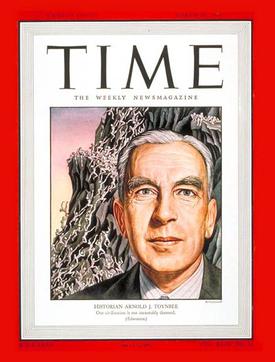
A Study of History was both a commercial and an academic success. In the US alone, more than 7,000 sets of the ten-volume edition were sold by 1955. A 1947 one-volume abridgement by David Churchill Somervell of the first six volumes sold over 300,000 copies in the US. Toynbee appeared on the cover of Time magazine in 1947, with an article describing his work as "the most provocative work of historical theory written in England since Karl Marx's Capital". He became a regular commentator for the BBC on the then-current hostility between east and west and on non-western views of the western world.
Toynbee's overall theory was taken up by some scholars, such as Ernst Robert Curtius, as a sort of paradigm in the post-war period. In the opening pages of his own study of medieval Latin literature, Curtius wrote:
How do cultures, and the historical entities which are their media, arise, grow and decay? Only a comparative morphology with exact procedures can hope to answer these questions. It was Arnold J. Toynbee who undertook the task.
After 1960, Toynbee's ideas faded in both academia and in popular culture. His work is seldom cited today. In general, historians said he had a preference for myths, allegories, and religion over factual data. His critics argued that his conclusions are more those of a Christian moralist than of a historian. In his 2011 article for the Journal of History titled "Globalization and Global History in Toynbee," historian Michael Lang wrote:
To many world historians today, Arnold J. Toynbee is regarded like an embarrassing uncle at a house party. He gets a requisite introduction by virtue of his place on the family tree, but he is quickly passed over for other friends and relatives.
Toynbee's work continues to be referenced by some classical historians because "his training and surest touch is in the world of classical antiquity." His roots in classical literature are also manifested by similarities between his approach and that of classical historians such as Herodotus and Thucydides. Comparative history, in which his work is often categorised, has been in the doldrums.
Toynbee is thanked in the acknowledgment section of Mark Lane's Rush to Judgment (1966), which critiques the official explanation of the assassination of John F. Kennedy, for having been "kind enough to read the manuscript and make suggestions" to the book. Toynbee endorsed Lane's organization, the Citizens Committee of Inquiry, with his endorsement featuring in an advertisement for the organization.
Political influence in foreign policy
While the writing of the Study was underway, Toynbee produced numerous smaller works and served as Director of Studies of the Royal Institute of International Affairs, Chatham House (from 1929 to 1956). He also retained his position at the London School of Economics until his retirement in 1956.
Foreign Office and Paris Peace Conference 1919
Toynbee worked for the Political Intelligence Department of the British Foreign Office during World War I and served as a delegate to the Paris Peace Conference in 1919.
Chatham House
He was Director of Studies at Chatham House from 1929 to 1956. Toynbee was co-editor with his research assistant, Veronica M. Boulter, of the RIIA's annual Survey of International Affairs, from 1922 to 1956. It became the "bible" for international specialists in Britain.
Chatham House's World War II Foreign Press and Research Service
At the outbreak of the Second World War the institute was decentralised for security reasons, with many of the staff moving to Balliol College, Oxford from Chatham House's main buildings in St James's Square. There, the Foreign Press and Research Service of the Institute worked closely with the Foreign Office to provide intelligence for and to work closely with the Foreign Office dedicating their research to the war effort under the Chairmanship of Waldorf Astor.
The formal remit of Chatham House for the FPRS at Balliol was:
1. To review the press overseas.
2. To "produce at the request of the Foreign Office, and the Service and other Departments, memoranda giving the historical and political background on any given situation on which information is desired".
3. "To provide information on special points desired" (in regards to each country). It provided various reports on foreign press, historical and political background of the enemy and various other topics.
Many eminent historians served on the FPRS under Arnold J. Toynbee as its Director and with Lionel Curtis (represented the Chairman) at Oxford until 1941 when Ivison Macadam took over the role from Curtis. There were four deputy directors. The four Deputy Directors were Alfred Zimmern, George N. Clark, Herbert J. Patton and Charles K. Webster and a number of experts in its nineteen divisions.
The FRBS with Toynbee and his entire team was moved to the Foreign Office 1943–46.
Meeting Hitler
While on a visit in Berlin in 1936 to address the Law Society, Toynbee was invited to a private interview with Adolf Hitler at Hitler's request. During the interview, which was held a day before Toynbee delivered his lecture, Hitler emphasized his limited expansionist aim of building a greater German nation, and his desire for British understanding and co-operation with Nazi Germany. Hitler also suggested Germany could be an ally to Britain in the Asia-Pacific region if Germany's Pacific colonial empire were restored. Toynbee believed that Hitler was sincere and endorsed Hitler's message in a confidential memorandum for the British prime minister and foreign secretary.
Toynbee presented his lecture in English, but copies of it were circulated in German by Nazi officials, and it was warmly received by his Berlin audience who appreciated its conciliatory tone. Tracy Philipps, a British 'diplomat' stationed in Berlin at the time, later informed Toynbee that it 'was an eager topic of discussion everywhere'. Back home, some of Toynbee's colleagues were dismayed by his attempts at managing Anglo-German relations.
Russia
Toynbee was troubled by the Russian Revolution since he saw Russia as a non-Western society and the revolution as a threat to Western society. In 1952, he argued that the Soviet Union had been a victim of Western aggression. He portrayed the Cold War as a religious competition that pitted a Marxist materialist heresy against the West's spiritual Christian heritage, which had already been foolishly rejected by a secularised West. A heated debate ensued, and an editorial in The Times promptly attacked Toynbee for treating communism as a "spiritual force".
United States
In his 1962 America and The World Revolution, Toynbee argued that the United States has undergone a fundamental transformation from the "inspirer and leader" of global revolution to the vanguard of a "world-wide anti-revolutionary movement." He contends that by prioritizing the defense of its unprecedented industrial wealth and "vested interests," America has abandoned its 1775 mission to adopt a role reminiscent of Imperial Rome or the conservative statesman Metternich—supporting the wealthy minority against the poor majority. Ultimately, Toynbee suggests that while the "American shot" continues to incite revolutionary fervor across the globe, the U.S. has become "embarrassed and annoyed" by its own legacy, now finding itself psychologically burdened by the defensive, joyless task of shoring up global inequality against the very forces it originally unleashed.
Greece, Turkey and the Koraes Chair of Modern Greek and Byzantine History
Toynbee visited Greece in November 1911. According to Richard Clogg, Toynbee "had privately manifested not mere dislike of, but a profound loathing for, the modern inhabitants of the Greek lands", a sentiment which developed extremely intensely and extremely rapidly, just a few days after his visit, since his idealized vision of ancient Greece collided with modern Greek reality.
At the start of the First World War, Toynbee was found to be unfit for military service because of a bout of dysentery after his return from Greece. In 1915, he began working for the intelligence department of the British Foreign Office. He worked under Viscount Bryce to investigate the Ottoman atrocities against the Armenians and also wrote a number of pro-Allied leaflets.
Ronald Burrows, a staunch philhellene, was unaware of Toynbee's earlier anti-Greek sentiment and, in 1919, backed Toynbee's appointment to the Koraes Chair of Modern Greek and Byzantine History at King's College, University of London, despite Toynbee's own warning that "[t]he chair should be held by ‘more of an active Philhellene’ than he felt himself to be".
In 1921 and 1922 he was the Manchester Guardian correspondent during the Greco-Turkish War, an experience that resulted in the publication of The Western Question in Greece and Turkey. In the book, Toynbee expressed pro-Turkish sympathies and anti-Greek sentiment. The work was considered to have been so egregious that Toynbee was forced to resign from his academic position as the Koraes Chair. After a letter by Toynbee to The Times in 3 January 1924, his pro-Turkish sentiments became widely known.
In his era, Toynbee's publication became infamous in Britain; it was accused of being "a one-sided apologetic narrative favoring the Turkish point of view". Even David Lloyd George lamented how Toynbee had turned "pro-Turk" and had "forsaken the Gladstonian position". Robert William Seton-Watson was harsher, noting how "at the supreme crisis in the fate of the Greek nation – probably without exaggeration the most decisive since Xerxes" Toynbee had "plunged into a violent propagandist campaign in favour of the Turks". George William Rendel wrote that Toynbee was "notorious for [his] virulent hatred of Greece, for passionate championship of the Turks and for total lack of balance and judgment on any questions connected with the Greco-Turkish conflict".
In today's era, Benny Morris and Dror Ze’evi note that Toynbee played a "bothsideist" role in the conflict. They criticize this attempted "moral equivalence" as fraudulent, questionable and exaggerated against Greeks. They also state that Toynbee, like Mark Lambert Bristol, described several alleged massacres of Turks by Greeks to which he wasn't an eyewitness to, but rather accepted them as fact after being "fed information" by leading Turks. Richard Clogg also wrote that Toynbee was motivated by "mishellenism", adding that although Greeks placed no restriction on Toynbee's travels, the Turks purposely kept him away from sites in which massacres were suspected to have occurred. Toynbee also initially falsely asserted that the Greeks burnt down Smyrna, although he later backtracked and accepted Turkish responsibility.
Toynbee's proclivities were so bad that even his mother, a highly educated woman, reproached him about them. In addition, according to David S. Katz, "When E.M. Forster (1879–1970) foolishly involved Toynbee in a plan to translate into English the works of the Egyptian-Greek poet Constantine Cavafy (1863–1933), the project went cold".
Cyprus
In 1923, Toynbee supported enosis between Greece and Cyprus, as well as the cession of the Dodecanese by Italy to Greece, on the principle that all islands were majority Greek. In 1931, he reiterated this view.