Arianism (Koine Greek: Ἀρειανισμός, romanized: Areianismós) is a Christological doctrine that rejects the traditional notion of the Trinity, teaching that Jesus was created by God and is therefore distinct from God. It is named after its proponent Arius (250 or 256 – 336 AD) and is regarded as heretical by most modern mainstream branches of Christianity. Arianism is held by a minority of modern denominations, although some of these groups espouse related doctrines such as Socinianism, and others avoid the term "Arian" because of its historically negative connotations. Modern denominations sometimes associated with the teaching include Jehovah's Witnesses and some churches within the Churches of Christ (among them the movement's founder, Barton W. Stone).
It is first attributed to Arius, a Christian presbyter who preached and studied in Alexandria, Egypt, though Arianism developed out of various preexisting strands of Christianity that differed from later Nicene Christianity in their Christologies. The term Arian is derived from the name Arius; it was not what the followers of Arius's teachings called themselves, but rather a term used by outsiders. Arian theology holds that Jesus is the Son of God, who was begotten by God the Father, with the difference that the Son of God did not always exist but was begotten/made before time by God the Father. Therefore, Jesus was not coeternal with God the Father, but nonetheless Jesus began to exist outside time.
Arius's trinitarian theology, later given an extreme form by Aëtius of Antioch and his disciple Eunomius of Cyzicus and called anomoean ('dissimilar'), asserts a total dissimilarity between the Son and the Father. Arianism holds that the Son is distinct from the Father and therefore subordinate to him. The nature of Arius's and his supporters' teachings were opposed to the theological doctrines held by Homoousian Christians regarding the nature of the Trinity and the nature of Christ. Homoousianism and Arianism were contending interpretations of Jesus's divinity, both based upon the trinitarian theological orthodoxy of the time.
Homoousianism was formally affirmed by the first two ecumenical councils; since then, Arianism has been condemned as "the heresy or sect of Arius". Trinitarian (Homoousian) doctrines were vigorously upheld by Patriarch Athanasius of Alexandria, who insisted that Jesus (God the Son) was "same in being" or "same in essence" with God the Father. Arius dissented: "If the Father begat the Son, then he who was begotten had a beginning in existence, and from this it follows there was a time when the Son was not." The ecumenical First Council of Nicaea of 325 declared Arianism to be a heresy. According to Everett Ferguson, "The great majority of Christians had no clear views about the nature of the Trinity and they did not understand what was at stake in the issues that surrounded it."
Arianism is also used to refer to other nontrinitarian theological systems of the 4th century, which regarded Jesus—the Son of God and the Logos—as either a begotten creature of a similar or different substance to that of the Father, but not identical (as Homoiousian and Anomoeanism) or as neither uncreated nor created in the sense other beings are created (as in semi-Arianism).
Origin
Some early Christians whose beliefs would have fallen under 'orthodoxy' in the third and fourth centuries denied the eternal generation of the Son; they viewed the Son as having been begotten in time. These include Tertullian and Justin Martyr. Tertullian is considered a pre-Arian. Among the other church fathers, Origen was accused of Arianism for using terms like "second God", and Patriarch Dionysius of Alexandria was denounced at Rome for saying that the Son is a work and creature of God (i.e., a created being). However, the subordinationism of Origen is not identical to Arianism, and it has been generally viewed as closer to the Nicene-Constantinopolitan view of the Trinity.

Controversy over Arianism arose in the late 3rd century and persisted throughout most of the 4th century. It involved most church members—from simple believers, priests, and monks to bishops, emperors, and members of Rome's imperial family. Two Roman emperors, Constantius II and Valens, became Arians or semi-Arians, as did prominent Gothic, Vandal, and Lombard warlords both before and after the fall of the Western Roman Empire. The antipopes Felix II and Ursinus were Arian, and Pope Liberius was forced to sign the Arian Creed of Sirmium of 357—though the letter says he willingly agreed with Arianism. Such a deep controversy within the early Church during this period could not have materialized without significant historical influences providing a basis for the Arian doctrines.
Arius had been a pupil of Lucian of Antioch at Lucian's private academy in Antioch and inherited from him a modified form of the teachings of Paul of Samosata. Arius taught that God the Father and the Son of God did not always exist together eternally.
Beliefs
Little of Arius's own work survives except in quotations selected for polemical purposes by his opponents, and there is no certainty about what theological and philosophical traditions formed his thought. The influence from the One of Neoplatonism was widespread throughout the Eastern Roman Empire, and this influenced Arius.

Arius's basic premise is that only God is independent of existing. Since the Son is dependent, he must, therefore, be called a creature. Arians put forward a question for their belief: "Has God birthed Jesus willingly or unwillingly?" This question was used to argue that Jesus is dependent for his existence since Jesus exists only because God wants him to be.
Arianism taught that the Logos was a divine being created by God the Father before the world's creation, serving as the medium for creation, and that the Son of God is subordinate to the Father. The concept of the Logos refers to an inner attribute of God associated with wisdom. Jesus is identified as the Logos due to a supposed resemblance to this inner aspect of God's nature.
According to Arianism, a verse from the Book of Proverbs spoke of the creation of the Son by God: "The Lord created me at the beginning of his work." Therefore, they posited, the Son was rather the very first and the most perfect of God's creatures, and he was called "God" only by the Father's permission and power. The term "Son" is ambiguous, as Arians use adoptionist theology to support the belief that Jesus was created ex nihilo by the Father.

Arians do not believe in the traditional doctrine of the Trinity. The letter of the Arian bishop Auxentius of Durostorum regarding the Arian missionary Ulfilas (c. 311–383) gives an overview of Arian beliefs. Ulfilas, ordained by Arian bishop Eusebius of Nicomedia, became a missionary to the Goths and believed that God the Father, the "unbegotten" Almighty, is the only true God. According to Auxentius, Ulfilas believed the Son of God, Jesus, the "only-begotten god", was begotten before time began. The Holy Spirit, he wrote, is the illuminating and sanctifying power of God. Using 1 Corinthians 8:5–6 as a proof text:
Indeed, even though there may be so-called gods in heaven or on earth—as in fact there are many gods and many lords/masters—yet for us there is one God (Gk. theos – θεός), the Father, from whom are all things and for whom we exist, and one Lord/Master (kyrios – κύριος), Jesus Christ, through whom are all things and through whom we exist.
The creed of Ulfilas, which concludes the letter mentioned above, distinguishes God the Father ("unbegotten"), who is the only true God, from the Son of God ("only-begotten") and the Holy Spirit, the illuminating and sanctifying power, which is neither God the Father nor the God the Son:
I, Ulfila, bishop and confessor, have always so believed, and in this, the one true faith, I make the journey to my Lord; I believe in only one God the Father, the unbegotten and invisible, and in his only-begotten Son, our Lord/Master and God, the designer and maker of all creation, having none other like him. Therefore, there is one God of all, who is also God of our God; and in one Holy Spirit, the illuminating and sanctifying power, as Christ said after his resurrection to his apostles: "And behold, I send the promise of my Father upon you; but tarry ye in the city of Jerusalem, until ye be clothed with power from on high" and again "But ye shall receive power, when the Holy Ghost is come upon you"; Neither God nor Lord, but the faithful minister of Christ; not equal, but subject and obedient in all things to the Son. And I believe the Son to be subject and obedient in all things to God the Father.
Within the letter from Arius to Eusebius of Nicomedia, Arius qualifies his beliefs about the Son:
We are not able to listen to these kinds of impieties, even if the heretics threaten us with ten thousand deaths. But what do we say and think and what have we previously taught and do we presently teach?—that the Son is not unbegotten, nor a part of an unbegotten entity in any way, nor from anything in existence, but that he is subsisting in will and intention before time and before the ages, fully God, the only-Begotten, unchangeable.

Arius would teach that the Son had a beginning in the Father, and rejected the idea of homoousios because it would imply the essence of the Father was materially broken off like gold from a bar. He would emphasize that the Father is true God (per se) and the Son and the Holy Spirit were derivative. This was a radical and strict theological interpretation of the already prevalent subordinationist and monarchical language used by the early Church Fathers. Former Archbishop of Canterbury, Rowan Williams, in his work Arius: Heresy and Tradition, wrote, "Arius's primary motivation was not to 'demote' the Son, but to protect the absolute uniqueness and transcendence of the Father as the sole source of all things ... He was an arch-conservative, a lonely and somewhat pedantic figure, clinging to a theological style that was rapidly becoming obsolete."
In Arius's mind, to be 'begotten' was logically the same as being 'created' in the sense that both imply a dependence on the Father’s will. By calling the Son a 'perfect creature', he was actually exalting him as the supreme being through whom all else was made.
Arius would be noted as wanting to preserve the monarchy of the Father from modalism (homoousios used for modalism in Paul of Samosata, condemned in the Synod of Antioch (264–269)), from gnostic partialism (homoousios was used to explain the emanations). In the gnostic sense, it implied that the divine substance was like a physical dough that could be pulled apart into different pieces. Arius affirmed Jesus was God, yet God begotten or derived from the Father (who is autotheos), and the Holy Spirit was created or proceeded from the Son (as the first of his works). This was due to his synthesis of trinitarianism and middle platonism which posited the transcendent (the One), and its Logos (visible Mediator).
For Arius, the Son was eternal, fully God, yet subordinate to the Father; being God in every sense except being unbegotten (agennetos), but being begotten (gennetos). For Arius, the Son is eternally begotten and the eternal birth of the Son is within the bosom of the Father. Yet, the Father has no birth or beginning in another. Thus, they are not co-eternal in the same sense, but one is beginningless eternally, fully God the only Unbegotten; the other is eternally beginning, fully God the only Begotten. This would be noted by scholars have been important in the logical order used to explain the relations of origin of the persons of the Trinity. However, during the proceedings of the First Council of Nicaea, Arius saw the homoiousian party, which promulgated one hypostasis, as a radical theological innovation.
Therefore, he taught three hypostases, to safeguard the unbegotten esse of the Father in his own eyes, preserving monarchia through hypostatic distinctions. The Nicene party would see his explanations as implying relations and begetting in a temporal manner. The monohypostatic language to unify the persons can be found in the anathema concomitant to the Nicene Creed. “But those who say, 'There was when he was not,' and 'Before being begotten he was not,' and that he came to be from things that are not, or who say that the Son of God is from a different hypostasis or ousia, or created, or changeable, or alterable – these the catholic and apostolic Church anathematizes."
Thus, a radical departure began with the Arian party strictly defining God the Father as true God and the Son not co-eternal in that same respect; the Nicene party unifying the persons of the Trinity through homoiousian logic as theologian Lewis Ayres would explain in his work Nicaea and Its Legacy. For Arius, the term 'God' properly applies to the Father alone because He is the only one who is unbegotten (agennetos). To say the Son is 'true God' in the same sense as the Father was, for Arius, to introduce two first principles and thus to fall into pagan polytheism.
So in essence, Arius taught that the Son was fully God eternally as the divine Logos, wishing to stress the monarchical language used at the time to defend the Monarchia of the Father. However, due to his own pride and overscrupulousness, such a sentiment was not understood by opponents.
Principally, the dispute between Trinitarianism and Arianism was about two questions:
has the Son always existed eternally with the Father, or was the Son begotten at a certain time in the past?
is the Son equal to the Father or subordinate to the Father?
For Constantine, these were minor theological points that stood in the way of uniting the Empire, but for the theologians, it was of huge importance; for them, it was a matter of salvation.
For the theologians of the 19th century, it was already obvious that, in fact, Arius and Alexander/Athanasius did not have much to quarrel about; the difference between their views was very small, and the end of the fight was by no means clear during their quarrel, both Arius and Athanasius suffering a great deal for their own views. Arius was the father of homoiousianism, and Alexander was the father of homoousianism, which Athanasius championed. For those theologians, it was clear that Arius, Alexander, and Athanasius were far from a true doctrine of the Trinity, which developed later, historically speaking.
Guido M. Berndt and Roland Steinacher state clearly that the beliefs of Arius were acceptable ("not especially unusual") to a huge number of orthodox clergy; this is the reason why such a major conflict was able to develop inside the Church since Arius's theology received widespread sympathy (or at least was not considered to be overly controversial) and could not be dismissed outright as individual heresy.
Homoian Arianism
Arianism had several different variants, including Eunomianism and Homoian Arianism. Homoian Arianism is associated with Acacius and Eudoxius. Homoian Arianism avoided the use of the word ousia to describe the relation of Father to Son, and described these as "like" each other. Hanson lists twelve creeds that reflect the Homoian faith:
The Second Sirmian Creed of 357
The Creed of Nice (Constantinople) 360
The creed put forward by Acacius at Seleucia, 359
The Rule of Faith of Ulfilas
The creed uttered by Ulfilas on his deathbed, 383
The creed attributed to Eudoxius
The Creed of Auxentius of Milan, 364
The Creed of Germinius professed in correspondence with Ursacius of Singidunum and Valens of Mursa
Palladius's rule of faith
Three credal statements found in fragments, subordinating the Son to the Father
Struggles with orthodoxy
First Council of Nicaea
In 321, Arius was denounced by a synod at Alexandria for teaching a heterodox view of the relationship of Jesus to God the Father. Because Arius and his followers had great influence in the schools of Alexandria—counterparts to modern universities or seminaries—their theological views spread, especially in the eastern Mediterranean.
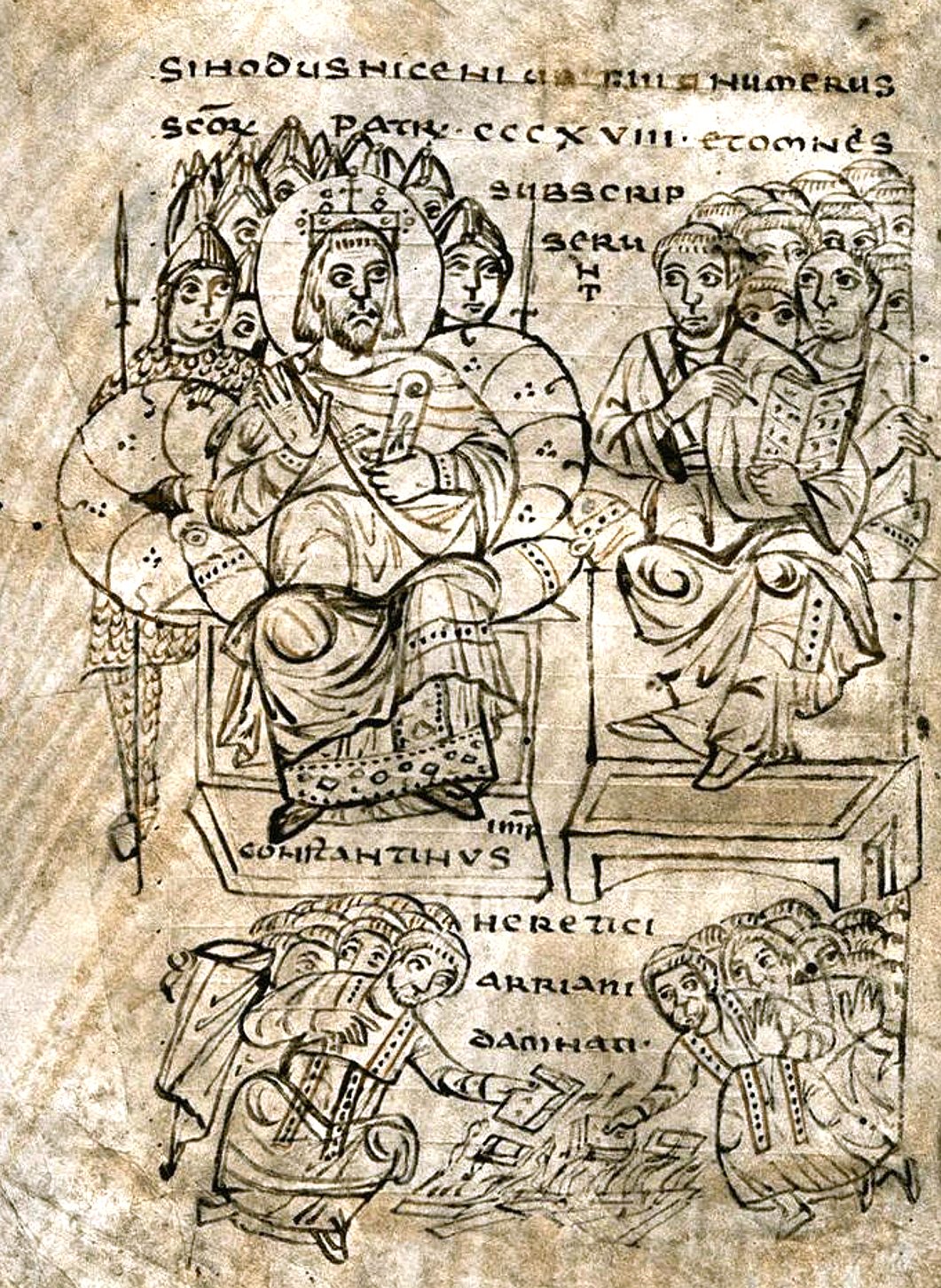
By 325, the controversy had become significant enough that the Emperor Constantine called an assembly of bishops, the First Council of Nicaea, which condemned Arius's doctrine and formulated the original Nicene Creed of 325. The Nicene Creed's central term, used to describe the relationship between the Father and the Son, is Homoousios (Ancient Greek: ὁμοούσιος), or Consubstantiality, meaning "of the same substance" or "of one being". The Athanasian Creed is less often used but is a more overtly anti-Arian statement on the Trinity.
The focus of the Council of Nicaea was the nature of the Son of God and his precise relationship to God the Father. (See Paul of Samosata and the Synods of Antioch.) Arius taught that Jesus Christ was divine or holy and was sent to Earth for the salvation of mankind, but that Jesus Christ was not equal to God the Father (infinite, primordial origin) in rank, and that God the Father and the Son of God were not equal to the Holy Spirit. Under Arianism, Christ was instead not consubstantial with God the Father since both the Father and the Son under Arius were made of "like" essence or being (see homoiousia) but not of the same essence or being (see homoousia).
In the Arian view, God the Father is a deity and is divine; the Son of God is not a deity, but is still divine. God the Father sent Jesus to earth for salvation of mankind. Ousia is essence or being, in Eastern Christianity, and is the aspect of God that is completely incomprehensible to mankind and human perception. It is all that subsists by itself and which has not its being in another, God the Father and God the Son and God the Holy Spirit all being uncreated.
According to the teaching of Arius, the preexistent Logos and thus the incarnate Jesus Christ was a begotten being; only the Son was directly begotten by God the Father, before ages, but was of a distinct, though similar, essence or substance from the Creator. His opponents argued that this would make Jesus less than God and that this was heretical. Much of the distinction between the differing factions was over the phrasing that Christ expressed in the New Testament to express submission to God the Father. The theological term for this submission is kenosis. This ecumenical council declared that Jesus Christ was true God, co-eternal and consubstantial (i.e., of the same substance) with God the Father.
Constantine is believed to have exiled those who refused to accept the Nicaean Creed—Arius himself, the deacon Euzoios, and the Libyan bishops Theonas of Marmarica and Secundus of Ptolemais, along with the bishops who signed the creed but refused to join in condemnation of Arius, Eusebius of Nicomedia and Theognis of Nicaea. The emperor also ordered all copies of the Thalia, the book in which Arius had expressed his teachings, to be burned. However, there is no evidence that his son and ultimate successor, Constantius II, a Semi-Arian Christian, was exiled.
Although he was committed to maintaining what the Great Church had defined at Nicaea, Constantine was also bent on pacifying the situation and eventually became more lenient toward those condemned and exiled at the council. First, he allowed Eusebius of Nicomedia, who was a protégé of his sister, and Theognis to return once they had signed an ambiguous statement of faith. The two, and other friends of Arius, worked for Arius's rehabilitation.
At the First Synod of Tyre in AD 335, they brought accusations against Athanasius, now bishop of Alexandria, the primary opponent of Arius. After this, Constantine had Athanasius banished since he considered him an impediment to reconciliation. In the same year, the Synod of Jerusalem under Constantine's direction readmitted Arius to communion in 336. Arius died on the way to this event in Constantinople. Some scholars suggest that Arius may have been poisoned by his opponents. Eusebius and Theognis remained in the Emperor's favor; when Constantine—who had been a catechumen much of his adult life—accepted baptism on his deathbed, it was from Eusebius of Nicomedia.
Condemnation by the Council of Nicaea
Emperor Constantine the Great summoned the First Council of Nicaea, which defined the dogmatic fundaments of Christianity; these definitions served to rebut the questions posed by Arians. Since Arius was not a bishop, he was not allowed to sit on the council, and it was Eusebius of Nicomedia who spoke for him and the position he represented. All the bishops who were there were in agreement with the major theological points of the proto-orthodoxy, since at that time all other forms of Christianity "had by this time already been displaced, suppressed, reformed, or destroyed".
Although the proto-orthodox won the previous disputes, due to the more precise defining of orthodoxy, they were vanquished with their own weapons, ultimately being declared heretics, not because they would have fought against ideas regarded as theologically correct, but because their positions lacked the precision and refinement needed by the fusion of several contradictory theses accepted at the same time by later orthodox theologians.
Of the roughly 300 bishops in attendance at the Council of Nicaea, two bishops did not sign the Nicene Creed that condemned Arianism. Constantine the Great also ordered a penalty of death for those who refused to surrender the Arian writings:
In addition, if any writing composed by Arius should be found, it should be handed over to the flames, so that not only will the wickedness of his teaching be obliterated, but nothing will be left even to remind anyone of him. And I hereby make a public order, that if someone should be discovered to have hidden a writing composed by Arius, and not to have immediately brought it forward and destroyed it by fire, his penalty shall be death. As soon as he is discovered in this offence, he shall be submitted for capital punishment. ...