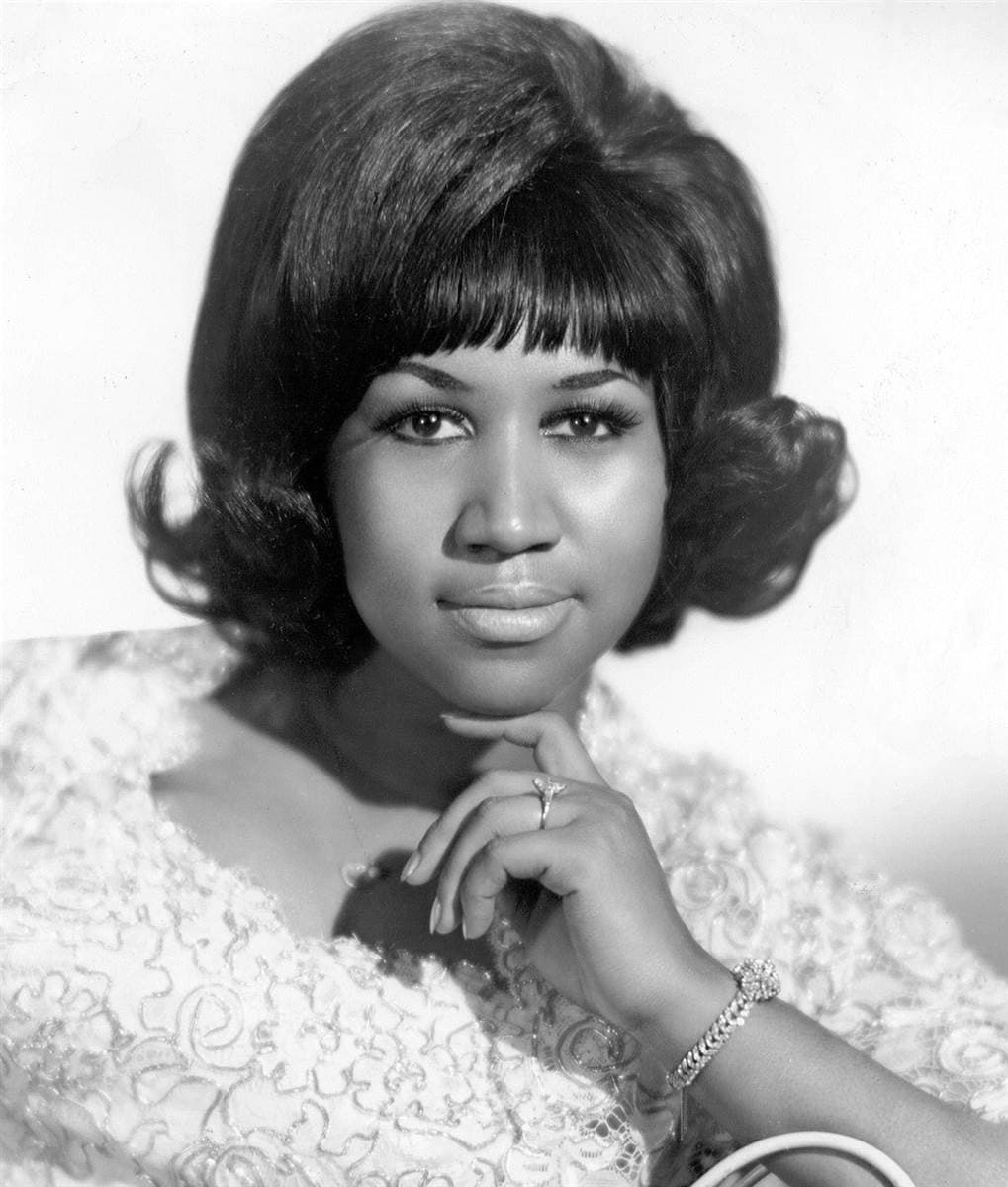
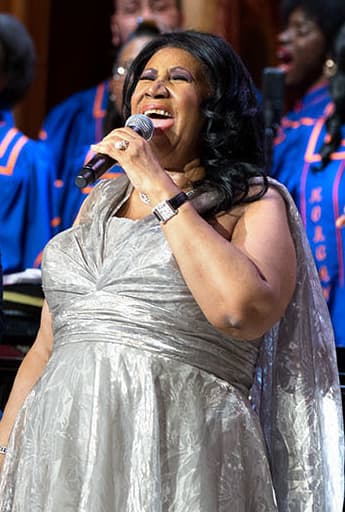
Aretha Louise Franklin ( ə-REE-thə; March 25, 1942 – August 16, 2018) was an American singer, songwriter and pianist. Regarded as the "Queen of Soul", she was twice named by Rolling Stone magazine as the greatest singer of all time.
As a child, Franklin was noticed for her gospel singing at New Bethel Baptist Church in Detroit, Michigan, where her father C. L. Franklin was a minister. At the age of 18, she was signed as a recording artist for Columbia Records. While her career did not immediately flourish, Franklin found acclaim and commercial success once she signed with Atlantic Records in 1966. There, she recorded significant hit albums such as I Never Loved a Man the Way I Love You, Lady Soul and Aretha Now in the late 1960s and Young, Gifted and Black, Amazing Grace and Sparkle in the 1970s, before experiencing problems with the record company. Franklin left Atlantic in 1979 and signed with Arista Records, where her career was revived with the hit albums Jump to It, Who's Zoomin' Who?, Aretha and A Rose Is Still a Rose.
Franklin is one of the best-selling music artists, with more than 75 million records sold worldwide. She charted 112 singles on the US Billboard charts, including 73 Hot 100 entries, 17 top-ten pop singles, 96 R&B entries and 20 number-one R&B singles. While her rendition of "Respect" has been referred to as her signature song, Franklin is known for other hit singles such as "(You Make Me Feel Like) A Natural Woman", "Chain of Fools", "Think", "I Say a Little Prayer", "Rock Steady", "Day Dreaming", "Freeway of Love" and "I Knew You Were Waiting (For Me)" (a duet with George Michael), to name a few. She also made a featured appearance in the 1980 musical-comedy film The Blues Brothers.
Franklin received numerous honors throughout her career. She won 18 Grammy Awards out of 44 nominations, including the first eight awards given for Best Female R&B Vocal Performance (1968–1975), as well as a Grammy Living Legend Award and Lifetime Achievement Award. She was also awarded the National Medal of Arts and the Presidential Medal of Freedom. In 1987, she became the first female artist to be inducted into the Rock and Roll Hall of Fame. Her other inductions include the UK Music Hall of Fame in 2005, the Gospel Music Hall of Fame in 2012, and posthumously the National Women's Hall of Fame in 2020 and the Volunteer State Music Hall of Fame in 2026. In 2019, the Pulitzer Prize jury awarded her a posthumous special citation "for her indelible contribution to American music and for more than five decades".
Reading level
Audio Summary
Played with your browser's voice. Studio-quality audio can be added with a text-to-speech service.
Ask about this article
📝 Quick Quiz1 / 3
What is "Aretha Franklin" primarily known for?
Vocix Daily — In Your Inbox
Top stories, deep-dive articles, and "On This Day" history — one crisp digest delivered every morning.
Sources & references
Reference material for this entry is drawn from the open encyclopedic record, including Wikipedia , available under the CC BY-SA 4.0 license. Images are credited individually beside each photo.
Aretha Louise Franklin was born on March 25, 1942, to Barbara (née Siggers) and Clarence LaVaughn "C. L." Franklin. She was delivered at her family's home located at 406 Lucy Avenue, Memphis, Tennessee. Her father was a Baptist minister and circuit preacher originally from Shelby, Mississippi, while her mother was an accomplished piano player and vocalist. C. L. and Barbara Franklin both had children from prior relationships in addition to the four children they had together. When Aretha was two years old, the family relocated to Buffalo, New York. By the time Aretha turned five, C. L. Franklin had permanently relocated the family to Detroit, Michigan where he took over the pastorship of the New Bethel Baptist Church.
The Franklins had a troubled marriage because of C. L. Franklin's infidelities, and they separated in 1948. At that time, Barbara Franklin returned to Buffalo with Aretha's half-brother, Vaughn. After the separation, Aretha recalled seeing her mother in Buffalo during the summer, and Barbara Franklin frequently visited her children in Detroit. Aretha's mother died of a heart attack on March 7, 1952, before Aretha's 10th birthday. Several women, including Aretha's grandmother, Rachel, and Mahalia Jackson, took turns helping with the children at the Franklin home. During this time, Aretha learned how to play piano by ear. She also attended public school in Detroit, going through her first year at Northern High School, but dropping out during her second year.
Aretha became pregnant with her first child, Clarence, when she was only 12 years old. She originally claimed that the father was a classmate named Edward Jordan, but would later write in her will that the father was Edward Jordan Sr.
Aretha's father's emotionally driven sermons resulted in his being known as the man with the "million-dollar voice". He earned thousands of dollars for sermons in various churches across the country. His fame led to his home being visited by various celebrities. Among the visitors were gospel musicians Clara Ward, James Cleveland, and early Caravans members Albertina Walker and Inez Andrews. Martin Luther King Jr., Jackie Wilson and Sam Cooke all became friends of C. L. Franklin, as well. Ward was romantically involved with Aretha's father from around 1949 until Ward's death in 1973, though Aretha "preferred to view them strictly as friends". Ward also served as a role model to the young Aretha.
Musical career
1952–1960: Beginnings
Just after her mother's death, Franklin began singing solos at New Bethel Baptist Church, debuting with the hymn "Jesus, Be a Fence Around Me". When Franklin was 12, her father began managing her; he would take her on the road with him, during his "gospel caravan" tours for her to perform in various churches. He also helped her sign her first recording deal with J.V.B. Records. Franklin was featured on vocals and piano. In 1956, J.V.B. released Franklin's first single, "Never Grow Old", backed with "You Grow Closer". "Precious Lord (Part One)" backed with "Precious Lord (Part Two)" followed in 1959. These four tracks, with the addition of "There Is a Fountain Filled with Blood", were released on side one of the 1956 album, Spirituals. This was reissued by Battle Records in 1962, under the same title. In 1965, Checker Records released Songs of Faith, featuring the five tracks from the 1956 Spirituals album, with the addition of four previously unreleased recordings. Aretha was only 14 when Songs of Faith was recorded.
During this time, Franklin would occasionally travel with the Soul Stirrers. As a young gospel singer, Franklin spent summers on the gospel circuit in Chicago and stayed with Mavis Staples's family.
According to music producer Quincy Jones, while Franklin was still young, Dinah Washington let him know that "Aretha was the 'next one'". Franklin and her father traveled to California, where she met singer Sam Cooke. At the age of 16, Franklin went on tour with Dr. Martin Luther King Jr., and she would ultimately sing at his funeral in 1968. Other influences in her youth included Marvin Gaye, as well as Ray Charles and Sam Cooke, "two of Franklin's greatest influences". Also important was James Cleveland, known as the King of Gospel music, "who helped to focus her early career as a gospel singer"; Cleveland had been recruited by her father as a pianist for the Southern California Community Choir.
1960–1966: Columbia years
After turning 18, Franklin confided to her father that she aspired to follow Sam Cooke in recording pop music, and moved to New York. Serving as her manager, C. L. Franklin agreed to the move and helped to produce a two-song demo that soon was brought to the attention of Columbia Records, who agreed to sign her in 1960, as a "five-percent artist". During this period, Franklin would be coached by choreographer Cholly Atkins to prepare for her pop performances. Before signing with Columbia, Sam Cooke tried to persuade Franklin's father to sign her with his label, RCA Victor, but she had already decided to go with Columbia. Berry Gordy had also asked Franklin and her elder sister Erma to sign with his Tamla label, but C. L. Franklin turned Gordy down, as he felt Tamla was not yet an established label. Franklin's first Columbia single, "Today I Sing the Blues", was issued in September 1960 and later reached the top 10 of the Hot R&B Sides chart.
In January 1961, Columbia issued Franklin's first album, Aretha: With The Ray Bryant Combo. The album featured her first single to chart the Billboard Hot 100, "Won't Be Long", which also peaked at number 7 on the R&B chart. Mostly produced by Clyde Otis, Franklin's Columbia recordings saw her performing in diverse genres, such as standards, vocal jazz, blues, doo-wop and rhythm and blues. Before the year was out, Franklin scored her first hit-single with her rendition of the standard "Rock-a-Bye Your Baby with a Dixie Melody". By the end of 1961, Franklin was named as a "new-star female vocalist" in DownBeat magazine. In 1962, Columbia issued two more albums, The Electrifying Aretha Franklin and The Tender, the Moving, the Swinging Aretha Franklin, the latter of which became her first charting album, reaching number 69 on the Billboard Top LPs – Monaural chart.
In the 1960s, during a performance at the Regal Theater in Chicago, WVON radio personality Pervis Spann announced that Franklin should be crowned "the Queen of Soul". Spann ceremonially placed a crown on her head. By 1964, Franklin began recording more pop music, reaching the top 10 on the R&B chart with the ballad "Runnin' Out of Fools", in early 1965. She had two R&B charted singles in 1965 and 1966, with the songs "One Step Ahead" and "Cry Like a Baby", while also reaching the Easy Listening charts with the ballads "You Made Me Love You" and "(No, No) I'm Losing You". By the mid-1960s, Franklin was making $100,000 per year from countless performances in nightclubs and theaters. Also during that period, she appeared on rock-and-roll shows, such as Hollywood a Go-Go and Shindig! However, she struggled with commercial success while at Columbia. Label executive John H. Hammond later said he felt Columbia did not understand Franklin's early gospel background and failed to bring that aspect out further during her period there.
1966–1979: Atlantic years
In November 1966, Franklin's Columbia recording contract expired; at that time, she owed the company money because record sales had not met expectations. Producer Jerry Wexler convinced her to move to Atlantic Records. Wexler decided that he wanted to take advantage of her gospel background; his philosophy in general was to encourage a "tenacious form of rhythm & blues that became increasingly identified as soul". The Atlantic days would lead to a series of hits for Aretha Franklin between 1967 and early 1972; her rapport with Wexler helped in the creation of the majority of her peak recordings on the Atlantic label. The next seven years' achievements were less impressive. However, according to Rolling Stone, "they weren't as terrible as some claimed, they were pro forma and never reached for new heights".
In January 1967, Franklin traveled to Muscle Shoals, Alabama, to record at FAME Studios and recorded the song "I Never Loved a Man (The Way I Love You)", backed by the Muscle Shoals Rhythm Section. Franklin only spent one day recording at FAME, as an altercation broke out between her manager and husband Ted White, studio owner Rick Hall, and a horn player, and sessions were abandoned. The song was released the following month and reached number one on the R&B chart, while also peaking at number nine on the Billboard Hot 100, giving Franklin her first top-ten pop single. The song's B-side, "Do Right Woman, Do Right Man", reached the R&B top 40, peaking at number 37. "Respect" was Otis Redding's song but Aretha modified it with a "supercharged interlude featuring the emphatic spelling-out of the song's title". Her frenetic version was released in April and reached number one on both the R&B and pop charts. "Respect" became her signature song and was later hailed as a civil rights and feminist anthem. Upon hearing her version, Otis Redding said admiringly: "That little girl done took my song away from me." Franklin's debut Atlantic album, I Never Loved a Man the Way I Love You, also became commercially successful, later going gold. According to National Geographic, this recording "would catapult Franklin to fame". Franklin scored two additional top-ten singles in 1967: "Baby I Love You" and "(You Make Me Feel Like) A Natural Woman".
Working with Wexler and Atlantic, Franklin had become "the most successful singer in the nation" by 1968. In 1968, Franklin issued the top-selling albums Lady Soul and Aretha Now, which included some of her most popular hit singles, including "Chain of Fools", "Ain't No Way", "Think", and "I Say a Little Prayer". That February, Franklin earned the first two of her Grammys, including the debut category for Best Female R&B Vocal Performance. On February 16, Franklin was honored with a day named for her and was greeted by longtime friend Martin Luther King Jr., who gave her the SCLC Drum Beat Award for Musicians less than two months before his death. Franklin toured outside the US for the first time in late April/May 1968, including an appearance at the Concertgebouw, Amsterdam, where she played to a near-hysterical audience who covered the stage with flower petals. She performed two concerts in London, at the Finsbury Park Astoria and the Hammersmith Odeon on May 11 and 12. In June 1968, she appeared on the cover of Time magazine in a portrait illustration by Boris Chaliapin.
In March 1969, Franklin was unanimously voted winner of Académie du Jazz's R&B award, Prix Otis Redding, for her albums Lady Soul, Aretha Now, and Aretha in Paris. That year, Franklin was the subject of a criminal impersonation scheme. Another woman performed at several Florida venues under the name Aretha Franklin. Suspicion was drawn when the fake Franklin charged only a fraction of the expected rate to perform. Franklin's lawyers contacted Florida authorities and uncovered a coercive scheme in which the singer, Vickie Jones, had been threatened with violence and constrained into impersonating her idol, whom she resembled closely both in voice and looks. After being cleared of wrongdoing, Jones subsequently enjoyed a brief career of her own, during which she was herself the subject of an impersonation.
Franklin's success further expanded during the early 1970s, during which she recorded the multi-week R&B number one "Don't Play That Song (You Lied)", as well as the top-ten singles "Spanish Harlem", "Rock Steady", and "Day Dreaming". Some of these releases were from the acclaimed albums Spirit in the Dark (released in August 1970, in which month she again performed at London's Hammersmith Odeon) and Young, Gifted and Black (released in early 1972). In 1971, Franklin became the first R&B performer to headline Fillmore West, later that year releasing the live album Aretha Live at Fillmore West.
In January 1972, she returned to gospel music in a two-night, live-church recording, with the album Amazing Grace, in which she reinterpreted standards such as Mahalia Jackson's "How I Got Over". Originally released in June 1972, Amazing Grace sold more than two million copies, and is one of bestselling gospel albums of all time. The live performances were filmed for a concert film directed by Sydney Pollack, but because of synching problems and Franklin's own attempts to prevent the film's distribution, the film's release was only realized by producer Alan Elliott in November 2018.
Franklin's career began to experience problems while recording the album Hey Now Hey, which featured production from Quincy Jones. Despite the success of the single "Angel", the album bombed upon its release in 1973. Franklin continued having R&B success with songs such as "Until You Come Back to Me" and "I'm in Love", but by 1975 her albums and songs were no longer top sellers. After Jerry Wexler left Atlantic for Warner Bros. Records in 1976, Franklin worked on the soundtrack to the film Sparkle with Curtis Mayfield. The album yielded Franklin's final top 40 pop hit of the decade, "Something He Can Feel", which also peaked at number one on the R&B chart. Franklin's follow-up albums for Atlantic, including Sweet Passion (1977), Almighty Fire (1978) and La Diva (1979), bombed on the charts, and in 1979 Franklin left the company. On November 7, 1979, she guested The Mike Douglas Show with her yellow costume from her La Diva album, and sang "Ladies Only", "What If I Should Ever Need You" and "Yesterday" by the Beatles.
1980–2007: Arista years
In 1980, after leaving Atlantic Records, Franklin signed with Clive Davis's Arista Records. "Davis was beguiling and had the golden touch", according to Rolling Stone. "If anybody could rejuvenate Franklin's puzzlingly stuck career, it was Davis." Franklin participated in the musical comedy film, The Blues Brothers, in a cameo guest role as a soul food restaurant proprietor and wife of Matt "Guitar" Murphy. In November of that year, Franklin participated in the Royal Variety Performance at the London Palladium in front of Queen Elizabeth The Queen Mother, directed by Louis Benjamin in celebration of fifty years of entertainment.
Franklin's first Arista release, Aretha, was released in 1980 and produced the top three R&B hit single "United Together". While not released as a single, Franklin's funk-influenced cover of Otis Redding's "I Can't Turn You Loose" on the same album resulted in her first Grammy nomination in four years.
The follow-up album, Love All the Hurt Away (1981) featured her hit R&B duet of the title track with George Benson, while a post-disco rendition of Sam & Dave's "Hold On, I'm Comin'" won Franklin her first Grammy in six years.
For her next Arista release, Clive Davis hired rising soul singer Luther Vandross to produce, resulting in Jump to It (1982). Producing her first top 40 single on the Billboard Hot 100 since "Something He Can Feel" with the danceable title track", the album would become her first since the Sparkle soundtrack seven years earlier to receive a gold certification from the RIAA.
When her immediate Vandross-helmed follow-up, Get It Right (1983), failed to perform successfully despite the title track becoming a number one R&B single, Arista hired a young Narada Michael Walden to produce the album, Who's Zoomin' Who.
Eschewing her R&B and soul roots, the album brought on a crossover pop sound with elements of synthesized dance-rock and urban pop. Featuring the top ten Hot 100 hits such as "Freeway of Love" and the title track, the album peaked at number thirteen on the Billboard 200, her highest peak in nearly 20 years and was her first album to be certified platinum in the United States. Part of the album's success was due to exposure on the then-fledgling music video channel MTV, which also exposed Franklin to a younger audience. Franklin also achieved a top 20 hit with the duet, "Sisters Are Doing It for Themselves" with the new wave band Eurythmics.
On October 27, 1986, Franklin issued her sixth Arista release, Aretha (sometimes referred to as Aretha '86). The Walden-produced album went gold on the strength of her globally successful duet with George Michael, "I Knew You Were Waiting (For Me)", which became her first single in nearly twenty years to top the Billboard Hot 100 and also topped the charts in the United Kingdom and Australia and resulted in Grammy wins for Franklin. Other hit singles on Aretha included a pop-rock rendition of "Jumpin' Jack Flash", culled from the Whoopi Goldberg-starring film of the same name, and "Jimmy Lee".
Throughout 1987, Franklin provided vocals to the theme songs of the TV shows A Different World and Together. Also in 1987, the artist performed "America the Beautiful" at WWE's Wrestlemania III; one source states that "to this day her WrestleMania III performance might be the most memorable" of the event openers by many artists. That same year, Franklin released her second full-length gospel album, One Lord, One Faith, One Baptism, which was recorded at her late father's New Bethel church.
After 1988, "Franklin never again had huge hits", according to Rolling Stone. In 1989, Franklin reunited with Narada Michael Walden on the album Through the Storm. Despite the appearances of Elton John and fellow label mate and "honorary niece" Whitney Houston, the album sold poorly, as did her 1991 follow-up, What You See is What You Sweat. Both albums attempted to bring Franklin to the new jack swing era but were critical failures as well.
Franklin returned to the charts in 1993 with the house song "A Deeper Love", which was featured on the soundtrack to Sister Act 2: Back in the Habit and topped the Billboard Dance Club Play chart and was a UK top five hit. A year later, Franklin began working with Babyface, landing her first top 40 single in five years with the R&B ballad, "Willing to Forgive".
In 1995, Franklin portrayed Aunt Em in the Apollo Theater revival of The Wiz. That year, Franklin contributed to the soundtrack of Waiting to Exhale, after being handpicked by Whitney Houston to perform the ballad "It Hurts Like Hell", which reached the Billboard R&B charts.
Three years after that, Franklin released the album, A Rose Is Still a Rose, which produced her final top 40 single with the title track, with both the album and single earning gold certifications.
That same year, Franklin received global praise after her 1998 Grammy Awards performance. She had initially been asked to perform in honor of the 1980 film The Blues Brothers, in which she appeared with Dan Aykroyd and John Belushi. That evening, after the show had already begun, another performer, opera tenor Luciano Pavarotti became too ill to perform the aria "Nessun dorma" as planned. The show's producers, desperate to fill the time slot, approached Franklin with their dilemma. She was a friend of Pavarotti and had sung the aria two nights prior at the annual MusiCares event. She asked to hear Pavarotti's rehearsal recording, and after listening, agreed that she could sing it in the tenor range that the orchestra was prepared to play in. More than one billion people worldwide saw the performance, and she received an immediate standing ovation.
She would go on to record the selection and perform it live several more times in the years to come. The last time she sang the aria live was for Pope Francis at the World Meeting of Families in Philadelphia in September 2015. A small boy was so touched by her performance that he came onto the stage and embraced her while Franklin was still singing.
Her final Arista album, So Damn Happy, was released in 2003 and featured the Grammy-winning song "Wonderful". In 2004, Franklin announced that she was leaving Arista after more than 20 years with the label.
To complete her Arista obligations, Franklin issued the duets compilation album Jewels in the Crown: All-Star Duets with the Queen in 2007. In February 2006, she performed "The Star-Spangled Banner" with Aaron Neville and Dr. John for Super Bowl XL, held in her hometown of Detroit.
In 2007, Franklin would perform America the Beautiful at WrestleMania 23, 20 years since her performance at WrestleMania 3, where she was specifically chosen to reflect the events "all grown up" theme and tagline.
2007–2018: Final years
In 2008, Franklin issued the holiday album This Christmas, Aretha on DMI Records. On February 8, 2008, Franklin was honored as the MusiCares Person of the Year, and performed "Never Gonna Break My Faith", which had won her the Grammy for best gospel performance the year before. Twelve years later, an unheard performance of "Never Gonna Break My Faith" was released in June 2020 to commemorate Juneteenth with a new video visualizing the American human rights movement. This caused the song to enter the Billboard gospel charts at number one, giving Franklin the distinction of having had a number one record in every decade since the 1960s. On November 18, 2008, she performed "Respect" and "Chain of Fools" at Dancing with the Stars.
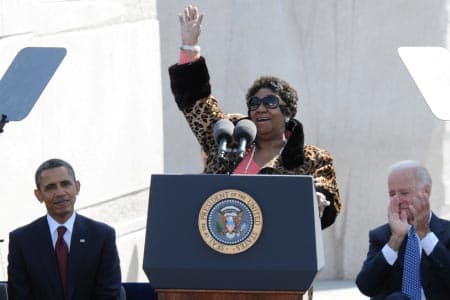
On January 20, 2009, Franklin made international headlines for performing "My Country, 'Tis of Thee" at President Barack Obama's inaugural ceremony with her church hat becoming a popular topic online. In 2010, Franklin accepted an honorary degree from Yale University. In 2011, under her own label, Aretha's Records, she issued the album Aretha: A Woman Falling Out of Love.
In 2014, Franklin was signed under RCA Records, controller of the Arista catalog and a sister label to Columbia via Sony Music Entertainment, and worked with Clive Davis. There were plans for her to record an album produced by Danger Mouse, who was replaced with Babyface and Don Was when Danger Mouse left the project. On September 29, 2014, Franklin performed to a standing ovation, with Cissy Houston as backup, a compilation of Adele's "Rolling in the Deep" and "Ain't No Mountain High Enough" on the Late Show with David Letterman. Franklin's cover of "Rolling in the Deep" was featured among nine other songs in her first RCA release, Aretha Franklin Sings the Great Diva Classics, released in October 2014. In doing so, she became the first woman to have 100 songs on Billboard's Hot R&B/Hip-Hop Songs chart with the success of her cover of Adele's "Rolling in the Deep", which debuted at number 47 on the chart.
In December 2015, Franklin gave an acclaimed performance of "(You Make Me Feel Like) A Natural Woman" at the 2015 Kennedy Center Honors during the section for honoree Carole King, who co-wrote the song. During the swelling bridge of the song, Franklin dramatically dropped her fur coat from her shoulders to the stage, for which the audience rewarded her with a mid-performance standing ovation. Dropping the coat was symbolic according to Rolling Stone: it "echoed back to those times when gospel queens would toss their furs on top of the coffins of other gospel queens — a gesture that honored the dead but castigated death itself".
She returned to Detroit's Ford Field on Thanksgiving Day 2016 to once again perform the national anthem before the game between the Minnesota Vikings and Detroit Lions. Seated behind the piano, wearing a black fur coat and Lions stocking cap, Franklin gave a rendition of "The Star-Spangled Banner" that lasted more than four minutes and featured a host of improvisations. Franklin released the album A Brand New Me in November 2017 with the Royal Philharmonic Orchestra, which uses archived recordings from Franklin.
Franklin canceled some concerts in 2017 for health reasons. Nevertheless, she was still garnering highly favorable reviews for her skill and showmanship. At the Ravinia Festival on September 3, 2017, she gave her last full concert. Franklin's final public performance was at the Cathedral of St. John the Divine in New York City during Elton John's 25th anniversary gala for the Elton John AIDS Foundation on November 7, 2017.
Music style and image
According to Richie Unterberger, Franklin was "one of the giants of soul music, and indeed of American pop as a whole. More than any other performer, she epitomized soul at its most gospel-charged". She had often been described as a great singer and musician because of "vocal flexibility, interpretive intelligence, skillful piano-playing, her ear, her experience". Franklin's voice was described as being a "powerful mezzo-soprano voice". She was praised for her arrangements and interpretations of other artists' hit songs. According to David Remnick, what "distinguishes her is not merely the breadth of her catalog or the cataract force of her vocal instrument; it's her musical intelligence, her way of singing behind the beat, of spraying a wash of notes over a single word or syllable, of constructing, moment by moment, the emotional power of a three-minute song. 'Respect' is as precise an artifact as a Ming vase." Describing Franklin's voice on her first album, Songs of Faith, released in 1956 when she was just 14, Jerry Wexler explained that it "was not that of a child but rather of an ecstatic hierophant". Critic Randy Lewis assessed her skills as a pianist as "magic" and "inspirational". Musicians and professionals alike – such as Elton John, Keith Richards, Carole King, and Clive Davis – were fans of her piano performances. In 2015, President Barack Obama wrote the following regarding Franklin:Nobody embodies more fully the connection between the African-American spiritual, the blues, R. & B., rock and roll—the way that hardship and sorrow were transformed into something full of beauty and vitality and hope. American history wells up when Aretha sings. That's why, when she sits down at a piano and sings 'A Natural Woman,' she can move me to tears—the same way that Ray Charles's version of 'America the Beautiful' will always be in my view the most patriotic piece of music ever performed—because it captures the fullness of the American experience, the view from the bottom as well as the top, the good and the bad, and the possibility of synthesis, reconciliation, transcendence.
Activism
From her time growing up in the home of a prominent African-American preacher to the end of her life, Franklin was immersed and involved in the struggle for civil rights and women's rights. She provided money for civil rights groups, at times covering payroll, and performed at benefits and protests.
When Angela Davis was jailed in 1970, Franklin told Jet: "Angela Davis must go free ... Black people will be free. I've been locked up (for disturbing the peace in Detroit) and I know you got to disturb the peace when you can't get no peace. Jail is hell to be in. I'm going to see her free if there is any justice in our courts, not because I believe in communism, but because she's a Black woman and she wants freedom for Black people."
Her songs "Respect" and "(You Make Me Feel Like) A Natural Woman" became anthems of these movements for social change.
Franklin and several other American icons declined to take part in performing at President Donald Trump's 2017 inauguration as a mass act of musical protest.
Franklin was also a strong supporter of Native American rights. She quietly and without fanfare supported Indigenous peoples' struggles worldwide, and numerous movements that supported Native American and First Nation cultural rights.
Personal life
Franklin moved to New York City from Detroit in the 1960s where she lived until relocating to Los Angeles in the mid-1970s. She eventually settled in the Los Angeles neighborhood of Encino, where she lived until 1982. She then returned to the Detroit suburb of Bloomfield Hills to be close to her ailing father and siblings. Franklin maintained a residence there until her death. Following an incident in 1984, she cited a fear of flying that prevented her from traveling overseas; she performed only in North America afterwards. Franklin was Baptist.