
Archimedes of Syracuse ( AR-kih-MEE-deez; c. 287 – c. 212 BC) was an Ancient Greek mathematician, physicist, engineer, astronomer, and inventor from the city of Syracuse in Sicily. Although few details of his life are known, based on his surviving work, he is considered one of the leading scientists in classical antiquity, and one of the greatest mathematicians of all time. Archimedes anticipated modern calculus and analysis by applying the concept of the infinitesimals and the method of exhaustion to derive and rigorously prove many geometrical theorems, including the area of a circle, the surface area and volume of a sphere, the area of an ellipse, the area under a parabola, the volume of a segment of a paraboloid of revolution, the volume of a segment of a hyperboloid of revolution, and the area of a spiral.
Archimedes' other mathematical achievements include deriving an approximation of pi (π), defining and investigating the Archimedean spiral, and devising a system using exponentiation for expressing very large numbers. He was also one of the first to apply mathematics to physical phenomena, working on statics and hydrostatics. Archimedes' achievements in this area include a proof of the law of the lever, the widespread use of the concept of center of gravity, and the enunciation of the law of buoyancy known as Archimedes' principle. In astronomy, he made measurements of the apparent diameter of the Sun and the size of the universe. He is also said to have built a planetarium device that demonstrated the movements of the known celestial bodies, and may have been a precursor to the Antikythera mechanism. He is also credited with designing innovative machines, such as his screw pump, compound pulleys, and defensive war machines to protect his native Syracuse from invasion.
Archimedes died during the siege of Syracuse, when he was killed by a Roman soldier despite orders that he should not be harmed. Cicero describes visiting Archimedes' tomb, which was surmounted by a sphere and a cylinder that Archimedes requested be placed there to represent his most valued mathematical discovery.

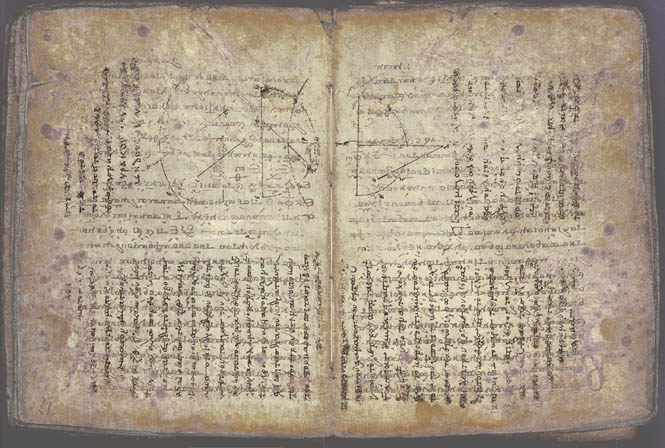
Unlike his inventions, Archimedes' mathematical writings were little known in antiquity. Alexandrian mathematicians read and quoted him, but the first comprehensive compilation was not made until c. 530 AD by Isidore of Miletus in Byzantine Constantinople, while Eutocius' commentaries on Archimedes' works in the same century opened them to wider readership for the first time. In the Middle Ages, Archimedes' work was translated into Arabic in the 9th century and then into Latin in the 12th century, and were an influential source of ideas for scientists during the Renaissance and in the Scientific Revolution. The discovery in 1906 of works by Archimedes in the Archimedes Palimpsest has provided new insights into how he obtained mathematical results.
Biography
The details of Archimedes's life are obscure; a biography of Archimedes mentioned by Eutocius was allegedly written by his friend Heraclides Lembus, but this work has been lost, and modern scholarship is doubtful that it was written by Heraclides to begin with.
Based on a statement by the Byzantine Greek scholar John Tzetzes that Archimedes lived for 75 years before his death in 212 BC, Archimedes is estimated to have been born c. 287 BC in the seaport city of Syracuse, Sicily, at that time a self-governing colony in Magna Graecia. In the Sand-Reckoner, Archimedes gives his father's name as Phidias, an astronomer about whom nothing else is known; Plutarch wrote in his Parallel Lives that Archimedes was related to King Hiero II, the ruler of Syracuse, although Cicero and Silius Italicus suggest he was of humble origin. It is also unknown whether he ever married or had children, or if he ever visited Alexandria, Egypt, during his youth; though his surviving written works, addressed to Dositheus of Pelusium, a student of the Alexandrian astronomer Conon of Samos, and to the head librarian Eratosthenes of Cyrene, suggested that he maintained collegial relations with scholars based there. In the preface to On Spirals addressed to Dositheus, Archimedes says that "many years have elapsed since Conon's death." Conon of Samos lived c. 280–220 BC, suggesting that Archimedes may have been an older man when writing some of his works.
Golden wreath
Another story of a problem that Archimedes is credited solving with in service of Hiero II is the "wreath problem." According to Vitruvius, writing about two centuries after Archimedes' death, King Hiero II of Syracuse had commissioned a golden wreath for a temple to the immortal gods, and had supplied pure gold to be used by the goldsmith. However, the king had begun to suspect that the goldsmith had substituted some cheaper silver and kept some of the pure gold for himself, and, unable to make the smith confess, asked Archimedes to investigate. Later, while stepping into a bath, Archimedes allegedly noticed that the level of the water in the tub rose more the lower he sank in the tub and, realizing that this effect could be used to determine the golden crown's volume, was so excited that he took to the streets naked, having forgotten to dress, crying "Eureka!", meaning "I have found [it]!" According to Vitruvius, Archimedes then took a lump of gold and a lump of silver that were each equal in weight to the wreath, and, placing each in the bathtub, showed that the wreath displaced more water than the gold and less than the silver, demonstrating that the wreath was gold mixed with silver.
A different account is given in the Carmen de Ponderibus, an anonymous 5th century Latin didactic poem on weights and measures once attributed to the grammarian Priscian. In this poem, the lumps of gold and silver were placed on the scales of a balance, and then the entire apparatus was immersed in water; the difference in density between the gold and the silver, or between the gold and the crown, causes the scale to tip accordingly. Unlike the more famous bathtub account given by Vitruvius, this poetic account uses the hydrostatics principle now known as Archimedes' principle that is found in his treatise On Floating Bodies, where a body immersed in a fluid experiences a buoyant force equal to the weight of the fluid it displaces. Galileo Galilei, who invented a hydrostatic balance in 1586 inspired by Archimedes' work, considered it "probable that this method is the same that Archimedes followed, since, besides being very accurate, it is based on demonstrations found by Archimedes himself."
Launching the Syracusia
A large part of Archimedes' work in engineering probably arose from fulfilling the needs of his home city of Syracuse. Athenaeus of Naucratis in his Deipnosophistae quotes a certain Moschion for a description on how King Hiero II commissioned the design of a huge ship, the Syracusia, which is said to have been the largest ship built in classical antiquity and, according to Moschion's account, it was launched by Archimedes. Plutarch tells a slightly different account, relating that Archimedes boasted to Hiero that he was able to move any large weight, at which point Hiero challenged him to move a ship. These accounts contain many fantastic details that are historically implausible, and the authors of these stories provide conflicting ideas about how this task was accomplished: Plutarch states that Archimedes constructed a block-and-tackle pulley system, while Hero of Alexandria attributed the same boast to Archimedes' invention of the baroulkos, a kind of windlass. Pappus of Alexandria attributed this feat, instead, to Archimedes' use of mechanical advantage, the principle of leverage to lift objects that would otherwise have been too heavy to move, attributing to him the oft-quoted remark: "Give me a place to stand on, and I will move the Earth."

Athenaeus, likely garbling the details of Hero's account of the baroulkos, also mentions that Archimedes used a "screw" in order to remove any potential water leaking through the hull of the Syracusia. Although this device is sometimes referred to as Archimedes' screw, it likely predates him by a significant amount, and none of his closest contemporaries who describe its use (Philo of Byzantium, Strabo, and Vitruvius) credit him with its use.
War machines
The greatest reputation Archimedes earned during antiquity was for the defense of his city from the Romans during the Siege of Syracuse. According to Plutarch, Archimedes had constructed war machines for Hiero II, but had never been given an opportunity to use them during Hiero's lifetime. In 214 BC, however, during the Second Punic War, when Syracuse switched allegiances from Rome to Carthage, the Roman army under Marcus Claudius Marcellus attempted to take the city, Archimedes allegedly personally oversaw the use of these war machines in the defense of the city, greatly delaying the Romans, who were only able to capture the city after a long siege. Three different historians, Plutarch, Livy, and Polybius provide testimony about these war machines, describing improved catapults, cranes that dropped heavy pieces of lead on the Roman ships or which used an iron claw to lift them out of the water, dropping them back in so that they sank.
A much more improbable account, not found in any of the three earliest accounts (Plutarch, Polybius, or Livy) describes how Archimedes used "burning mirrors" to focus the sun's rays onto the attacking Roman ships, setting them on fire. The earliest account to mention ships being set on fire, by the 2nd century CE satirist Lucian of Samosata, does not mention mirrors, and only says the ships were set on fire by artificial means, which may imply that burning projectiles were used. The first author to mention mirrors is Galen, writing later in the same century. Nearly four hundred years after Lucian and Galen, Anthemius, despite skepticism, tried to reconstruct Archimedes' hypothetical reflector geometry. The purported device, sometimes called "Archimedes' heat ray", has been the subject of an ongoing debate about its credibility since the Renaissance. René Descartes rejected it as false, while modern researchers have attempted to recreate the effect using only the means that would have been available to Archimedes, with mixed results.

Death
There are several divergent accounts of Archimedes' death during the sack of Syracuse after it fell to the Romans: The oldest account, from Livy, says that, while drawing figures in the dust, Archimedes was killed by a Roman soldier who did not know he was Archimedes. According to Plutarch, the soldier demanded that Archimedes come with him, but Archimedes declined, saying that he had to finish working on the problem, and the soldier killed Archimedes with his sword. Another story from Plutarch has Archimedes carrying mathematical instruments before being killed because a soldier thought they were valuable items. Another Roman writer, Valerius Maximus (fl. 30 AD), wrote in Memorable Doings and Sayings that Archimedes' last words as the soldier killed him were "... but protecting the dust with his hands, said 'I beg of you, do not disturb this.'" which is similar to the last words now commonly attributed to him, "Do not disturb my circles," which do not appear in any ancient sources.
Marcellus was reportedly angered by Archimedes' death, as he considered him a valuable scientific asset (he called Archimedes "a geometrical Briareus") and had ordered that he should not be harmed. Cicero (106–43 BC) mentions that Marcellus brought to Rome two planetariums Archimedes built, which were constructed by Archimedes and which showed the motion of the Sun, Moon and five planets, one of which he donated to the Temple of Virtue in Rome, and the other he allegedly kept as his only personal loot from Syracuse." Pappus of Alexandria reports on a now lost treatise by Archimedes On Sphere-Making, which may have dealt with the construction of these mechanisms. Constructing mechanisms of this kind would have required a sophisticated knowledge of differential gearing, which was once thought to have been beyond the range of the technology available in ancient times, but the discovery in 1902 of the Antikythera mechanism, another device built c. 100 BC designed with a similar purpose, has confirmed that devices of this kind were known to the ancient Greeks, with some scholars regarding Archimedes' device as a precursor.
While serving as a quaestor in Sicily, Cicero himself found what was presumed to be Archimedes' tomb near the Agrigentine gate in Syracuse, in a neglected condition and overgrown with bushes. Cicero had the tomb cleaned up and was able to see the carving and read some of the verses that had been added as an inscription. The tomb carried a sculpture illustrating Archimedes' favorite mathematical proof, that the volume and surface area of the sphere are two-thirds that of an enclosing cylinder including its bases.

Mathematics
While he is often regarded as a designer of mechanical devices, Archimedes also made contributions to the field of mathematics, both in applying the techniques of his predecessors to obtain new results, and developing new methods of his own.
Method of exhaustion
In Quadrature of the Parabola, Archimedes states that a certain proposition in Euclid's Elements demonstrating that the area of a circle is proportional to its diameter was proven using a lemma now known as the Archimedean property, that “the excess by which the greater of two unequal regions exceed the lesser, if added to itself, can exceed any given bounded region.” Prior to Archimedes, Eudoxus of Cnidus and other earlier mathematicians applied this lemma, a technique now referred to as the "method of exhaustion," to find the volume of a tetrahedron, cylinder, cone, and sphere, for which proofs are given in book XII of Euclid's Elements.
In Measurement of a Circle, Archimedes employed this method to show that the area of a circle is the same as a right triangle whose base and height are equal to its radius and circumference. He then approximated the ratio between the radius and the circumference, the value of π, by drawing a larger regular hexagon outside a circle then a smaller regular hexagon inside the circle, and progressively doubling the number of sides of each regular polygon, calculating the length of a side of each polygon at each step. As the number of sides increases, it becomes a more accurate approximation of a circle. After four such steps, when the polygons had 96 sides each, he was able to determine that the value of π lay between 31/7 (approx. 3.1429) and 310/71 (approx. 3.1408), consistent with its actual value of approximately 3.1416. In the same treatise, he also asserts that the value of the square root of 3 as lying between 265/153 (approximately 1.7320261) and 1351/780 (approximately 1.7320512), which he may have derived from a similar method.

In Quadrature of the Parabola, Archimedes used this technique to prove that the area enclosed by a parabola and a straight line is 4/3 times the area of a corresponding inscribed triangle as shown in the figure at right, expressing the solution to the problem as an infinite geometric series with the common ratio 1/4:
{\displaystyle \sum _{n=0}^{\infty }4^{-n}=1+4^{-1}+4^{-2}+4^{-3}+\cdots ={4 \over 3}.\;}
If the first term in this series is the area of the triangle, then the second is the sum of the areas of two triangles whose bases are the two smaller secant lines, and whose third vertex is where the line that is parallel to the parabola's axis and that passes through the midpoint of the base intersects the parabola, and so on. This proof uses a variation of the series 1/4 + 1/16 + 1/64 + 1/256 + · · · which sums to 1/3.
He also used this technique in order to measure the surface areas of a sphere and cone, to calculate the area of an ellipse, and to find the area contained within an Archimedean spiral.
Mechanical method
For it is more feasible, having already in one’s possession, through the method, of a knowledge of some sort of the matters under investigation, to provide the proof – rather than investigating it, knowing nothing.
In addition to developing on the works of earlier mathematicians with the method of exhaustion, Archimedes also pioneered a novel technique using the law of the lever in order to measure the area and volume of shapes using physical means. He first gives an outline of this proof in Quadrature of the Parabola alongside the geometric proof, but he gives a fuller explanation in The Method of Mechanical Theorems. According to Archimedes, he proved the results in his mathematical treatises first using this method, and then worked backwards, applying the method of exhaustion only after he had already calculated an approximate value for the answer.
Large numbers
Archimedes also developed methods for representing large numbers.
In The Sand Reckoner, Archimedes devised a system of counting based on the myriad, the Greek term for the number 10,000, in order to calculate a number that was greater than the grains of sand needed to fill the universe. He proposed a number system using powers of a myriad of myriads (100 million, i.e., 10,000 x 10,000) and concluded that the number of grains of sand required to fill the universe would be 8 vigintillion, or 8×1063. In doing so, he demonstrated that mathematics could represent arbitrarily large numbers.
In the Cattle Problem, Archimedes challenges the mathematicians at the Library of Alexandria to count the numbers of cattle in the Herd of the Sun, which involves solving a number of simultaneous Diophantine equations. A more difficult version of the problem in which some of the answers are required to be square numbers, and the answer is a very large number, approximately 7.760271×10206544.
Archimedean solid
In a lost work described by Pappus of Alexandria, Archimedes proved that there are exactly thirteen semiregular polyhedra.
Writings
Archimedes made his work known through correspondence with mathematicians in Alexandria, which were originally written in Doric Greek, the dialect of ancient Syracuse.
Surviving works
The following are ordered chronologically based on new terminological and historical criteria set by Knorr (1978) and Sato (1986).
Measurement of a Circle
This is a short work consisting of three propositions. It is written in the form of a correspondence with Dositheus of Pelusium, who was a student of Conon of Samos. In Proposition II, Archimedes gives an approximation of the value of pi (π), showing that it is greater than 223/71 (3.1408...) and less than 22/7 (3.1428...).
The Sand Reckoner
In this treatise, also known as Psammites, Archimedes finds a number that is greater than the grains of sand needed to fill the universe. This book mentions the heliocentric theory of the Solar System proposed by Aristarchus of Samos, as well as contemporary ideas about the size of the Earth and the distance between various celestial bodies, and attempts to measure the apparent diameter of the Sun. By using a system of numbers based on powers of the myriad, Archimedes concludes that the number of grains of sand required to fill the universe is 8×1063 in modern notation. The introductory letter states that Archimedes' father was an astronomer named Phidias. The Sand Reckoner is the only surviving work in which Archimedes discusses his views on astronomy.
Archimedes discusses astronomical measurements of the Earth, Sun, and Moon, as well as Aristarchus' heliocentric model of the universe, in the Sand-Reckoner. Without the use of either trigonometry or a table of chords, Archimedes determines the Sun's apparent diameter by first describing the procedure and instrument used to make observations (a straight rod with pegs or grooves), applying correction factors to these measurements, and finally giving the result in the form of upper and lower bounds to account for observational error.
Ptolemy, quoting Hipparchus, also references Archimedes' solstice observations in the Almagest. This would make Archimedes the first known Greek to have recorded multiple solstice dates and times in successive years.
On the Equilibrium of Planes
There are two books to On the Equilibrium of Planes: the first contains seven postulates and fifteen propositions, while the second book contains ten propositions. In the first book, Archimedes proves the law of the lever, which states that:
Magnitudes are in equilibrium at distances reciprocally proportional to their weights.
Earlier descriptions of the principle of the lever are found in a work by Euclid and in the Mechanical Problems, belonging to the Peripatetic school of the followers of Aristotle, the authorship of which has been attributed by some to Archytas.
Archimedes uses the principles derived to calculate the areas and centers of gravity of various geometric figures including triangles, parallelograms and parabolas.
Quadrature of the Parabola
In this work of 24 propositions addressed to Dositheus, Archimedes proves by two methods that the area enclosed by a parabola and a straight line is 4/3 the area of a triangle with equal base and height. He achieves this by two different methods: first by applying the law of the lever, and by calculating the value of a geometric series that sums to infinity with the ratio 1/4.
On the Sphere and Cylinder
In this two-volume treatise addressed to Dositheus, Archimedes obtains the result of which he was most proud, namely the relationship between a sphere and a circumscribed cylinder of the same height and diameter. The volume is 4/3πr3 for the sphere, and 2πr3 for the cylinder. The surface area is 4πr2 for the sphere, and 6πr2 for the cylinder (including its two bases), where r is the radius of the sphere and cylinder.
On Spirals
This work of 28 propositions is also addressed to Dositheus. The treatise defines what is now called the Archimedean spiral. It is the locus of points corresponding to the locations over time of a point moving away from a fixed point with a constant speed along a line which rotates with constant angular velocity. Equivalently, in modern polar coordinates (r, θ), it can be described by the equation
{\displaystyle \,r=a+b\theta }