
The Arab world (Arabic: اَلْعَالَمُ الْعَرَبِيُّ al-ʿālam al-ʿarabī), formally the Arab homeland (اَلْوَطَنُ الْعَرَبِيُّ al-waṭan al-ʿarabī), also known as the Arab nation (اَلْأُمَّةُ الْعَرَبِيَّةُ al-ummah al-ʿarabiyyah), the Arabsphere, or the Arab states, comprises a large group of countries, mainly located in West Asia and North Africa. While the majority of people in the Arab world are ethnically Arab, there are also significant populations of other ethnic groups such as Berbers, Kurds, Somalis and Nubians, among other groups. Arabic is used as the lingua franca throughout the Arab world.
The Arab world is at its minimum defined as the 19 states where Arabs form at least a plurality of the population. At its maximum it consists of the 22 members of the Arab League, an international organization, which on top of the 19 plurality Arab states also includes the Bantu-speaking Comoros, and the Cushitic-speaking Djibouti and Somalia. The region stretches from the Atlantic Ocean in the west to the Arabian Sea in the east, and from the Mediterranean Sea in the north to the Indian Ocean in the southeast. The eastern part of the Arab world is known as the Mashriq, and the western part as the Maghreb.
According to the World Bank, the Arab world has a total population of 456 million inhabitants and a gross domestic product of $2.85 trillion, as of 2021. The region is economically quite diverse, and includes some of the wealthiest as well as poorest populations in the world.
In post-classical history, the Arab world was synonymous with the historic Arab empires and caliphates. Arab nationalism arose in the second half of the 19th century along with other nationalist movements within the Ottoman Empire. The Arab League was formed in 1945 to represent the interests of Arab people and especially to pursue the political unification of the Arab countries, a project known as pan-Arabism.
Terminology
In page 9 of Best Divisions for Knowledge of the Regions, 10th century Arab geographer Al Maqdisi used the term Arab regions to refer to the lands of the Arabian Peninsula (Bahrain, Iraq, Jordan, Kuwait, Oman, Qatar, Saudi Arabia, United Arab Emirates and Yemen). He also considered Iraq, alongside Upper Mesopotamia (Iraq, Syria and Turkey), Ash-Sham (Israel, Jordan, Lebanon, Palestine, Syria and Turkey), Egypt and the Maghreb (Algeria, Libya, Mauritania, Morocco, Tunisia and Western Sahara Sahrawi Arab Democratic Republic) to be part of the Arab regions.
Malta, an island country in Southern Europe whose national language, Maltese, derives from Arabic through Siculo‑Arabic, is not included in the Arab world. Similarly, Chad, Eritrea, and Israel recognize Arabic as one of their official or working languages but are not included in the region because they are not members of the Arab League.
Definition
The linguistic and political denotation inherent in the term Arab is generally dominant over genealogical considerations. In Arab states, Standard Arabic is used by the government. Local vernacular languages are referred to as Darija (الدَّارِجَة "everyday/colloquial language") in the Maghreb or Aammiyya (ٱلْعَامِيَّة "common language") in the Mashreq. The majority of the vocabulary in these vernaculars is shared with Standard Arabic; however, some of them also significantly borrow from other languages, such as Berber, French, Spanish and Italian in the Maghreb.
Standard territorial
Although no globally accepted definition of the Arab world exists, all countries that are members of the Arab League are generally acknowledged as being part of the Arab world.
The Arab League is a regional organisation that aims, among other things, to consider in a general way the affairs and interests of the Arab countries and sets out the following definition of an Arab:
An Arab is a person whose language is Arabic, who lives in an Arab country, and who is in sympathy with the aspirations of the Arab people.
This standard territorial definition is sometimes seen to be inappropriate or problematic, and may be supplemented with certain additional elements (see ancillary linguistic definition below).
Member states of the Arab League
Ancillary linguistic
As an alternative to, or in combination with, the standard territorial definition, the Arab world may be defined as consisting of peoples and states united to at least some degree by Arabic language, culture or geographic contiguity, or those states or territories in which the majority of the population speaks Arabic, and thus may also include populations of the Arab diaspora.

When an ancillary linguistic definition is used in combination with the standard territorial definition, various parameters may be applied to determine whether a state or territory should be included in this alternative definition of the Arab world. These parameters may be applied to the states and territories of the Arab League (which constitute the Arab world under the standard definition) and to other states and territories. Typical parameters that may be applied include: whether Arabic is widely spoken; whether Arabic is an official or national language; or whether an Arabic cognate language is widely spoken.
While Arabic dialects are spoken in a number of Arab League states, Literary Arabic is official in all of them. Several states have declared Arabic to be an official or national language, although Arabic is not as widely spoken there. As members of the Arab League, however, they are considered part of the Arab world under the standard territorial definition.
Somalia has two official languages, Arabic and Somali, while Somaliland has three, Arabic, Somali and English. Both Arabic and Somali belong to the larger Afro-Asiatic language family. Although Arabic is widely spoken by many people in the north and urban areas in the south, Somali is the most widely used language, and contains many Arabic loan words.
Similarly, Djibouti has two official languages, Arabic and French. It also has several formally recognized national languages; besides Somali, many people speak Afar, which is also an Afro-Asiatic language. The majority of the population speaks Somali and Afar, although Arabic is also widely used for trade and other activities.
The Comoros has three official languages: Arabic, Comorian and French. Comorian is the most widely spoken language, with Arabic having a religious significance, and French being associated with the educational system.
Chad, Eritrea and Israel all recognize Arabic as an official or working language, but none of them is a member-state of the Arab League, although both Chad and Eritrea are observer states of the League (with possible future membership) and have large populations of Arabic speakers.

Israel is not a part of the Arab world. By some definitions, Arab citizens of Israel may concurrently be considered a constituent part of the Arab world.
Iran has about 1.5 million Arabic speakers. Iranian Arabs are mainly found in Ahvaz, a southwestern region in the Khuzestan Province; others inhabit the Bushehr and Hormozgan provinces and the city of Qom. Mali and Senegal recognize Hassaniya, the Arabic dialect of the Moorish ethnic minority, as a national language. Greece and Cyprus also recognize Cypriot Maronite Arabic under the European Charter for Regional or Minority Languages. Additionally, Malta, though not part of the Arab world, has as its official language Maltese. The language is grammatically akin to Maghrebi Arabic.
History
Early history
The Arabs historically originate as a Central Semitic group in the northern Arabian Peninsula, the Southern Levant and the Syrian Desert. Arab tribes and federations included the Nabataeans, Tanukhids, Salihids, Ghassanids.
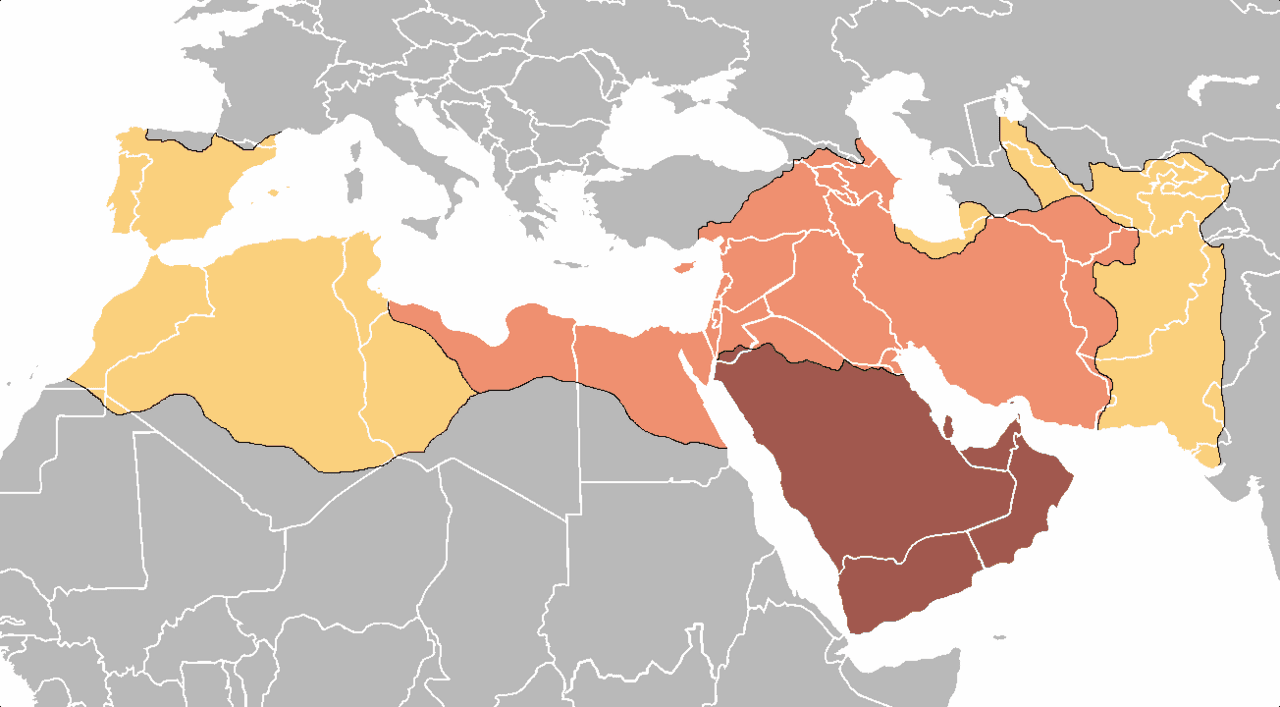
Arab expansion is due to the early Muslim conquests of the 7th and 8th centuries. Iraq was conquered in 633, Levant (modern Syria, Israel, Palestine, Jordan and Lebanon) was conquered between 636 and 640 CE. Egypt was conquered in 639, and gradually Arabized during the medieval period. A distinctively Egyptian Arabic language emerged by the 16th century. The Maghreb was also conquered in the 7th century, and gradually Arabized under the Fatimids.
Islam was brought to Sudan from Egypt during the 8th to 11th centuries. The culture of Sudan today depends on the tribe, some have a pure Nubian, Beja, or Arabic culture and some have a mixture of Arab and Nubian elements.
Ottoman and colonial rule
The Arab Abbasid Caliphate fell to the Mongol invasions in the 13th century. Egypt, the Levant and Hejaz also came under the Turkish Mamluk Sultanate.
By 1570, the Turkish Ottoman Empire controlled most of the Arab world. However, Morocco remained under the rule of the Zenata Wattasid dynasty, which was succeeded by the Saadi dynasty in the 16th to 17th centuries. The Ajuran Sultanate also held sway in the southern part of the Horn region.
The sentiment of Arab nationalism arose in the second half of the 19th century along with other nationalisms within the declining Ottoman Empire.
When the Ottoman Empire collapsed as a result of World War I, much of the Arab world came to be controlled by the European colonial empires: Mandatory Palestine, Mandatory Iraq, British protectorate of Egypt, French protectorate of Morocco, Italian Libya, French Tunisia, French Algeria, Mandate for Syria and the Lebanon and the so-called Trucial States, a British protectorate formed by the sheikhdoms on the former "Pirate Coast".
These Arab states only gained their independence during or after World War II: the Republic of Lebanon in 1943, the Syrian Arab Republic and the Hashemite Kingdom of Jordan in 1946, the Kingdom of Libya in 1951, the Kingdom of Egypt in 1952, the Kingdom of Morocco and Tunisia in 1956, the Republic of Iraq in 1958, the Somali Republic in 1960, Algeria in 1962, and the United Arab Emirates in 1971.
By contrast, Saudi Arabia had fragmented with the fall of the Ottoman Empire, and was unified under Ibn Saud of Saudi Arabia by 1932.
The Mutawakkilite Kingdom of Yemen also seceded directly from the Ottoman Empire in 1918. Oman, apart from brief intermittent Persian and Portuguese rule, has been self-governing since the 8th century.
Rise of Arab nationalism
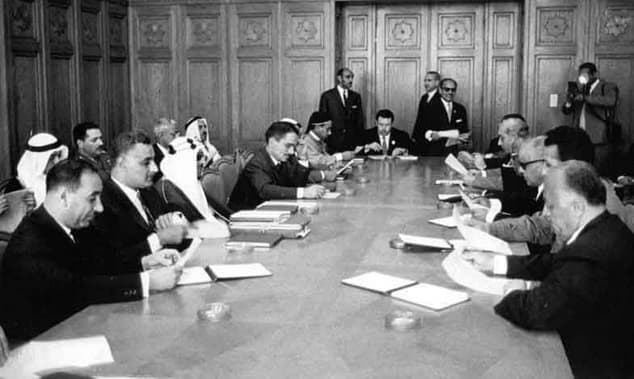
The Arab League was formed in 1945 to represent the interests of the Arabs, and especially to pursue the political unification of the Arab world, a project known as Pan-Arabism.
There were some short-lived attempts at such unification in the mid-20th century, notably the United Arab Republic of 1958 to 1961.
The Arab League's main goal is to unify politically the Arab populations so defined. Its permanent headquarters are located in Cairo. However, it was moved temporarily to Tunis during the 1980s, after Egypt was expelled for signing the Camp David Accords (1978).
Pan-Arabism has mostly been abandoned as an ideology since the 1980s, and was replaced by Pan-Islamism on one hand, and individual nationalisms on the other.
Modern conflicts
Unification of Saudi Arabia
The unification of Saudi Arabia was a 30-year-long military and political campaign, by which the various tribes, sheikhdoms, and emirates of most of the Arabian Peninsula were conquered by the House of Saud, or Al Saud, between 1902 and 1932, when the modern-day Kingdom of Saudi Arabia was proclaimed. Carried out under the charismatic Abdul Aziz Ibn Saud, this process created what is sometimes referred to as the Third Saudi State, to differentiate it from the first and second states that existed under the Al Saud clan.
The Al-Saud had been in exile in Ottoman Iraq since 1893 following the disintegration of the Second Saudi State and the rise of Jebel Shammar under the Al Rashid clan. In 1902, Ibn Saud recaptured Riyadh, the Al Saud dynasty's former capital. He went on to subdue the rest of Nejd, Al-Hasa, Jebel Shammar, Asir, and Hejaz (location of the Muslim holy cities of Mecca and Medina) between 1913 and 1926. The resultant polity was named the Kingdom of Nejd and Hejaz from 1927 until it was further consolidated with Al-Hasa and Qatif into the Kingdom of Saudi Arabia in 1932.
Arab–Israeli conflict
The establishment of the State of Israel in 1948 has given rise to the Arab–Israeli conflict, one of the major unresolved geopolitical conflicts.
The Arab states in changing alliances were involved in a number of wars with Israel and its western allies between 1948 and 1973, including the 1948 Arab–Israeli War, the 1956 Suez Crisis, the Six-Day War of 1967, and the Yom Kippur War of 1973.
An Egypt–Israel peace treaty was signed in 1979.
Iran–Iraq War
The Iran–Iraq War (also known as the First Gulf War and by various other names) was an armed conflict between the armed forces of Iraq and Iran, lasting from September 1980 to August 1988, making it the second longest conventional war of the 20th century. It was initially referred to in English as the "Gulf War" prior to the "Gulf War" of 1990.
The war began when Iraq invaded Iran, launching a simultaneous invasion by air and land into Iranian territory on 22 September 1980 following a long history of border disputes, and fears of Shia Islam insurgency among Iraq's long-suppressed Shia majority influenced by the Iranian Revolution. Iraq was also aiming to replace Iran as the dominant Persian Gulf state. Although Iraq hoped to take advantage of the revolutionary chaos in Iran (see Iranian Revolution, 1979) and attacked without formal warning, they made only limited progress into Iran and were quickly repelled by the Iranians who regained virtually all lost territory by June 1982. For the next six years, Iran was on the offensive.
Lebanese Civil War
The Lebanese Civil War was a multifaceted civil war in Lebanon, lasting from 1975 to 1990 and resulting in an estimated 120,000 fatalities. Another one million people (a quarter of the population) were wounded, and today approximately 76,000 people remain displaced within Lebanon. There was also a mass exodus of almost one million people from Lebanon.
Western Sahara conflict
The Western Sahara War was an armed struggle between the Sahrawi Polisario Front and Morocco between 1975 and 1991, being the most significant phase of the Western Sahara conflict. The conflict erupted after the withdrawal of Spain from the Spanish Sahara in accordance with the Madrid Accords, by which it transferred administrative control of the territory to Morocco and Mauritania, but not the sovereignty. In 1975, Moroccan government organized the Green March of some 350,000 Moroccan citizens, escorted by around 20,000 troops, who entered Western Sahara, trying to establish Moroccan presence.
While at first met with just minor resistance by the Polisario, Morocco later engaged a long period of guerilla warfare with the Sahrawi nationalists. During the late 1970s, the Polisario Front, desiring to establish an independent state in the territory, successively fought both Mauritania and Morocco. In 1979, Mauritania withdrew from the conflict after signing a peace treaty with the Polisario. The war continued in low intensity throughout the 1980s, though Morocco made several attempts to take the upper hand in 1989–1991. A cease-fire agreement was finally reached between the Polisario Front and Morocco in September 1991.
North Yemen Civil War
The North Yemen Civil War was fought in North Yemen between royalists of the Mutawakkilite Kingdom of Yemen and factions of the Yemen Arab Republic from 1962 to 1970. The war began with a coup d'état carried out by the republican leader, Abdullah as-Sallal, which dethroned the newly crowned Imam al-Badr and declared Yemen a republic under his presidency. The Imam escaped to the Saudi Arabian border and rallied popular support.
