
The Apollo program, also known as Project Apollo, was the United States human spaceflight program led by NASA, which landed the first humans on the Moon in 1969. Apollo was conceived in 1960 in the Dwight D. Eisenhower presidency during Project Mercury and executed after Project Gemini. Apollo was later dedicated to President John F. Kennedy's national goal, "before this decade is out, of landing a man on the Moon and returning him safely to the Earth" in his address to the U.S. Congress on May 25, 1961.
Kennedy's goal was accomplished on the Apollo 11 mission, when astronauts Neil Armstrong and Buzz Aldrin landed their Apollo Lunar Module (LM) on July 20, 1969, and walked on the lunar surface, while Michael Collins remained in lunar orbit in the command and service module (CSM), and all three landed safely on Earth in the Pacific Ocean on July 24. Approximately 650 million people worldwide watched this first landing on television. Five subsequent Apollo missions also landed astronauts on the Moon, the last, Apollo 17, in December 1972. In these six spaceflights, twelve people walked on the Moon.
Apollo ran from 1961 to 1972, with the first crewed flight in 1968. It encountered a major setback in 1967 when the Apollo 1 cabin fire killed the entire crew during a prelaunch test. After the first Moon landing, sufficient flight hardware remained for nine follow-on landings with a plan for extended lunar geological and astrophysical exploration. Budget cuts forced the cancellation of three of these. Five of the remaining six missions achieved landings; but the Apollo 13 landing had to be aborted after an oxygen tank exploded en route to the Moon, crippling the CSM. The crew barely managed a safe return to Earth by using the Lunar Module as a "lifeboat" on the return journey.

Apollo used the Saturn family of rockets as launch vehicles, which were also used for an Apollo Applications Program, which consisted of Skylab, a space station that supported three crewed missions in 1973–1974, and the Apollo–Soyuz Test Project, a joint United States-Soviet Union low Earth orbit mission in 1975.
Apollo set several major human spaceflight milestones. It stands alone in sending humans to the lunar surface. Apollo 8 was the first crewed mission to leave low Earth orbit and to orbit another celestial body, and Apollo 11 was the first crewed mission to land humans on one.
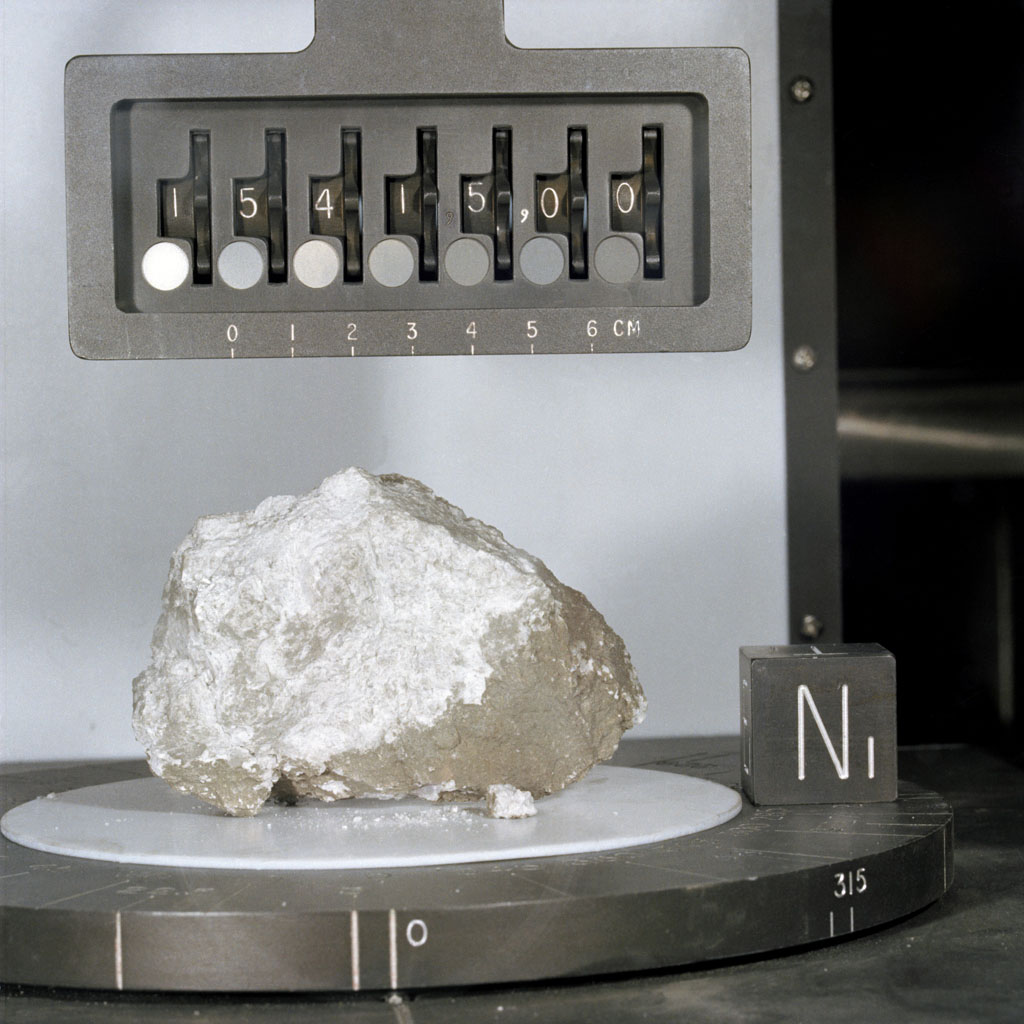
Overall, the Apollo program returned 842 pounds (382 kg) of lunar rocks to Earth, greatly contributing to the understanding of the Moon's composition and geological history. The program laid the foundation for NASA's subsequent human spaceflight capability and funded construction of its Johnson Space Center and Kennedy Space Center. Apollo also spurred advances in many areas of technology incidental to rocketry and human spaceflight, including avionics, telecommunications, and computers.
The only other time humans have left low Earth orbit has been the Artemis II flyby of the Moon in 2026, as part of the Artemis program, established as a successor to Apollo in 2017. Artemis intends to return humans to the Moon's surface no earlier than 2028.
Name
The program was named after the Greek god Apollo by NASA manager Abe Silverstein, who later said, "I was naming the spacecraft like I'd name my baby." Silverstein chose the name at home one evening, early in 1960, because he felt "Apollo riding his chariot across the Sun was appropriate to the grand scale of the proposed program".
The context of this was that the program focused at its beginning mainly on developing an advanced crewed spacecraft, the Apollo command and service module, succeeding the Mercury program. A lunar landing became the focus of the program only in 1961. Thereafter Project Gemini instead followed the Mercury program to test and study advanced crewed spaceflight technology.

Background
Origin and spacecraft feasibility studies
The Apollo program was conceived during the Eisenhower administration in early 1960, as a follow-up to Project Mercury. While the Mercury capsule could support only one astronaut on a limited Earth orbital mission, Apollo would carry three. Possible missions included ferrying crews to a space station, circumlunar flights, and eventual crewed lunar landings.
In July 1960, NASA Deputy Administrator Hugh L. Dryden announced the Apollo program to industry representatives at a series of Space Task Group conferences. Preliminary specifications were laid out for a spacecraft with a mission module cabin separate from the command module (piloting and reentry cabin), and a propulsion and equipment module. On August 30, a feasibility study competition was announced, and on October 25, three study contracts were awarded to General Dynamics/Convair, General Electric, and the Glenn L. Martin Company. Meanwhile, NASA performed its own in-house spacecraft design studies led by Maxime Faget, to serve as a gauge to judge and monitor the three industry designs.
Political pressure builds
In November 1960, John F. Kennedy was elected president after a campaign that promised American superiority over the Soviet Union in the fields of space exploration and missile defense. Up to the election of 1960, Kennedy had been speaking out against the "missile gap" that he and many other senators said had developed between the Soviet Union and the United States due to the inaction of President Eisenhower. Beyond military power, Kennedy used aerospace technology as a symbol of national prestige, pledging to make the US not "first but, first and, first if, but first period".

Despite Kennedy's rhetoric, he did not immediately come to a decision on the status of the Apollo program once he became president. He knew little about the technical details of the space program, and was put off by the massive financial commitment required by a crewed Moon landing. When Kennedy's newly appointed NASA Administrator James E. Webb requested a 30 percent budget increase for his agency, Kennedy supported an acceleration of NASA's large booster program but deferred a decision on the broader issue.
On April 12, 1961, Soviet cosmonaut Yuri Gagarin became the first person to fly in space, reinforcing American fears about being left behind in a technological competition with the Soviet Union. At a meeting of the US House Committee on Science and Astronautics one day after Gagarin's flight, many congressmen pledged their support for a crash program aimed at ensuring that America would catch up. Kennedy was circumspect in his response to the news, refusing to make a commitment on America's response to the Soviets.
On April 20, Kennedy sent a memo to Vice President Lyndon B. Johnson, asking Johnson to look into the status of America's space program, and into programs that could offer NASA the opportunity to catch up. Johnson responded approximately one week later, concluding that "we are neither making maximum effort nor achieving results necessary if this country is to reach a position of leadership." His memo concluded that a crewed Moon landing was far enough in the future that it was likely the United States would achieve it first.

On May 25, 1961, twenty days after the first American crewed spaceflight Freedom 7, Kennedy proposed the crewed Moon landing in a Special Message to the Congress on Urgent National Needs:
Now it is time to take longer strides—time for a great new American enterprise—time for this nation to take a clearly leading role in space achievement, which in many ways may hold the key to our future on Earth.
... I believe that this nation should commit itself to achieving the goal, before this decade is out, of landing a man on the Moon and returning him safely to the Earth. No single space project in this period will be more impressive to mankind, or more important in the long-range exploration of space; and none will be so difficult or expensive to accomplish.

NASA expansion
At the time of Kennedy's proposal, only one American had flown in space—less than a month earlier—and NASA had not yet sent an astronaut into orbit. Even some NASA employees doubted whether Kennedy's ambitious goal could be met. By 1963, Kennedy even came close to agreeing to a joint US-USSR Moon mission, to eliminate duplication of effort.
With the clear goal of a crewed landing replacing the more nebulous goals of space stations and circumlunar flights, NASA decided that, in order to make progress quickly, it would discard the feasibility study designs of Convair, GE, and Martin, and proceed with Faget's command and service module design. The mission module was determined to be useful only as an extra room, and therefore unnecessary. They used Faget's design as the specification for another competition for spacecraft procurement bids in October 1961. On November 28, 1961, North American Aviation won the contract, although its bid was not rated as good as the Martin proposal. Webb, Dryden and Robert Seamans chose it in preference due to North American's longer association with NASA and its predecessor.
Landing humans on the Moon by the end of 1969 required the most sudden burst of technological creativity, and the largest commitment of resources ($25 billion; $187 billion in 2024 US dollars) ever made by any nation in peacetime. At its peak, the Apollo program employed 400,000 people and required the support of over 20,000 industrial firms and universities.
On July 1, 1960, NASA established the Marshall Space Flight Center (MSFC) in Huntsville, Alabama. MSFC designed the heavy lift-class Saturn launch vehicles, which would be required for Apollo.
Manned Spacecraft Center
It became clear that managing the Apollo program would exceed the capabilities of Robert R. Gilruth's Space Task Group, which had been directing the nation's crewed space program from NASA's Langley Research Center. So Gilruth was given authority to grow his organization into a new NASA center, the Manned Spacecraft Center (MSC). A site was chosen in Houston, Texas, on land donated by Rice University, and Administrator Webb announced the conversion on September 19, 1961. It was also clear NASA would soon outgrow its practice of controlling missions from its Cape Canaveral Air Force Station launch facilities in Florida, so a new Mission Control Center would be included in the MSC.
In September 1962, by which time two Project Mercury astronauts had orbited the Earth, Gilruth had moved his organization to rented space in Houston, and construction of the MSC facility was under way, Kennedy visited Rice to reiterate his challenge in a famous speech:
But why, some say, the Moon? Why choose this as our goal? And they may well ask, why climb the highest mountain? Why, 35 years ago, fly the Atlantic? ...
We choose to go to the Moon. We choose to go to the Moon in this decade and do the other things, not because they are easy, but because they are hard; because that goal will serve to organize and measure the best of our energies and skills; because that challenge is one that we are willing to accept, one we are unwilling to postpone, and one we intend to win ...
The MSC was completed in September 1963. It was renamed by the United States Congress in honor of Lyndon B. Johnson soon after his death in 1973.
Launch Operations Center
It also became clear that Apollo would outgrow the Canaveral launch facilities in Florida. The two newest launch complexes were already being built for the Saturn I and IB rockets at the northernmost end: LC-34 and LC-37. An even bigger facility was needed for the mammoth rocket required for the crewed lunar mission, so land acquisition was started in July 1961 for a Launch Operations Center (LOC) immediately north of Canaveral at Merritt Island.
The design, development and construction of the center was conducted by Kurt H. Debus, a member of Wernher von Braun's original V-2 rocket engineering team. Debus was named the LOC's first Director. Construction began in November 1962. Following Kennedy's death, President Johnson issued an executive order on November 29, 1963, to rename the LOC and Cape Canaveral in honor of Kennedy.
The LOC included Launch Complex 39, a Launch Control Center, and a 130-million-cubic-foot (3,700,000 m3) Vertical Assembly Building (VAB) in which the space vehicle (launch vehicle and spacecraft) would be assembled on a mobile launcher platform and then moved by a crawler-transporter to one of several launch pads. Although at least three pads were planned, only two, designated A and B, were completed in October 1965. The LOC also included an Operations and Checkout Building (OCB) to which Gemini and Apollo spacecraft were initially received prior to being mated to their launch vehicles. The Apollo spacecraft could be tested in two vacuum chambers capable of simulating atmospheric pressure at altitudes up to 250,000 feet (76 km), which is nearly a vacuum.
Organization
Administrator Webb realized that in order to keep Apollo costs under control, he had to develop greater project management skills in his organization, so he recruited George E. Mueller for a high management job. Mueller accepted, on the condition that he have a say in NASA reorganization necessary to effectively administer Apollo. Webb then worked with Associate Administrator (later Deputy Administrator) Seamans to reorganize the Office of Manned Space Flight (OMSF). On July 23, 1963, Webb announced Mueller's appointment as Deputy Associate Administrator for Manned Space Flight, to replace then Associate Administrator D. Brainerd Holmes on his retirement effective September 1. Under Webb's reorganization, the directors of the Manned Spacecraft Center (Gilruth), Marshall Space Flight Center (von Braun), and the Launch Operations Center (Debus) reported to Mueller.
Based on his industry experience on Air Force missile projects, Mueller realized some skilled managers could be found among high-ranking officers in the U.S. Air Force, so he got Webb's permission to recruit General Samuel C. Phillips, who gained a reputation for his effective management of the Minuteman program, as OMSF program controller. Phillips's superior officer Bernard A. Schriever agreed to loan Phillips to NASA, along with a staff of officers under him, on the condition that Phillips be made Apollo Program Director. Mueller agreed, and Phillips managed Apollo from January 1964, until it achieved the first human landing in July 1969, after which he returned to Air Force duty.
Charles Fishman, in One Giant Leap, estimated the number of people and organizations involved into the Apollo program as "410,000 men and women at some 20,000 different companies contributed to the effort".
Choosing a mission mode
Once Kennedy had defined a goal, the Apollo mission planners were faced with the challenge of designing a spacecraft that could meet it while minimizing risk to human life, limiting cost, and not exceeding limits in possible technology and astronaut skill. Four possible mission modes were considered:
Direct Ascent: The spacecraft would be launched as a unit and travel directly to the lunar surface, without first going into lunar orbit. A 50,000-pound (23,000 kg) Earth return ship would land all three astronauts atop a 113,000-pound (51,000 kg) descent propulsion stage, which would be left on the Moon. This design would have required development of the extremely powerful Saturn C-8 or Nova launch vehicle to carry a 163,000-pound (74,000 kg) payload to the Moon.
Earth Orbit Rendezvous (EOR): Multiple rocket launches (up to 15 in some plans) would carry parts of the Direct Ascent spacecraft and propulsion units for translunar injection (TLI). These would be assembled into a single spacecraft in Earth orbit.
Lunar Surface Rendezvous: Two spacecraft would be launched in succession. The first, an automated vehicle carrying propellant for the return to Earth, would land on the Moon, to be followed some time later by the crewed vehicle. Propellant would have to be transferred from the automated vehicle to the crewed vehicle.
Lunar Orbit Rendezvous (LOR): This turned out to be the winning configuration, which achieved the goal with Apollo 11 on July 20, 1969: a single Saturn V launched a 96,886-pound (43,947 kg) spacecraft that was composed of a 63,608-pound (28,852 kg) Apollo command and service module which remained in orbit around the Moon and a 33,278-pound (15,095 kg) two-stage Apollo Lunar Module spacecraft which was flown by two astronauts to the surface. Its ascent stage was flown back to dock with the command module and was then discarded. Landing the smaller spacecraft on the Moon, and returning an even smaller part (10,042 pounds or 4,555 kilograms) to lunar orbit, minimized the total mass to be launched from Earth, but this was the last method initially considered because of the perceived risk of rendezvous and docking.
In early 1961, direct ascent was generally the mission mode in favor at NASA. Many engineers feared that rendezvous and docking, maneuvers that had not been attempted in Earth orbit, would be nearly impossible in lunar orbit. LOR advocates—including Tom Dolan at Vought and John Houbolt at Langley Research Center—emphasized the important weight reductions that were offered by the LOR approach. Throughout 1960 and 1961, Houbolt campaigned for the recognition of LOR as a viable and practical option. Bypassing the NASA hierarchy, he sent a series of memos and reports on the issue to Associate Administrator Robert Seamans; while acknowledging that he spoke "somewhat as a voice in the wilderness", Houbolt pleaded that LOR should not be discounted in studies of the question.
Seamans's establishment of an ad hoc committee headed by his special technical assistant Nicholas E. Golovin in July 1961, to recommend a launch vehicle to be used in the Apollo program, represented a turning point in NASA's mission mode decision. This committee recognized that the chosen mode was an important part of the launch vehicle choice, and recommended in favor of a hybrid EOR-LOR mode. Its consideration of LOR—as well as Houbolt's ceaseless work—played an important role in publicizing the workability of the approach.
In late 1961 and early 1962, members of the Manned Spacecraft Center began to come around to support LOR, including the newly hired deputy director of the Office of Manned Space Flight, Joseph Shea, who became a champion of LOR. The engineers at Marshall Space Flight Center (MSFC), who were heavily invested in direct ascent, took longer to become convinced of its merits, but their conversion was announced by Wernher von Braun at a briefing on June 7, 1962.
Even after NASA reached internal agreement, it was far from smooth sailing. Kennedy's science advisor Jerome Wiesner, who had expressed his opposition to human spaceflight to Kennedy before the President took office, and had opposed the decision to land people on the Moon, hired Golovin, who had left NASA, to chair his own "Space Vehicle Panel", ostensibly to monitor, but actually to second-guess NASA's decisions on the Saturn V launch vehicle and LOR by forcing Shea, Seamans, and even Webb to defend themselves, delaying its formal announcement to the press on July 11, 1962, and forcing Webb to still hedge the decision as "tentative".
Wiesner kept up the pressure, even making the disagreement public during a two-day September visit by the President to Marshall Space Flight Center. Wiesner blurted out "No, that's no good" in front of the press, during a presentation by von Braun. Webb jumped in and defended von Braun, until Kennedy ended the squabble by stating that the matter was "still subject to final review". Webb held firm and issued a request for proposal to candidate Lunar Excursion Module (LEM) contractors. Wiesner finally relented, unwilling to settle the dispute once and for all in Kennedy's office, because of the President's involvement with the October Cuban Missile Crisis, and fear of Kennedy's support for Webb. NASA announced the selection of Grumman as the LEM contractor in November 1962.
Space historian James Hansen concludes that:
Without NASA's adoption of this stubbornly held minority opinion in 1962, the United States may still have reached the Moon, but almost certainly it would not have been accomplished by the end of the 1960s, President Kennedy's target date.
The LOR method had the advantage of allowing the lander spacecraft to be used as a "lifeboat" in the event of a failure of the command ship. Some documents prove this theory was discussed before and after the method was chosen. In 1964 an MSC study concluded, "The LM [as lifeboat] ... was finally dropped, because no single reasonable CSM failure could be identified that would prohibit use of the SPS." That type of failure happened on Apollo 13 when an oxygen tank explosion left the CSM without electrical power. The lunar module provided propulsion, electrical power and life support to get the crew home safely.
Spacecraft
Faget's preliminary Apollo design employed a cone-shaped command module, supported by one of several service modules providing propulsion and electrical power, sized appropriately for the space station, cislunar, and lunar landing missions. Once Kennedy's Moon landing goal became official, detailed design began of a command and service module (CSM) in which the crew would spend the entire direct-ascent mission and lift off from the lunar surface for the return trip, after being soft-landed by a larger landing propulsion module. The final choice of lunar orbit rendezvous changed the CSM's role to the translunar ferry used to transport the crew, along with a new spacecraft, the Lunar Excursion Module (LEM, later shortened to LM (Lunar Module) but still pronounced ) which would take two individuals to the lunar surface and return them to the CSM.
Command and service module
The command module (CM) was the conical crew cabin, designed to carry three astronauts from launch to lunar orbit and back to an Earth ocean landing. It was the only component of the Apollo spacecraft to survive without major configuration changes as the program evolved from the early Apollo study designs. Its exterior was covered with an ablative heat shield, and had its own reaction control system (RCS) engines to control its attitude and steer its atmospheric entry path. Parachutes were carried to slow its descent to splashdown. The module was 11.42 feet (3.48 m) tall, 12.83 feet (3.91 m) in diameter, and weighed approximately 12,250 pounds (5,560 kg).
A cylindrical service module (SM) supported the command module, with a service propulsion engine and an RCS with propellants, and a fuel cell power generation system with liquid hydrogen and liquid oxygen reactants. A high-gain S-band antenna was used for long-distance communications on the lunar flights. On the extended lunar missions, an orbital scientific instrument package was carried. The service module was discarded just before reentry. The module was 24.6 feet (7.5 m) long and 12.83 feet (3.91 m) in diameter. The initial lunar flight version weighed approximately 51,300 pounds (23,300 kg) fully fueled, while a later version designed to carry a lunar orbit scientific instrument package weighed just over 54,000 pounds (24,000 kg).