
Apollo 11 (July 16–24, 1969) was the American spaceflight that first landed humans on the Moon, and the fifth crewed mission of NASA's Apollo program. The mission was crewed by Commander Neil Armstrong, Command Module Pilot Michael Collins, and Lunar Module Pilot Edwin "Buzz" Aldrin, all of whom were on their second and final spaceflight.
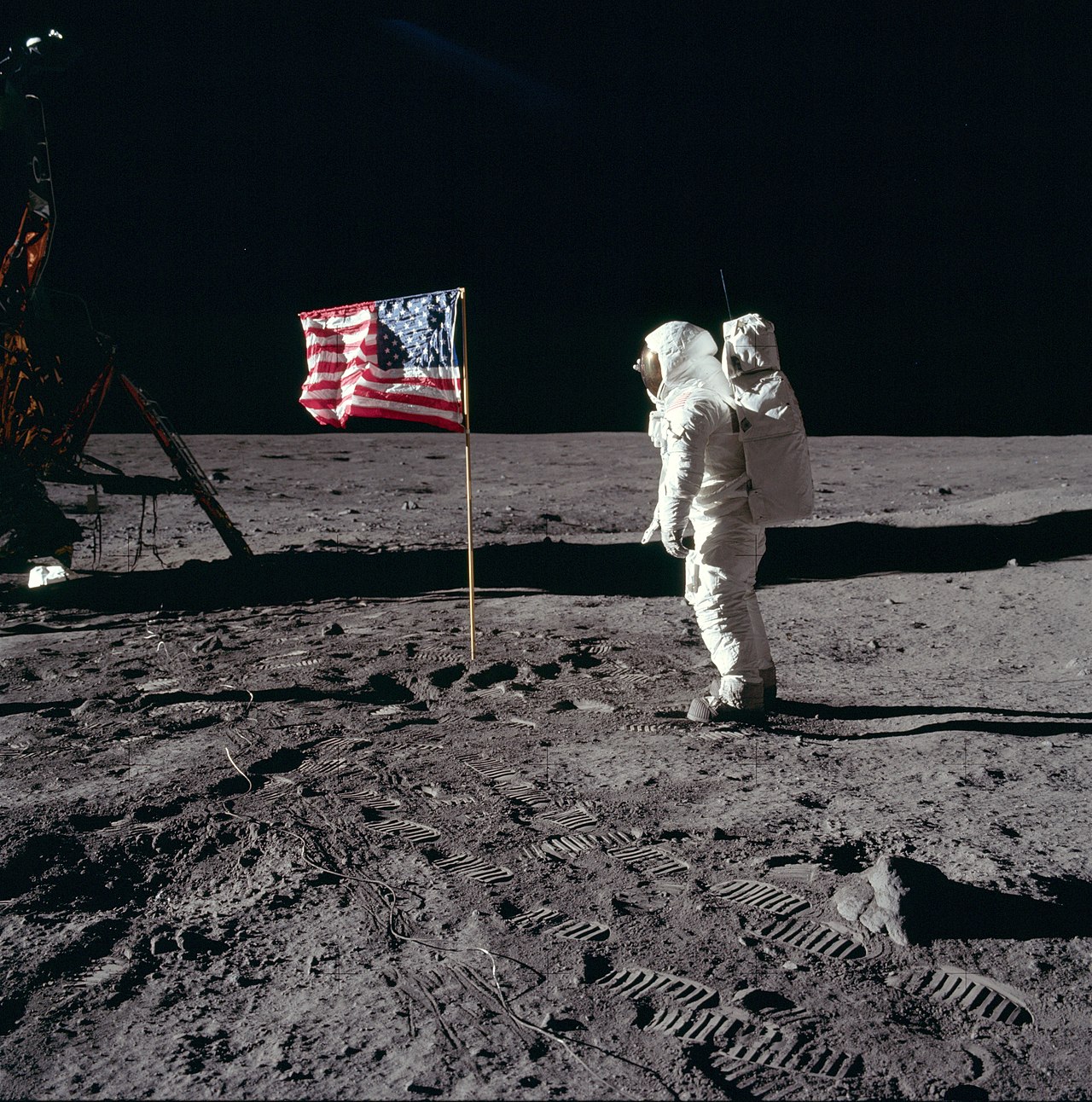
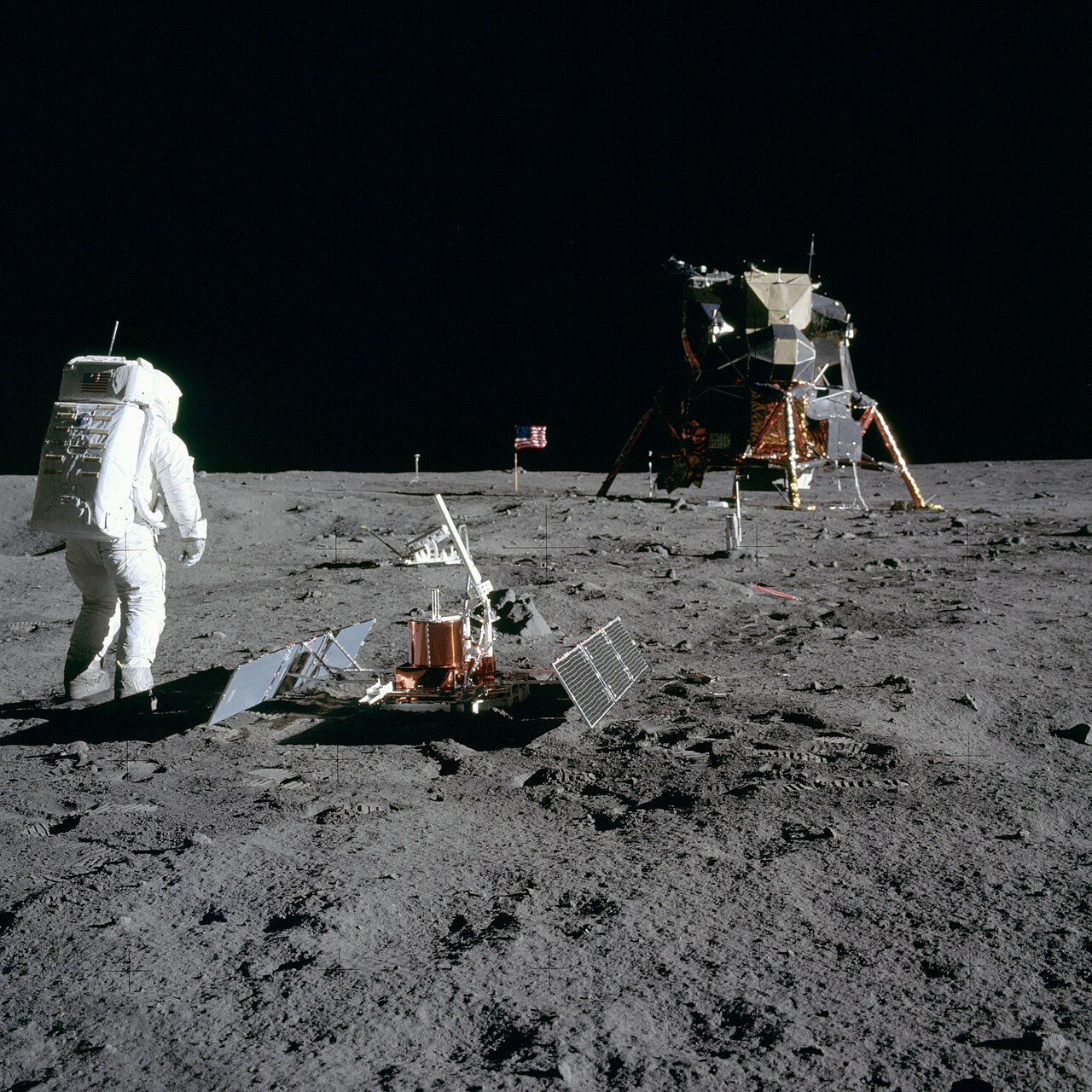
Launched atop a Saturn V rocket from Kennedy Space Center in Florida on July 16 at 13:32 UTC, the Apollo spacecraft consisted of three parts: the command module (CM), which housed the three astronauts and was the only part to return to Earth; the service module (SM), which provided propulsion, electrical power, oxygen, and water to the command module; and the Lunar Module (LM), which had two stages—a descent stage with a large engine and fuel tanks for landing on the Moon, and a lighter ascent stage containing a cabin for two astronauts and a small engine to return them to lunar orbit. After a three-day transit, Armstrong and Aldrin descended to the surface aboard the LM Eagle, landing in the Sea of Tranquility (Mare Tranquillitatis) on July 20 at 20:17 UTC while Collins remained in lunar orbit aboard the CM Columbia. Armstrong became the first human to walk on the Moon approximately six hours after landing, followed by Aldrin nineteen minutes later. Together they spent around two and a half hours walking on the surface, planting an American flag, speaking by telephone with President Richard Nixon, deploying scientific instruments, and collecting 21.5 kg (47.5 lb) of lunar material. After more than 21 hours on the surface, they rejoined Collins in lunar orbit, and the crew returned safely to Earth on July 24, splashing down in the Pacific Ocean.
Apollo 11 was the culmination of the Space Race, a geopolitical competition between the United States and the Soviet Union rooted in Cold War rivalry. It fulfilled a national goal set by President John F. Kennedy in May 1961, who had challenged the United States to land a man on the Moon and return him safely before the end of the decade. The program overcame a severe setback with the fatal Apollo 1 launchpad fire in January 1967 and drew on technologies developed through the preceding Mercury and Gemini programs. The Soviet Union, despite early leads in spaceflight, was unable to match the Saturn V rocket, and its uncrewed lunar probe Luna 15 crashed on the Moon on July 21, while Neil Armstrong and Buzz Aldrin were still on the lunar surface.

Armstrong's moonwalk was broadcast live to an estimated 600 million viewers, roughly one-fifth of the world's population, making it among the most-watched television events in history. Stepping onto the lunar surface, Armstrong declared: "That's one small step for [a] man, one giant leap for mankind." Lunar samples returned by the mission led to the identification of three previously unrecognized minerals, and scientific instruments deployed on the surface continued returning data for years afterwards. The crew were honoured with ticker-tape parades, a world goodwill tour, and the Presidential Medal of Freedom. The command module Columbia is preserved at the National Air and Space Museum in Washington, D.C., while the descent stage of Eagle remains on the lunar surface.
Background
In the late 1950s and early 1960s, the United States was engaged in the Cold War, a geopolitical rivalry with the Soviet Union. On October 4, 1957, the Soviet Union launched Sputnik 1, the first artificial satellite, surprising the world and fueling fears about Soviet technological and military capabilities. Its success demonstrated that the USSR could potentially deliver nuclear weapons over intercontinental distances, challenging American claims of military, economic, and technological superiority.
This incident sparked the Sputnik crisis and ignited the Space Race, as both superpowers sought to demonstrate superiority in spaceflight. President Dwight D. Eisenhower responded to the challenge posed by Sputnik by creating the National Aeronautics and Space Administration (NASA), and initiating Project Mercury, which aimed to place a man into Earth orbit. The Soviets took the lead on April 12, 1961, when cosmonaut Yuri Gagarin became the first person in space and the first to orbit the Earth. Nearly a month later, on May 5, 1961, Alan Shepard became the first American in space; his 15-minute flight was suborbital, not a full orbit.
Because the Soviet Union had launch vehicles with higher lift capacity, President John F. Kennedy, Eisenhower's successor, chose a challenge that exceeded the capabilities of the existing generation of rockets, so that both countries would be starting from an equal position. A crewed mission to the Moon would serve this purpose.
On May 25, 1961, Kennedy addressed the United States Congress on "Urgent National Needs" and declared:
I believe that this nation should commit itself to achieving the goal, before this decade [1960s] is out, of landing a man on the Moon and returning him safely to the Earth. No single space project in this period will be more impressive to mankind, or more important for the long-range exploration of space; and none will be so difficult or expensive to accomplish. We propose to accelerate the development of the appropriate lunar space craft. We propose to develop alternate liquid and solid fuel boosters, much larger than any now being developed, until certain which is superior. We propose additional funds for other engine development and for unmanned explorations—explorations which are particularly important for one purpose which this nation will never overlook: the survival of the man who first makes this daring flight. But in a very real sense, it will not be one man going to the Moon—if we make this judgment affirmatively, it will be an entire nation. For all of us must work to put him there.

On September 12, 1962, Kennedy delivered another speech before a crowd of about 40,000 people in the Rice University football stadium in Houston, Texas. A widely quoted refrain from the middle portion of the speech reads as follows:
There is no strife, no prejudice, no national conflict in outer space as yet. Its hazards are hostile to us all. Its conquest deserves the best of all mankind, and its opportunity for peaceful cooperation may never come again. But why, some say, the Moon? Why choose this as our goal? And they may well ask, why climb the highest mountain? Why, 35 years ago, fly the Atlantic? Why does Rice play Texas?
We choose to go to the Moon! We choose to go to the Moon ... We choose to go to the Moon in this decade and do the other things, not because they are easy, but because they are hard; because that goal will serve to organize and measure the best of our energies and skills, because that challenge is one that we are willing to accept, one we are unwilling to postpone, and one we intend to win, and the others, too.
In spite of that, the proposed program faced widespread opposition and was dubbed a "moondoggle" by Norbert Wiener, a mathematician at the Massachusetts Institute of Technology. The effort to land a man on the Moon already had a name: Project Apollo. When Kennedy met with Nikita Khrushchev, the Premier of the Soviet Union in June 1961, he proposed making the Moon landing a joint project, but Khrushchev declined the offer. Kennedy again proposed a joint expedition to the Moon in a speech to the United Nations General Assembly on September 20, 1963. The idea of a joint Moon mission was ultimately abandoned after Kennedy's death.
An early and crucial decision was choosing lunar orbit rendezvous over both direct ascent and Earth orbit rendezvous. A space rendezvous is an orbital maneuver in which two spacecraft navigate through space and meet up. In July 1962, NASA head James Webb announced that lunar orbit rendezvous would be used and that the Apollo spacecraft would have three major parts: a command module (CM) with a cabin for the three astronauts, and the only part that returned to Earth; a service module (SM), which supported the command module with propulsion, electrical power, oxygen, and water; and a lunar module (LM) that had two stages—a descent stage for landing on the Moon, and an ascent stage to place the astronauts back into lunar orbit. This design meant the spacecraft could be launched by a single Saturn V rocket that was then under development.
Technologies and techniques required for Apollo were developed by Project Gemini. The Apollo project was enabled by NASA's adoption of new advances in semiconductor device, including metal–oxide–semiconductor field-effect transistors (MOSFETs) in the Interplanetary Monitoring Platform (IMP) and silicon integrated circuit (IC) chips in the Apollo Guidance Computer (AGC).

Project Apollo was abruptly halted by the Apollo 1 fire on January 27, 1967, in which astronauts Gus Grissom, Ed White, and Roger B. Chaffee died, and the subsequent investigation. In October 1968, Apollo 7 evaluated the command module in Earth orbit, and in December Apollo 8 tested it in lunar orbit. In March 1969, Apollo 9 put the lunar module through its paces in Earth orbit, and in May Apollo 10 conducted a "dress rehearsal" in lunar orbit. By July 1969, all was in readiness for Apollo 11 to take the final step onto the Moon.
The Soviet Union appeared to be winning the Space Race, but its early lead was overtaken by the US Gemini program and Soviet failure to develop the N1 launcher, which would have been comparable to the Saturn V. Seeing these failures, the Soviets then attempted to beat the US to return lunar material to the Earth by means of uncrewed probes. On July 13, three days before Apollo 11's launch, the Soviet Union launched Luna 15, which reached lunar orbit before Apollo 11. During descent, a malfunction caused Luna 15 to crash in Mare Crisium about two hours before Armstrong and Aldrin took off from the Moon's surface to return to earth. The Nuffield Radio Astronomy Laboratories radio telescope in England recorded transmissions from Luna 15 during its descent, and these were released in July 2009 for the 40th anniversary of Apollo 11.
Personnel
Prime crew
The initial crew assignment of Commander Neil Armstrong, Command Module Pilot (CMP) Jim Lovell, and Lunar Module Pilot (LMP) Buzz Aldrin on the backup crew for Apollo 9 was officially announced on November 20, 1967. Lovell and Aldrin had previously flown together as the crew of Gemini 12. Due to design and manufacturing delays in the LM, Apollo 8 and Apollo 9 swapped prime and backup crews, and Armstrong's crew became the backup for Apollo 8. Based on the normal crew rotation scheme, Armstrong was then expected to command Apollo 11.

There would be one change. Michael Collins, the CMP on the Apollo 8 crew, began experiencing trouble with his legs. Doctors diagnosed a bony growth between his fifth and sixth vertebrae, requiring surgery. Lovell took his place on the Apollo 8 crew, and when Collins recovered he joined Armstrong's crew as CMP. In the meantime, Fred Haise filled in as backup LMP, and Aldrin as backup CMP for Apollo 8. Apollo 11 was the second American mission where all the crew members had prior spaceflight experience, the first being Apollo 10. The next was STS-26 in 1988.
Deke Slayton gave Armstrong the option to replace Aldrin with Lovell, since some thought Aldrin was difficult to work with. Armstrong had no issues working with Aldrin but thought it over for a day before declining. He thought Lovell deserved to command his own mission (eventually Apollo 13).
The Apollo 11 prime crew had none of the close cheerful camaraderie characterized by that of Apollo 12. Instead, they forged an amiable working relationship. Armstrong in particular was notoriously aloof, but Collins, who considered himself a loner, confessed to rebuffing Aldrin's attempts to create a more personal relationship. Aldrin and Collins described the crew as "amiable strangers". Armstrong did not agree with the assessment, and said "all the crews I was on worked very well together."
Backup crew
The backup crew consisted of Lovell as Commander, William Anders as CMP, and Haise as LMP. Anders had flown with Lovell on Apollo 8. In early 1969, Anders accepted a job with the National Aeronautics and Space Council effective August 1969, and announced he would retire as an astronaut at that time. Ken Mattingly was moved from the support crew into parallel training with Anders as backup CMP in case Apollo 11 was delayed past its intended July launch date, at which point Anders would be unavailable.
Under the normal Apollo crew rotation, Lovell, Mattingly, and Haise would have been assigned to Apollo 14. However, because Alan Shepard had only recently returned to flight status and needed additional training, NASA reassigned his crew to Apollo 14 and moved Lovell's crew up to fly Apollo 13 instead. Shortly before launch, Mattingly was replaced by Jack Swigert due to concerns over possible measles exposure.
Support crew
During Projects Mercury and Gemini, each mission had a prime and a backup crew. For Apollo, NASA added a third group, the support crew. Their job was to maintain the flight plan, checklists, and mission rules, and to keep the prime and backup crews updated on any changes. They also developed procedures—especially for emergencies, so that by the time the prime and backup crews entered the simulators, they could focus on practicing and mastering them. The support crew for Apollo 11 was Mattingly, Ronald Evans, and Bill Pogue.
Capsule communicators
The capsule communicator (CAPCOM) was an astronaut stationed at the Mission Control Center in Houston, Texas, and was typically the only person permitted to communicate directly with the flight crew. This practice ensured that messages came from someone best able to understand the situation in the spacecraft and to relay guidance from flight controllers as clearly as possible. For Apollo 11, the CAPCOMs were backup and support crew members Anders, Evans, Haise, Lovell, and Mattingly, along with Charles Duke, Owen Garriott, Don L. Lind, Bruce McCandless II, and Harrison Schmitt.
Flight directors
The flight directors for this mission were:
Other key personnel
Other key personnel who played important roles in the Apollo 11 mission include the following.
Preparations
Insignia
The Apollo 11 mission emblem was designed by Collins, who wanted a symbol for "peaceful lunar landing by the United States". At Lovell's suggestion, he chose the bald eagle, the national bird of the United States, as the symbol. Tom Wilson, a simulator instructor, suggested an olive branch in its beak to represent their peaceful mission. Collins added a lunar background with the Earth in the distance. The sunlight in the image was coming from the wrong direction; the shadow should have been in the lower part of the Earth instead of the left.
Aldrin, Armstrong and Collins decided the Eagle and the Moon would be in their natural colors, and decided on a blue and gold border. Armstrong was concerned that "eleven" would not be understood by non-English speakers, so they went with "Apollo 11", and they decided not to put their names on the patch, so it would "be representative of everyone who had worked toward a lunar landing".
An illustrator at the Manned Spacecraft Center (MSC) did the artwork, which was then sent off to NASA officials for approval. The design was rejected. Bob Gilruth, the director of the MSC felt the talons of the eagle looked "too warlike". After some discussion, the olive branch was moved to the talons. When the Eisenhower dollar coin was released in 1971, the patch design provided the eagle for its reverse side. The design was also used for the smaller Susan B. Anthony dollar unveiled in 1979.
Call signs
After the crew of Apollo 10 named their spacecraft Charlie Brown and Snoopy, assistant manager for public affairs Julian Scheer wrote to George Low, the Manager of the Apollo Spacecraft Program Office at the MSC, to suggest the Apollo 11 crew be less flippant in naming their craft. The name Snowcone was used for the CM and Haystack was used for the LM in both internal and external communications during early mission planning.
The LM was named Eagle after the motif which was featured prominently on the mission insignia. At Scheer's suggestion, the CM was named Columbia after Columbiad, the giant cannon that launched a spacecraft (also from Florida) in Jules Verne's 1865 novel From the Earth to the Moon. It also referred to Columbia, a historical name of the United States. In Collins' 1976 book, he said Columbia was in reference to Christopher Columbus.
Mementos
The astronauts had personal preference kits (PPKs), small bags containing personal items of significance they wanted to take with them on the mission. Five 0.5-pound (0.23 kg) PPKs were carried on Apollo 11: three (one for each astronaut) were stowed on Columbia before launch, and two on Eagle.
Neil Armstrong's LM PPK contained a piece of wood from the Wright brothers' 1903 Wright Flyer's left propeller and a piece of fabric from its wing, along with a diamond-studded astronaut pin originally given to Slayton by the widows of the Apollo 1 crew. This pin had been intended to be flown on that mission and given to Slayton afterwards, but following the disastrous launch pad fire and subsequent funerals, the widows gave the pin to Slayton. Armstrong took it with him on Apollo 11.
Site selection
NASA's Apollo Site Selection Board announced five potential landing sites on February 8, 1968. These were the result of two years' worth of studies based on high-resolution photography of the lunar surface by the five uncrewed probes of the Lunar Orbiter program and information about surface conditions provided by the Surveyor program. The best Earth-bound telescopes could not resolve features with the resolution Project Apollo required. The landing site had to be close to the lunar equator to minimize the amount of propellant required, clear of obstacles to minimize maneuvering, and flat to simplify the task of the landing radar. Scientific value was not a consideration.
Areas that appeared promising on photographs taken on Earth were often found to be totally unacceptable. The original requirement that the site be free of craters had to be relaxed, as no such site was found. Five sites were considered: Sites 1 and 2 were in the Sea of Tranquility (Mare Tranquillitatis); Site 3 was in the Central Bay (Sinus Medii); and Sites 4 and 5 were in the Ocean of Storms (Oceanus Procellarum).
The final site selection was based on seven criteria:
The site needed to be smooth, with relatively few craters;
with approach paths free of large hills, tall cliffs or deep craters that might confuse the landing radar and cause it to issue incorrect readings;
reachable with a minimum amount of propellant;
allowing for delays in the launch countdown;
providing the Apollo spacecraft with a free-return trajectory, one that would allow it to coast around the Moon and safely return to Earth without requiring any engine firings should a problem arise on the way to the Moon;
with good visibility during the landing approach, meaning the Sun would be between 7 and 20 degrees behind the LM; and
a general slope of less than two degrees in the landing area.
The requirement for the Sun angle was particularly restrictive, limiting the launch date to one day per month. A landing just after dawn was chosen to limit the temperature extremes the astronauts would experience. The Apollo Site Selection Board selected Site 2, with Sites 3 and 5 as backups in the event of the launch being delayed. In May 1969, Apollo 10's lunar module flew to within 15 kilometers (9.3 mi) of Site 2, and reported it was acceptable.
First-step decision
During the first press conference after the Apollo 11 crew was announced, the first question was, "Which one of you gentlemen will be the first man to step onto the lunar surface?" Slayton told the reporter it had not been decided, and Armstrong added that it was "not based on individual desire".