Antioch College is a private liberal arts college in Yellow Springs, Ohio, United States. It was founded in 1850 by the Christian Connection and began operating in 1852 as a non-sectarian institution; politician and education reformer Horace Mann was its first president. The college is named after the ancient city of Antioch where the disciples of Jesus were first named as Christians.
The college has been politically liberal and reformist since its inception. It was the fourth college in the country to admit African-American students on an equal basis with whites. It has had a tumultuous financial and corporative history, closing repeatedly, for years at a time, until new funding was assembled.
Antioch College began opening new campuses in 1964 when it purchased the Putney School of Education in Vermont. Eventually, it opened 38 different campuses, and in 1978 it changed its name to Antioch University. While most of the university's campuses focused on adult education, graduate programs, and degree completion, Antioch College remained a traditional undergraduate institution on the original campus. In 2008, the university closed the college, but it reopened under new management in 2011 after a group of alumni formed the Antioch College Continuation Corporation and bought from the university both the physical campus and the right to use the name.

Antioch has a cooperative education work program mandatory for all students. It is a member of the Great Lakes Colleges Association, the Global Liberal Arts Alliance, and the Strategic Ohio Council for Higher Education. The college is affiliated with two Nobel Prize winners, José Ramos-Horta and Mario Capecchi.
History
Antioch College is on the site of a short-lived Owenite community, a utopian socialist collective agricultural enterprise that was established in July 1825 and terminated at the end of that year.
On October 5, 1850, the General Convention of the Christian Church passed a resolution stating "that our responsibility to the community, and the advancement of our interests as a denomination, demand of us the establishing of a College." The delegates further pledged "the sum of one hundred thousand dollars as the standard by which to measure our zeal and our effort in raising the means for establishing the contemplated College." The Committee on the Plan for a College was formed to undertake the founding of a college and make decisions regarding the name of the school, the endowment, fundraising, faculty, and administration. Most notably, the committee decided that the college "shall afford equal privileges to students of both sexes." The Christian Connection sect wanted the new college to be sectarian, but the planning committee decided otherwise.
Despite its enthusiasm, the Christian Connection's fundraising efforts were insufficient. The money raised before the school opened failed to cover the cost of the three original buildings, much less create an endowment. The Unitarian Church contributed an equal amount of funds and nearly as many students to the new school, causing denominational strife early on.
1850–1899
Horace Mann, Antioch's first president, ran the college from its start in 1853 until his death in 1859. The young college had relatively high academic standards, and "good moral character" was a requirement for graduation. The first curriculum focused on Latin, Greek, mathematics, history, philosophy, and science, and offered electives in art, botany, pedagogy, and modern languages. Tuition was $24 a year, and the first graduating class consisted of 28 students. Although the founders planned for approximately 1,000 students, enrollment exceeded 500 only once in the 19th century, in 1857.
One notable character in Antioch's history is Rebecca Pennell, Mann's niece, who was one of the college's ten original faculty members. She was the first female college professor in the United States to have the same rank and pay as her male colleagues. Her home, now part of the Antioch campus and called Pennell House, served in recent years as community space for several of Antioch's student-led independent groups.

In 1859, Mann gave his final commencement speech, including what became the college's motto: "Be ashamed to die until you have won some victory for humanity." Mann died in August and was interred on the Antioch College grounds. The next year, he was reinterred in Providence, Rhode Island, next to his first wife. Mann is commemorated by two monuments: an obelisk on campus that bears the college's motto and marks his original grave, and a bronze statue in the Glen Helen.
Noteworthy among historical figures at the college are Austin Craig and Lucretia Crocker. The Reverend Craig became the third president of Antioch College. Crocker taught mathematics and astronomy. As the first woman supervisor of the Boston Public Schools, Crocker pioneered the discovery method of teaching mathematics and the natural sciences during her decade-long tenure, which began with her appointment in 1876. Earlier, in 1873, she was among the first women elected to the Boston School Committee, and a strong advocate for higher education for women.
Racial and gender equity
The original founders gave no consideration to the question of whether Antioch should admit students of color, neither forbidding nor explicitly allowing it. The associated preparatory school admitted two African-American girls during the mid-1850s, an action one trustee responded to by resigning and removing his own children from the school. His opinion was apparently the minority one, as the black students were not withdrawn.

Financial difficulties
Antioch College was insolvent the day it opened and faced financial difficulties from its first years. From 1857 to 1859, Antioch ran an annual deficit of $5,000 out of a total budget of $13,000. In 1858, Antioch was bankrupt. Mann died in 1859, and the college was reorganized, but deficits continued. Mann's successor, Thomas Hill, took Antioch's presidency on the condition that faculty salaries be paid despite deficits. Despite this stipulation, his salary was often not paid, and he supported his family with loans. Hill and a colleague attempted to raise an endowment, but potential donors were put off by the strong sectarian leanings of some of the college's trustees. Hill resigned in 1862 due to increasing financial troubles, sectarian conflict between Christian Connection and Unitarian trustees, and his election as president of Harvard. In 1862, the college was closed until finances improved and remained closed until after the end of the Civil War.
Unitarian phase
In 1865, the college reopened, now administered by the American Unitarian Association. The financial health of the college seemed improved, as the Unitarians had raised a $100,000 endowment in two months. The endowment was originally invested in government bonds and later in real estate and timber. The investment income, while performing well, was still insufficient to maintain the college at the level desired by the trustees. Some of the principal was lost to foreclosures during the Long Depression, which began in 1873. The college closed again from 1881 to 1882 to allow the endowment to recover.
Baseball milestone
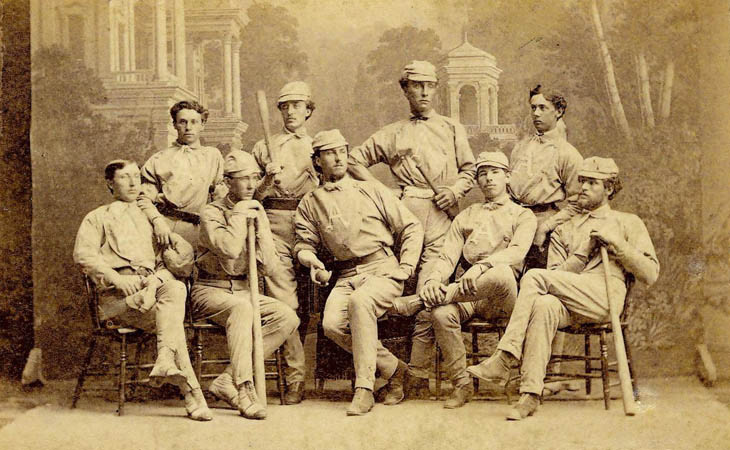
In 1869, when the Cincinnati Red Stockings began their inaugural season as the first professional baseball team, they played a preseason game at the site of what is now the Grand Union Terminal in Cincinnati against the Antiochs, who were regarded as one of the finest amateur clubs in Ohio. The game was played on May 15, 1869, and Cincinnati defeated Antioch 41–7. Antioch had been scheduled to host the first game of this professional tour on May 31, 1869, but it was rained out. So, while Antioch was not a part of the first professional baseball game, the college does hold claim to hosting the first ever rainout in professional baseball.

1900–1945
The turn of the century saw little improvement in the college's finances. In 1900, faculty were paid between $500 and $700 a year, very low for the time, and the president was paid $1,500 a year. In contrast, Horace Mann's annual salary had been $3,000 more than forty years prior. Enrollment did increase significantly under the presidency of Simeon D. Fess, who served from 1906 to 1917. In 1912 he was elected to the United States House of Representatives and served three of his five terms while also acting as president of Antioch.
World War I had little effect on the college, and though some people on campus contracted influenza during the Spanish flu epidemic, there were no deaths. In February 1919, YMCA attempted a peaceful takeover of the college, offering to raise an endowment of $500,000 if Antioch would serve as the official national college of YMCA of the USA. YMCA's proposal was received positively by the college's trustees and enacted by a unanimous vote, and Grant Perkins, a YMCA executive, assumed the college's presidency. By May, Perkins had resigned, reporting that he was not prepared to raise the necessary funds.
Morgan era
In June 1919, several candidates were submitted to the trustees, including Arthur Morgan. Morgan was elected to the board without any prior notification of his candidacy. An engineer, he had been involved in planning a college in upstate New York that would have included work-study along with a more traditional curriculum. Morgan also received the right to demand the resignations of faculty and trustees. He presented his plan for "practical industrial education" to the trustees, who accepted the new plan. Antioch closed for a third time while the curriculum was reorganized and the co-op program developed. In 1920, Morgan was unanimously elected president and, in 1921, the college reopened with the cooperative education program.
The early co-op program was not required; students could enter as traditional students or cooperative education students. By the 1935 academic year, nearly 80% of the student body had chosen the cooperative program. Students initially studied for eight-week-long terms alternating with eight-week-long work experiences. Male students generally took apprenticeships with craftsmen or jobs in factories; female students often served as nursing or teaching assistants. In 1921, when the program was inaugurated, fewer than 1% of available co-op jobs were outside of Ohio, but that grew to about 75% within 15 years.
Morgan constructed a new board of trustees of prominent businessmen, replacing many of the local ministers and adding a new source of income. Charles Kettering alone contributed more than $500,000 to Antioch. Major donations by board members and their friends totaled more than $2 million for the decade. Kettering and other major patrons hoped to create a model institution that would create potential business administrators with students "trained for proprietorship." The college declined an offer from John Henry Patterson to finance the college completely if Antioch would leave rural Yellow Springs, re-establish itself on NCR grounds in Dayton, and rechristen itself the National Cash Register College.
1946–2000
Center of activism
During World War II, Antioch, among other eastern colleges, with the help of Victor Goertzel, participated in a program that arranged for students of Japanese origin interned in Relocation camps to enroll in college. In 1943 the college Race Relations Committee began offering scholarships to non-white students to help diversify the campus, which had been mostly white since its founding. The first scholarship recipient was Edythe Scott, elder sister of Coretta Scott King. Coretta Scott also received the scholarship and attended Antioch two years after her sister. Antioch was also the first historically white college to appoint a black person to be chair of an academic department, when Walter Anderson was appointed chair of the music department.
In the 1950s, Antioch faced pressure from the powerful House Un-American Activities Committee and faced criticism from many area newspapers because it did not expel students and faculty accused of having Communist leanings.
In the 1960s and 1970s, the college continued to develop its reputation as a source of activism and progressive political thought. In 1965, Dr. Martin Luther King Jr. gave the commencement speech.
Dixon presidency and development of university system
Encouraged by President James Dixon, a Harvard-educated physician, upwards of 40 branch campuses and centers—known collectively as the Antioch Network (or The Network)—were established during the 1960s and 1970s, with the College as the central operating institution. Antioch University, of which Antioch College was now a component, formally came to exist in 1978. Antioch University New England was the first graduate school offshoot, in 1964, and many others were established as well, including what ultimately became Antioch University Midwest (located on a new campus in Yellow Springs that opened in September 2007).
Vice-president Morris Keeton in 1967 started the process of creating a campus in the new planned city of Columbia, Maryland. The land development promoted progressive clean-sheet concepts. The plans endured counter-culture cynicism with students calling the effort "Rouseland" and "Rouse's Fantasy Corporation". A field studies center opened with 150 students and interns working for the Rouse Company, but the project folded after a few years.
In many instances, the culture of the school spurred its students to activism. Eleanor Holmes Norton, future congressional delegate for Washington, D.C., recalled her time at Antioch as one "when the first real action that could be called movement action was ignited."
The 1973 strike
In the 1960s, Antioch recruited poor and minority students through its New Directions scholarship program to improve educational opportunities for minorities. In the late 60s, as the administration added satellite centers across the country, the college adopted an academic program in Yellow Springs that gave students unprecedented independence in choosing their coursework. Then it doubled enrollment: Antioch had 2,470 students in 1972.
In 1973 the Nixon Administration threatened to cut federal aid. Financial-aid and New Directions students and activists demanded that Antioch guarantee their aid. On April 20, protesters barricaded the administration building and locked other buildings, shutting down the college for six weeks. Vandalism was extensive, including three arson fires requiring Fire Department response. The shutdown ended when county sheriffs came on campus to enforce a judge's injunction against the strike. That year's graduates received their diplomas by mail.
The strike and its notoriety resulted in many students transferring and a sharp decline in applications and enrollment, a decline that continued until the college closed in 2008 with 400 students.
Birenbaum years
After consideration of 337 candidates, William Birenbaum was chosen as president of Antioch College in April 1976. The chairman of the search committee called him a "courageous and charismatic personality" who is an "experienced chief executive with a strong track record in crisis-type settings." By 1979, The New York Times described tensions on campus due to the school's dire financial crisis and that Birenbaum's "pugnacious and often abrasive style had offended many Antiochians", with enrollment at the Yellow Springs, Ohio, campus dropping from 2,000 to 1,000 during the 1970s. Birenbaum implemented cost-cutting measures including a reduction in the number of satellite campus programs nationwide from 30 down to under 10 and changing the name of the corporation to Antioch University. By November 1980, The New York Times was able to report in a headline of an article about the college that "A Streamlined Antioch Appears on the Way to Survival". Birenbaum announced in June 1984 that he would be retiring and Alan E. Guskin of the University of Wisconsin–Parkside was named to succeed him as of September 1, 1985.
Late 20th century
The college was led in the mid-1980s through the 1990s by Antioch presidents Alan Guskin, James Crowfoot, and Bob Devine. Citing the challenges of serving as both the college and University president, Guskin presided over the change to what he described as a federal model, wherein Antioch College became one of the campuses comprising Antioch University, which newly had its own central administration. Guskin served as the university's first chancellor, while James E. Crowfoot became the first president of solely Antioch College since Birenbaum. Antioch College's enrollment figures never surpassed 1,000 students but the campus underwent renovations and buildings that had been boarded up were repaired and reopened, including South Hall, one of the college's three original buildings.
Sexual Offense Prevention Policy (SOPP)
A "Sexual Offense Prevention Policy" was initiated after two date rapes reportedly occurred on the Antioch College campus during the 1990–91 academic year.
In 1991, a group of students formed under the name "Womyn of Antioch" to address their concern that sexual offenses in general were not being taken seriously enough by the administration or some in the campus community. A "Sexual Offense Prevention Policy," was created during a couple of late-night meetings in the campus Womyn's Center, as the Antioch College website commented "this original policy was questionable. It was not legally binding, no rights were given to the accused, and it called for immediate expulsion of the accused with no formal process." The policy was presented when the Womyn of Antioch stormed a community meeting a few days later.
In 1991–92, the college employed a part-time advocate, as the start of the Sexual Offenses Prevention and Survivors' Advocacy Program (SOP/SAP), who developed with the aid of the community the Antioch Sexual Offense Prevention Policy. Thus Antioch College became the first in America to mandate ongoing verbal affirmation during sexual encounters. Under this policy, consent for sexual behavior must be "(a) verbal, (b) mutual, and (c) reiterated for every new level of sexual behavior."
This policy was the subject of media satire, such as a parody sketch in 1993 on Saturday Night Live titled "Is It Date Rape?" Some media outlets voiced support for the policy. For example, syndicated columnist Ellen Goodman asserted that most "sexual policy makers write like lawyers in love," and that, likewise, "at Antioch the authors could use some poetry, and passion." But she was ultimately sympathetic to their goals of leveling the sexual playing field and making students think about what consent means, saying that the Antioch campus "has the plot line just about right."
By 2015, similar affirmative consent standards were adopted by colleges across the nation, including every Ivy League university except Harvard, as well as by state legislatures including California, Michigan, and New York.
In late 2022, some students were demanding changes to the SOPP following a sexual encounter between a professor and a student which the student characterized as "sexual assault and ... sexual harassment."
The 21st century
In 2000, Antioch College was again subject to media attention after inviting political activist and former death row inmate Mumia Abu-Jamal and transgender rights advocate and Abu-Jamal supporter Leslie Feinberg to be commencement speakers. Graduating students had chosen Abu-Jamal and Feinberg to highlight their concerns with capital punishment and the American criminal justice system. Many conservative commentators criticized the Antioch administration for allowing students to choose such controversial commencement speakers and the college administration received death threats. Antioch President Bob Devine chose not to overturn the students' choice of speakers, citing the ideals of free speech and free exchange of ideas, and likened the media reaction to the coverage of Martin Luther King Jr.'s 1965 commencement address.
Change in structure
The college uncovered accounting mistakes starting in 2006, which doubled the school's projected deficit. At an Antioch University Board of Trustees meeting in June 2007 the board stated that while the college was in only its third year of implementation of a rescue plan, they had not raised the funds needed, and the college would be indefinitely closed at the end of the 2007–08 academic year.
Alumni action to save the college
Many Antioch alumni and faculty, upset at the prospect of the loss of the college's legacy, began organizing and raising funds in an effort to save the college, keep it open without interruption, and gain greater transparency in its governance. In August 2007, the college faculty filed suit against the Board of Trustees, charging that the board was violating various contractual obligations.
Following a meeting between university and alumni representatives in August 2007, the Board of Trustees approved a resolution giving the Alumni Board until the October 2007 trustees' meeting to demonstrate the viability of an Alumni Board proposal to maintain the operations of the college. Despite initially stating he would remain until December, Antioch president Steve Lawry abruptly stepped down as president on September 1, 2007. The role of president was turned over to a three-person group, comprising the Dean of Faculty, Director of Student Services, and Director of Communications. While no reason for Lawry's immediate departure was given, it has been reported that he was forcibly ousted by the board of trustees. In response to this reported ousting, the faculty gave Antioch University Chancellor Toni Murdock a vote of no confidence.
A story about Antioch's closing in The Chronicle of Higher Education detailed the uncertain future of some faculty and staff members, along with the town of Yellow Springs, following suspended operations at the college. One professor, who received tenure just 28 hours before the college announced its closing, had turned down other jobs in academia to work at Antioch. The story includes a slideshow showing outdated and crumbling buildings on campus.