
The United States entered into World War I on 6 April, 1917, more than two and a half years after the war began in Austria-Hungary. Apart from an Anglophile element urging early support for the British and an anti-tsarist element sympathizing with Germany's war against Russia, American public opinion had generally reflected a desire to stay out of the war. Over time, especially after reports of German atrocities in Belgium in 1914 and after the sinking of the RMS Lusitania in a torpedo attack by a submarine of the Imperial German Navy off the southern coast of Ireland in May 1915, Americans increasingly came to see Imperial Germany as the aggressor in Europe.
When the country was at peace, American banks made huge loans to the Entente powers (Allies), which were used mainly to buy munitions, raw materials, and food from across the Atlantic in North America from the United States and Canada. Although president Woodrow Wilson made minimal preparations for a land war before 1917, he did authorize a shipbuilding program for the United States Navy. Wilson was narrowly re-elected in 1916 on an anti-war platform.
By 1917, with Belgium and northern France occupied by German troops, the Russian Empire experiencing turmoil and upheaval in the February Revolution overthrowing the tsar on the Eastern Front, and with the remaining Entente nations low on credit, the German empire appeared to have the upper hand in Europe. However, a British economic embargo and naval blockade were causing severe shortages of fuel and food in Germany. Berlin then decided to resume unrestricted submarine warfare. The aim was to break the trans-Atlantic supply chain to Britain from other nations to the West, although the German high command realized that sinking American-flagged ships would almost certainly bring the United States into the war.

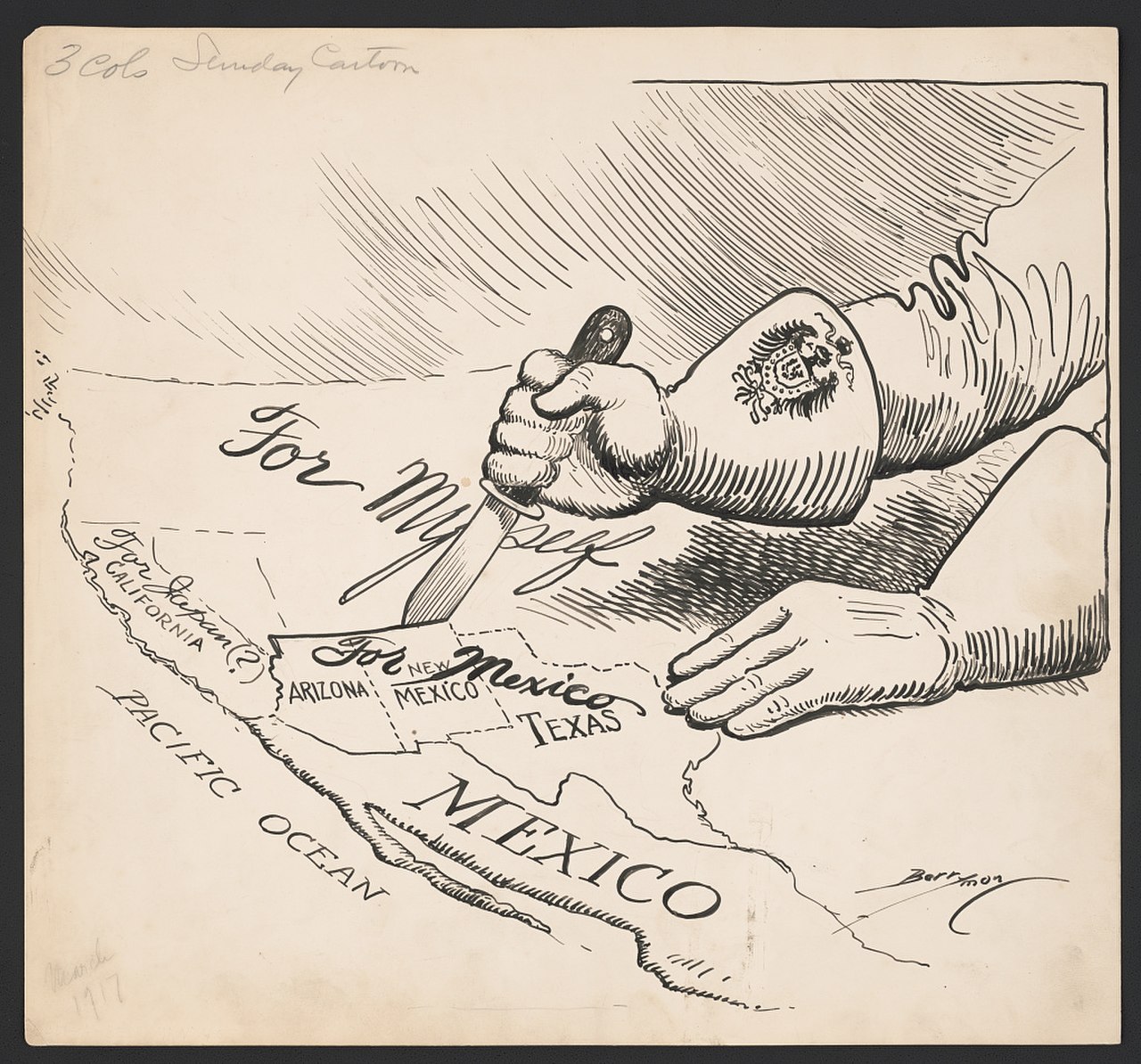
Imperial Germany also made a secret offer to help Mexico regain territories of the Mexican Cession of 1849, lost seven decades before in the Mexican–American War of 1846–1848, (now incorporated in the Southwestern United States) in an encoded diplomatic secret telegram known as the Zimmermann Telegram intercepted by British intelligence. Publication in the media of that communique outraged Americans just as German submarines started sinking American merchant ships in the North Atlantic in their U-boat campaign. President Wilson then asked Congress for "a war to end all wars" that would "make the world safe for democracy", and Congress voted to declare war on Germany on April 6, 1917. US troops began to arrive in Europe later that year, and served in major combat operations on the Western Front under the command of general John J. Pershing, particularly during the final Hundred Days Offensive.
Main issues
Naval blockade
Britain used its large navy to prevent cargo vessels entering German ports, mainly by intercepting them in the North Sea between the coasts of Scotland and Norway. By the end of 1915, the Royal Navy had successfully interdicted and stopped the naval shipment of most war supplies and food to Germany. Neutral American merchant cargo ships that tried to trade with Germany were seized or turned back by the Royal Navy in outlying waters who viewed such trade as in direct conflict with the Allies' war efforts. The impact from the blockade became apparent very slowly because Germany and its allies controlled extensive farmlands and raw materials on the continent of Europe and could trade with land-bordering neutral countries like Sweden and the Netherlands who were not themselves blockaded by the British or French. However, because Germany and adjacent Central Powers ally Austria-Hungary had decimated their agricultural production by drafting and taking so many farmers and supplies of nitrate fertilisers into their armies, and the Allies were able to pressure neutral countries into reducing exports, the situation worsened, with the "turnip winter" of 1916–1917 an example of the emerging severe shortages in Central Europe. The situation at the start of 1917 was such that there was clear pressure on the German leadership to avoid a "war of exhaustion", while the softening of neutral trade reduced the importance to keep the neutral countries on side.
Germany had considered a blockade from 1914. "England wants to starve us", said Grand Admiral Alfred von Tirpitz (1849–1930), the man who built the Imperial German Navy fleet after 1871 with the unification of Germany during the last few decades and who remained a key advisor to the German Emperor / Kaiser Wilhelm II. "We can play the same game. We can bottle her up and destroy every ship that endeavors to break the blockade". Admiral Tirpitz wanted to sink or scare off merchant and passenger ships en route to Britain. He and others in the Admiralty reasoned that since the island of Britain depended on imports of food, raw materials, and manufactured goods, preventing a substantial number of ships from supplying Britain would effectively undercut its long-term ability to maintain an army on the Western Front and potentially force Britain into speedy surrender. Such strategy would also give an essential, war winning role to the German Imperial Navy, who had been mostly passive in the war thus far due to being unable to challenge the powerful Royal Navy surface warship fleet.

While Germany had ample shipyard capacity to build hundreds of U-boats, they had only nine long-range U-boats at the start of the war in August 1914. Nevertheless, without consulting colleagues earlier superiors like Tirpitz, the outgoing head of the German Admiralty Hugo von Pohl (1855–1916), declared the beginning of the first round of unrestricted submarine warfare six months after the war began in February 1915. However, instead of ceasing shipping to Britain and blaming the British (as the Germans positioned the move as a reprisal) as the Germans anticipated, the United States demanded that Germany respect the earlier peace-time international agreements upon "freedom of the seas", which protected neutral American and other ships on the high seas from seizure or sinking by either belligerent. Furthermore, Americans insisted on strict accountability for the deaths of innocent American civilians, demanding an apology, compensation and suggesting that it is grounds for a declaration of war.
While the British Royal Navy frequently violated America's neutral rights by defining contraband very broadly in their naval blockade of Germany, German submarine warfare threatened American lives. Wilson's top advisor, legendary Colonel Edward M. House (1858–1938), commented that, "The British have gone as far as they possibly could in violating neutral rights, though they have done it in the most courteous way". Further, while the British justified their argument with an appeal to precedent, the Germans claimed that they should be allowed to use their new weapon to its best potential and so existing rules and norms need not apply. This is especially exemplified when German submarines torpedoed ships without warning, causing sailors and passengers to drown. Though in practice this was initially rare, since U-boats preferred to attack on the surface, this strategy was justified by claims that submarines were so vulnerable that they dared not surface near merchant ships that might be carrying guns and which were too small to rescue submarine crews. The Americans countered that if the new weapon cannot be used while protecting civilian lives, it should not be used at all.
From February 1915, despite the United States warning Germany about the misuse of submarines, several incidents occurred where neutral ships were attacked or Americans killed. After the Thrasher incident, the German Imperial Embassy warned US citizens against boarding vessels to Britain, which would have to face German attack. Then on May 7, Germany torpedoed the British ocean liner RMS Lusitania, sinking her. This act of aggression caused the loss of 1,199 civilian lives, including 128 US citizens. The sinking of a large, unarmed passenger ship, combined with the previous stories of atrocities in Belgium, shocked Americans and turned public opinion hostile to Germany, although not yet to the point of war. Wilson issued a warning to Germany affirming it would face "strict accountability" if it killed more American citizens. Berlin acquiesced, ordering its submarines to avoid passenger ships.
By January 1917, however, Field Marshal Paul von Hindenburg and General Erich Ludendorff decided that an unrestricted submarine blockade was the only way to achieve a decisive victory. They demanded that Kaiser Wilhelm order unrestricted submarine warfare be resumed. Germany knew this decision meant war with the United States, but they gambled that they could win before the United States' potential strength could be mobilized. However, they overestimated how many ships they could sink and thus the extent Britain would be weakened. Finally, they did not foresee that convoys could and would be used to defeat their efforts. They believed that the United States was so weak militarily that it could not be a factor on the Western Front for more than a year and that submarines would stop the transport of troops anyway. The civilian government in Berlin objected, but the Kaiser sided with his military.
The second round of unrestricted submarine warfare was communicated to the Americans on January 31, 1917. The State Department had some indications that the campaign would come, but Wilson declared to his cabinet that the announcement had come as a complete surprise. The announcement was especially galling due to Wilson's "peace without victory" speech nine days earlier, as well as ongoing discussions on US opposition to British use of armed merchant ships. The Germans started targeting American vessels the very next day.
Business considerations
The beginning of war in Europe coincided with the end of the recession of 1913–1914 in the US. Exports to belligerent nations rose rapidly over the first four years of the War from $824.8 million in 1913 to $2.25 billion in 1917. Loans from American financial institutions to the Allied nations in Europe also increased dramatically over the same period. Economic activity towards the end of this period boomed as government resources aided the production of the private sector. Between 1914 and 1917, industrial production increased 32% and GNP increased by almost 20%. The improvements to industrial production in the United States outlasted the war. The capital build-up that had allowed US companies to supply belligerents and the US Army resulted in a greater long-run rate of production even after the war had ended in 1918.

The J.P. Morgan Bank offered assistance in the wartime financing of Britain and France from the earliest stages of the conflict through the US's entrance in 1917. J.P. Morgan's New York office, was designated as the primary financial agent to the British government starting in 1914 after successful lobbying by the British ambassador, Sir Cecil Spring Rice. The same bank would later take a similar role in France. J.P. Morgan & Co. became the primary issuer of loans to the French government, providing the capital of US investors, operating from their French affiliate Morgan, Harjes. Relations between Morgan and the French government became tense as the war raged on with no end in sight however. France's ability to borrow from other sources diminished, leading to greater lending rates and a depressing of the value of the franc. After the war ended, J.P. Morgan & Co. continued to aid the French government financially through monetary stabilization and debt relief.
Because the United States was still a declared neutral state, the financial dealings of United States banks in Europe caused a great deal of contention between Wall Street and the US government. Secretary of State William Jennings Bryan strictly opposed financial support of warring nations and wanted to ban loans to the belligerents in August 1914. He told President Wilson that "refusal to loan to any belligerent would naturally tend to hasten a conclusion of the war." Wilson at first agreed, but then reversed himself when France argued that if it was legal to buy US goods then it was legal to take out credits on the purchase.
J.P. Morgan issued loans to France including one in March 1915 and, following negotiations with the Anglo-French Financial Commission, another joint loan to Britain and France in October 1915, the latter amounting to US$500,000,000. Although the stance of the US government was that stopping such financial assistance could hasten the end of the war and therefore save lives, little was done to insure adherence to the ban on loans, in part due to pressure from Allied governments and US business interests.

The US steel industry had faced difficulties and declining profits during the recession of 1913–1914. As war began in Europe, however, the increased demand for tools of war began a period of heightened productivity that alleviated many US industrial companies from the low-growth environment of the recession. Bethlehem Steel took particular advantage of the increased demand for armaments abroad. Prior to US entrance into the war, these companies benefited from unrestricted commerce with sovereign customers abroad. After President Wilson issued his declaration of war, the companies were subjected to price controls created by the US Trade Commission in order to ensure that the US armed forces would have access to the necessary armaments.
By the end of the war in 1918, Bethlehem Steel had produced 65,000 pounds of forged military products and 70 million pounds of armor plate, 1.1 billion pounds of steel for shells, and 20.1 million rounds of artillery ammunition for Britain and France. Bethlehem Steel took advantage of the domestic armaments market and produced 60% of the US weaponry and 40% of the artillery shells used in the war. Even with price controls and a lower profit margin on manufactured goods, the profits resulting from wartime sales expanded the company into the third largest manufacturing company in the country. Bethlehem Steel became the primary arms supplier for the United States and other allied powers again in 1939.
Views of the elites
Historians divide the views of US political, social and business leaders into four distinct groups:

The first of these were the Non-Interventionists, a loosely affiliated and politically diverse anti-war movement which sought to keep the United States out of the conflict altogether. Members of this group tended to view the war as a clash between the imperialist and militaristic great powers of Europe, whom they deemed to be corrupt and unworthy of support. Others were pacifists, who objected on moral grounds. Prominent leaders included Democrats like former Secretary of State William Jennings Bryan, industrialist Henry Ford and publisher William Randolph Hearst; Republicans such as Senator Robert M. La Follette of Wisconsin and Senator George W. Norris of Nebraska; and Progressive activist Jane Addams.
At the far-left end of the political spectrum, the Socialists, led by their perennial candidate for President, Eugene V. Debs, and movement veterans like Victor L. Berger and Morris Hillquit, were staunch anti-militarists. They were opposed to any US intervention, branding the conflict as a "capitalist war" which US workers should resist. However, after the US joined the war in April 1917, a schism developed between the anti-war party leadership and a pro-war faction of socialist writers and intellectuals led by John Spargo, William English Walling and E. Haldeman-Julius. This clique founded the rival Social Democratic League of America to promote the war effort among their fellow Socialists.
Next were the more moderate Liberal-Internationalists. This nominally progressive group reluctantly supported US entry into the war against Germany, with the postwar goal of establishing strong international institutions designed to peacefully resolve future conflicts between nations and to promote liberal democratic values more broadly. This camp's views were advocated by interest groups such as the League to Enforce Peace. Adherents included U.S. President Woodrow Wilson, his influential advisor Edward M. House, former President William Howard Taft, chairman of the Commission for Relief in Belgium Herbert Hoover, Wall Street financier Bernard Baruch, and Harvard University President Abbott Lawrence Lowell.
Finally, there were the Atlanticists. Politically conservative and unambiguously pro-Allied, this faction had championed US intervention in the war since the sinking of the Lusitania and also strongly supported the Preparedness Movement. Proponents also advocated for an enduring postwar alliance with Great Britain, which they saw as vital to maintaining the future security of the US. Prominent among the Anglophile Eastern establishment, supporters included former U.S. President Theodore Roosevelt, Major General Leonard Wood, lawyer and diplomat Joseph Hodges Choate, former Secretary of War Henry Stimson, and Senators Henry Cabot Lodge of Massachusetts and Elihu Root of New York.
Public opinion
Parties
A surprising factor in the development of US public opinion was how little the political parties became involved. Wilson and the Democrats in 1916 campaigned on the slogan "He kept us out of war!", saying a Republican victory would mean war with both Mexico and Germany. His position probably was critical in winning the western states. Charles Evans Hughes, the GOP candidate, insisted on downplaying the war issue.
The Socialist Party of America talked peace. Socialist rhetoric declared the European conflict to be "an imperialist war" blaming the war on capitalism and pledged total opposition. "A bayonet", its propaganda said, "was a weapon with a worker at each end". When war was declared, however, many Socialists, including much of the party's intellectual leadership, supported the decision and sided with the pro-Allied efforts. The majority, led by Eugene V. Debs (the party's presidential candidate from 1900 to 1912), remained ideological and die-hard opponents. Many socialists came under investigation from the Espionage Act of 1917 and many suspected of treason were arrested, including Debs. This increased the Socialists' and anti-war groups' resentment toward the US government.
Workers, farmers, and African Americans
The working class was relatively quiet and tended to divide along ethnic lines. At the beginning of the war, neither working men nor farmers took a large interest in the debates on war preparation. Samuel Gompers, head of the AFL labor movement, denounced the war in 1914 as "unnatural, unjustified, and unholy", but by 1916 he was supporting Wilson's limited preparedness program, against the objections of Socialist union activists. In 1916 the labor unions supported Wilson on domestic issues and ignored the war question.
The war at first disrupted the cotton market; the Royal Navy blockaded shipments to Germany, and prices fell from 11 cents a pound to only 4 cents. By 1916, however, the British decided to bolster the price to 10 cents to avoid losing Southern support. The cotton growers seem to have moved from neutrality to intervention at about the same pace as the rest of the nation. Midwestern farmers generally opposed the war, particularly those of German and Scandinavian descent. The Midwest became the stronghold of isolationism; other remote rural areas also saw no need for war.
The African-American community did not take a strong position one way or the other. A month after Congress declared war, W. E. B. Du Bois called on African-Americans to "fight shoulder to shoulder with the world to gain a world where war shall be no more". Once the war began and black men were drafted, they worked to achieve equality. Many had hoped the community's help in the war efforts abroad would earn civil rights at home. When such civil liberties were still not granted, many African-Americans grew tired of waiting for recognition of their rights as American citizens.
South
There was a strong antiwar element among poor rural whites in the South and border states. In rural Missouri for example, distrust of powerful eastern influences focused on the risk that Wall Street would lead the US into war. Across the South poor white farmers warned each other that "a rich man's war meant a poor man's fight," and they wanted nothing of it. Antiwar sentiment was strongest among Christians affiliated with the Churches of Christ, the Holiness movement and Pentecostal churches. Congressman James Hay, Democrat of Virginia was the powerful chairman of the House Committee on Military Affairs. He repeatedly blocked prewar efforts to modernize and enlarge the army. Preparedness was not needed because Americans were already safe, he insisted in January 1915:
Isolated as we are, safe in our vastness, protected by a great navy, and possessed of an army sufficient for any emergency that may arise, we may disregard the lamentations and predictions of the militarists.
Educated, urban, middle-class Southerners generally supported entering the war, and many worked on mobilization committees. In contrast to this many rural southern whites opposed entering the war. Those with more formal education were more in favor of entering the war and those in the South with less formal education were more likely to oppose entering the war. Letters to newspapers with spelling or grammatical errors overwhelmingly opposed entry into the war; letters without errors overwhelmingly supported entry into the war. When the war began Texas and Georgia led the Southern states with volunteers. 1,404 from Texas, 1,397 from Georgia, 538 from Louisiana, 532 from Tennessee, 470 from Alabama, 353 from North Carolina, 316 from Florida, and 225 from South Carolina. Every Southern senator voted in favor of entering the war except Mississippi firebrand James K. Vardaman. Some regions of the South were more heavily in favor of intervention than others. Georgia had the largest portion of pro-British newspapers before the US entry into the war and provided the most volunteers per capita of any state in the country before the introduction of conscription. All five major newspapers of Southeast Georgia were outspokenly Anglophilic throughout the war and highlighted German atrocities such as the rape of Belgium and execution of British nurse Edith Cavell. Other magazines with nationwide distribution which were pro-British such as
The Outlook and The Literary Digest had a disproportionately high distribution throughout every region of the state of Georgia as well as the region of northern Alabama in the area around Huntsville and Decatur (when the war began there were 470 volunteers from the state of Alabama, of these, over 400 came from Huntsville-Decatur region).
Support for US entry into the war was also pronounced in central Tennessee. Letters to newspapers which expressed pro-British, anti-German or pro-interventionist sentiment were common. In between October 1914 and April 1917, letters about the war to newspapers from Tennessee included at least one of these three sentiments. In the Tennessee counties of Cheatham County, Robertson County, Sumner County, Wilson County, Rutherford County, Williamson County, Maury County, Marshall County, Bedford County, Coffee County and Cannon County over half of the letters contained all three of these elements. In South Carolina there was support for the US entering the war. Led by Governor Richard I. Manning, the cities of Greenville, Spartanburg, and Columbia had started lobbying for army training centers in their communities, for both economic and patriotic reasons, in preparation for US entry into the war. Similarly, Charleston had interned a German freighter in 1914, and when the freighter's skeleton crew tried to block Charleston harbor they were all arrested and imprisoned. From that point on Charleston was buzzing with "war fever." 1915, 1916 and early 1917 were all years when Charleston and the low country coastal counties to the south of Charleston were gripped by sentiment that was very "pro-British and anti-German."
German Americans
German Americans by this time usually had only weak ties to Germany; however, they were fearful of negative treatment they might receive if the United States entered the war (such mistreatment was already happening to German-descent citizens in Canada and Australia). Almost none called for intervening on Germany's side, instead calling for neutrality and speaking of the superiority of German culture. As more nations were drawn into the conflict, however, the English-language press increasingly supported Britain, while the German-American media called for neutrality while also defending Germany's position. Chicago's Germans worked to secure a complete embargo on all arms shipments to Europe. In 1916, large crowds in Chicago's Germania celebrated the Kaiser's birthday, something they had not done before the war. German Americans in early 1917 still called for neutrality, but proclaimed that if a war came they would be loyal to the United States. By this point, they had been excluded almost entirely from national discourse on the subject. German-American Socialists in Milwaukee, Wisconsin actively campaigned against entry into the war.
Christian churches and pacifists
Leaders of most religious groups (except the Episcopalians) tended to pacifism, as did leaders of the woman's movement. The Methodists and Quakers were among the vocal opponents of the war. President Wilson, a devout Presbyterian, often framed the war in terms of good and evil in an appeal for religious support of the war.
A concerted effort was made by pacifists including Jane Addams, Oswald Garrison Villard, David Starr Jordan, Henry Ford, Lillian Wald, and Carrie Chapman Catt. Their goal was to encourage Wilson's efforts to mediate an end of the war by bringing the belligerents to the conference table. Finally in 1917 Wilson convinced some of them that to be truly anti-war they needed to support what he promised would be "a war to end all wars".
Once war was declared, the more liberal denominations, which had endorsed the Social Gospel, called for a war for righteousness that would uplift all mankind. The theme—an aspect of American exceptionalism—was that God had chosen America as his tool to bring redemption to the world.
US Catholic bishops maintained a general silence toward the issue of intervention. Millions of Catholics lived in both warring camps, and Catholic Americans tended to split on ethnic lines in their opinions toward US involvement in the war. At the time, heavily Catholic towns and cities in the east and Midwest often contained multiple parishes, each serving a single ethnic group, such as Irish, German, Italian, Polish, or English. US Catholics of Irish and German descent opposed intervention most strongly. Pope Benedict XV made several attempts to negotiate a peace. All of his efforts were rebuffed by both the Allies and the Germans, and throughout the war the Vatican maintained a policy of strict neutrality.
Jewish Americans
In 1914–1916, there were few Jewish Americans in favor of US entry into the war. New York City, with its Jewish community numbering 1.5 million, was a center of antiwar activism, much of which was organized by labor unions which were primarily on the political left and therefore opposed to a war that they viewed to be a battle between several great powers.
Some Jewish communities worked together during the war years to provide relief to Jewish communities in Eastern Europe decimated by fighting, famine and scorched earth policies of the Russian and Austro-German armies.
Of greatest concern to Jewish Americans was the tsarist government in Russia due its toleration of pogroms and allegedly following antisemitic policies. As historian Joseph Rappaport reported through his study of Yiddish press during the war, "The pro-Germanism of America's immigrant Jews was an inevitable consequence of their Russophobia." However, after the February Revolution of 1917 led to the transformation of Russia into a republic, a major obstacle was removed for those Jews who refused to support US entry into the war on the side of Russia. The draft went smoothly in New York City, and left-wing opposition to the war largely collapsed when Zionists saw the possibility of using the war to demand a state of Israel.
Irish-Americans
The most effective domestic opponents of the war were Irish-American Catholics. Many had little interest in the continent; despite traditional hostility towards the United Kingdom and British Empire, some Irish Americans took a more neutral stance on the issue of aiding the Entente on account of the recently passed Government of Ireland Act 1914, allowing Irish Home Rule. However, the Act was suspended until the war ended.
John Redmond and the Irish Parliamentary Party (IPP) declared that Irish Volunteers should support the US's pro-Allied war efforts first; his political opponents argued that it was not the time to support Britain in its attempt to "strengthen and expand her empire". The attacks on the IPP and pro-Allied press showed a firm belief that a German victory would hasten the achievement of an independent Irish state. Yet rather than proposing intervention on behalf of the Germans, Irish American leaders and organizations focused on demanding US neutrality. But the increased contact between militant Irish nationalists and German agents in the United States only fueled concerns of where the primary loyalties of Irish Americans lay. Nevertheless, nearly 1,000 Irish-born Americans died fighting with the US armed forces in WWI. The Easter Rising in Dublin in April 1916 was defeated within a week and its leaders executed by firing squad. Both the mainstream Irish and US press treated the uprising as foolish and misguided, and later joined the British press in suspecting it was largely created and planned by the Germans. Overall public opinion remained faithfully pro-Entente.
In many major US cities, Irish-Americans dominated the Democratic Party, forcing Wilson to take into account their political viewpoints. Irish-American political efforts influenced the United States into defining its own objectives from the war separate from those of its allies, which were primarily (among other objectives) self-determination for the various nations and ethnic groups of Europe. Wilson gave assurances he would promote Irish independence after the war which helped to secure support for his war policies. However once the war was over Wilson reneged, disappointing many Irish-Americans. Though an ideological proponent of self-determination in general, Wilson saw the Irish situation purely as an internal affair of the United Kingdom and did not perceive the dispute and the unrest in Ireland as one and the same as that being faced by the various other nationalities in Europe as fallout from World War I.
Pro-Allied immigrants
Some British immigrants worked actively for intervention. London-born Samuel Insull, Chicago's leading industrialist, for example, enthusiastically provided money, propaganda, and means for volunteers to enter the British or Canadian armies. After the United States's entry, Insull directed the Illinois State Council of Defense, with responsibility for organizing the state's mobilization.
Immigrants from eastern Europe usually cared more about politics in their homeland than politics in the United States. Spokesmen for Slavic immigrants hoped that an Allied victory would bring independence for their homelands. Large numbers of Hungarian immigrants who were liberal and nationalist in sentiment, and sought an independent Hungary, separate from the Austro-Hungarian Empire lobbied in favor of the war and allied themselves with the Atlanticist or Anglophile portion of the population. This community was largely pro-British and anti-German in sentiment. Albanian-Americans in communities such as Boston also campaigned for entry into the war and were overwhelmingly pro-British and anti-German, as well as hopeful the war would lead to an independent Albania which would be free from the Ottoman Empire. Wisconsin had the distinction of being the most isolationist state due to its many German-Americans, socialists and pacifists. However, the exception to this were pockets within the state such as the city of Green Bay. Green Bay had a large number of pro-Allied immigrants, including the largest Belgian immigrant community in the entire country, and for this reason anti-German and pro-war sentiment were significantly higher in Green Bay than the country overall. There was a large Serbian-American community in Alaska which also was enthusiastically in favor of US entry into World War I. In the case of Alaska, which was at the time a territory, thousands of Serbian immigrants and Serbian-Americans volunteered early to join the U.S. Army shortly after the declaration of war, after the community had been outspokenly in favor of the US's entry into the war before this. During the First World War, many Serbian Americans volunteered to fight overseas, with thousands coming from Alaska.
Popular pacifism
Henry Ford supported the pacifist cause by sponsoring a large-scale private peace mission, with numerous activists and intellectuals aboard the "Peace Ship" (the ocean liner Oscar II). Ford chartered the ship in 1915 and invited prominent peace activists to join him to meet with leaders on both sides in Europe. He hoped to create enough publicity to prompt the belligerent nations to convene a peace conference and mediate an end to the war. The mission was widely mocked by the press as a "Ship of Fools". Infighting between the activists, mockery by the press contingent aboard, and an outbreak of influenza marred the voyage. Four days after the ship arrived in neutral Norway, a beleaguered and physically ill Ford abandoned the mission and returned to the United States; he had demonstrated that independent small efforts accomplished nothing.