
The American Revolutionary War (April 19, 1775 – September 3, 1783), also known as the Revolutionary War or American War of Independence or simply the American Revolution, was the armed conflict that comprised the final eight years of the broader American Revolution, in which American Patriot forces organized as the Continental Army and commanded by George Washington defeated the British Army. The conflict was fought in North America, the Caribbean, and the Atlantic Ocean. The war's outcome seemed uncertain for most of the war, but Washington and the Continental Army's decisive victory in the Siege of Yorktown in 1781 led King George III and the Kingdom of Great Britain to negotiate an end to the war. In 1783, in the Treaty of Paris, the British monarchy acknowledged the independence of the Thirteen Colonies, leading to the establishment of the United States as an independent and sovereign nation.
In 1763, after the British Empire gained dominance in North America following its victory over the French in the Seven Years' War, tensions and disputes began escalating between the British and the Thirteen Colonies, especially following passage of the Stamp and Townshend Acts. The British Army responded by seeking to occupy Boston militarily, leading to the Boston Massacre on March 5, 1770. In mid-1774, with tensions escalating even further between the British Army and the colonies, the British Parliament imposed the Intolerable Acts, an attempt to disarm Americans, leading to the Battles of Lexington and Concord in April 1775, the first battles of the Revolutionary War. In June 1775, the Second Continental Congress voted to incorporate colonial-based Patriot militias into a central military, the Continental Army, and unanimously appointed Washington its commander-in-chief. Two months later, in August 1775, George III declared the colonies to be in a state of rebellion. In July 1776, the Second Continental Congress formalized the war, passing the Lee Resolution on July 2, and, two days later, unanimously adopting the Declaration of Independence, on July 4.
In March 1776, in an early win for the newly-formed Continental Army under Washington's command, following a successful siege of Boston, the Continental Army successfully drove the British Army out of Boston. British commander in chief William Howe responded by launching the New York and New Jersey campaign, which resulted in Howe's capture of New York City in November. Washington responded by clandestinely crossing the Delaware River and winning small but significant victories at Trenton and Princeton.

In the summer of 1777, as Howe was poised to capture Philadelphia, the Continental Congress fled to Baltimore. In October 1777, a separate northern British force under the command of John Burgoyne was forced to surrender at Saratoga in an American victory that proved crucial in convincing France and Spain that an independent United States was a viable possibility. France signed a commercial agreement with the revolutionaires, followed by a Treaty of Alliance in February 1778. In 1779, the Sullivan Expedition undertook a scorched earth campaign against British-allied factions of the Haudenosaunee Confederacy (also Iroquois). Native American raids on the American frontier, however, continued to be a problem. Also, in 1779, Spain allied with France against Great Britain in the Treaty of Aranjuez, though Spain did not formally ally with the Americans.
Howe's replacement Henry Clinton intended to take the war against the Americans into the Southern Colonies. Despite some initial success, British General Cornwallis was besieged by a Franco-American army in Yorktown, Virginia, in September and October 1781. The French navy cut off Cornwallis's escape and he was forced to surrender in October. The British wars with France and Spain continued for another two years, but fighting largely ceased in North America. In the Treaty of Paris, signed on September 3, 1783, Great Britain acknowledged the sovereignty and independence of the United States, bringing the American Revolutionary War to an end. The Treaties of Versailles resolved Great Britain's conflicts with France and Spain, and forced Great Britain to cede Tobago, Senegal, and small territories in India to France, and Menorca, West Florida, and East Florida to Spain.
Prelude to war
The French and Indian War, part of the wider global conflict known as the Seven Years' War, ended with the 1763 Peace of Paris, which expelled France from their possessions in New France. The Royal Proclamation of 1763 was designed to refocus colonial expansion north into Nova Scotia and south into Florida, with the Mississippi River as the dividing line between British and Spanish possessions in America. Settlement was tightly restricted beyond the 1763 limits, and claims west of this line, including by Virginia and Massachusetts, were rescinded. With the exception of Virginia and others deprived of rights to western lands, the colonial legislatures agreed on the boundaries but disagreed on where to set them. Many settlers resented the restrictions entirely, and enforcement required permanent garrisons along the frontier, which led to increasingly bitter disputes over who should pay for them.

Taxation and legislation
The huge debt incurred by the Seven Years' War and demands from British taxpayers for cuts in government expenditure meant Parliament expected the colonies to fund their own defense. The 1763 to 1765 Grenville ministry instructed the Royal Navy to cease trading smuggled goods and enforce customs duties levied in American ports. The most important was the 1733 Molasses Act; routinely ignored before 1763, it had a significant economic impact since 85% of New England rum exports were manufactured from imported molasses. These measures were followed by the Sugar Act and Stamp Act, which imposed additional taxes on the colonies to pay for defending the western frontier. The taxes proved highly burdensome, particularly for the poorer classes, and quickly became a source of discontent. In July 1765, the Whigs formed the First Rockingham ministry, which repealed the Stamp Act and reduced tax on foreign molasses to help the New England economy, but re-asserted Parliamentary authority in the Declaratory Act.
However, this did little to end the discontent; in 1768, a riot started in Boston when the authorities seized the sloop Liberty on suspicion of smuggling. Tensions escalated in March 1770 when British troops fired on rock-throwing civilians, killing five in what became known as the Boston Massacre. The Massacre coincided with the partial repeal of the Townshend Acts by the Tory-based North Ministry. North insisted on retaining duty on tea to enshrine Parliament's right to tax the colonies; the amount was minor, but ignored the fact it was that very principle Americans found objectionable.
In April 1772, colonialists staged the first American tax revolt against British royal authority in Weare, New Hampshire, later referred to as the Pine Tree Riot. This would inspire the design of the Pine Tree Flag. Tensions escalated following the destruction of a customs vessel in the June 1772 Gaspee Affair, then came to a head in 1773. A banking crisis led to the near-collapse of the East India Company, which dominated the British economy; to support it, Parliament passed the Tea Act, giving it a trading monopoly in the Thirteen Colonies. Since most American tea was smuggled by the Dutch, the act was opposed by those who managed the illegal trade, while being seen as another attempt to impose the principle of taxation by Parliament. In December 1773, a group called the Sons of Liberty disguised as Mohawks dumped crates of tea into Boston Harbor, an event later known as the Boston Tea Party. The British Parliament responded by passing the so-called Intolerable Acts, aimed specifically at Massachusetts, although many colonists and members of the Whig opposition considered them a threat to liberty in general. This increased sympathy for the Patriot cause locally, in the British Parliament, and in the London press.

Break with the British Crown
Throughout the 18th century, the elected lower houses in the colonial legislatures gradually wrested power from their governors. Dominated by smaller landowners and merchants, these assemblies now established ad-hoc provincial legislatures, effectively replacing royal control. With the exception of Georgia, twelve colonies sent representatives to the First Continental Congress to agree on a unified response to the crisis. Many of the delegates feared that a boycott would result in war and sent a Petition to the King calling for the repeal of the Intolerable Acts. After some debate, on September 17, 1774, Congress endorsed the Massachusetts Suffolk Resolves and on October 20 passed the Continental Association, which instituted economic sanctions and a boycott of goods against Britain.
While denying its authority over internal American affairs, a faction led by James Duane and future Loyalist Joseph Galloway insisted Congress recognize Parliament's right to regulate colonial trade. Expecting concessions by the North administration, Congress authorized the colonial legislatures to enforce the boycott; this succeeded in reducing British imports by 97% from 1774 to 1775. However, on February 9 Parliament declared Massachusetts to be in rebellion and instituted a blockade of the colony. In July, the Restraining Acts limited colonial trade with the British West Indies and Britain and barred New England ships from the Newfoundland cod fisheries. The tension led to a scramble for control of militia stores, which each assembly was legally obliged to maintain for defense. On April 19, a British attempt to secure the Concord arsenal culminated in the Battles of Lexington and Concord, which began the Revolutionary War.
Political reactions
After the Patriot victory at Concord, moderates in Congress led by John Dickinson drafted the Olive Branch Petition, offering to accept royal authority in return for George III mediating in the dispute. However, since the petition was immediately followed by the Declaration of the Causes and Necessity of Taking Up Arms, Colonial Secretary Lord Dartmouth viewed the offer as insincere and refused to present the petition to the king. Although constitutionally correct, since the monarch could not oppose his own government, it disappointed those Americans who hoped he would mediate in the dispute, while the hostility of his language annoyed even Loyalist members of Congress. Combined with the Proclamation of Rebellion, issued on August 23 in response to the Battle at Bunker Hill, it ended hopes of a peaceful settlement.
Backed by the Whigs, Parliament initially rejected the imposition of coercive measures by 170 votes, fearing an aggressive policy would drive the Americans towards independence. However, by the end of 1774 the collapse of British authority meant both Lord North and George III were convinced war was inevitable. After Boston, Gage halted operations and awaited reinforcements; the Irish Parliament approved the recruitment of new regiments, while allowing Catholics to enlist for the first time. Britain also signed a series of treaties with German states to supply additional troops. Within a year, it had an army of over 32,000 men in America, the largest ever sent outside Europe at the time. The employment of German soldiers against people viewed as British citizens was opposed by many in Parliament and by the colonial assemblies; combined with the lack of activity by Gage, opposition to the use of foreign troops allowed the Patriots to take control of the legislatures.
Declaration of Independence
Support for independence was boosted by Thomas Paine's pamphlet Common Sense, which was published on January 10, 1776, and argued for American self-government and was widely reprinted. To draft the Declaration of Independence, the Second Continental Congress appointed the Committee of Five: Thomas Jefferson, John Adams, Benjamin Franklin, Roger Sherman, and Robert Livingston. The declaration was written almost exclusively by Jefferson.
Identifying inhabitants of the Thirteen Colonies as "one people", the declaration simultaneously dissolved political links with Britain, while including a long list of alleged violations of "English rights" committed by George III. This is also one of the first times that the colonies were referred to as "United States", rather than the more common United Colonies. On July 2, Congress voted for independence and published the declaration on July 4.

At this point, the revolution ceased to be an internal dispute over trade and tax policies between the Thirteen Colonies and Great Britain, becoming a civil war, with each state represented in Congress engaged in a struggle with Britain. The conflict was also a civil war between American Patriots and American Loyalists. Patriots generally supported independence from Britain and a new national union in Congress, while Loyalists remained aligned with British rule. Estimates of numbers vary, one suggestion being the population as a whole was split evenly between committed Patriots, committed Loyalists, and those who were indifferent. Others calculate the split as 40% Patriot, 40% neutral, 20% Loyalist, but with considerable regional variations.
At the onset of the war, the Second Continental Congress realized defeating Britain required foreign alliances and intelligence-gathering. The Committee of Secret Correspondence was formed for "the sole purpose of corresponding with our friends in Great Britain and other parts of the world". From 1775 to 1776, the committee shared information and built alliances through secret correspondence, as well as employing secret agents in Europe to gather intelligence, conduct undercover operations, analyze foreign publications, and initiate Patriot propaganda campaigns. Paine served as secretary, while Benjamin Franklin and Silas Deane, sent to France, Britain's longtime rival, to recruit military engineers, were instrumental in securing French aid in Paris.
War breaks out
Early engagements
On April 14, 1775, Sir Thomas Gage, Commander-in-Chief, North America and Governor of Massachusetts, received orders to take action against the Patriots. He decided to destroy militia ordnance stored at Concord, Massachusetts, and capture John Hancock and Samuel Adams, who were considered the principal instigators of the rebellion. The operation was to begin around midnight on April 19, in the hope of completing it before the American Patriots could respond. However, Paul Revere learned of the plan and notified Captain Parker, commander of the Concord militia, who prepared to resist. The first action of the war, commonly referred to as the shot heard round the world, was a brief skirmish at Lexington, followed by the full-scale Battles of Lexington and Concord. British troops suffered around 300 casualties before withdrawing to Boston, which was then besieged by the militia.

In May 1775, 4,500 British reinforcements arrived under Generals William Howe, John Burgoyne, and Sir Henry Clinton. On June 17, they seized the Charlestown Peninsula at the Battle of Bunker Hill, a frontal assault in which they suffered over 1,000 casualties. Dismayed at the costly attack which had gained them little, Gage appealed to London for a larger army, but instead was replaced as commander by Howe.
On June 14, 1775, Congress took control of Patriot forces outside Boston, and Congressional leader John Adams nominated Washington as commander-in-chief of the newly formed Continental Army. On June 16, Hancock officially proclaimed him "General and Commander in Chief of the army of the United Colonies." He assumed command on July 3, preferring to fortify Dorchester Heights outside Boston rather than assaulting it. In early March 1776, Colonel Henry Knox arrived with heavy artillery acquired in the Capture of Fort Ticonderoga. Under cover of darkness, on March 5, Washington placed these on Dorchester Heights, from where they could fire on the town and British ships in Boston Harbor. Fearing another Bunker Hill, Howe evacuated the city on March 17 without further loss and sailed to Halifax, Nova Scotia, while Washington moved south to New York City.
Beginning in August 1775, American privateers raided towns in Nova Scotia, including Saint John, Charlottetown, and Yarmouth. In 1776, John Paul Jones and Jonathan Eddy attacked Canso and Fort Cumberland respectively. British officials in Quebec began negotiating with the Iroquois for their support, while US envoys urged them to remain neutral. Aware of Native American leanings toward the British and fearing an Anglo-Indian attack from Canada, Congress authorized a second invasion in April 1775. After the defeat at the Battle of Quebec on December 31, the Americans maintained a loose blockade of the city until they retreated on May 6, 1776. A second defeat at Trois-Rivières on June 8 ended operations in Quebec.
British pursuit was initially blocked by American naval vessels on Lake Champlain until victory at Valcour Island on October 11 forced the Americans to withdraw to Fort Ticonderoga, while in December an uprising in Nova Scotia sponsored by Massachusetts was defeated at Fort Cumberland. These failures impacted public support for the Patriot cause, and aggressive anti-Loyalist policies in the New England colonies alienated the Canadians.
In Virginia, Dunmore's Proclamation on November 7, 1775, promised freedom to any slaves who fled their Patriot masters and agreed to fight for the Crown. British forces were defeated at Great Bridge on December 9 and took refuge on British ships anchored near Norfolk. When the Third Virginia Convention refused to disband its militia or accept martial law, Lord Dunmore ordered the Burning of Norfolk on January 1, 1776.
The siege of Savage's Old Fields began on November 19 in South Carolina between Loyalist and Patriot militias, and the Loyalists were subsequently driven out of the colony in the Snow Campaign. Loyalists were recruited in North Carolina to reassert British rule in the South, but they were decisively defeated in the Battle of Moore's Creek Bridge. A British expedition sent to reconquer South Carolina launched an attack on Charleston in the Battle of Sullivan's Island on June 28, 1776, but it failed.
A shortage of gunpowder led Congress to authorize a naval expedition against the Bahamas to secure ordnance stored there. On March 3, 1776, an American squadron under the command of Esek Hopkins landed at the east end of Nassau and encountered minimal resistance at Fort Montagu. Hopkins' troops then marched on Fort Nassau. Hopkins had promised governor Montfort Browne and the civilian inhabitants that their lives and property would not be in any danger if they offered no resistance; they complied. Hopkins captured large stores of powder and other munitions that was so great he had to impress an extra ship in the harbor to transport the supplies back home, when he departed on March 17. A month later, after a brief skirmish with HMS Glasgow, they returned to New London, Connecticut, the base for American naval operations.
British New York counter-offensive
After regrouping at Halifax in Nova Scotia, Howe set sail for New York in June 1776 and began landing troops on Staten Island near the entrance to New York Harbor on July 2. The Americans rejected Howe's informal attempt to negotiate peace on July 30; Washington knew that an attack on the city was imminent and realized that he needed advance information to deal with disciplined British regular troops.
On August 12, 1776, Patriot Thomas Knowlton was ordered to form an elite group for reconnaissance and secret missions. Knowlton's Rangers, which included Nathan Hale, became the Army's first intelligence unit. When Washington was driven off Long Island, he soon realized that he would need to professionalize military intelligence. With aid from Benjamin Tallmadge, Washington launched the six-man Culper spy ring. The efforts of Washington and the Culper Spy Ring substantially increased the effective allocation and deployment of Continental regiments in the field. Throughout the war, Washington spent more than 10 percent of his total military funds on military intelligence.
Washington split the Continental Army into positions on Manhattan and across the East River in western Long Island. On August 27 at the Battle of Long Island, Howe outflanked Washington and forced him back to Brooklyn Heights, but he did not attempt to encircle Washington's forces. Through the night of August 28, Knox bombarded the British. Knowing they were up against overwhelming odds, Washington ordered the assembly of a war council on August 29; all agreed to retreat to Manhattan. Washington quickly had his troops assembled and ferried them across the East River to Manhattan on flat-bottomed freight boats without any losses in men or ordnance, leaving General Thomas Mifflin's regiments as a rearguard.
Howe met with a delegation from the Second Continental Congress at the September Staten Island Peace Conference, but it failed to conclude peace, largely because the British delegates only had the authority to offer pardons and could not recognize independence. On September 15, Howe seized control of New York City when the British landed at Kip's Bay and unsuccessfully engaged the Americans at the Battle of Harlem Heights the following day. On October 18, Howe failed to encircle the Americans at the Battle of Pell's Point, and the Americans withdrew. Howe declined to close with Washington's army on October 28 at the Battle of White Plains and instead attacked a hill that was of no strategic value.
Washington's retreat isolated his remaining forces and the British captured Fort Washington on November 16. The British victory there amounted to Washington's most disastrous defeat with the loss of 3,000 prisoners. The remaining American regiments on Long Island fell back four days later. General Henry Clinton wanted to pursue Washington's disorganized army, but he was first required to commit 6,000 troops to capture Newport, Rhode Island, to secure the Loyalist port. General Charles Cornwallis pursued Washington, but Howe ordered him to halt.
The outlook following the defeat at Fort Washington appeared bleak for the American cause. The reduced Continental Army had dwindled to fewer than 5,000 men and was reduced further when enlistments expired at the end of the year. Popular support wavered, and morale declined. On December 20, 1776, the Continental Congress abandoned the revolutionary capital of Philadelphia and moved to Baltimore, where it remained until February 27, 1777. Loyalist activity surged in the wake of the American defeat, especially in New York state.
In London, news of the victorious Long Island campaign was well received with festivities held in the capital. Public support reached a peak. Strategic deficiencies among Patriot forces were evident: Washington divided a numerically weaker army in the face of a stronger one, his inexperienced staff misread the military situation, and American troops fled in the face of enemy fire. The successes led to predictions that the British could win within a year. The British established winter quarters in the New York City area and anticipated renewed campaigning the following spring.
Patriot resurgence
On the night of December 25–26, 1776, Washington crossed the Delaware River, leading a column of Continental Army troops from today's Bucks County, Pennsylvania, to today's Mercer County, New Jersey, in a logistically challenging and dangerous operation.
Meanwhile, the Hessians were involved in numerous clashes with small bands of Patriots and were often aroused by false alarms at night in the weeks before the actual Battle of Trenton. By Christmas they were tired, while a heavy snowstorm led their commander, Colonel Johann Rall, to assume no significant attack would occur. At daybreak on the 26th, the American Patriots surprised and overwhelmed Rall and his troops, who lost over 20 killed including Rall, while 900 prisoners, German cannons and supplies were captured.
The Battle of Trenton restored the American army's morale, reinvigorated the Patriot cause, and dispelled their fear of what they regarded as Hessian "mercenaries". A British attempt to retake Trenton was repulsed at Assunpink Creek on January 2; during the night, Washington outmaneuvered Cornwallis, then defeated his rearguard in the Battle of Princeton the following day. The two victories helped convince the French that the Americans were worthy military allies.
After his success at Princeton, Washington entered winter quarters at Morristown, New Jersey, where he remained until May and received Congressional direction to inoculate all Patriot troops against smallpox. With the exception of a minor skirmishing between the two armies which continued until March, Howe made no attempt to attack the Americans.
British northern strategy fails
The 1776 campaign demonstrated that regaining New England would be a prolonged affair, which led to a change in British strategy to isolating the north by taking control of the Hudson River, allowing them to focus on the south where Loyalist support was believed to be substantial. In December 1776, Howe wrote to the Colonial Secretary Lord Germain, proposing a limited offensive against Philadelphia, while a second force moved down the Hudson from Canada. Burgoyne supplied several alternatives, all of which gave him responsibility for the offensive, with Howe remaining on the defensive. The option selected required him to lead the main force south from Montreal down the Hudson Valley, while a detachment under Barry St. Leger moved east from Lake Ontario. The two would meet at Albany, leaving Howe to decide whether to join them. Reasonable in principle, this did not account for the logistical difficulties involved and Burgoyne erroneously assumed Howe would remain on the defensive; Germain's failure to make this clear meant he opted to attack Philadelphia instead.
With a mixed force of British regulars, professional German soldiers and Canadian militia Burgoyne set out on June 14, 1777, and captured Fort Ticonderoga on July 5. As General Horatio Gates retreated, his troops blocked roads, destroyed bridges, dammed streams, and stripped the area of food. This slowed Burgoyne's progress and forced him to send out large foraging expeditions; one of more than 700 British troops were captured at the Battle of Bennington on August 16. St Leger moved east and besieged Fort Stanwix; despite defeating an American relief force at the Battle of Oriskany on August 6, St. Leger was abandoned by his Indian allies and withdrew to Quebec on August 22. Now isolated and outnumbered by Gates, Burgoyne continued onto Albany rather than retreating to Fort Ticonderoga, reaching Saratoga on September 13. He asked Clinton for support while constructing defenses around the town.
Morale among his troops rapidly declined, and an unsuccessful attempt to break past Gates at the Battle of Freeman Farms on September 19 resulted in 600 British casualties. When Clinton advised he could not reach them, Burgoyne's subordinates advised retreat; a reconnaissance in force on October 7 was repulsed by Gates at the Battle of Bemis Heights, forcing them back into Saratoga with heavy losses. By October 11, all hope of British escape had vanished; persistent rain reduced the camp to a "squalid hell" and supplies were dangerously low. Burgoyne capitulated on October 17; around 6,222 soldiers, including German forces commanded by General Friedrich Adolf Riedesel, surrendered their arms before being taken to Boston, where they were to be transported to England.
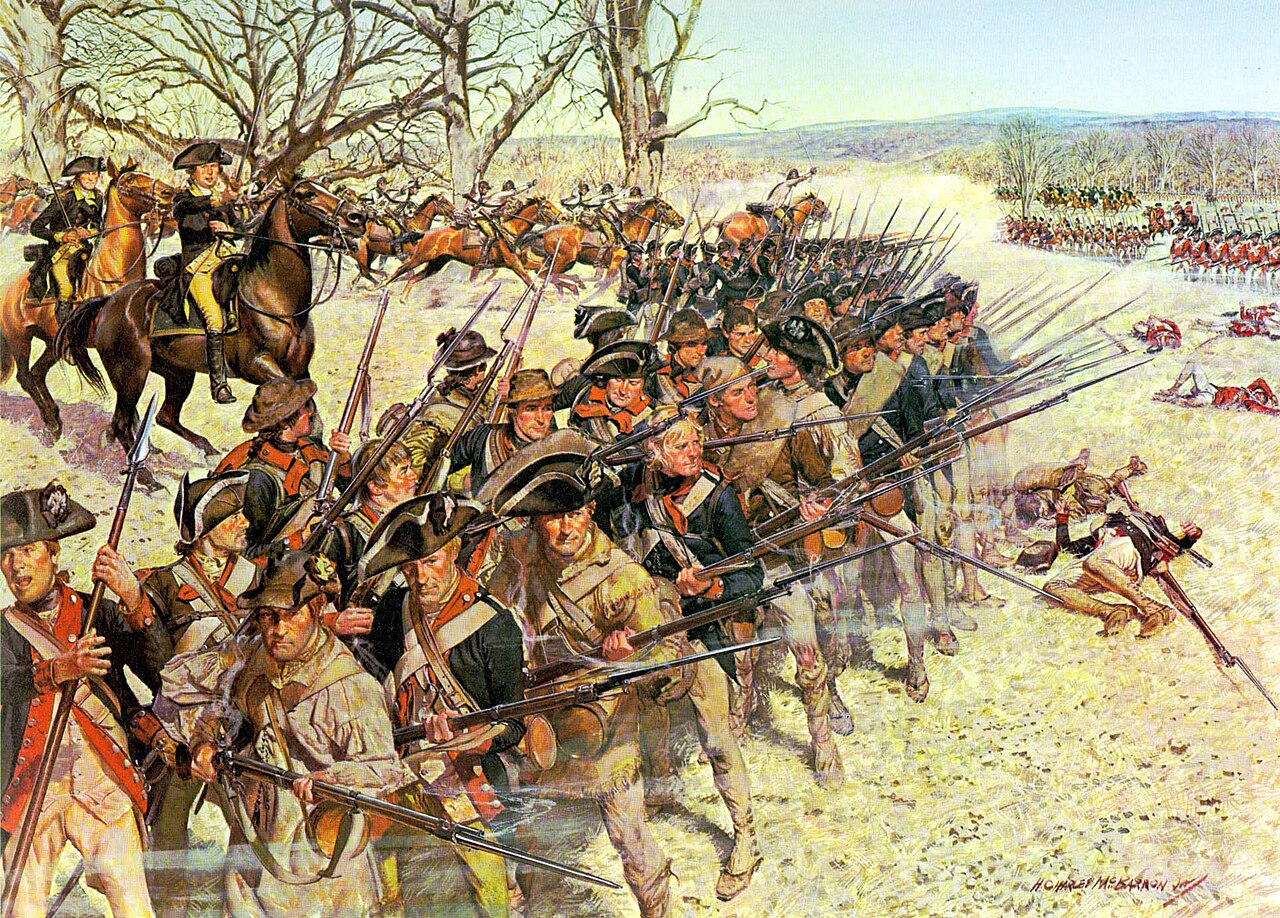
After securing additional supplies, Howe made another attempt on Philadelphia by landing his troops in Chesapeake Bay on August 24. He now compounded failure to support Burgoyne by missing repeated opportunities to destroy his opponent: despite defeating Washington at the Battle of Brandywine on September 11, he then allowed him to withdraw in good order. After dispersing an American detachment at Paoli on September 20, Cornwallis occupied Philadelphia on September 26, with the main force of 9,000 under Howe based just to the north at Germantown. Washington attacked them on October 4, but was repulsed.
To prevent Howe's forces in Philadelphia being resupplied by sea, the Patriots erected Fort Mifflin and nearby Fort Mercer on the east and west banks of the Delaware respectively, and placed obstacles in the river south of the city. This was supported by a small flotilla of Continental Navy ships on the Delaware, supplemented by the Pennsylvania State Navy, commanded by John Hazelwood. An attempt by the Royal Navy to take the forts in the October 20 to 22 Battle of Red Bank failed; a second attack captured Fort Mifflin on November 16, while Fort Mercer was abandoned two days later when Cornwallis breached the walls. His supply lines secured, Howe tried to tempt Washington into giving battle, but after inconclusive skirmishing at the Battle of White Marsh from December 5 to 8, he withdrew to Philadelphia for the winter.
On December 19, the Americans followed suit and entered winter quarters at Valley Forge. As Washington's domestic opponents contrasted his lack of battlefield success with Gates' victory at Saratoga, foreign observers such as Frederick the Great were equally impressed with Washington's command at Germantown, which demonstrated resilience and determination. Over the winter, poor conditions, supply problems and low morale resulted in 2,000 deaths, with another 3,000 unfit for duty due to lack of shoes. However, Baron Friedrich Wilhelm von Steuben took the opportunity to introduce Prussian Army drill and infantry tactics to "model companies" in each Continental Army regiment, who then instructed their home units. Despite Valley Forge being only twenty miles away, Howe made no effort to attack their camp, an action some critics argue could have ended the war.
Foreign intervention
Like his predecessors, French foreign minister Vergennes considered the 1763 Peace a national humiliation and viewed the war as an opportunity to weaken Britain. He initially avoided open conflict, but allowed American ships to take on cargoes in French ports, a technical violation of neutrality. Vergennes persuaded Louis XVI to secretly fund a government front company to purchase munitions for the Patriots, carried in neutral Dutch ships and imported through Sint Eustatius in the Caribbean.
Many Americans opposed a French alliance, fearing to "exchange one tyranny for another", but this changed after a series of military setbacks in early 1776. As France had nothing to gain from the colonies reconciling with Britain, Congress had three choices: making peace on British terms, continuing the struggle on their own, or proclaiming independence, guaranteed by France. Although the Declaration of Independence had wide public support, over 20% of Congressmen voted against an alliance with France. Congress agreed to the treaty with reluctance and as the war moved in their favor increasingly lost interest in it.
Silas Deane was sent to Paris to begin negotiations with Vergennes, whose key objectives were replacing Britain as the United States' primary commercial and military partner while securing the French West Indies from American expansion. These islands were extremely valuable; in 1772, the value of sugar and coffee produced by Saint-Domingue on its own exceeded that of all American exports combined. Talks progressed slowly until October 1777, when British defeat at Saratoga and their apparent willingness to negotiate peace convinced Vergennes only a permanent alliance could prevent the "disaster" of Anglo-American rapprochement. Assurances of formal French support allowed Congress to reject the Carlisle Peace Commission and insist on nothing short of complete independence.
On February 6, 1778, France and the United States signed the Treaty of Amity and Commerce regulating trade between the two countries, followed by a defensive military alliance against Britain, the Treaty of Alliance. In return for French guarantees of American independence, Congress undertook to defend their interests in the West Indies, while both sides agreed not to make a separate peace; conflict over these provisions would lead to the 1798 to 1800 Quasi-War. Charles III of Spain was invited to join on the same terms but refused, largely due to concerns over the impact of the Revolution on Spanish colonies in the Americas. Spain had complained on multiple occasions about encroachment by American settlers into Louisiana, a problem that could only get worse once the United States replaced Britain.
Although Spain ultimately made important contributions to American success, in the Treaty of Aranjuez, Charles agreed only to support France's war with Britain outside America, in return for help in recovering Gibraltar, Menorca and Spanish Florida. The terms were confidential since several conflicted with American aims; for example, the French claimed exclusive control of the Newfoundland cod fisheries, a non-negotiable for colonies like Massachusetts. One less well-known impact of this agreement was the abiding American distrust of 'foreign entanglements'; the US would not sign another treaty with France until their NATO agreement of 1949. This was because the US had agreed not to make peace without France, while Aranjuez committed France to keep fighting until Spain recovered Gibraltar, effectively making it a condition of US independence without the knowledge of Congress.
To encourage French participation in the struggle for independence, the US representative in Paris, Silas Deane, promised promotion and command positions to any French officer who joined the Continental Army. This included Gilbert du Motier, Marquis de Lafayette, whom Congress via Dean appointed a major general, on July 31, 1777.
When the war started, Britain tried to borrow the Dutch-based Scots Brigade for service in America, but pro-Patriot sentiment led the States General to refuse. Although the Republic was no longer a major power, prior to 1774 they still dominated the European carrying trade, and Dutch merchants made large profits shipping French-supplied munitions to the Patriots. This ended when Britain declared war in December 1780, a conflict that proved disastrous to the Dutch economy.