
Alexander Hamilton (January 11, 1755 or 1757 – July 12, 1804) was an American military officer, statesman, and Founding Father who served as the first U.S. secretary of the treasury from 1789 to 1795 under the presidency of George Washington. He also founded America's first political party, the Federalist Party, in 1791.
Born out of wedlock in Charlestown on the Caribbean island of Nevis, Hamilton was orphaned as a child and taken in by a prosperous merchant. He was given a scholarship and pursued his education at King's College (now Columbia University) in New York City where, despite his young age, he was an anonymous but prolific and widely read pamphleteer and advocate for the American Revolution. He then served as an artillery officer in the American Revolutionary War, where he saw military action against the British Army in the New York and New Jersey campaign, served for four years as aide-de-camp to Continental Army commander in chief George Washington, and fought under Washington's command in the war's climactic battle, the Siege of Yorktown, which secured American victory in the war and with it the independence of the United States.
After the Revolutionary War, Hamilton served as a delegate from New York to the Congress of the Confederation in Philadelphia. He resigned to practice law and founded the Bank of New York. In 1786, Hamilton led the Annapolis Convention, which sought to strengthen the power of the loose confederation of independent states under the limited authorities granted the Congress by the Articles of Confederation. The following year he was a delegate to the Philadelphia Convention, which drafted the U.S. Constitution creating a more centralized federal national government. He then authored 51 of the 85 installments of The Federalist Papers, which proved persuasive in securing its ratification by the states and remains the preeminent interpretation of Constitutional intent.
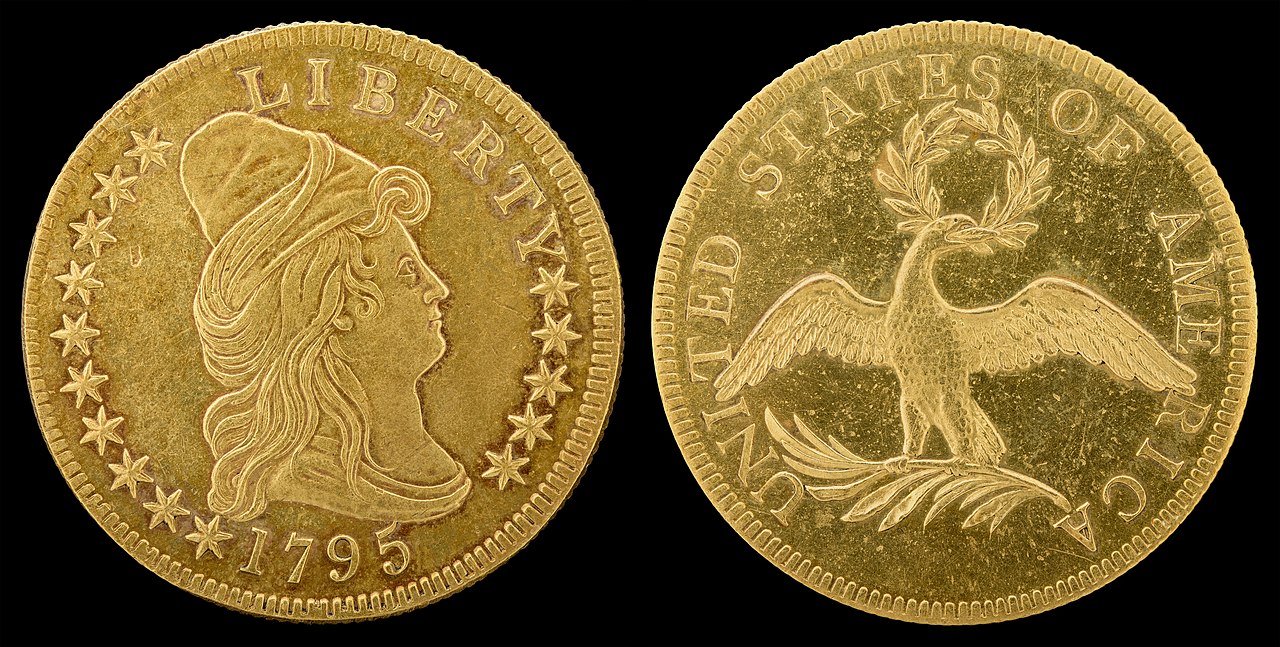
As a trusted member of President Washington's first cabinet, Hamilton served as the first U.S. secretary of the treasury. He envisioned a central government led by an energetic executive, a strong national defense, and a more diversified economy with significantly expanded industry. He successfully argued that the implied powers of the U.S. Constitution provided the legal basis to create the First Bank of the United States, and assume the states' war debts, which was funded by a tariff on imports and a whiskey tax. Hamilton opposed American entanglement with the succession of unstable French revolutionary governments. In 1790, he persuaded the U.S. Congress to establish the U.S. Revenue Cutter Service to protect American shipping. In 1793, he advocated in support of the Jay Treaty under which the U.S. resumed friendly trade relations with the British Empire. Hamilton's views became the basis for the Federalist Party, which was opposed by the Democratic-Republican Party, led by Thomas Jefferson. Hamilton and other Federalists supported the Haitian Revolution, and Hamilton helped draft Haiti's constitution in 1801.
After resigning as the nation's secretary of the treasury in 1795, Hamilton resumed his legal and business activities and helped lead the abolition of the Atlantic slave trade. In the Quasi-War, fought at sea between 1798 and 1800, Hamilton called for mobilization against France, and President John Adams appointed him major general. The U.S. Army, however, did not see combat in the conflict. Outraged by Adams' response to the crisis, Hamilton opposed his 1800 presidential re-election. Jefferson and Aaron Burr tied for the presidency in the electoral college and, despite philosophical differences, Hamilton endorsed Jefferson over Burr, whom he found unprincipled. When Burr ran for Governor of New York in 1804, Hamilton again opposed his candidacy, arguing that he was unfit for the office. Taking offense, Burr challenged Hamilton to a pistol duel, which took place in Weehawken, New Jersey, on July 11, 1804. Hamilton was mortally wounded and immediately transported back across the Hudson River in a delirious state to the home of William Bayard Jr. in Greenwich Village, New York, for medical attention. The following day, on July 12, 1804, Hamilton succumbed to his wounds.
Scholars generally regard Hamilton as an astute and intellectually brilliant administrator, politician, and financier who was sometimes impetuous. His ideas are credited with influencing the founding principles of American finance and government. In 1997, historian Paul Johnson wrote that Hamilton was a "genius—the only one of the Founding Fathers fully entitled to that accolade—and he had the elusive, indefinable characteristics of genius."

Early life and education
Hamilton was born on January 11, 1755, or 1757, in Charlestown, the capital of Nevis in the British Leeward Islands, where he spent his childhood. Hamilton and his older brother, James Jr., were born out of wedlock to Rachel Lavien (née Faucette), a married woman of half-British and half-Huguenot descent, and James A. Hamilton, a Scotsman and the fourth son of Alexander Hamilton, the laird of Grange, Ayrshire. His maternal grandfather was John Faucette (born c. 1680–1684), a French Huguenot, planter and medical doctor born in the Saintonge province of France who had settled on the British west indies island of Nevis, after the 1685 Revocation of the Edict of Nantes by Louis XIV.
Prior to Alexander's birth, in 1745, Rachel Lavien married Johann Lavien in Saint Croix. Together, they had one son, Peter. However, Rachel Lavien left her husband and first son in 1750, traveling to Saint Kitts, where she met James Hamilton. Hamilton and Lavien moved together to Nevis, her birthplace, where she had inherited a seaside lot in town from her father. While their mother was living, Alexander and James Jr. received individual tutoring and classes in a private school led by a Jewish headmistress. Alexander supplemented his education with a family library of 34 books.
James Hamilton later abandoned Rachel Lavien and their two sons, ostensibly to "spar[e] [her] a charge of bigamy...after finding out that her first husband intend[ed] to divorce her under Danish law on grounds of adultery and desertion." Lavien then moved with their two children back to Saint Croix, where she supported them by managing a small store in Christiansted. Both his mother and Hamilton contracted yellow fever. On February 19, 1768, Hamilton's mother died from the disease, leaving him orphaned.

In probate court, Lavien's "first husband seized her estate" and obtained the few valuables that she had owned, including some household silver. Many items were auctioned off, and a friend purchased the family's books, returning them to Hamilton.
The brothers were briefly taken in by their cousin Peter Lytton. However, Lytton took his own life in July 1769, leaving his property to his mistress and their son, and the propertyless Hamilton brothers were subsequently separated. James Jr. apprenticed with a local carpenter, while Alexander was given a home by Thomas Stevens, a merchant from Nevis.
Hamilton became a clerk at Beekman and Cruger, a local import-export firm that traded with the Province of New York and New England. Though still a teenager, Hamilton proved capable enough as a trader to be left in charge of the firm for five months in 1771 while the owner was at sea. He remained an avid reader, and later developed an interest in writing and a life outside Saint Croix. He wrote a detailed letter to his father regarding a hurricane that devastated Christiansted on August 30, 1772. The Presbyterian Reverend Hugh Knox, a tutor and mentor to Hamilton, submitted the letter for publication in the Royal Danish-American Gazette. Biographer Ron Chernow found the letter astounding because "for all its bombastic excesses, it does seem wondrous [that a] self-educated clerk could write with such verve and gusto" and that a teenage boy produced an apocalyptic "fire-and-brimstone sermon" viewing the hurricane as a "divine rebuke to human vanity and pomposity." The essay impressed community leaders, who collected a fund to send Hamilton to the North American colonies for his education.

In October 1772, Hamilton arrived by ship in Boston and then proceeded to New York City, where he boarded with Hercules Mulligan, the Irish-born brother of a trader known to Hamilton's benefactors. Mulligan assisted Hamilton in selling the cargo that Hamilton was to use to pay for his education and support. Hamilton sought to fill gaps in his education in preparation for college, and later that year began to attend Elizabethtown Academy, a preparatory school run by Francis Barber in Elizabeth, New Jersey. While there, he was introduced to William Livingston, a local leading intellectual and revolutionary who influenced him, and he boarded with the Livingstons while studying.
In fall 1773, Hamilton returned to New York and entered Mulligan's alma mater, King's College (now Columbia University). Hamilton began as a private student and boarded again with Mulligan until he matriculated into the college the following year, in May 1774. His college roommate and lifelong friend Robert Troup spoke glowingly of Hamilton's clarity in concisely explaining the Patriot case against the British during the American Revolution in what was Hamilton's first public appearance, on July 6, 1774. As King's College students, Hamilton, Troup, and four other undergraduates formed an unnamed literary society that is regarded as a precursor to what is now the Philolexian Society.
Later in 1774, Church of England clergyman Samuel Seabury in New York published a series of pamphlets promoting the Loyalist cause, seeking to provoke fear in the Thirteen Colonies, which he hoped would discourage them from uniting against the British. Hamilton countered anonymously with his first published political writings, A Full Vindication of the Measures of Congress and The Farmer Refuted. He published two additional pieces attacking the Quebec Act, and may have also authored the 15 anonymous installments of "The Monitor" for Holt's New York Journal. Hamilton supported the revolutionary cause before the war began, but he disapproved of mob violence against the Loyalists. On May 10, 1775, he was credited with saving King's College president Myles Cooper, a Loyalist, from an angry mob by speaking to the crowd long enough to allow Cooper to escape. Hamilton was forced to discontinue his studies before graduating when the college closed its doors during the British occupation of New York City and his subsequent military service.

Revolutionary War (1775–1782)
Early military career
In 1775, following the outbreak of the Revolutionary War with the Battles of Lexington and Concord, Hamilton and other King's College students joined a New York volunteer militia company, the Corsicans, whose name reflected the Corsican Republic that was suppressed six years earlier and which young American patriots regarded as a political model to be emulated.
Hamilton drilled with the company before classes in the graveyard of nearby St. Paul's Chapel, studied military history and tactics on his own, and was soon elected an officer. Under fire from HMS Asia, and coordinating with Hercules Mulligan and the Sons of Liberty, he led his newly renamed unit, the "Hearts of Oak," on a successful raid for British cannons in the Battery. The seizure of the cannons resulted in the unit being re-designated an artillery company.
Through his connections with influential New York patriots, including Alexander McDougall and John Jay, Hamilton was commissioned by the revolutionary government to raise the New York Provincial Company of Artillery of 60 men in 1776, and was then appointed captain. The company took part in the campaign of 1776 in and around New York City; as rearguard of the Continental Army's retreat up Manhattan, serving at the Battle of Harlem Heights shortly after, and at the Battle of White Plains a month later. At the Battle of Trenton, the company was stationed at the high point of town at the intersection of present-day Warren and Broad streets to keep the Hessians pinned down in their barracks.

Hamilton participated in the Battle of Princeton on January 3, 1777. After an initial setback, Washington rallied the Continental Army troops and led them in a successful charge against the British forces. After making a brief stand, the British fell back, some leaving Princeton, and others taking up refuge in Nassau Hall. Hamilton transported three cannons to the hall, and had them fire upon the building as others rushed the front door and broke it down. The British subsequently put a white flag outside one of the windows; 194 British soldiers walked out of the building and laid down their arms, ending the battle in an American victory.
George Washington's staff
Hamilton was invited to become an aide to Continental Army general William Alexander, Lord Stirling, and another general, perhaps Nathanael Greene or Alexander McDougall. He declined these invitations, believing his best chance for improving his station in life was glory on the Revolutionary War's battlefields. Hamilton eventually received an invitation he felt he could not refuse: to serve as George Washington's aide with the rank of lieutenant colonel. Washington believed that "Aides de camp are persons in whom entire confidence must be placed and it requires men of abilities to execute the duties with propriety and dispatch."
Hamilton served four years as Washington's chief staff aide. He handled letters to the Continental Congress, state governors, and the most powerful generals of the Continental Army. He drafted many of Washington's orders and letters under Washington's direction, and he eventually issued orders on Washington's behalf over his own signature. Hamilton was involved in a wide variety of high-level duties, including intelligence, diplomacy, and negotiation with senior army officers as Washington's emissary.
While stationed at the army's winter headquarters in Morristown, New Jersey from December 1779 to March 1780, Hamilton met Elizabeth Schuyler, a daughter of General Philip Schuyler and Catherine Van Rensselaer. They married on December 14, 1780, at the Schuyler Mansion in Albany, New York. They had eight children, Philip, Angelica, Alexander, James, John, William, Eliza, and another Philip.
During the Revolutionary War, Hamilton became the close friend of several fellow officers. His letters to the Marquis de Lafayette and to John Laurens, employing the sentimental literary conventions of the late 18th century and alluding to Greek history and mythology, have been read by Jonathan Ned Katz as revelatory of a homosocial or even homosexual relationship. Biographer Gregory D. Massey amongst others, by contrast, dismisses all such speculation as unsubstantiated, describing their friendship as purely platonic camaraderie instead and placing their correspondence in the context of the flowery diction of the time.
Field command
While on Washington's staff, Hamilton long sought command and a return to active combat. As the war drew nearer to an end, he knew that opportunities for military glory were diminishing. On February 15, 1781, Hamilton was reprimanded by Washington after a minor misunderstanding. Although Washington quickly tried to mend their relationship, Hamilton insisted on leaving his staff. He officially left in March, and settled with his new wife Elizabeth Schuyler close to Washington's headquarters. He continued to repeatedly ask Washington and others for a field command. Washington continued to demur, citing the need to appoint men of higher rank. This continued until early July 1781, when Hamilton submitted a letter to Washington with his commission enclosed, "thus tacitly threatening to resign if he didn't get his desired command."
On July 31, Washington relented and assigned Hamilton as commander of a battalion of light infantry companies of the 1st and 2nd New York Regiments and two provisional companies from Connecticut. In the planning for the assault on Yorktown, Hamilton was given command of three battalions, which were to fight in conjunction with the allied French troops in taking Redoubts No. 9 and No. 10 of the British fortifications at Yorktown. Hamilton and his battalions took Redoubt No. 10 with bayonets alone so as not to risk accidental gunfire and discovery in a nighttime action, as planned. The French also suffered heavy casualties and took Redoubt No. 9. These actions led to the surrender of the besieged British army at Yorktown, marking the de facto end of the war, although small battles continued for two more years until the signing of the Treaty of Paris and the departure of the last British troops.
Return to civilian life (1782–1789)
Congress of the Confederation
After Yorktown, Hamilton returned to New York City and resigned his commission in March 1782. He passed the bar in July after six months of self-directed education and, in October, was licensed to argue cases before the Supreme Court of New York. He also accepted an offer from Robert Morris to become receiver of continental taxes for the New York state. Hamilton was appointed in July 1782 to the Congress of the Confederation as a New York representative for the term beginning in November 1782. Before his appointment to Congress in 1782, Hamilton was already sharing his criticisms of Congress. He expressed these criticisms in his letter to James Duane dated September 3, 1780: "The fundamental defect is a want of power in Congress ... the confederation itself is defective and requires to be altered; it is neither fit for war, nor peace."
While on Washington's staff, Hamilton had become frustrated with the decentralized nature of the wartime Continental Congress, particularly its dependence upon the states for voluntary financial support that was not often forthcoming. Under the Articles of Confederation, Congress had no power to collect taxes or to demand money from the states. This lack of a stable source of funding had made it difficult for the Continental Army both to obtain its necessary provisions and to pay its soldiers. During the war, and for some time after, Congress obtained what funds it could from subsidies from the King of France, European loans, and aid requested from the several states, which were often unable or unwilling to contribute.
An amendment to the Articles had been proposed by Thomas Burke, in February 1781, to give Congress the power to collect a five percent impost, or duty on all imports, but this required ratification by all states; securing its passage as law proved impossible after it was rejected by Rhode Island in November 1782. James Madison joined Hamilton in influencing Congress to send a delegation to persuade Rhode Island to change its mind. Their report recommending the delegation argued the national government needed not just some level of financial autonomy, but also the ability to make laws that superseded those of the individual states. Hamilton transmitted a letter arguing that Congress already had the power to tax, since it had the power to fix the sums due from the several states; but Virginia's rescission of its own ratification of this amendment ended the Rhode Island negotiations.
Congress and the army
While Hamilton was in Congress, discontented soldiers began to pose a danger to the young United States. Most of the army was then posted at Newburgh, New York. Those in the army were funding much of their own supplies, and they had not been paid in eight months. Furthermore, after Valley Forge, the Continental officers had been promised in May 1778 a pension of half their pay when they were discharged. By the early 1780s, due to the structure of the government under the Articles of Confederation, it had no power to tax to either raise revenue or pay its soldiers. In 1782, after several months without pay, a group of officers organized to send a delegation to lobby Congress, led by Captain Alexander McDougall. The officers had three demands: the army's pay, their own pensions, and commutation of those pensions into a lump-sum payment if Congress were unable to afford the half-salary pensions for life. Congress rejected the proposal.
Several congressmen, including Hamilton, Robert Morris, and Gouverneur Morris, attempted to use the so-called Newburgh Conspiracy as leverage to secure support from the states and in Congress for funding of the national government. They encouraged MacDougall to continue his aggressive approach, implying unknown consequences if their demands were not met, and defeated proposals designed to end the crisis without establishing general taxation: that the states assume the debt to the army, or that an impost be established dedicated to the sole purpose of paying that debt.
Hamilton suggested using the Army's claims to prevail upon the states for the proposed national funding system. The Morrises and Hamilton contacted General Henry Knox to suggest he and the officers defy civil authority, at least by not disbanding if the army were not satisfied. Hamilton wrote Washington to suggest that Hamilton covertly "take direction" of the officers' efforts to secure redress, to secure continental funding but keep the army within the limits of moderation. Washington wrote Hamilton back, declining to introduce the army. After the crisis had ended, Washington warned of the dangers of using the army as leverage to gain support for the national funding plan.
On March 15, Washington defused the Newburgh situation by addressing the officers personally. Congress ordered the Army officially disbanded in April 1783. In the same month, Congress passed a new measure for a 25-year impost—which Hamilton voted against—that again required the consent of all the states; it also approved a commutation of the officers' pensions to five years of full pay. Rhode Island again opposed these provisions, and Hamilton's robust assertions of national prerogatives in his previous letter were widely held to be excessive.
In June 1783, a different group of disgruntled soldiers from Lancaster, Pennsylvania, sent Congress a petition demanding their back pay. When they began to march toward Philadelphia, Congress charged Hamilton and two others with intercepting the mob. Hamilton requested militia from Pennsylvania's Supreme Executive Council, but was turned down. Hamilton instructed Assistant Secretary of War William Jackson to intercept the men. Jackson was unsuccessful. The mob arrived in Philadelphia, and the soldiers proceeded to harangue Congress for their pay. Hamilton argued that Congress ought to adjourn to Princeton, New Jersey. Congress agreed, and relocated there. Frustrated with the weakness of the national government, Hamilton while in Princeton, drafted a call to revise the Articles of Confederation. This resolution contained many features of the future Constitution of the United States, including a strong federal government with the ability to collect taxes and raise an army. It also included the separation of powers into the legislative, executive, and judicial branches.
Return to New York
Hamilton resigned from Congress in 1783. When the British left New York in 1783, he practiced there in partnership with Richard Harison. He specialized in defending Tories and British subjects, as in Rutgers v. Waddington, in which he defeated a claim for damages done to a brewery by the Englishmen who held it during the military occupation of New York. He pleaded for the mayor's court to interpret state law consistent with the 1783 Treaty of Paris, which had ended the Revolutionary War. In 1784, Hamilton founded the Bank of New York.
Long dissatisfied with the Articles of Confederation as too weak to be effective, Hamilton played a major leadership role at the 1786 Annapolis Convention. He drafted its resolution for a constitutional convention, and in doing so brought one step closer to reality his longtime desire to have a more effectual, more financially self-sufficient federal government.
As a member of the legislature of New York, Hamilton argued forcefully and at length in favor of a bill to recognize the sovereignty of the State of Vermont, against numerous objections to its constitutionality and policy. Consideration of the bill was deferred to a later date. From 1787 to 1789, Hamilton exchanged letters with Nathaniel Chipman, a lawyer representing Vermont. After the Constitution of the United States went into effect, Hamilton said, "One of the first subjects of deliberation with the new Congress will be the independence of Kentucky, for which the southern states will be anxious. The northern will be glad to send a counterpoise in Vermont." Vermont was admitted to the Union in 1791.
In 1788, he was awarded a Master of Arts degree from his alma mater, the former King's College, now reconstituted as Columbia College. It was during this post-war period that Hamilton served on the college's board of trustees, playing a part in the reopening of the college and placing it on firm financial footing.
Constitution and The Federalist Papers
In 1787, Hamilton served as assemblyman from New York County in the New York State Legislature and was chosen as a delegate at the Constitutional Convention in Philadelphia by his father-in-law Philip Schuyler. Even though Hamilton had been a leader in calling for a new Constitutional Convention, his direct influence at the Convention itself was quite limited. Governor George Clinton's faction in the New York legislature had chosen New York's other two delegates, John Lansing Jr. and Robert Yates, and both of them opposed Hamilton's goal of a strong national government. Thus, whenever the other two members of the New York delegation were present, they decided New York's vote, to ensure that there were no major alterations to the Articles of Confederation.
Early in the convention, Hamilton made a speech proposing a president-for-life; it had no effect upon the deliberations of the convention. He proposed to have an elected president and elected senators who would serve for life, contingent upon "good behavior" and subject to removal for corruption or abuse; this idea contributed later to the hostile view of Hamilton as a monarchist sympathizer, held by James Madison. According to Madison's notes, Hamilton said in regards to the executive, "The English model was the only good one on this subject. The hereditary interest of the king was so interwoven with that of the nation, and his personal emoluments so great, that he was placed above the danger of being corrupted from abroad... Let one executive be appointed for life who dares execute his powers."
Hamilton argued, "And let me observe that an executive is less dangerous to the liberties of the people when in office during life than for seven years. It may be said this constitutes as an elective monarchy ... But by making the executive subject to impeachment, the term 'monarchy' cannot apply ..." In his notes of the convention, Madison interpreted Hamilton's proposal as claiming power for the "rich and well born". Madison's perspective all but isolated Hamilton from his fellow delegates and others who felt they did not reflect the ideas of revolution and liberty.
During the convention, Hamilton constructed a draft for the Constitution based on the convention debates, but he never presented it. This draft had most of the features of the actual Constitution. In this draft, the Senate was to be elected in proportion to the population, being two-fifths the size of the House, and the president and senators were to be elected through complex multistage elections, in which chosen electors would elect smaller bodies of electors; they would hold office for life, but were removable for misconduct. The president would have an absolute veto. The Supreme Court was to have immediate jurisdiction over all lawsuits involving the United States, and state governors were to be appointed by the federal government.
At the end of the convention, Hamilton was still not content with the final Constitution, but signed it anyway as a vast improvement over the Articles of Confederation, and urged his fellow delegates to do so also. Since the other two members of the New York delegation, Lansing and Yates, had already withdrawn, Hamilton was the only New York signer to the United States Constitution. He then took a highly active part in the successful campaign for the document's ratification in New York in 1788, which was a crucial step in its national ratification. He first used the popularity of the Constitution by the masses to compel George Clinton to sign, but was unsuccessful. The state convention in Poughkeepsie in June 1788 pitted Hamilton, Jay, James Duane, Robert Livingston, and Richard Morris against the Clintonian faction led by Melancton Smith, Lansing, Yates, and Gilbert Livingston.
Clinton's faction wanted to amend the Constitution, while maintaining the state's right to secede if their attempts failed, and members of Hamilton's faction were against any conditional ratification, under the impression that New York would not be accepted into the Union. During the state convention, New Hampshire and Virginia becoming the ninth and tenth states to ratify the Constitution, respectively, had ensured any adjournment would not happen and a compromise would have to be reached. Hamilton's arguments used for the ratifications were largely iterations of work from The Federalist Papers, and Smith eventually went for ratification, though it was more out of necessity than Hamilton's rhetoric. The vote in the state convention was ratified 30 to 27, on July 26, 1788.
The Federalist Papers
Hamilton recruited John Jay and James Madison to write The Federalist Papers, a series of essays, to defend the proposed Constitution. He made the largest contribution to that effort, writing 51 of the 85 essays published. Hamilton supervised the entire project, enlisted the participants, wrote the majority of the essays, and oversaw the publication. During the project, each person was responsible for their areas of expertise. Jay covered foreign relations. Madison covered the history of republics and confederacies, along with the anatomy of the new government. Hamilton covered the branches of government most pertinent to him: the executive and judicial branches, with some aspects of the Senate, as well as covering military matters and taxation. The papers first appeared in The Independent Journal on October 27, 1787.
Hamilton wrote the first paper signed as Publius, and all of the subsequent papers were signed under the name. Jay wrote the next four papers to elaborate on the confederation's weakness and the need for unity against foreign aggression and against splitting into rival confederacies, and, except for No. 64, was not further involved. Hamilton's highlights included discussion that although republics have been culpable for disorders in the past, advances in the "science of politics" had fostered principles that ensured that those abuses could be prevented, such as the division of powers, legislative checks and balances, an independent judiciary, and legislators that were represented by electors (No. 7–9). Hamilton also wrote an extensive defense of the constitution (No. 23–36), and discussed the Senate and executive and judicial branches (No. 65–85). Hamilton and Madison worked to describe the anarchic state of the confederation (No. 15–22), and the two have been described as not being significantly different in thought during this time period—in contrast to their stark opposition later in life. Subtle differences appeared with the two when discussing the necessity of standing armies.
First U.S. secretary of the treasury (1789–1795)
In 1789, Washington—who had become the first president of the United States—appointed Hamilton to be his cabinet's secretary of the treasury on the advice of Robert Morris, Washington's initial pick. On September 11, 1789, Hamilton was nominated and confirmed in the Senate and sworn in the same day as the first United States secretary of the treasury.
Report on Public Credit
Before the adjournment of the House in September 1789, they requested Hamilton to make a report on suggestions to improve the public credit by January 1790. Hamilton had written to Morris as early as 1781, that fixing the public credit will win their objective of independence. The sources that Hamilton used ranged from Frenchmen such as Jacques Necker and Montesquieu to British writers such as Hume, Hobbes, and Malachy Postlethwayt. While writing the report he also sought out suggestions from contemporaries such as John Witherspoon and Madison. Although they agreed on additional taxes such as distilleries and duties on imported liquors and land taxes, Madison feared that the securities from the government debt would fall into foreign hands.