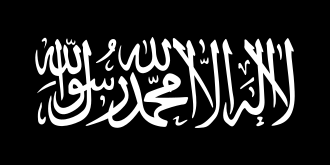
al-Qaeda is a pan-Islamist militant organization led by Sunni Islamist jihadists who self-identify as a vanguard spearheading a global Islamist revolution to unite the Muslim world under a supra-national Islamic caliphate. Its membership is primarily composed of Arabs, with additional representation from other ethnic groups. Al-Qaeda has mounted attacks on civilian and military targets of the U.S. and its allies; such as the 1998 U.S. embassy bombings, the USS Cole bombing, and the September 11 attacks. It has been designated a terrorist organization by the United Nations and over two dozen countries around the world.
The organization was founded in a series of meetings held in Peshawar during 1988, attended by Abdullah Yusuf Azzam, Osama bin Laden, Mohammed Atef, Ayman Al-Zawahiri and other veterans of the Soviet–Afghan War. Building upon the networks of Maktab Al-Khidamat, the founding members decided to create the organization to serve as a "vanguard" for jihad. When Iraqi forces invaded and occupied Kuwait in 1990, bin Laden offered to support Saudi Arabia by sending his mujahideen fighters. His offer was rebuffed by the Saudi government, which instead sought the aid of the United States. The stationing of U.S. troops in the Arabian Peninsula prompted bin Laden to declare a jihad against both the rulers of Saudi Arabia – whom he denounced as murtadd (apostates) – and against the US. From 1992, al-Qaeda established its headquarters in Sudan until it was expelled in 1996. It then shifted its base to the Taliban-ruled Afghanistan and later expanded to other parts of the world, primarily in the Middle East and South Asia. In 1996 and 1998, bin Laden issued two fatwās that demanded the withdrawal of U.S. troops from Saudi Arabia.
In 1998, al-Qaeda conducted the US embassy bombings in Kenya and Tanzania, which killed 224 people. The U.S. retaliated by launching Operation Infinite Reach, against al-Qaeda targets in Afghanistan and Sudan. In 2001, al-Qaeda carried out the September 11 attacks, resulting in nearly 3,000 deaths, long-term health consequences of nearby residents, damage to global economic markets, the triggering of drastic geo-political changes as well as generating profound cultural influence across the world. The U.S. launched the war on terror in response and invaded Afghanistan to depose the Taliban and destroy al-Qaeda. In 2003, a U.S.-led coalition invaded Iraq, overthrowing the Ba'athist regime which they falsely accused of having ties with al-Qaeda. In 2004, al-Qaeda launched its Iraqi regional branch. After pursuing him for almost a decade, the U.S. military killed bin Laden in Pakistan in May 2011.

Al-Qaeda members believe that a Judeo-Christian alliance led by the U.S. is waging a war against Islam and conspiring to destroy Islam. Al-Qaeda also opposes man-made laws, and seek to implement sharia law in Muslim countries. Al-Qaeda fighters characteristically deploy tactics such as suicide attacks (Inghimasi and Istishhadi operations) involving simultaneous bombing of several targets in battle-zones. Al-Qaeda's Iraq branch, which later morphed into the Islamic State of Iraq after 2006, was responsible for numerous sectarian attacks against Shias during the Iraqi insurgency. Al-Qaeda ideologues envision the violent removal of all foreign and secularist influences in Muslim countries, which it denounces as corrupt deviations. Following the death of bin Laden in 2011, al-Qaeda vowed to avenge his killing. The group was then led by Egyptian Ayman Al-Zawahiri, until he too was killed by the U.S. in 2022. As of 2021, they have reportedly suffered from a deterioration of central command over its regional operations.
Name
The English name of the organization is a simplified transliteration of the Arabic noun al-qāʿidah (القاعدة), which means "the foundation" or "the base". The initial al- is the Arabic definite article "the", hence "the base". In Arabic, al-Qaeda has four syllables (/alˈqaː.ʕi.da/). However, since two of the Arabic consonants in the name are not phones found in the English language, the common naturalized English pronunciations include , and . Al-Qaeda's name can also be transliterated as al-Qaida, al-Qa'ida, or el-Qaida.
The doctrinal concept of al-Qaeda was first coined by the Palestinian Islamist scholar and jihadist leader Abdullah Azzam in an April 1988 issue of Al-Jihad magazine to describe a religiously committed vanguard of Muslims who wage armed jihad globally to liberate oppressed Muslims from foreign invaders, establish sharia (Islamic law) across the Islamic world by overthrowing the ruling secular governments; and thus restore the past Islamic prowess. This was to be implemented by establishing an Islamic state that would nurture generations of Muslim soldiers that would perpetually attack Americans and the U.S.' allied governments in the Islamic world. Numerous historical models were cited by Azzam as successful examples of his call; starting from the early Muslim conquests of the 7th century to the recent anti-Soviet Afghan mujahideen of the 1980s. According to Azzam's world-view: It is about time to think about a state that would be a solid base for the distribution of the (Islamic) creed, and a fortress to host the preachers from the hell of the Jahiliyyah [the pre-Islamic period].

Bin Laden explained the origin of the term in 2001:
The name 'al-Qaeda' was established a long time ago by mere chance. The late Abu Ebeida El-Banashiri established the training camps for our mujahedeen against Russia's terrorism. We used to call the training camp al-Qaeda. The name stayed.
It has been argued that two documents seized from the Sarajevo office of the Benevolence International Foundation prove the name was not simply adopted by the mujahideen movement and that a group called al-Qaeda was established in August 1988. Both of these documents contain minutes of meetings held to establish a new military group, and contain the term "al-Qaeda".

Former British Foreign Secretary Robin Cook wrote that the word al-Qaeda should be translated as "the database", because it originally referred to the computer file of the thousands of mujahideen militants who were recruited and trained with CIA help to defeat the Soviets. In April 2002, the group assumed the name Qa'idat Al-Jihad (قاعدة الجهاد qāʿidat al-jihād), which means "the base of Jihad". According to Diaa Rashwan, this was "apparently as a result of the merger of the overseas branch of Egypt's Al-Jihad, which was led by Ayman al-Zawahiri, with the groups bin Laden brought under his control after his return to Afghanistan in the mid-1990s."
Organization
Al-Qaeda only indirectly controls its day-to-day operations. Its philosophy calls for the centralization of decision making, while allowing for the decentralization of execution. The top leaders of al-Qaeda have defined the organization's ideology and guiding strategy, and they have also articulated simple and easy-to-receive messages. At the same time, mid-level organizations were given autonomy, but they had to consult with top management before large-scale attacks and assassinations. Top management included the shura council as well as committees on military operations, finance, and information sharing. Through the information committees of al-Qaeda, al-Zawahiri placed special emphasis on communicating with his groups. However, after the war on terror, al-Qaeda's leadership has become isolated. As a result, the leadership has become decentralized, and the organization has become regionalized into several al-Qaeda groups.
The group was initially dominated by Egyptians and Saudis, with some participation from Yemenis and Kuwaitis. Over time, it has evolved into a more international terrorist organization. While its core group originally shared a background in Egypt and the Arabian Peninsula, it has since attracted fighters from other Arab groups, including North Africans, Jordanians, Palestinians, and Iraqis. In the decade following the 9/11 attacks, Muslims from non-Arab backgrounds, such as Pakistanis, Afghans, Turks, Kurds, and European converts to Islam, have also joined the organization.

Many Western analysts do not believe that the global jihadist movement is driven at every level by al-Qaeda's leadership. However, bin Laden held considerable ideological influence over revolutionary Islamist movements across the world. Experts argue that al-Qaeda has fragmented into a number of disparate regional movements, and that these groups bear little connection with one another.
This view mirrors the account given by bin Laden in a 2001 interview:
"this matter isn't about any specific person and ... is not about the al-Qa'idah Organization. We are the children of an Islamic Nation, with Prophet Muhammad as its leader, our Lord is one ... and all the true believers [mu'mineen] are brothers. So the situation isn't like the West portrays it, that there is an 'organization' with a specific name (such as 'al-Qa'idah') and so on. That particular name is very old. It was born without any intention from us. Brother Abu Ubaida ... created a military base to train the young men to fight against the vicious, arrogant, brutal, terrorizing Soviet empire ... So this place was called 'The Base' ['Al-Qa'idah'], as in a training base, so this name grew and became. We aren't separated from this nation. We are the children of a nation, and we are an inseparable part of it, and from those public demonstrations which spread from the far east, from the Philippines to Indonesia, to Malaysia, to India, to Pakistan, reaching Mauritania ... and so we discuss the conscience of this nation."

As of 2010, however, Bruce Hoffman saw al-Qaeda as a cohesive network that was strongly led from the Pakistani tribal areas.
Affiliates
Al-Qaeda has the following direct affiliates:
The following are presently believed to be allied with al-Qaeda:
Al-Qaeda's former affiliates or allies include the following:
Leadership
Osama bin Laden (1988 – May 2011)
Osama bin Laden served as the emir of al-Qaeda from the organization's founding in 1988 until his assassination by US forces on May 2, 2011. Atiyah Abd Al-Rahman was alleged to be second in command prior to his death on August 22, 2011.
Bin Laden was advised by a Shura Council, which consists of senior al-Qaeda members. The group was estimated to consist of 20–30 people.
After May 2011
Ayman al-Zawahiri had been al-Qaeda's deputy emir and assumed the role of emir following bin Laden's death. Al-Zawahiri replaced Saif Al-Adel, who had served as interim commander.
On 4 June 2012, Al-Rahman's alleged successor as his second in command, Abu Yahya Al-Libi, was killed in Pakistan.
Nasir Al-Wuhayshi was alleged to have become al-Qaeda's overall second in command and general manager in 2013. He was concurrently the leader of al-Qaeda in the Arabian Peninsula (AQAP) until he was killed by a US airstrike in Yemen in June 2015. Abu Khayr Al-Masri, Wuhayshi's alleged successor as the deputy to al-Zawahiri, was killed by a U.S. airstrike in Syria in February 2017. Al-Qaeda's next alleged number two leader, Abdullah Ahmed Abdullah, was killed by Israeli agents. His pseudonym was Abu Muhammad Al-Masri, who was killed in November 2020 in Iran. He was involved in the 1998 bombings of the U.S. embassies in Kenya and Tanzania.
Al-Qaeda's network was built from scratch as a conspiratorial network which drew upon the leadership of a number of regional nodes. The organization divided itself into several committees, which include:
The Military Committee, which is responsible for training operatives, acquiring weapons, and planning attacks.
The Money/Business Committee, which funds the recruitment and training of operatives through the hawala banking system. US-led efforts to eradicate the sources of "terrorist financing" were most successful in the year immediately following the September 11 attacks. Al-Qaeda continues to operate through unregulated banks, such as the 1,000 or so hawaladars in Pakistan, some of which can handle deals of up to US$10 million. The committee also procures false passports, pays al-Qaeda members, and oversees profit-driven businesses. In the 9/11 Commission Report, it was estimated that al-Qaeda required $30 million per year to conduct its operations.
The Law Committee reviews Sharia law, and decides upon courses of action conform to it.
The Islamic Study/Fatwah Committee issues religious edicts, such as an edict in 1998 telling Muslims to kill Americans.
The Media Committee ran the now-defunct newspaper Nashrat al Akhbar ("Newscast") and handled public relations.
In 2005, al-Qaeda formed As-Sahab, a media production house, to supply its video and audio materials.
After Al-Zawahiri (2022 – present)
Al-Zawahiri was killed on July 31, 2022, in a drone strike in Afghanistan. In 2023, a UN report concluded that de facto leadership of al-Qaeda had passed to Saif Al-Adel, who was operating out of Iran. Adel, a former Egyptian army officer, became a military instructor in al-Qaeda camps in the 1990s and was known for his involvement in the Battle of Mogadishu. The report stated that Al-Adel's leadership could not officially be declared by al-Qaeda because of "political sensitivities" of Afghan government in acknowledging the death of al-Zawahiri as well as due to "theological and operational" challenges posed by the location of Al-Adel in Iran.
Command structure
Most of al-Qaeda's top leaders and operational directors were veterans who fought against the Soviet invasion of Afghanistan in the 1980s. bin Laden and al-Zawahiri were the leaders who were considered the operational commanders of the organization. Nevertheless, al-Qaeda was not operationally managed by al-Zawahiri. Several operational groups exist, which consult with the leadership in situations where attacks are in preparation. "... al-Zawahiri does not claim to have direct hierarchical control over al Qaeda's vast, networked structure. Al-Qaeda's core leadership seeks to centralize the organization's messaging and strategy rather than to manage the daily operations of its franchises. But formal affiliates are required to consult with al-Qaeda's core leadership before carrying out large-scale attacks." Al-Qaeda central (AQC) is a conglomerate of expert committees, each in supervision of distinct tasks and objectives. Its membership is mostly composed of Egyptian Islamist leaders who participated in the anti-communist Afghan Jihad. Assisting them are hundreds of Islamic field operatives and commanders, based in various regions of the Islamic world. The central leadership assumes control of the doctrinal approach and overall propaganda campaign; while the regional commanders were empowered with independence in military strategy and political maneuvering. This novel hierarchy made it possible for the organisation to launch wide-range offensives.
Nasser Al-Bahri, who was bin Laden's bodyguard for four years in the run-up to 9/11 wrote in his memoir a highly detailed description of how the group functioned at that time. Al-Bahri described al-Qaeda's formal administrative structure and vast arsenal. However, the author Adam Curtis argued that the idea of al-Qaeda as a formal organization is primarily an American invention. Curtis contended the name "al-Qaeda" was first brought to the attention of the public in the 2001 trial of bin Laden and the four men accused of the 1998 US embassy bombings in East Africa. Curtis wrote:
The reality was that bin Laden and Ayman al-Zawahiri had become the focus of a loose association of disillusioned Islamist militants who were attracted by the new strategy. But there was no organization. These were militants who mostly planned their own operations and looked to bin Laden for funding and assistance. He was not their commander. There is also no evidence that bin Laden used the term "al-Qaeda" to refer to the name of a group until after September 11 attacks, when he realized that this was the term the Americans had given it.
During the 2001 trial, the U.S. Department of Justice needed to show that bin Laden was the leader of a criminal organization in order to charge him in absentia under the Racketeer Influenced and Corrupt Organizations Act. The name of the organization and details of its structure were provided in the testimony of Jamal Al-Fadl, who said he was a founding member of the group and a former employee of bin Laden. Questions about the reliability of Al-Fadl's testimony have been raised by a number of sources because of his history of dishonesty, and because he was delivering it as part of a plea bargain agreement after being convicted of conspiring to attack US military establishments. Sam Schmidt, a defense attorney who defended Al-Fadl, said:
There were selective portions of al-Fadl's testimony that I believe was false, to help support the picture that he helped the Americans join together. I think he lied in a number of specific testimony about a unified image of what this organization was. It made al-Qaeda the new Mafia or the new Communists. It made them identifiable as a group and therefore made it easier to prosecute any person associated with al-Qaeda for any acts or statements made by bin Laden.
Field operatives
The number of individuals in the group who have undergone proper military training, and are capable of commanding insurgent forces, is largely unknown. Documents captured in the raid on bin Laden's compound in 2011 show that the core al-Qaeda membership in 2002 was 170. In 2006, it was estimated that al-Qaeda had several thousand commanders embedded in 40 countries. As of 2009, it was believed that no more than 200–300 members were still active commanders.
According to the 2004 documentary The Power of Nightmares, al-Qaeda was so weakly linked together that it only consisted of bin Laden and a small clique of close associates. The lack of any significant numbers of convicted al-Qaeda members, despite a large number of arrests on terrorism charges, was cited by the documentary as a reason to doubt whether a widespread entity that met the description of al-Qaeda existed. Al-Qaeda's commanders, as well as its sleeping agents, are hiding in different parts of the world to this day. They are mainly hunted by the American and Israeli secret services.
Insurgent forces
As of 2006, al-Qaeda maintained two separate forces which are deployed alongside insurgents in Iraq and Pakistan. The first, numbering in the tens of thousands, was "organized, trained, and equipped as insurgent combat forces" in the Soviet–Afghan war. The force was composed primarily of foreign mujahideen from Saudi Arabia and Yemen. Many of these fighters went on to fight in Bosnia and Somalia for global jihad. Another group, which numbered 10,000 in 2006, live in the West and have received rudimentary combat training.
Other analysts have described al-Qaeda's rank and file as being "predominantly Arab" in its first years of operation, but that the organization also includes "other peoples" as of 2007. It has been estimated that 62 percent of al-Qaeda members have a university education. In 2011 and the following year, the Americans successfully settled accounts with bin Laden, Anwar Al-Awlaki, the organization's chief propagandist, and Abu Yahya Al-Libi's deputy commander. The optimistic voices were already saying it was over for al-Qaeda. Nevertheless, it was around this time that the Arab Spring greeted the region, the turmoil of which came great to al-Qaeda's regional forces. Seven years later, al-Zawahiri became arguably the number one leader in the organization, implementing his strategy with systematic consistency. Tens of thousands loyal to al-Qaeda and related organizations were able to challenge local and regional stability and ruthlessly attack their enemies in the Middle East, Africa, South Asia, Southeast Asia, Europe and Russia alike. In fact, from Northwest Africa to South Asia, al-Qaeda had more than two dozen "franchise-based" allies. The number of al-Qaeda militants was set at 20,000 in Syria alone, and they had 4,000 members in Yemen and about 7,000 in Somalia. The war was not over.
In 2001, al-Qaeda had around 20 functioning cells and 70,000 insurgents spread over sixty nations. According to latest estimates, the number of active-duty soldiers under its command and allied militias have risen to approximately 250,000 by 2018.
Financing
Al-Qaeda usually does not disburse funds for attacks, and very rarely makes wire transfers. In the 1990s, financing came partly from the personal wealth of bin Laden. Other sources of income included the heroin trade and donations from supporters in Kuwait, Saudi Arabia, and other Gulf states. A 2009 leaked diplomatic cable stated that "terrorist funding emanating from Saudi Arabia remains a serious concern."
Among the first pieces of evidence regarding Saudi Arabia's support for al-Qaeda was the "Golden Chain", a handwritten list of early al-Qaeda funders seized during a 2002 raid in Sarajevo by Bosnian police. The list was validated by al-Qaeda defector Jamal Al-Fadl, and included the names of both donors and beneficiaries. Bin Laden's name appeared seven times among the beneficiaries, while 20 Saudi and Gulf-based businessmen and politicians were listed among the donors. Notable donors included Adel Batterjee, and Wael Hamza Julaidan. Batterjee was designated as a terror financier by the U.S. Department of the Treasury in 2004, and Julaidan is recognized as one of al-Qaeda's founders.
Documents seized during the 2002 Bosnia raid showed that al-Qaeda widely exploited charities to channel financial and material support to its operatives across the globe. Notably, this activity exploited the International Islamic Relief Organization (IIRO) and the Muslim World League (MWL). The IIRO had ties with al-Qaeda associates worldwide, including al-Zawahiri. Al-Zawahiri's brother worked for the IIRO in Albania and had actively recruited on behalf of al-Qaeda. The MWL was openly identified by al-Qaeda's leader as one of the three charities al-Qaeda primarily relied upon for funding sources.
Allegations of Qatari support
Several Qatari citizens have been accused of funding al-Qaeda. This includes Abd Al-Rahman Al-Nuaimi, a Qatari citizen and a human-rights activist who founded the Swiss-based non-governmental organization (NGO) Alkarama. In 2013, the U.S. Treasury designated Nuaimi as a terrorist for his activities supporting al-Qaeda. The U.S. Treasury Department has said Nuaimi "has facilitated significant financial support to al-Qaeda in Iraq, and served as an interlocutor between al-Qaeda in Iraq and Qatar-based donors".
Nuaimi was accused of overseeing a $2 million monthly transfer to al-Qaeda in Iraq as part of his role as mediator between Iraq-based al-Qaeda senior officers and Qatari citizens. Nuaimi allegedly entertained relationships with Abu-Khalid Al-Suri, Al-Qaeda's top envoy in Syria, who processed a $600,000 transfer to al-Qaeda in 2013. Nuaimi is also known to be associated with Abd Al-Wahhab Muhammad 'Abd Al-Rahman Al-Humayqani, a Yemeni politician and founding member of Alkarama, who was listed as a Specially Designated Global Terrorist (SDGT) by the U.S. Treasury Department in 2013. The U.S. authorities claimed that Humayqani exploited his role in Alkarama to fundraise on behalf of al-Qaeda in the Arabian Peninsula (AQAP). A prominent figure in AQAP, Nuaimi was also reported to have facilitated the flow of funding to AQAP affiliates based in Yemen. Nuaimi was also accused of investing funds in the charity directed by Humayqani to ultimately fund AQAP. About ten months after being sanctioned by the US Treasury, Nuaimi was also restrained from doing business in the UK.
Another Qatari citizen, Kalifa Mohammed Turki Subayi, was sanctioned by the US Treasury on June 5, 2008, for his activities as a "Gulf-based al-Qaeda financier". Subayi's name was added to the UN Security Council's Sanctions List in 2008 on charges of providing financial and material support to al-Qaeda senior leadership. Subayi allegedly moved al-Qaeda recruits to South Asia-based training camps. He also financially supported Khalid Sheikh Mohammed, a Pakistani national and senior al-Qaeda officer who is believed to be the mastermind behind the September 11 attacks according to the 9/11 Commission Report.