
Adi Shankara (8th c. CE), also called Adi Shankaracharya (Sanskrit: आदि शङ्कर, आदि शङ्कराचार्य, romanized: Ādi Śaṅkara, Ādi Śaṅkarācārya, lit. 'First Shankaracharya', pronounced [aːd̪i ɕɐŋkɐraːt͡ɕaːrjɐ]), was an Indian Vedic scholar-monk, philosopher, and teacher (acharya) of Advaita Vedanta. He wrote influential commentaries on the Brahma sutras and other texts, and in recent times is often revered as the most important Indian philosopher. Reliable information on Shankara's actual life is scant, and the historical influence of his works on Hindu intellectual thought has been questioned. The historical Shankara was probably relatively unknown and Vaishnava-oriented and his true impact lies in the popular perception of him as a heroic religious leader who re-established traditional Hinduism.
Until the 10th century Shankara was overshadowed by his older contemporary Maṇḍana Miśra, and there is no mention of him in concurrent Hindu, Buddhist or Jain sources until the 11th century. The legendary Shankara was created in the 14th century, centuries after his death, when Sringeri matha (Sanskrit: मठ)(maṭha) (monasteries) started to receive patronage from the emperors of the Vijayanagara Empire and shifted their allegiance from Advaitic Agamic Shaivism (Śaivism) to Brahmanical Advaita orthodoxy. Hagiographies dating from the 14th-17th centuries deified him as a ruler-renunciate, travelling on a digvijaya (conquest of the four quarters) across the Indian subcontinent to propagate his philosophy, defeating his opponents in theological debates. These hagiographies also portray him as founding four mathas. Adi Shankara also came to be regarded as the organiser of the Dashanami monastic order, and the unifier of the Shanmata tradition of worship. The title of Shankaracharya, used by heads of certain monasteries in India, is derived from his name. Tradition also portrays him as the one who reconciled the various sects (Vaishnavism, Shaivism, and Shaktism) with the introduction of the Panchayatna (Pañcāyatana) form of worship, the simultaneous worship of five deities – Ganesha, Surya, Vishnu, Shiva, and Devi, arguing that all deities were but different forms of the one Brahman, the invisible Supreme Being.
Owing to his later fame over 300 texts are attributed to him, including commentaries (Bhashya, Bhāṣya), introductory topical expositions (Prakaraṇa grantha) and poetry (Stotra). However, most of these are likely to have been written by admirers, or pretenders, or scholars with an eponymous name. Works known to have been written by Shankara himself are the Brahmasutrabhasya, his commentaries on ten principal Upanishads, his commentary on the Bhagavad Gita, and the Updeshsahasri (Upadeśasāhasrī). The authenticity of Shankara as the author of Vivekchudamani (Vivekacūḍāmaṇi) has been questioned and mostly rejected by scholarship.

His authentic works present a harmonizing reading of the shastras, with liberating knowledge of the self at its core, synthesizing the inherited Advaita Vedanta teachings of his time. The central concern of Shankara's writings was the liberating knowledge of the true identity of jivatman (jīvātman) (individual self) as Atman (Ātman-Brahman), emphasizing that "right knowledge arises at the moment of hearing" the mahavakyas (mahāvākyas), without the need of meditating on them. These mahavakyas are found in the Upanishads, which Shankara saw as the authoritative means of knowledge, beyond the ritually oriented Mimansa (Mīmāṃsā)-exegesis of the Vedas. Shankara's Advaita showed influences from Mahayana Buddhism, despite Shankara's critiques; and Hindu Vaishnava opponents have even accused Shankara of being a "crypto-Buddhist," a qualification which is rejected by the Advaita Vedanta tradition, highlighting their respective views on Atman, Anatman (Anātman) and Brahman.
Dating
Several different dates have been proposed for Shankara. While the Advaita tradition assigns him to the 5th century BCE, the scholarly-accepted dating places Shankara to be a scholar from the first half of the 8th century CE.
Matha datings
The prominent Advaita-mathas date Shankara to the 5th century BCE. This dating is based on records of the heads of the Shankara's cardinal institutions Maṭhas. The exact dates of birth of Adi Shankaracharya believed by several monasteries are Kali 2593 (509 BCE) according to the Kanchipuram, 507 BCE according to Govardhan Math, 491 BCE according to Dvarka (Dvārakā), 485 BCE according to Jyotirmath, 484 BCE according to Jagannatha Puri, and 483 BCE according to Sringeri.

The records of the Sringeri Matha state that Shankara was born in the 14th year of the reign of "Vikramaditya", but it is unclear to which king this name refers. Though some researchers identify the name with Chandragupta II (4th century CE), modern scholarship accepts the Vikramaditya as being from the Chalukya dynasty of Badami, most likely Vikramaditya II (733–746 CE).
Scholarly datings
788–820 CE: This was proposed by late 19th and early twentieth century scholars, following K.P. Tiele, and was customarily accepted by scholars such as Max Müller, Macdonnel, Pathok, Deussen and Radhakrishna. Though the 788–820 CE dates are widespread in 20th-century publications, recent scholarship has questioned the 788–820 CE dates.
c. 700 – c. 750 CE: Late 20th-century and early 21st-century scholarship tends to place Shankara's life in the first half of the 8th century. This estimate is based on the probable earliest and latest limits for his lifetime. His works contains traces of debates with Buddhist and Mimansa authors from the 5th-7th century, setting the earliest limit at c. 650 CE. The latest limit is established by Vachaspati Mishra's commentary on Sankara's work, dated first half of the 9th century, thus setting the latest limit for Sankara at c. 800 CE.

Other datings
44–12 BCE: the commentator Anandagiri believed he was born at Chidambaram in 44 BCE and died in 12 BCE.
6th century CE: Telang placed him in this century. Sir R.G. Bhandarkar believed he was born in 680 CE.
805–897 CE: Venkiteswara not only places Shankara later than most, but also had the opinion that it would not have been possible for him to have achieved all the works apportioned to him, and has him live ninety-two years.

Traditional and historical views on Shankara
Traditional views of Shankara
Shankara has an unparalleled status in the tradition of Advaita Vedanta. Hagiographies from the 14th-17th centuries portray him as a victor who travelled all over India to help restore the study of the Vedas. According to Frank Whaling, some Hindus, particularly those who follow Advaita, view Shankara as someone who defended Hindu dharma in response to Buddhist and Jain challenges and contributed to the decline of Buddhism in India. His teachings and tradition are central to Smartism and have influenced Sant Mat lineages. Tradition portrays him as the one who reconciled the various sects (Vaishnavism, Shaivism, and Shaktism) with the introduction of the Panchayatna form of worship, the simultaneous worship of five deities – Ganesha, Surya, Vishnu, Shiva and Devi, arguing that all deities were but different forms of the one Brahman, the invisible Supreme Being, implying that Advaita Vedanta stood above all other traditions.
Historical Shankara and (lack of) early influence (until 10th century)
Scholars have questioned Shankara's early influence in India. The Buddhist scholar Richard E. King states,
Although it is common to find Western scholars and Hindus arguing that Shankaracharya was the most influential and important figure in the history of Hindu intellectual thought, this does not seem to be justified by the historical evidence.
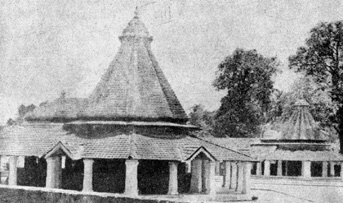
According to numerous scholars, Shankara and other early Advaitins were probably Vaishnavites, or at least teaching in a Vaishnava-oriented milieu, and Shankara may have had a Pancharatra background.
According to Clark, "Shankara was relatively unknown during his life-time, and probably for several centuries after, as there is no mention of him in Buddhist or Jain sources for centuries; nor is he mentioned by other important philosophers of the ninth and tenth centuries." According to King, until the 10th century, Shankara's works seem to have been overshadowed by his older contemporary Maṇḍana Miśra; Roodurmun notes that Maṇḍana was considered the major representative of Advaita. Maṇḍana Miśra, a Mimansa scholar, follower of Kumarila Bhatta, and older contemporary of Shankara, wrote the Brahma-siddhi, a seminal text on Advaita that has survived into the modern era. The "theory of error" set forth in the Brahma-siddhi became the normative in later Advaita Vedanta discussion of error. His student Vachaspati Miśra, who is believed by Advaita tradition to have been an incarnation of Shankara to popularize the Advaita view, wrote the Bhamati (Bhāmatī), a commentary on Shankara's Brahma Sutra Bhashya, and the Brahmatattva-samiksa, a commentary on Mandana Mishra's Brahma-siddhi. His thought was mainly inspired by Mandana Mishra, and harmonises Shankara's thought with that of Mandana Mishra. The Bhamati school takes an ontological approach. It sees the jiva (jīva) as the source of avidya (avidyā). It sees meditation as the main factor in the attainment of liberation, while the study of the Vedas and reflection are additional factors. The later Advaita Vedanta tradition identified Maṇḍana Mishra with Sureśvara, Shankara's pupil, believing that Maṇḍana Mishra became a disciple of Shankara after a public debate which Shankara won.
According to Satchidanandendra Sarasvati, "almost all the later Vedantins were influenced" by Mandana Mishra and Bhaskara "in working out their own line of thought". Potter notes that modern interpreters of Advaita such as Satchidanandendra Sarasvati argue that most post-Shankara Advaita Vedanta actually deviates from Shankara, and that only his student Sureśvara - whose interpretation had little influence, represents Shankara correctly. In this view, Shankara's influential student Padmapada misunderstood Shankara, while his views were maintained by the Sureshvara school.
Vaishnavite Vedanta (10th-14th century)
Hajime Nakamura states that prior to Shankara, views similar to his already existed, but did not occupy a dominant position within the Vedanta. Until the 11th century, Vedanta itself was a peripheral school of thought; Vedanta became a major influence when it was utilized by various sects of Hinduism to ground their doctrines. The early Vedanta scholars were from the upper classes of society, well-educated in traditional culture. They formed a social elite, "sharply distinguished from the general practitioners and theologians of Hinduism." Their teachings were "transmitted among a small number of selected intellectuals". Works of the early Vedanta schools do not contain references to Vishnu or Shiva. It was only after Shankara that "the theologians of the various sects of Hinduism utilized Vedanta philosophy to a greater or lesser degree to form the basis of their doctrines," whereby "its theoretical influence upon the whole of Indian society became final and definitive." Examples are Ramanuja (11th c.), who aligned bhakti, "the major force in the religions of Hinduism," with philosophical thought, meanwhile rejecting Shankara's views, and the Nath-tradition.
Vijayanagara Empire and Vidyaranya (14th century) - creation of legendary (hagiographic) views
In medieval times, Advaita Vedanta position as most influential Hindu darsana started to take shape, as Advaitins in the Vijayanagara Empire competed for patronage from the royal court, and tried to convert others to their sect. It is only during this period that the historical fame and cultural influence of Shankara and Advaita Vedanta was established. Many of Shankara's biographies were created and published in and after the 14th century, such as Vidyaranya's widely cited Śankara-vijaya. Vidyaranya, also known as Madhava, who was the 12th Jagadguru of the Śringeri Śarada Pītham from 1380 to 1386 and a minister in the Vijayanagara Empire, inspired the re-creation of the Hindu Vijayanagara Empire of South India. This may have been in response to the devastation caused by the Islamic Delhi Sultanate, but his efforts were also targeted at Sri Vaishnava groups, especially Visishtadvaita, which was dominant in territories conquered by the Vijayanagara Empire. Furthermore, sects competed for patronage from the royal court, and tried to convert others to their own sectarian system. Vidyaranya and his brothers, note Paul Hacker and other scholars, wrote extensive Advaitic commentaries on the Vedas and Dharma to make "the authoritative literature of the Aryan religion" more accessible. Vidyaranya was an influential Advaitin, and he created legends to turn Shankara, whose elevated philosophy had no appeal to gain widespread popularity, into a "divine folk-hero who spread his teaching through his digvijaya ("universal conquest," see below) all over India like a victorious conqueror." In his doxography Sarvadarśanasaṅgraha ("Summary of all views") Vidyaranya presented Shankara's teachings as the summit of all darsanas, presenting the other darsanas as partial truths which converged in Shankara's teachings, which was regarded to be the most inclusive system. The Vaishanava traditions of Dvaita and Visishtadvaita were not classified as Vedanta, and placed just above Buddhism and Jainism, reflecting the threat they posed for Vidyaranya's Advaita allegiance. Bhedabheda wasn't mentioned at all, "literally written out of the history of Indian philosophy." Such was the influence of the Sarvadarśanasaṅgraha, that early Indologists also regarded Advaita Vedanta as the most accurate interpretation of the Upanishads. And Vidyaranya founded a matha, proclaiming that it was established by Shankara himself. Vidyaranya enjoyed royal support, and his sponsorship and methodical efforts helped establish Shankara as a rallying symbol of values, spread historical and cultural influence of Shankara's Vedānta philosophies, and establish mathas to expand the cultural influence of Shankara and Advaita Vedānta.
Hagiographies: Digvijaya - "The conquests of Shankara" (14th-17th century)
Reliable information on Shankara's actual life is scanty. His existing biographies are not historical accurate documents, but politically motivated hagiographies which were all written several centuries after his time and abound in legends and improbable events, creating the popular image of Shankara as "a religious leader who harmonized the major Hindu traditions, visited various temples, and composed hymns."
Early life
According to the oldest hagiographies, Shankara was born in the southern Indian state of Kerala, in a village named Kaladi sometimes spelled as Kalati or Karati. His parents were an aged, childless, couple who led a devout life of service to the poor. They named their child Shankara, meaning "giver of prosperity". His father died while Shankara was very young. Shankara's upanayanam, the initiation into student-life, had to be delayed due to the death of his father, and was then performed by his mother.
Sannyasa
Shankara's hagiographies describe him as someone who was attracted to the life of Sannyasa (hermit) from early childhood. His mother disapproved. A story, found in every hagiography, describes Shankara at age eight going to a river with his mother, Sivataraka, to bathe, where he is caught by a crocodile. Shankara calls out to his mother to give him permission to become a Sannyasin (a religious ascetic), or else the crocodile will kill him. The mother agrees and Shankara is freed, and leaves his home for education. He reaches a Saivite sanctuary along a river in a north-central state of India, and becomes the disciple of a teacher named Govinda Bhagavatpada. The stories in various hagiographies diverge in details about the first meeting between Shankara and his Guru, where they met, as well as what happened later. Several texts suggest Shankara's schooling with Govindapada happened along the river Narmada in Omkareshwar, but a few place it along the River Ganges in Kashi (Varanasi) as well as Badari (Badrinath in the Himalayas).
The hagiographies vary in their description of where he went, who he met and debated and many other details of his life. Most mention Shankara studying the Vedas, Upanishads and Brahmasutra with Govindapada, and Shankara authoring several key works in his youth, while he was studying with his teacher. It is with his teacher Govinda, that Shankara studied Gaudapadiya Karika, as Govinda was himself taught by Gaudapada. Most also mention a meeting with scholars of the Mimansa school of Hinduism namely Kumarila and Prabhakara, as well as Mandana and various Buddhists, in Shastrartha (an Indian tradition of public philosophical debates attended by large number of people, sometimes with royalty).
Travels (Digvijaya) and disciples
Thereafter, the hagiographies about Shankara vary significantly. Different and widely inconsistent accounts of his life include diverse journeys, pilgrimages, public debates, installation of yantras and lingas, as well as the founding of monastic centers in north, east, west, and south India.
While the details and chronology vary, most hagiographies present Shankara as traveling widely within India, Gujarat to Bengal, and participating in public philosophical debates with different orthodox schools of Hindu philosophy, as well as heterodox traditions such as Buddhists, Jains, Arhatas, Saugatas, and Charvakas. The hagiographies credit him with starting several matha (monasteries), but this is uncertain. Ten monastic orders in different parts of India are generally attributed to Shankara's travel-inspired Sannyasin schools, each with Advaita notions, of which four have continued in his tradition: Bharati (Sringeri), Sarasvati (Kanchi), Tirtha and Asramin (Dvaraka). Other monasteries that record Shankara's visit include Giri, Puri, Vana, Aranya, Parvata and Sagara – all names traceable to the Ashrama system in Hinduism and Vedic literature.
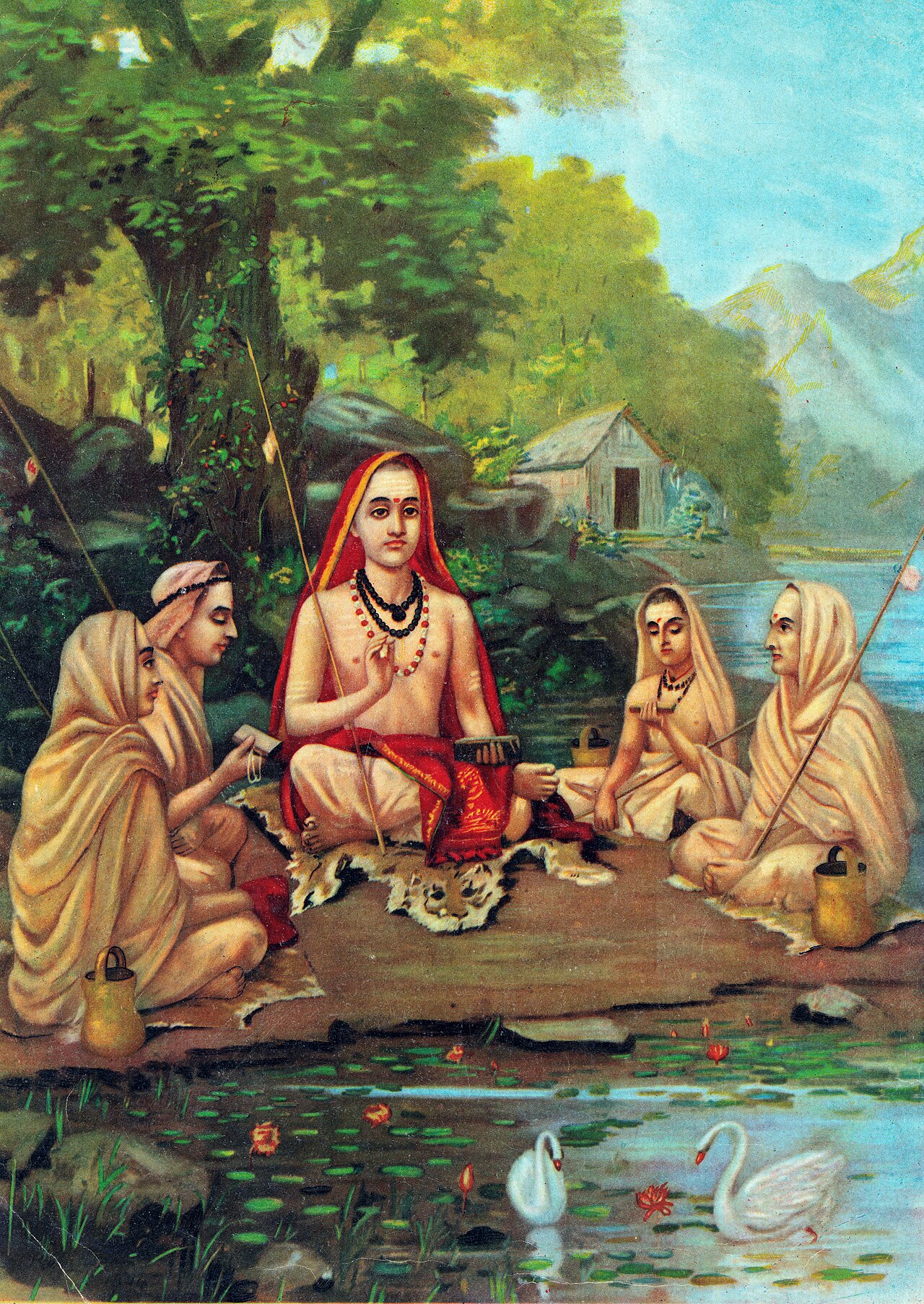
Shankara had a number of disciple scholars during his travels, including Padmapadacharya(also called Sanandana, associated with the text Atma-bodha), Sureśvaracharya, Totakacharya, Hastamalakacharya, Chitsukha, Prthividhara, Chidvilasayati, Bodhendra, Brahmendra, Sadananda and others, who authored their own literature on Shankara and Advaita Vedanta.
Death
According to hagiographies, associated with the four maths, Adi Shankara died at Kedarnath, a Hindu pilgrimage site in the Himalayas, located in the northern Indian state of Uttarakhand. Texts say that he was last seen by his disciples behind the Kedarnath temple, walking into the Himalayas until he could no longer be traced. Some texts locate his death in alternate locations such as Kanchipuram in Tamil Nadu or in Kerala. According to the hagiographies related to the monastery of Kanchi, Adi Shankara attains siddhi in Kanchi.
Hagiographies: attribution of Mathas and Smarta tradition (14-17th century)
Traditionally, Shankara is regarded as the founder of the Daśanāmi Sampradāya of Hindu monasticism, and the Panchayatana puja and Ṣaṇmata of the Smarta tradition.
Dashanami Sampradaya and mathas
Advaita Vedanta is, at least in the west, primarily known as a philosophical system. But it is also a tradition of renunciation. Philosophy and renunciation are closely related:
Most of the notable authors in the advaita tradition were members of the sannyasa tradition, and both sides of the tradition share the same values, attitudes and metaphysics.
In the 14th century an elaborate legend was created, presenting Shankara as an incarnation of Shiva to facilitate the adoption of his teachings by previously Shaiva (Śaiva)-oriented Mathas (Maṭhas) in the Vijayanagara Empire. From the 14th century onwards, hagiographies began to present Shankara as an incarnation of Shiva, portraying him as establishing the Daśanāmi Sampradaya, organizing a section of the Ekadandi monks under an umbrella grouping of ten names. Several other Hindu monastic and Ekadandi traditions, however, remained outside the organisation of the Dasanāmis.
According to tradition, Adi Sankara organised the Hindu monks of these ten sects or names under four mathas, with the headquarters at Dvārakā in the West, Jagannatha Puri in the East, Sringeri in the South and Badrikashrama in the North. Each matha was headed by one of his four main disciples, who each continues the Vedanta Sampradaya.
According to Paul Hacker, the system may have been initiated by Vidyaranya (14th c.), who may have founded a matha, proclaiming that it was established by Shankara himself, as part of his campaign to propagate Shankara's Advaita Vedanta. Vidyaranya enjoyed royal support, and his sponsorship and methodical efforts helped establish Shankara as a rallying symbol of values, spread historical and cultural influence of Shankara's Vedānta philosophies, and establish monasteries (mathas) to expand the cultural influence of Shankara and Advaita Vedānta.
Smarta Tradition
Traditionally, Shankara is regarded as the greatest teacher and reformer of the Smartism sampradaya, which is one of four major sampradaya of Hinduism. According to Alf Hiltebeitel, Shankara established the nondualist interpretation of the Upanishads as the touchstone of a revived smarta tradition:
Practically, Shankara fostered a rapprochement between Advaita and smarta orthodoxy, which by his time had not only continued to defend the varnasramadharma theory as defining the path of karman, but had developed the practice of pancayatanapuja ("five-shrine worship") as a solution to varied and conflicting devotional practices. Thus one could worship any one of five deities (Vishnu, Siva, Durga, Surya, Ganesa) as one's istadevata ("deity of choice").
Panchayatana puja (IAST Pañcāyatana pūjā) is a system of puja (worship) in the Smarta tradition. It consists of the worship of five deities set in a quincunx pattern, the five deities being Shiva, Vishnu, Devi, Surya, and an Ishta Devata such as Kartikeya, or Ganesha or any personal god of devotee's preference. Sometimes the Ishta Devata is the sixth deity in the mandala. while in the Shanmata system, Skanda, also known as Kartikeya and Murugan, is added. Panchayatana puja is a practice that became popular in medieval India, and has been attributed to Adi Shankara. However, archaeological evidence suggests that this practice long predates the birth of Adi Shankara.
Neo-Vedanta (19-20th century)
Shankara's position was further established in the 19th and 20th-century, when neo-Vedantins and western Orientalists elevated Advaita Vedanta "as the connecting theological thread that united Hinduism into a single religious tradition," and became "an iconic representation of Hindu religion and culture," despite the fact that most Hindus do not adhere to Advaita Vedanta.
21st century
Reflecting contemporary Hindu-nationalist culture politics, large statues of deities and other Hindu icons have recently been build, including 12-foot statue of Shankara at Kedarnath which was unveiled by Indian Prime Minister Narendra Modi. A 108-foot statue of Adi Shankara was unveiled near Omkareshwar Temple in Madhya Pradesh as part of a "temple tourism project" on 21 September 2023.
Works
Adi Shankara is highly esteemed in contemporary Advaita Vedanta, and over 300 texts are attributed to his name, including commentaries (Bhāṣya), original philosophical expositions (Prakaraṇa grantha) and poetry (Stotra). However, most of these are not authentic works of Shankara, and are likely to be written by his admirers, or scholars whose name was also Shankaracharya. Piantelli has published a complete list of works attributed to Adi Sankara, along with issues of authenticity for most.