
Aaron Charles Rodgers (born December 2, 1983) is an American professional football quarterback for the Pittsburgh Steelers of the National Football League (NFL). He played college football for the California Golden Bears, setting the school's record for lowest single-season and career interception rates before being selected by the Green Bay Packers in the first round of the 2005 NFL draft. He is regarded as one of the greatest and most talented quarterbacks of all time.
After backing up Brett Favre for the first three years of his NFL career, Rodgers became the Packers' starting quarterback in 2008. In the 2010 season, he led them to a victory in Super Bowl XLV, earning the Super Bowl MVP. He was named Associated Press Athlete of the Year in 2011, and was voted league MVP by the Associated Press for the 2011, 2014, 2020, and 2021 NFL seasons. Rodgers is the fifth player to win NFL MVP in consecutive seasons, joining Peyton Manning, Favre, Joe Montana and Jim Brown. Rodgers has led the NFL six times in touchdown-to-interception ratio (2011, 2012, 2014, 2018, 2020, 2021); six times in lowest passing interception percentage (2009, 2014, 2018, 2019, 2020, 2021); four times in passer rating (2011, 2012, 2020, 2021); and four times in touchdown passing percentage (2011, 2012, 2020, 2021); three times in total touchdowns (2011, 2016, 2020); twice in touchdown passes (2016, 2020) and once in yards per attempt (2011) and completion percentage (2020). In 2023, Rodgers was traded to the New York Jets, where he spent two seasons with the team. Released by the Jets after the 2024 season, Rodgers signed with the Steelers, whom he led to a division title that season.
Ranking first on the NFL's all-time regular-season career passer rating list, Rodgers is among the most efficient quarterbacks of all time. Apart from a regular-season career passer rating of over 100 (the first to ever have a career rating over 100), he also holds the best touchdown-to-interception ratio and the lowest passing interception percentage in NFL history while also having had the highest passer rating in NFL history throughout the entire 2010s decade. In the postseason, he is second in both touchdown passes and touchdown-to-interception ratio, fourth in passing yards, and eighth in all-time passer rating. In the regular season, he has the best touchdown-to-interception ratio in NFL history at 4.34, holds the league's second lowest career interception percentage at 1.4 percent and the highest single-season passer rating record of 122.5. Rodgers is also a four-time winner of the Best NFL Player ESPY Award.

Early life
Aaron Charles Rodgers was born on December 2, 1983, in Chico, California, the son of Darla Leigh (née Pittman) and Edward Wesley Rodgers. His father is a Texas-born chiropractor who played football as an offensive lineman for the Chico State Wildcats from 1973 to 1976. Rodgers is of English, Irish and German ancestry. The family moved to Ukiah, California, where he attended Oak Manor Elementary School. Edward Rodgers tossed a football with his sons Luke, Aaron and Jordan Rodgers, and told them not to drink and not to party in college or they would limit themselves in sports like he did. Aaron took this advice to heart. At the age of ten, he was featured on the front page of the Ukiah Daily Journal for his top performance at a local basketball free throw competition.
Later, the family moved to Beaverton, Oregon, where Rodgers attended Vose Elementary School and Whitford Middle School, and played baseball in the Raleigh Hills Little League at shortstop, center field and pitcher.
The Rodgers family returned to Chico in 1997, and Aaron attended Pleasant Valley High School, starting for two years at quarterback and garnering 4,421 passing yards. He set single-game records of six touchdowns and 440 all-purpose yards. Rodgers set a single-season school record with 2,466 total yards in 2001. He graduated from Pleasant Valley High School in spring 2002, after scoring 1310 in the SAT and with an A− average.

College career
Despite his impressive high school record, Rodgers attracted little interest from Division I programs. In a 2011 interview with E:60, he attributed the relative lack of attention in the recruiting process to his unimposing physical stature as a high school player at 5 ft 10 in (1.78 m) and 165 pounds (75 kg). Rodgers wanted to attend Florida State and play under head coach Bobby Bowden, but was rejected. He was only offered an opportunity to compete for a scholarship as a walk-on from University of Illinois. He declined the invitation, and considered quitting football to play baseball instead or giving up entirely on the idea of playing in professional sports and attending law school after completing his undergraduate degree.
He was then recruited to play football at Butte College in Oroville, a junior college about 15 miles (24 km) southeast of Chico.
Butte
2002 season
Rodgers threw 26 touchdowns in his freshman season at Butte, leading the school to a 10–1 record, the NorCal Conference championship, and a No. 2 national ranking. While there, he was discovered by the California Golden Bears' head coach Jeff Tedford, who was recruiting Butte tight end Garrett Cross. Tedford was surprised to learn that Rodgers had not been recruited earlier. Because of Rodgers' good high school scholastic record, he was eligible to transfer to the University of California, Berkeley after one year of junior college instead of the typical two.

California
2003 season
As a junior college transfer, Rodgers had three years of eligibility at Cal. He was named the starting quarterback in the fifth game of the 2003 season, beating the only team that offered him a Division I opportunity out of high school, Illinois. As a sophomore, he helped lead the Golden Bears to a 7–3 record as a starter.
In his second career start, Rodgers led the team to a 21–7 halftime lead against #3 USC. Due to injury, Rodgers was replaced in the second half by Reggie Robertson. The Bears won in triple overtime, 34–31. Rodgers passed for 394 yards and was named game MVP in the Insight Bowl against Virginia Tech.
In 2003, Rodgers tied the school season record for 300-yard games with five and set a school record for the lowest percentage of passes intercepted at 1.43%.
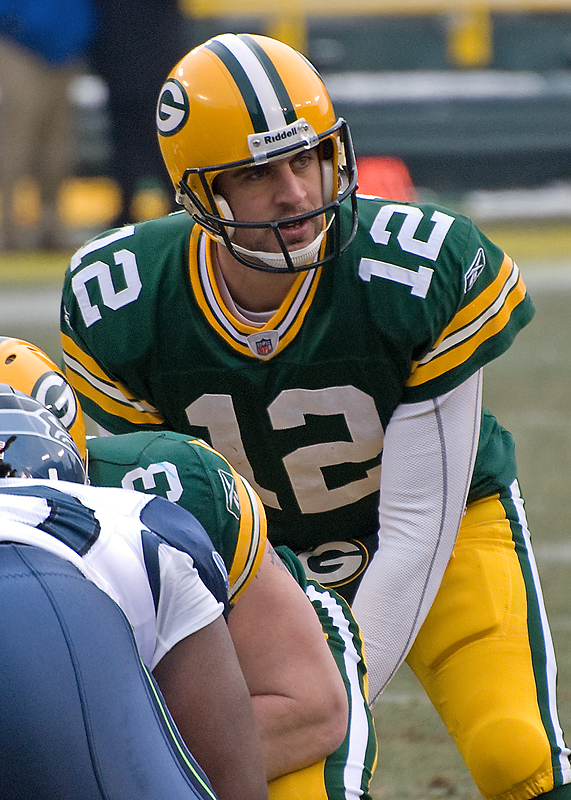
2004 season
As a junior, Rodgers led Cal to a 10–1 record and top-five ranking at the end of the regular season, with their only loss a 23–17 loss at No. 1 USC. In that game, Rodgers set a school record for consecutive completed passes with 26 and tied an NCAA record with 23 consecutive passes completed in one game. He set a Cal single-game record for passing completion percentage of 85.3. Rodgers holds the Cal career record for lowest percentage of passes intercepted at 1.95 percent. Rodgers' performance set up the Golden Bears at first and goal with 1:47 remaining and a chance for the game-winning touchdown. On the first play of USC's goal line stand, Rodgers threw an incomplete pass. This was followed by a second-down sack by Manuel Wright. After a timeout and Rodgers' incomplete pass on third down, USC stopped Cal's run play to win the game. Rodgers commented that it was "frustrating that we couldn't get the job done." Overall, he finished the 2004 season with 2,566 passing yards, 24 touchdowns, and eight interceptions. His 66.1% pass completion percentage led the Pac-10. He finished ninth in Heisman Trophy voting.
After Texas was picked over Cal for a Rose Bowl berth, the fourth-ranked Bears were awarded a spot in the Holiday Bowl, which they lost to Texas Tech, 45–31. After the season, Rodgers decided to forgo his senior season to enter the 2005 NFL draft.
Professional career
2005 NFL draft
Rodgers was expected to be selected early in the 2005 NFL draft as he had posted impressive numbers as a junior with Cal, throwing for 2,320 yards with a 67.5 completion rate in the regular season. He threw for 24 touchdowns and only eight interceptions in his last college season, impressing many NFL scouts. They commented that he was a "talented strong-armed junior" who "combines arm strength, mechanics and delivery to make all the throws", but noted that his stats could be inflated due to playing in a quarterback-friendly system and that he would need to adjust to the more elaborate defensive schemes of the NFL.
Before the draft, Rodgers was confident that he would be drafted to the San Francisco 49ers, the team he supported and grew up near, who possessed the No. 1 overall pick in the draft. The 49ers, however, drafted quarterback Alex Smith out of Utah instead, and Rodgers slid all the way down to the 24th overall pick by the Green Bay Packers. Rodgers has said that he experienced much angst and restlessness when waiting to be selected several hours into the draft, as he had expected himself to be selected much sooner. Rodgers' slip to the 24th selection and the Packers choosing to pick Brett Favre's future replacement became one of the biggest stories of the draft, though he was still the second quarterback selected. His drop in the draft was later ranked number one on the NFL Network's Top 10 Draft Day Moments. Many teams drafting between the second and 23rd positions had positional needs more pressing than quarterback.
Rodgers is one of six quarterbacks coached by Jeff Tedford to be drafted in the first round of an NFL draft, joining Trent Dilfer, Akili Smith, David Carr, Joey Harrington and Kyle Boller.
Green Bay Packers
Backup years: 2005–2007
In August 2005, Rodgers agreed to a reported five-year, $7.7 million deal that included $5.4 million in guaranteed money and had the potential to pay him as much as $24.5 million if all incentives and escalators were met.

Rodgers spent his rookie season as the Packers' backup quarterback behind Brett Favre. The Packers were 4–12 at this point and he received his first extended look in the opening preseason game against the San Diego Chargers after replacing Favre. In his first NFL game, Rodgers completed two out of seven passes and was sacked twice. He continued to struggle through the preseason, before ending the preseason by converting two third downs and throwing a touchdown pass to tight end Ben Steele against the Tennessee Titans. Once the regular season began, Rodgers saw very little action that year. He played against the New Orleans Saints in the fourth quarter of a 52–3 victory, and completed his first career pass to fullback Vonta Leach for 0 yards. On December 19, 2005, Rodgers entered the game against the Baltimore Ravens at the end of the third quarter in a 48–3 loss. He completed eight of 15 passes for 65 yards and an interception.
After the Packers' losing season, head coach Mike Sherman was fired and replaced by Mike McCarthy. Rodgers was then placed in McCarthy's "Quarterback school" for six hours a day several times a week. This focused on working on Rodgers' motor skills such as hand-eye coordination, finger dexterity, and mechanics. McCarthy also worked on Rodgers' release point, moving it from right beside the ear hole of his helmet to further below it, to give him a smoother release. When the 2006 preseason began, Rodgers played as the backup in all four games; he completed 22 out 38 passes for 323 yards and three touchdowns. Rodgers saw very little action during the 2006 season, but did step in briefly on October 2 against the Philadelphia Eagles when Favre left the game due to injury. On November 19, 2006, Rodgers broke his left foot while playing against the New England Patriots in a 35–0 defeat at home, filling in for an injured Favre, and Rodgers missed the remainder of the 2006 season.
Following the team's season-ending victory at Chicago, Favre announced that he would stay with the Packers for the 2007 season, again postponing Rodgers' hopes of becoming the Packers' starting quarterback. Prior to the 2007 season, rumors surfaced about a potential trade involving Rodgers in which he would be traded to the Oakland Raiders for wide receiver Randy Moss. However, Moss was traded to the Patriots during the second day of the 2007 NFL draft, and Rodgers stayed in Green Bay.
Rodgers stepped in when Favre was injured in the second quarter against the Dallas Cowboys on Thursday Night Football on November 29, 2007. Rodgers completed 18 passes for 201 yards, with no interceptions. He also threw his first touchdown pass but was sacked three times. Rodgers brought the team back from a 17-point deficit to a 3-point deficit, but the Cowboys went on to win 37–27.
2008: Transition to starter
Favre's retirement announcement on March 4, 2008, opened up the Packers' starting quarterback position to Rodgers for the 2008 season. Although Favre decided to return from retirement, he was traded to the New York Jets, which meant that Rodgers would become the starter.
Rodgers quickly proved that he was one of the best quarterbacks in the league by passing for 4,038 yards in his first season as a starter as well as throwing for 28 touchdowns and only 13 interceptions. As of the 2025 season, this still stands as the most interceptions he has thrown in a season. With Rodgers making his debut as a starter, the Packers beat the Minnesota Vikings 24–19 at Lambeau Field. This marked the first time since 1992 that a quarterback other than Favre started a regular season game for the Packers. Rodgers ended the game with 178 yards passing and two touchdowns (one passing and one rushing). In just his second NFL start the following week, Rodgers was voted the FedEx Air award winner after passing for 328 yards and three touchdowns in a win against the Lions.
During the fourth week of the season, Rodgers' streak of 157 consecutive pass attempts without an interception ended when he was intercepted by Derrick Brooks of the Tampa Bay Buccaneers. The streak was the third-longest in franchise history behind Bart Starr (294) and Brett Favre (163). Rodgers suffered a severe shoulder sprain in the game but continued to start and played well in a win against the Seattle Seahawks two weeks later. Despite early successes, Rodgers had been unable to win a close game during the season despite seven opportunities to do so.
On October 31, 2008, Rodgers signed a six-year, $65 million contract extension through the 2014 season. In Rodgers' first full season with the team, the Packers finished with a 6–10 record and missed the playoffs.
2009
For the opening game of the 2009 season, Rodgers recorded his first win in a comeback situation. The Packers were trailing at the beginning of the fourth quarter when Rodgers completed a fifty-yard touchdown pass to wide receiver Greg Jennings with about a minute remaining in the game to contribute to the 21–15 victory over the Chicago Bears.
Rodgers was named NFC Offensive Player of the Month for October 2009, when he passed for 988 yards, completed 74.5 percent of his passes, and recorded a passer rating over 110 for all three games played during the month.
After a 4–4 start to the season and a 38–28 loss to the previously winless Buccaneers, the team began to heat up. Rodgers led the Packers to five straight wins, in which he threw for a total of 1,324 yards, nine touchdowns, and two interceptions. Rodgers and the Packers won two of their last three games, finishing the second half of the season with a 7–1 record and an overall 11–5 record; good enough to secure a wild card playoff berth and clinch the fifth seed in the playoffs.
The Packers set a new franchise record by scoring 461 total points (third in the league), breaking the previous record held by the 1996 Super Bowl team (456). Rodgers became the first quarterback in NFL history ever to throw for 4,000 yards in both of his first two years as a starter. He finished the season fourth in passing yards (4,434), touchdown passes (30), passer rating (103.2), and yards per attempt (8.2) as well as eighth in completion percentage (64.7%), while also coming second among quarterbacks in rushing yards (316). His passing yardage made him second all-time in Packers history, behind only Lynn Dickey's all-time single-season record. His passer rating of 103.2 was also third-highest in team history at the time, behind only Bart Starr's 105.0 rating in 1966 and 104.3 rating in 1968 (minimum 150 attempts).
In the Wild Card Round, the Packers played the Arizona Cardinals, the same team they had previously beaten the week before, 33–7. Rodgers and Cardinals quarterback Kurt Warner put on a show that later ranked second on NFL Network's Top 10 Quarterback Duels. Rodgers' first pass was intercepted by Dominique Rodgers-Cromartie. Rodgers settled down after that miscue, however, and finished the game completing 28 of 42 passes for 423 yards, with four touchdown passes all in a second-half comeback. His 423 passing yards are the most by any quarterback in his first playoff game as well as his four touchdown passes and five total touchdowns. Warner shredded the Packers' second-ranked defense, completing 29 of 33 passes for 379 yards, five touchdowns, no interceptions, and a passer rating of 154.1. Despite Rodgers' offensive efforts, the Packers lost the game when he fumbled on a controversial play in overtime. The ball was returned by Karlos Dansby for the winning touchdown in the 51–45 Cardinals victory. It was the highest scoring playoff game in NFL history.
Due to his regular season performance, Rodgers earned a trip to his first Pro Bowl as the NFC's third quarterback, behind Drew Brees and Brett Favre. However, after Favre dropped out due to injury and Brees was replaced due to his participation in Super Bowl XLIV, Rodgers became the NFC's starter.
2010: Super Bowl XLV season
In 2010, Rodgers led the Packers to a 2–0 start, but then lost three of their next four games, including back-to-back overtime losses. The two overtime defeats brought Rodgers' record in overtime games to 0–5.
At midseason, Rodgers had already thrown nine interceptions compared to only throwing seven all of the previous season, and was 16th in the league with an 85.3 passer rating. Over the remainder of the regular season, however, his play improved as he threw 16 touchdowns to only two interceptions, completed 71.4% of his passes, and had a passer rating of 122.0.
In Week 13, in a 34–16 victory over the San Francisco 49ers, Rodgers had 298 passing yards and three touchdowns to earn his first career NFC Offensive Player of the Week honor. In Week 14, he sustained his second concussion of the season. Backup Matt Flynn was put into the game as Rodgers' replacement. The Packers lost the game 7–3 to the Lions. Against the Patriots, Rodgers missed the next week's regular season start, ending his streak of consecutive starts at 45, which is tied for the second longest in team history.
After their road loss to the Patriots, the Packers found themselves at 8–6 and had to win their final two regular season games to qualify for the playoffs. Rodgers turned around the team's performance; they won their final two regular season games, one of them against the New York Giants, where Rodgers completed 25 of 37 passes for 404 yards, with four touchdown passes, and with a passer rating of 139.9. It was his first regular season 400-yard passing game. For his effort against the Giants, he earned his second NFC Offensive Player of the Week honor for the 2010 season. In the next game, they defeated the Bears by a score of 10–3 in the regular season finale.
Rodgers was named the FedEx Air NFL Player of the Year for his passing performance in the 2010 season.
With a 10–6 record, the Packers entered the playoffs as a Wild Card and the No. 6 seed. In the Wild Card Round, they defeated the No. 3 seeded Eagles 21–16. In the Divisional Round, Rodgers completed 31 of 36 pass attempts for 366 yards and four touchdowns in a 48–21 blowout victory over the No. 1 seeded Atlanta Falcons. It was the most points scored in Packers postseason history. During the contest, Rodgers tied an NFL record for consecutive playoff games with at least three touchdown passes (3 games). Rodgers also set an NFL record by becoming the only quarterback to pass for ten touchdowns combined through three consecutive playoff games. On January 23, 2011, Rodgers had a 55.4 passer rating as the Packers beat the No. 2 seed Chicago Bears 21–14 win in the NFC Championship.
After winning the NFC Championship, the Packers earned a trip to Super Bowl XLV against the Pittsburgh Steelers. In the game, Rodgers completed 24 of 39 pass attempts for 304 yards and three touchdowns in the 31–25 win, and was named Super Bowl MVP for his performance. This would ultimately be his only Super Bowl appearance with the Packers.
From his playoff performance, Rodgers became only the third player in NFL history to pass for over 1,000 yards in a single postseason and also became one of only four quarterbacks to record over 300 yards passing, with at least three touchdown passes, and no interceptions in a Super Bowl. He finished with 1,094 passing yards, nine touchdown passes, two rushing touchdowns, and two interceptions, while completing 68.2% of his passes for a passer rating of 109.8. From this postseason, Rodgers also became the only player to pass for at least 900 yards and rush for at least two touchdowns in a single postseason. He was ranked 11th by his fellow players on the NFL Top 100 Players of 2011.
2011: First MVP
Because of the 2011 NFL lockout, the Packers and Rodgers did not schedule unofficial off-season workouts, despite many teams doing so. Rodgers and the Packers quickly quelled any concerns over their readiness by defeating the Saints, who had scheduled off-season workouts, 42–34. He had 312 passing yards and three touchdowns to earn NFC Offensive Player of the Week. After the game, Rodgers said in the press conference, "I was going to ask myself, what would have happened if we had offseason workouts? I mean, could we have started any faster and scored more points tonight?"
In Week 4, a 49–23 victory over the Denver Broncos, Rodgers had 408 passing yards, four touchdowns, and one interception and ran for two touchdowns to earn another NFC Offensive Player of the Week honor. In Week 6, a 24–3 victory over the St. Louis Rams, Rodgers converted on a career-high 93-yard touchdown pass to Jordy Nelson. In Week 9, a 45–38 victory over the Chargers, he had 247 passing yards and four touchdowns to earn his third NFC Offensive Player of the Week honor for the 2011 season. Rodgers and the Packers got off to a 13–0 start in 2011, tying the NFC record for most consecutive wins to start a season, but were upset by the Kansas City Chiefs 19–14 in week 15, ending their winning streak at 19 games, the second-longest winning streak in NFL history.
Rodgers finished the season with 4,643 passing yards, 45 touchdown passes, and six interceptions, good for a passer rating of 122.5, which as of 2024 is the highest single-season passer rating in NFL history. His passing yards, touchdown passes, and passer rating set single-season franchise records. In addition to passer rating, Rodgers led the league in touchdown to interception ratio (7.5, fourth-best all-time), touchdowns passing % (9.0%, second highest all-time), and yards per attempt (9.2, fourth-highest all-time since becoming an official stat in 1970), while finishing second in both touchdown passes (45, sixth-highest all-time) and completion percentage (68.3%), as well as fifth in passing yards. He earned NFC Offensive Player of the Month awards for September, October, and November, and FedEx Air Player of the Week six times (Weeks 4, 5, 6, 7, 9, and 13). In week four, against the Denver Broncos, Rodgers became the only quarterback in NFL history to record over 400 passing yards with four touchdown passes, while also rushing for two touchdowns in the same game. He was the winner of the 2011 Galloping gobbler as MVP of the Thanksgiving game between the Packers and the Lions, a 27–15 Green Bay victory, and tied an NFL record for consecutive games with at least two touchdown passes (13).
The Packers became the fifth team in NFL history to finish the regular season with a 15–1 record. Rodgers played in 15 of the 16 games, with the only exception being Week 17 against the Lions, a game in which Rodgers was rested after the club clinched home-field advantage for the playoffs the previous week. In the game, Rodgers assisted backup quarterback Matt Flynn in his stellar 480-yard, six-touchdown performance by helping call some plays. The Packers' offense set franchise record for points scored in a season with 560, which as of 2016 is the third-most ever behind only the 2007 Patriots and 2013 Broncos.
Rodgers set numerous NFL records in 2011. He recorded a passer rating of over 100.0 in thirteen games during the season, including twelve games in a row (both records), and a passer rating of 110.0 or higher in twelve games, including eleven in a row (also records). Rodgers also won the league's MVP award, receiving 48 of the 50 votes (the other two going to Drew Brees). He also finished second, behind Brees, for the AP Offensive Player of the Year award. Rodgers' 2011 season was later ranked as the third greatest passing season of all time by ESPN in 2013, and was regarded as the most efficient.