
In February and March 2014, Russia invaded the Crimean Peninsula, part of Ukraine, and then annexed it. This took place in the relative power vacuum immediately following the Revolution of Dignity. It marked the beginning of the Russo-Ukrainian war.
The events in Kyiv that ousted Ukrainian president Viktor Yanukovych on 22 February 2014 sparked both pro-Russian and anti-separatism demonstrations in Crimea. At the same time, Russian president Vladimir Putin told his security chiefs to begin work on "returning Crimea to Russia". On 27 February, Russian special forces without insignia seized strategic sites across Crimea. Russia at first denied involvement, but Putin later admitted that they were Russian troops. As the armed men occupied Crimea's parliament, it dismissed the Crimean government, installed the pro-Russian Aksyonov government, and announced a referendum on Crimea's status. The referendum was held under Russian occupation and, according to the Russian-installed authorities, the result was overwhelmingly in favor of joining Russia. The next day, 17 March 2014, Crimea's authorities declared independence and requested to join Russia. Russia formally incorporated Crimea on 18 March 2014 as the Republic of Crimea and federal city of Sevastopol. Following the annexation, Russia militarized the peninsula and warned against any outside intervention.
Ukraine and many other countries condemned the annexation and consider it to be a violation of international law and Russian agreements safeguarding the territorial integrity of Ukraine. The annexation led to the other members of the G8 suspending Russia from the group and introducing sanctions. The United Nations General Assembly also rejected the referendum and annexation, adopting a resolution affirming the "territorial integrity of Ukraine within its internationally recognised borders", and referring to the Russian action as a "temporary occupation".

The Russian government opposes the "annexation" label, with Putin defending the referendum as complying with the principle of the self-determination of peoples.
Other names
In Ukraine
The names of the Crimean annexation vary. In Ukraine, the annexation is known as the temporary occupation of the Autonomous Republic of Crimea and Sevastopol by Russia (Ukrainian: тимчасова окупація Автономної Республіки Крим і Севастополя Росією, romanized: tymchasova okupatsiia Avtonomnoi Respubliky Krym i Sevastopolia Rosiieiu), the illegal occupation of the Autonomous Republic of Crimea, the fall of Crimea, and the invasion of Crimea.
In Russia
In the Russian Federation, it is also known as the accession of Crimea to the Russian Federation (Russian: присоединение Крыма к Российской Федерации, romanized: prisoyedineniye Kryma k Rossiyskoy Federatsii), the return of Crimea (Russian: возвращение Крыма, romanized: vozvrashcheniye Kryma), and the reunification of Crimea.

Background
Crimea was part of the Crimean Khanate from 1441 until it was annexed by the Russian Empire in 1783 by a decree of Catherine the Great.
After the downfall of Russian empire in 1917 during the first stages of the Russian Civil War there were a series of short-lived independent governments (Crimean People's Republic, Crimean Regional Government, Crimean SSR). They were followed by White Russian governments (General Command of the Armed Forces of South Russia and later South Russian Government).
In October 1921, the Bolshevik Russian SFSR gained control of the peninsula and instituted the Crimean Autonomous Soviet Socialist Republic as a member of Russian Federation. In the following year Crimea joined the Soviet Union as a part of Russia (the RSFSR).

After the Second World War and the 1944 deportation of all of the indigenous Crimean Tatars by the Soviet government, the Crimean ASSR was stripped of its autonomy in 1946 and downgraded to the status of an oblast of the Russian SFSR. In 1954, the Crimean Oblast was transferred from the Russian SFSR to the Ukrainian SSR by decree of the Presidium of the Supreme Soviet of the Soviet Union to commemorate the 300th anniversary of Ukraine's union with Russia. In 1989, under Gorbachev's perestroika, the Supreme Soviet declared that the deportation of the Crimean Tatars under Stalin had been illegal and the mostly Muslim ethnic group was allowed to return to Crimea.
In 1990, the Soviet of the Crimean Oblast proposed the restoration of the Crimean ASSR. The oblast conducted a referendum in 1991, which asked whether Crimea should be elevated into a signatory of the New Union Treaty (that is, become a union republic on its own). By that time, though, the dissolution of the Soviet Union was well underway. The Crimean ASSR was restored for less than a year as part of Ukrainian SSR before the restoration of Ukrainian independence. Newly independent Ukraine maintained Crimea's autonomous status, while the Supreme Council of Crimea affirmed the peninsula's "sovereignty" as a part of Ukraine.
The confrontation between the government of Ukraine and Crimea deteriorated between 1992 and 1995. In May 1992 the regional parliament declared an independent "Crimean republic." In June 1992, the parties reached a compromise, that Crimea would have considerable autonomy but remain part of Ukraine. Yuri Meshkov, a leader of the Russian movement was elected President of Crimea in 1994 and his party won a majority in the regional parliamentary elections in the same year. The pro-Russian movement was then weakened by internal disagreements and in March 1995 the Ukrainian government gained the upper hand. The office of the elected President of Crimea was abolished and a loyal head of region was installed instead of Meshkov; the 1992 constitution and a number of local laws were repealed. According to Gwendolyn Sasse the conflict was defused due to Crimea's multi-ethnic population, fractures within the pro-Russian movement, Kyiv's policy of avoiding escalation and the lack of active support from Russia.

During the 1990s, the serious dispute over control of the Black Sea Fleet and Crimean naval facilities, as well as the status of Crimea in whole were source of tensions between Russia and Ukraine. In 1992, Vladimir Lukin, then chairman of the Russian Duma's Committee on Foreign Affairs, suggested that to pressure Ukraine to give up its claim to the Black Sea Fleet, Russia should question Ukrainian control over Crimea. In 1998 the Partition Treaty divided the fleet and gave Russia a naval base in Sevastopol, and the Treaty of Friendship recognized the inviolability of existing borders. However, in 2003 Tuzla Island conflict issues over maritime border resurfaced.
In September 2008, the Ukrainian Foreign Minister Volodymyr Ohryzko accused Russia of giving Russian passports to the population in Crimea, and described it as a "real problem", given Russia's declared policy of military intervention abroad to protect Russian citizens.
On 24 August 2009, anti-Ukrainian demonstrations were held in Crimea by ethnic Russian residents. Sergei Tsekov (of the Russian Bloc and then deputy speaker of the Crimean parliament) said then that he hoped that Russia would treat Crimea the same way as it had treated South Ossetia and Abkhazia. Crimea is populated by an ethnic Russian majority and a minority of both ethnic Ukrainians and Crimean Tatars, and thus demographically possessed one of Ukraine's largest ethnically Russian populations.
As early as in 2010, some analysts already speculated that the Russian government had irredentist plans. Taras Kuzio said that "Russia has an even more impossible time recognizing Ukraine's sovereignty over the Crimea and the port of Sevastopol – as seen by public opinion in Russia, statements by politicians, including members of the ruling United Russia party, experts and journalists". In 2011, William Varettoni wrote that "Russia wants to annex Crimea and is merely waiting for the right opportunity, most likely under the pretense of defending Russian brethren abroad".
Euromaidan and the Revolution of Dignity
The Euromaidan protest movement began in Kyiv in late November 2013 after President Viktor Yanukovych, of the Party of Regions, failed to sign the Ukraine–European Union Association Agreement. Yanukovych won the 2010 presidential election with strong support from voters in the Autonomous Republic of Crimea and southern and eastern Ukraine. The Crimean autonomous government strongly supported Yanukovych and condemned the protests, saying they were "threatening political stability in the country". The Crimean autonomous parliament said that it supported the government's decision to suspend negotiations on the pending association agreement and urged Crimeans to "strengthen friendly ties with Russian regions".
On 4 February 2014, the Presidium of the Supreme Council "promised" to consider holding a referendum on the peninsula's status. Speaker Vladimir Klychnikov asked to appeal to the Russian government to "guarantee the preservation of Crimean autonomy". The Security Service of Ukraine (SBU) responded by opening a criminal case to investigate the possible "subversion" of Ukraine's territorial integrity. On 20 February 2014, during a visit to Moscow, Chairman of the Supreme Council of Crimea Vladimir Konstantinov stated that the 1954 transfer of Crimea from the Russian Soviet Federative Socialist Republic to the Ukrainian Soviet Socialist Republic had been a mistake.

The Euromaidan protests came to a head in late February 2014, and Yanukovych and many of his ministers fled the capital on 22 February. After his flight, opposition parties and defectors from the Party of Regions put together a parliamentary quorum in the Verkhovna Rada (the Ukrainian parliament), and voted on 22 February to remove Yanukovych from his post on the grounds that he was unable to fulfill his duties. Arseniy Yatsenyuk was appointed by the Rada to serve as the head of a caretaker government until new presidential and parliament elections could be held. This new government was recognised internationally. Russian government and propaganda have described these events as a "coup d'état" and have said that the caretaker government was illegitimate, while researchers consider the subsequent annexation of Crimea to be a true military coup, because the Russian military seized Crimea's parliament and government buildings and instigated the replacement of its government with Russian proxies.
Annexation
Russian planning
At the end of January 2014, Russian oligarch Konstantin Malofeev travelled to Crimea with his head of security, former Federal Security Service (FSB) officer Igor Girkin (alias 'Strelkov'). Malofeev met with Vladimir Konstantinov, Chairman of the Supreme Council, asking him whether he would be willing to take "more drastic measures" to enforce Crimea's autonomy should there be a revolution. Konstantinov had already met with Nikolai Patrushev, head of the Security Council of Russia, in Moscow in December 2013 where he told Patrushev that if Yanukovych was overthrown, Crimea would be ready to break off and become part of Russia. At the end of January 2014, Konstantinov met with Vladislav Surkov, Putin's adviser on Ukraine. On 4 February, Konstantinov appealed to Putin to guard Crimean autonomy and began preparing a "survey" of Crimeans on what its status should be. Surkov visited Crimea on 14 February, where he might have tried to recruit Crimean prime minister, Anatolii Mohyliov, for the Russian cause.
In early February 2014, before the Ukrainian revolution, the Kremlin received a strategy paper outlining plans for the annexation of Crimea. It was reportedly part-written by Malofeev, and was published a year later by the Russian newspaper Novaya Gazeta. The documents said that the Ukrainian government and president Viktor Yanukovych were "totally bankrupt" and would not last. They proposed that Russia should foster separatism in Crimea and other eastern provinces, and should begin work on taking control of them. The documents outlined plans for starting pro-Russian protests and a public relations campaign to justify a Russian takeover.
On 21 February 2014, Ukrainian president Yanukovych secretly fled the capital. Russia's leadership worried that its naval base in Crimea might be at risk under a new Ukrainian government that was committed to closer ties with the West. On 22–23 February 2014, Russian president Putin held an all-night meeting with security chiefs to discuss the crisis. At the end of that meeting, Putin said: "we must start working on returning Crimea to Russia".
The GRU and FSB then began organizing sympathizers in Crimea to ensure that when the operation began there would be armed "local self‑defense groups" on the streets for support. In January 2014, the city council of Sevastopol—home of Russia's naval base in Crimea—had called for the formation of "people's militia" units to "ensure firm defence" of the city from "extremism".
According to political scientist Daniel Treisman, Putin may have begun planning to take Crimea even before Yanukovych was ousted. A source close to the commander of the operation said that Russian special forces in the port of Novorossiysk and the Black Sea Fleet in Sevastopol had already been put on alert on 18 February. Participants in the operation were later awarded a medal "For the Return of Crimea", which is engraved with 20 February as the start date of the operation.
Early unrest
The February 2014 Revolution of Dignity that ousted Ukrainian president Viktor Yanukovych sparked a political crisis in Crimea, which initially manifested as demonstrations against the new interim Ukrainian government, but rapidly escalated.
In late February, thousands of Russian soldiers dressed as civilians joined the "Crimean self-defense" units, as did almost one thousand Kuban Cossacks from the North Caucasus. The activities of these groups were closely coordinated with Russian military forces and planned by Russian defense officials. Igor Girkin ('Strelkov') oversaw command of some of the units and their coordination with Russian security officials. Almost ten thousand people joined these "self-defense" units, but it is unclear how many were locals.
On 20 February several buses with Crimean license plates were stopped at a pro-Maidan checkpoint in a town in Cherkasy oblast. Their passengers were violently intimidated and some buses were burned. This incident was subsequently used by Russian propaganda which made unsubstantiated claims that the passengers were killed in gruesome ways.
The local parliament of Crimea was the Verkhovna Rada of Crimea or Supreme Council of Crimea. Some MPs called for an extraordinary meeting on 21 February. In response to Russian separatist sentiment, the Security Service of Ukraine (SBU) said that it would "use severe measures to prevent any action taken against diminishing the territorial integrity and sovereignty of Ukraine". The party with the largest number of seats in the Crimean parliament (80 of 100), the Party of Regions of Ukrainian president Viktor Yanukovych, did not discuss Crimean secession, and were supportive of an agreement between President Yanukovych and Euromaidan activists to end the unrest that was struck on the same day in Kyiv.
Crimean prime minister Anatolii Mohyliov said that his government recognised the new provisional government in Kyiv, and that the Crimean autonomous government would carry out all laws passed by the Ukrainian parliament. In Simferopol, following a pro-Russian demonstration the previous day where protesters had replaced the Ukrainian flag over the parliament with a Russian flag, a pro-Euromaidan rally of between 5,000 and 15,000 was held in support of the new government, and demanding the resignation of the Crimean parliament; attendees waved Ukrainian, Tatar, and European Union flags. Meanwhile, in Sevastopol, thousands protested against the new Ukrainian government, voted to establish a parallel administration, and created civil defence squads with the support of the Russian Night Wolves motorcycle club. Protesters waved Russian flags, chanted "Putin is our president!" and said they would refuse to further pay taxes to the Ukrainian state. Russian military convoys were also alleged to be seen in the area.
In Kerch, pro-Russian protesters attempted to remove the Ukrainian flag from atop city hall and replace it with the flag of Russia. Over 200 attended, waving Russian, orange-and-black St. George, and the Russian Unity party flags. Mayor Oleh Osadchy attempted to disperse the crowd and police eventually arrived to defend the flag. The mayor said "This is the territory of Ukraine, Crimea. Here's a flag of Crimea," but was accused of treason and a fight ensued over the flagpole. On 24 February, more rallied outside the Sevastopol city state administration. Pro-Russian demonstrators accompanied by neo-Cossacks demanded the election of a Russian citizen as mayor and hoisted Russian flags around the city administration; they also handed out leaflets to sign up for a self-defence militia, warning that the "Blue-Brown Europlague is knocking".
Volodymyr Yatsuba, head of Sevastopol administration, announced his resignation, citing the "decision of the city's inhabitants" made at a pro-Russian rally, and while caretaker city administration initially leaned towards recognition of new Ukrainian government, continued pressure from pro-Russian activists forced local authorities to concede. Consequently, Sevastopol City Council illegally elected Alexei Chaly, a Russian citizen, as mayor. Under the law of Ukraine, it was not possible for Sevastopol to elect a mayor, as the Chairman of the Sevastopol City State Administration, appointed by the president of Ukraine, functions as its mayor. A thousand protesters present chanted "A Russian mayor for a Russian city".
On 25 February, several hundred pro-Russian protesters blocked the Crimean parliament demanding non-recognition of the central government of Ukraine and a referendum on Crimea's status. On the same day, crowds gathered again outside Sevastopol's city hall on Tuesday as rumours spread that security forces could arrest Chaly, but police chief Alexander Goncharov said that his officers would refuse to carry out "criminal orders" issued by Kyiv. Viktor Neganov, a Sevastopol-based adviser to the Internal Affairs Minister, condemned the events in the city as a coup. "Chaly represents the interests of the Kremlin which likely gave its tacit approval," he said. Sevastopol City State Administration chairman Vladimir Yatsuba was booed and heckled on 23 February, when he told a pro-Russian rally that Crimea was part of Ukraine. He resigned the next day. In Simferopol, the Regional State Administration building was blockaded with hundreds of protesters, including neo-Cossacks, demanding a referendum of separation; the rally was organized by the Crimean Front.
On 26 February, outside the Crimean parliament building in Simferopol, 4,000–5,000 Crimean Tatars and supporters of the Euromaidan-Crimea movement faced 600–700 supporters of pro-Russian organizations and the Russian Unity Party. Tatars leaders organised the demonstration to block the sitting of the Crimean parliament which is "doing everything to execute plans of separation of Crimea from Ukraine". Supreme Council Chairman Vladimir Konstantinov said that the Crimean parliament would not consider separation from Ukraine, and that earlier reports that parliament would hold a debate on the matter were provocations. Tatars created self-defence groups, encouraged collaboration with Russians, Ukrainians, and people of other nationalities, and called for the protection of churches, mosques, synagogues, and other important sites. By nightfall the Crimean Tatars had left; several hundred Russian Unity supporters rallied on.
The new Ukrainian government's acting Internal Affairs Minister Arsen Avakov tasked Crimean law enforcement agencies not to provoke conflicts and to do whatever necessary to prevent clashes with pro-Russian forces; and he added "I think, that way – through a dialogue – we shall achieve much more than with standoffs". New Security Service of Ukraine (SBU) chief Valentyn Nalyvaichenko requested that the United Nations provide around-the-clock monitoring of the security situation in Crimea.
Russian military takeover of Crimea
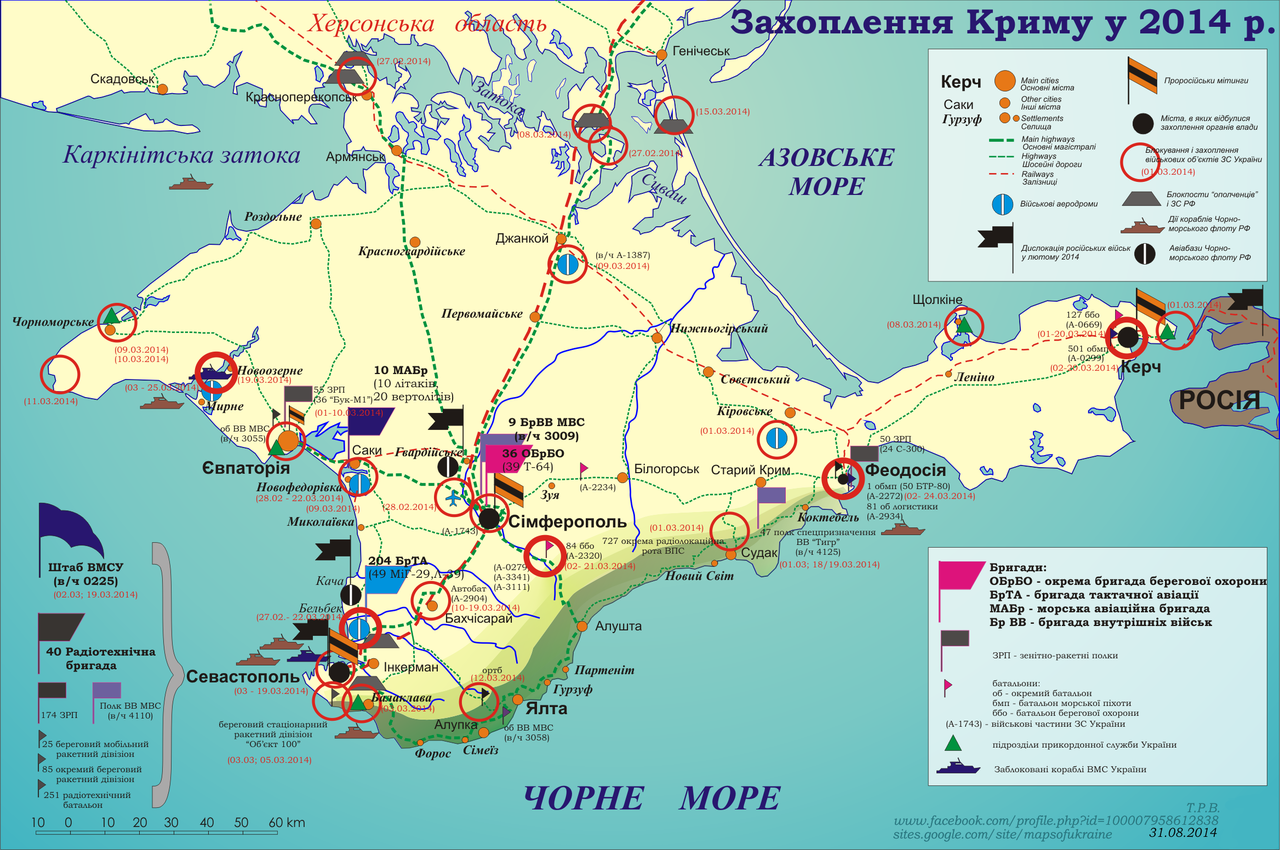
Russia took advantage of the uncertainty in Ukraine immediately after the ousting of Yanukovych. On 26 February, Russian soldiers without insignia began to occupy Crimea and to blockade Ukrainian military bases. In Simferopol, the Russian soldiers seized the Crimean parliament building and the Council of Ministers building. Russian flags were raised over these buildings and barricades were erected outside them. A military checkpoint, with a Russian flag and Russian military vehicles, was set up on the main highway between Sevastopol and Simferopol.
While the armed soldiers occupied the Crimean parliament building, the parliament held an emergency session. It voted to dismiss the Crimean government, and replace Prime Minister Anatolii Mohyliov with Sergey Aksyonov. Aksyonov belonged to the Russian Unity party, which received only 4% of votes in the last election. According to the Constitution of Ukraine, the prime minister of Crimea is appointed by the Crimean parliament (Supreme Council of Crimea) in consultation with the president of Ukraine. Both Aksyonov and speaker Vladimir Konstantinov stated that they viewed Viktor Yanukovych as the de jure president of Ukraine, through whom they were able to ask Russia for help. The parliament also voted to hold a referendum on greater autonomy, set for 25 May. Historian Andrew Wilson and journalist Luke Harding called this the "Crimean coup".
The troops had cut all of the building's communications, and took MPs' phones as they entered. No independent journalists were allowed inside the building while the votes were held. Some MPs said they were threatened and that votes were cast for them and other MPs, even though they were not in the chamber. Interfax-Ukraine reported that there was no way to know how many MPs were present, and whether they voted themselves or if someone else used their voting cards. The head of parliament's information and analysis department, Olha Sulnikova, phoned journalists from inside the building, telling them 61 of the registered 64 deputies had voted for the referendum resolution and 55 for the resolution to dismiss the government. These votes were immediately declared illegal by the Ukrainian interim government.
Russian FSB colonel Igor Girkin (alias 'Strelkov'), one of the commanders of the soldiers, said in January 2015 that Crimean MPs were held at gunpoint, and were forced to support the annexation. Girkin said:"Unfortunately I did not see any support from the [Crimean] authorities in Simferopol where I was ... It was militants who collected deputies and forced them to vote. Yes, I was one of the commanders of those militants".
The same day, more unmarked troops set up security checkpoints on the Isthmus of Perekop and the Chonhar Peninsula, which separate Crimea from the Ukrainian mainland. They were helped by what appeared to be local Berkut riot police, as well as Russian troops from the 31st Separate Airborne Assault Brigade dressed in Berkut uniforms. Within hours, Ukraine had been cut off from Crimea. Ukrainian TV channels became unavailable for Crimean viewers, some replaced with Russian stations. On 29 February, unmarked Russian special forces occupied Crimea's airports and communications centers.
On the day of the invasion, the Russian government dismissed accusations that it was in violation of the agreement on the Black Sea Fleet: "All movements of armored vehicles are undertaken in full compliance with the basic agreements and did not require any approvals". On 28 February, an estimated 1,400 Spetsnaz troops were flown in to the Gvardeyskoye air base from Russia. On the same day, Putin assured German Chancellor Angela Merkel in a phone call that no regular Russian soldiers are active in Crimea.
On 1 March 2014, Aksyonov asked Putin for "assistance in ensuring peace and tranquillity" in Crimea. Putin promptly received authorisation from the Federation Council of Russia for a Russian military intervention in Ukraine until the "political-social situation in the country is normalized". Ukraine's prime minister, Arseniy Yatsenyuk, said that Russian military intervention would be the beginning of war, and Ukraine's representative told an emergency meeting of the UN Security Council that Russia was committing "an act of aggression against the state of Ukraine". By 2 March, Russian troops were in full control of Crimea, having deployed from the naval base in Sevastopol and reinforced by troops, armour, and helicopters from mainland Russia.
At a press conference on 4 March, president Putin said that Russia had no plans to annex Crimea. He also said that it had no plans to invade Ukraine, but that it might intervene if Russians in Ukraine were threatened.
Numerous media reports and statements by the Ukrainian and foreign governments noted the identity of the unmarked troops as Russian soldiers, but Russian officials concealed the identity of their forces, claiming they were local "self-defence" units over whom they had no authority. As late as 17 April, Russian foreign minister Sergey Lavrov said that there were no "excessive Russian troops" in Ukraine, referring to those who were allowed to be at the Sevastopol naval base. Putin later acknowledged that he had ordered "work to bring Crimea back into Russia" as early as February.
Russia eventually admitted its troops' presence. Defence Minister Sergey Shoygu said Russian military actions in Crimea were undertaken by forces of the Black Sea Fleet and were justified by a "threat to lives of Crimean civilians" and danger of "takeover of Russian military infrastructure by extremists". Ukraine complained that Russia violated the agreement under which it headquartered its Black Sea Fleet in Sevastopol and violated the country's sovereignty. The United States and United Kingdom accused Russia of breaking the terms of the Budapest Memorandum on Security Assurances, by which Russia, the US, and the UK had affirmed they would not use force against the territorial integrity or political independence of Ukraine. The Russian government said the Budapest Memorandum did not apply due to "circumstances resulting from the action of internal political or socio-economic factors". In March 2015, retired Russian Admiral Igor Kasatonov said that, according to his information, the Russian troop deployment in Crimea included six helicopter landings and three landings of an IL-76 with 500 troops.
Legal issues
The obligations between Russia and Ukraine with regard to territorial integrity and the prohibition of the use of force are laid down in a number of multilateral or bilateral agreements to which Russia and Ukraine are signatories.
Vladimir Putin said that Russian troops in the Crimean Peninsula were aimed "to ensure proper conditions for the people of Crimea to be able to freely express their will," whilst Ukraine and other nations argue that such intervention is a violation of Ukraine's sovereignty.
In the 1994 Budapest Memorandum on Security Assurances Russia was among those who affirmed to respect the territorial integrity of Ukraine (including Crimea) and to refrain from the threat or use of force against the territorial integrity or political independence of Ukraine. The 1997 Russian–Ukrainian Treaty on Friendship,[193] Cooperation, and Partnership again reaffirmed the inviolability of the borders between both states, and required Russian forces in Crimea to respect the sovereignty of Ukraine, honor its legislation and not interfere in the internal affairs of the country.
The Russian–Ukrainian Partition Treaty on the Status and Conditions of the Black Sea Fleet signed in 1997 and prolonged in 2010, determined the status of Russian military presence in Crimea and restricted their operations, including requirement to show their "military identification cards" when crossing the international border and that operations beyond designated deployment sites was permitted only after coordination with Ukraine. According to Ukraine usage of navigation stations and troop movements were improperly covered by the treaty and were violated many times as well as related court decisions. February's troop movements were in "complete disregard" of the treaty.
According to the Constitution of Russia, the admission of new federal subjects is governed by federal constitutional law (art. 65.2). Such a law was adopted in 2001, and it postulates that admission of a foreign state or its part into Russia shall be based on a mutual accord between the Russian Federation and the relevant state and shall take place pursuant to an international treaty between the two countries; moreover, it must be initiated by the state in question, not by its subdivision or by Russia.
On 28 February 2014, Russian MP Sergey Mironov, along with other members of the Duma, introduced a bill to alter Russia's procedure for adding federal subjects. According to the bill, accession could be initiated by a subdivision of a country, provided that there is "absence of efficient sovereign state government in foreign state"; the request could be made either by subdivision bodies on their own or on the basis of a referendum held in the subdivision in accordance with corresponding national legislation.