
The 2006 protests in Hungary were a series of anti-government protests triggered by the release of Hungarian Prime Minister Ferenc Gyurcsány's leaked private speech in which he confessed that his Hungarian Socialist Party (MSZP) had lied to win the 2006 election, and had done nothing worth mentioning in the previous four years of governing. Most of the events took place in Budapest and other major cities between 17 September and 23 October. It was the first sustained protest in Hungary since 1989.
Disclosure of Őszöd speech
Audio recording
On September 17, 2006, an audio recording surfaced from a closed-door MSZP meeting which was held on May 26, 2006, in which Hungarian Prime Minister Ferenc Gyurcsány made a speech, notable for its obscene language, including the following excerpt (censored version):
There is not much choice. There is not, because we screwed up. Not a little, a lot. No European country has done something as boneheaded as we have. Evidently, we lied throughout the last year-and-a-half, two years. It was totally clear that what we are saying is not true. You cannot quote any significant government measure we can be proud of, other than at the end we managed to bring the government back from the brink. Nothing. If we have to give account to the country about what we did for four years, then what do we say?

Gyurcsány also said things which can be interpreted as admitting having called for clandestine media or private capital support.
The Prime Minister confirmed the authenticity of the recording and uploaded its transcript on his blog, but remarked that "in a closed meeting a person speaks differently than in front of the cameras".
First reactions
Late on Sunday, September 17, people gathered at the Parliament building demanding the PM should resign. By midnight, the number of demonstrators reached 2,000. A few hundred people went to the State President's residency but later returned. This spontaneous demonstration was entirely peaceful.

September 18
Budapest
Civil unrest
On September 18, as a consequence of the audio recording and the unwillingness of the Prime Minister or his party to resign, a demonstration was held near the Hungarian Parliament. Approximately 40,000 protesters demanded the resignation of Gyurcsány and his party for lying throughout the term and then during the campaign to win the next election. The police deemed the demonstration legal, arguing that the rules applicable during the campaign period towards the upcoming municipal elections allow for such short-notice political meetings.
Occupation of MTV Headquarters
After 23:00, a smaller group of the demonstrators tried to get into the Magyar Televízió public television building at Szabadság Tér (Liberty Square) to announce their demands on air. After they were not allowed to enter, a smaller group attacked the police forces. The riot police units which were intended to secure the building and the perimeter were ordered to disperse the crowd with tear gas and a water cannon. They blocked the main entrances but were unable to stop the attackers who could get inside the building. Some demonstrators became indignant at the authorities' resistance and were later joined by a group of enraged football ultras. A hardcore subgroup of them started to make repeated assaults in order to penetrate the defences and break into the building. The police retaliated, using tear gas and a water cannon. The crowd became enraged and attacked the police units by throwing cobblestones and debris (injuring 141 police officers), but they didn't attack the two drivers of the water cannon mobil. They also set several parked cars ablaze (which led to part of the building catching fire too) and eventually managed to enter the building, forcing the police back.
The demonstrators managed to voice their demands, but since the television station had already ceased its transmission due to the riot, it was not aired live. The building was abandoned about 02:30 by the police. After that, the mob entered the premises. Some of the intruders merely took pictures of themselves and the scene, while others destroyed the dining room and the main hall of the building. The historical television technology exhibition was also demolished: valuable vintage equipment was smashed and techno-historical objects like vintage props were stolen, as were some expensive plasma TV sets. Arson was also reported. All these acts were aired and/or verified by reports from state television officials, police and media coverage.

Police reinforcements arrived much later, and they managed to reclaim the building before dawn. Magyar Televízió resumed its transmission at 06:07. Over 150 people were injured, including 102 policemen. The property damage resulting from the fight is estimated to be over 230 million forints (about 800,000 EUR).
Other cities
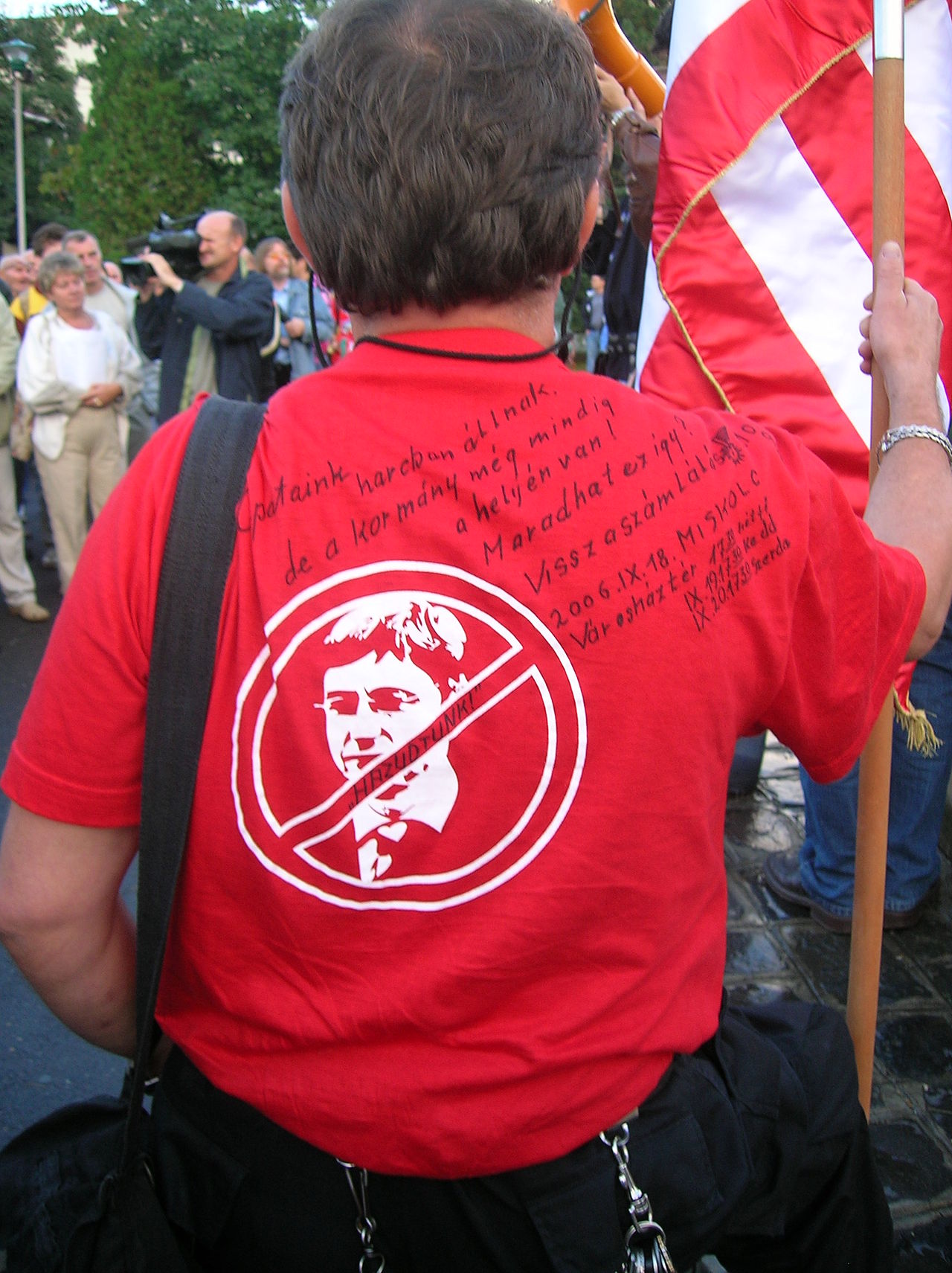
In Miskolc on Monday (September 18), about 2,000 citizens protested on St. Stephen Square, where Árpád Miklós, chairman of the Hungarian Justice and Life Party's (MIÉP) county committee gave a speech, jokingly saying that Gyurcsány might as well join MIÉP as they had been calling Gyurcsány a liar for years, and now he himself had admitted to it, so they are on the same opinion now. People shouted anti-government remarks and sang the national anthem and the Szekler anthem, then marched to the nearby city hall. Later, at the proposal of the MIÉP chairman, they went to the Hungarian Socialist Party's (MSZP) headquarters on Corvin Street, which was secured by the police. Traffic was blocked by the demonstrators in parts of the inner city.
Also on Monday the Miskolc committee of opposition party Fidesz sent a press release to MTI (Hungarian News Agency) titled “One cannot build a city on lies” (a play on MSZP slogan We're building a brand new Miskolc which refers to the extensive downtown reconstruction program started by the party). In the press release, the committee declared that the seven members of parliament from MSZP's Miskolc committee, including Mayor Sándor Káli and deputy mayors Vilmos Fedor and Erika Szűcs must have known about Gyurcsány's lies, since all of them were present in Balatonőszöd and heard the Prime Minister's speech. Fidesz accused these members of parliament of becoming Gyurcsány's accomplices by keeping quiet.
After the occupation of the TV headquarters
September 19
Budapest
In the evening a mostly peaceful demonstration took place at Kossuth Square, aside from demonstrators vandalizing a tram on the Square and a car in front of the Socialist Party's county headquarters.
Later that night in other parts of the city, including the areas near the headquarters of MSZP and the HQ of the public radio station, violence broke out again. Large numbers of riot troops were deployed along with mounted police and K-9 units, acting more systematically than before. The use of tear gas and water cannons with accompanying mounted assaults prevented another building siege. Other police units applied police batons and body force.
At 01:00 (Sep 20), about 3,000 protesters gathered at Blaha Lujza Square. The crowd demanded the departure of Prime Minister Gyurcsány. Protesters threw stones and debris at the police, set a police car ablaze and even tried to build barricades but repeated police movements forced them back. By 09:00, the streets were cleared and more than 90 troublemakers were arrested with over 50 people injured. Most local media sources (including news television and news portals) covering the events referred to the attacking civilians as "troublemakers" or "rowdies", thus implying that these violent people were neither protesters nor peaceful civil demonstrators, but just a mob. The first rows of the masses were reported to behave aggressively, backed verbally by youngsters in the background. As opposed to the first night's siege, the crowd did not attack or hinder fire brigade and paramedics, but on one (probably unique) occasion it was observed that a mobster repeatedly kicked another civilian already lying on the ground. Live reports suggested that part of the mob also shouted claims that the violent acts were similar to those of the 1956 Revolution.

On the late night live talk show, Este (Evening), on the previously besieged MTV, Prime Minister Ferenc Gyurcsány was faced with the consequences of his actions, and the protesters' demands, when he read their petition which they managed to hand over the previous day. He replied that it was not just himself, but everybody who had lied, and he would not resign. He said he was committed to pushing through his austerity measures in any circumstances, without the possibility of even a minor change to it.
Other cities
In Miskolc, policemen, including police captain Albert Pásztor, were already at St. Stephen Square when the demonstrations began at 17:00. People held banners saying "Our homeland is not a 'whore country'", (A hazánk nem egy "kurva ország") referring to the Gyurcsány talk. The demonstrators again went to the city hall, then to the MSZP office, where at the request of a university student, a speaker read the proclamation of the protest planned on September 21 against tuition fees (the introduction of which was one of the most controversial decisions of Gyurcsány's government). The national anthem and Szózat were sung both at the city hall and at the MSZP office, while demonstrators stood with their backs to the buildings. Demonstrators demanded that a declaration be read in a local TV station, but the station's manager refused.
In Szeged at 19:00, 500–600 people protested against Gyurcsány but, within a few minutes, there were already thousands of demonstrators marching from the city hall to Dóm tér (Cathedral Square). From there, they went to the Socialist Party's building, which was defended by the police. The demonstration was continued on Tuesday before the City Hall, where about 3,000 people demanded the government's resignation, new elections, and democracy. Police secured the City Hall and the regional offices of Hungarian Television and Hungarian Radio.
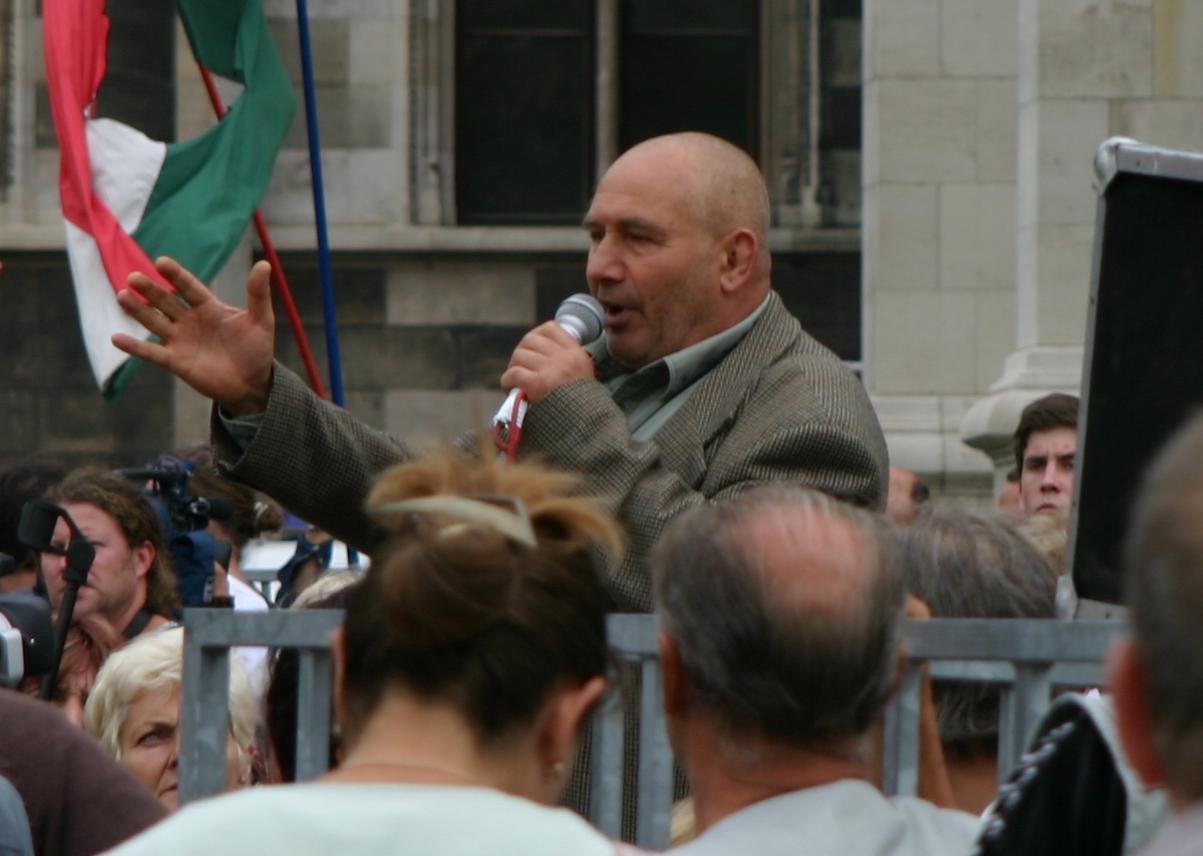
The county chairman of Jobbik, the organizer of the demonstration, stated that they wanted to achieve their goal – the resignation of Gyurcsány's government – through peaceful demonstrations, which would continue every evening until September 23, when they would hold a demonstration in Budapest.
In Eger about 1,000 citizens demonstrated, demanding that President Sólyom dissolve the National Assembly. Demonstrators also requested the city's Socialist mayor Imre Nagy to initiate Gyurcsány's dismissal.
Romania
On Tuesday, several demonstrations of solidarity took place in Romania, in cities with a strong ethnic Hungarian population. In the evening, some 700 people took part in a peaceful candlelight vigil in Odorheiu Secuiesc (Hungarian: Székelyudvarhely). This event was organised by the Hungarian Civic Party, took place in a park in the city centre, and featured the reading of a declaration of solidarity with the non-violent protesters in Budapest. Protesters in Odorheiu Secuiesc also expressed their belief that the results of the 2004 referendum on dual citizenship in Hungary were fraudulent.
When asked about protesting in front of the Hungarian consulate in Miercurea Ciuc (Hungarian: Csíkszereda), Magyar Civic Union president Jenő Szász said that this would be futile, that "Premier Gyurcsány must resign in Budapest and not in Csíkszereda".
September 20
Budapest
During the daytime the capital city was peaceful, though ruins and debris from the previous night's clash scenes reminded the citizens that the crisis was far from being over.
Daytime announcements from different political personalities all agreed that violence must be avoided and control must be maintained at all reasonable costs. Police leaders promised an immediate, zero-tolerance reaction to any turmoil. Identification of violators and troublemakers went on all day by police, via analyzing news videos, and dedicated police/detective units made more than 100 arrests during the afternoon.
Riot police were also present at all important scenes, including Parliament, state public radio station, MSZP HQ, and they kept Szabadság Square (where the previously sieged state public television resides) tightly sealed. Nobody was allowed to enter the square except residents of its buildings, television staff and law enforcers. Police units were reinforced, equipped with new special full-size shields, steel helmets, bulletproof vests, and gas masks.
As night fell, reports came in of large scale purchasing of baseball bats at a sports warehouse. Later, a downtown restaurant was raided by the police because delivery of "long stick-like objects" was witnessed, but these turned out to be merely promotional umbrellas.
After 01:00, protesters began to gather on the Grand Boulevard (Nagykörút), around Nyugati Square and Oktogon Square. About 2,000 people began to walk along Andrássy Avenue, demanding the departure of Gyurcsány. This time there were no serious attacks against policemen or vandalism, but the troops soon stormed over the protesters and pursued them on the Grand Boulevard towards Nyugati Square and neighbouring streets. Cases of police brutality against peaceful protesters and passers-by were reported by eyewitnesses on Internet forums and articles. Overall, this night was remarkably controlled by massive police presence and their rapid response, vandalism was mostly prevented and there were no reports of stone-throwing assault or arson. During the night, 62 persons were arrested, of which 55 persons are now in custody and charged with aggressive crimes, bringing the total arrests to over 200.
An article on the Hungarian news portal index.hu illustrated with photos the fact that the Lonsdale youth manifesto could be observed during the unrest.
Other cities
Early on Wednesday the large window of the Socialist Party's office in Miskolc was smashed with a garbage can. Downtown, several MSZP placards of the upcoming local elections were vandalized. Late afternoon demonstrations started again on St. Stephen Square; police secured both the square and the MSZP office long before the demonstrators arrived. Speakers asked demonstrators to behave themselves and keep the demonstration peaceful. A student of the University of Miskolc informed the people that the university's student council withdrew its approval of the protest against tuition fees, but students would protest anyway.
In Debrecen the city's mayor Lajos Kósa (Fidesz) was taking an active part of the demonstrations; he supported his party's plans to keep a rally in Budapest on Saturday (the rally had been cancelled since), and heavily criticized Gábor Demszky, the mayor of Budapest for his perceived inactivity. ("It's possible Gábor Demszky doesn't feel Budapest his own and he thinks that he has nothing to do when such things happen in the capital, but Debrecen is another city, it has a local government which cares for the city.") He also asked the demonstrators not to attack the MSZP's county headquarters in the city, stating that the building is Debrecen's property and the party is only renting it. (A similar thing happened in Miskolc where a speaker jokingly mentioned that "we have the strength to break into the building, but we won't do it; that building will still be useful for something else.")
A peaceful rally was held in the main square of Pécs.
Other countries
Romania: The Organisation of Transylvanian Magyar Youth held a demonstration on Wednesday at 18:00 in Marosvásárhely (Târgu-Mureş) to show solidarity with the Budapest protesters. This event took place in the yard of the Reformed Church in the Citadel. The demonstration remained peaceful, and those involved noted that they understood Hungarians' frustration while disagreeing with those who employed violent methods. Similar actions took place in Székelyudvarhely (Odorheiu Secuiesc), Sepsiszentgyörgy (Sfântu Gheorghe) and Csíkszereda (Miercurea-Ciuc).
Serbia: A small protest took place in the town of Zenta (Senta) on this day. The demonstration was organised by a local ethnic Hungarian political party. These people wanted to show their sympathy for the demonstrators in Hungary because, in their opinion, all people who peacefully demonstrate on the streets in Hungary had previously voted to give Hungarian citizenship to the ethnic Hungarians in the neighboring countries. Attila Juhász, the mayor of the town, said that he and his party (the Alliance of Vojvodina Hungarians), which is the most influential ethnic Hungarian party in Serbia, believe that Hungarians in Vojvodina have no business in the Hungarian events.
September 21
Budapest
Peaceful demonstration went on, but people showed markedly less interest. The main opposition party, Fidesz has cancelled its planned rally previously announced for September 23, due to warnings of a possible attack. The demonstrators of Kossuth Square still lacked any serious political support. Police issued arrest warrants against several football ultras and other presumed troublemakers.
A leader of a right-wing extremist demonstrator group announced in a local cable TV that he would take full responsibility for any future violence but his group planned no more attacks against the media.)
The day and night were quiet overall, but arson was reported when a district office of the Hungarian Socialist Party was set ablaze in Újpest (a district of Budapest). It was quickly extinguished.
September 22
Budapest
The day passed peacefully. The Kossuth Square demonstration carried on, with 10,000 demonstrators in the evening, and featured several speeches. The demonstration was very well supported with food and on-location made meals. The Parliament-outsider right-wing Hungarian Justice and Life Party held its peaceful, speech-oriented rally under heavy police presence. Police leaders announced that they will maintain their alert at the same level as that of the previous days.
Prime Minister Ferenc Gyurcsány made his official trip to Berlin, Germany today. He visited the X. International Bertelsmann Forum 2006 of the Bertelsmann Stiftung where he also met the German Chancellor Angela Merkel. After the meeting Gyurcsány claimed that Merkel found his leaked speech to be brave. Later the Chancellor's office denied even mentioning the word "brave".
Other cities
In Miskolc demonstrations started on St. Stephen Square as usual, with fewer demonstrators than on previous days. The speaker informed demonstrators about the latest happenings countrywide, then exhorted people to demonstrate every evening at 18:00 on the main squares of cities until the government resigns. He also said that the fundraising to help those who are penalized for taking part in the demonstrations should be held in the whole country, not only in Miskolc. The speaker mentioned that police officers informed him on Thursday that he will be held responsible for any atrocities committed in the city by the demonstrators; because of this he organized a committee of five people who will protect the demonstrators from provocators, remove the demonstrators who try to stir up trouble, and will try to prevent attacks against police officers.