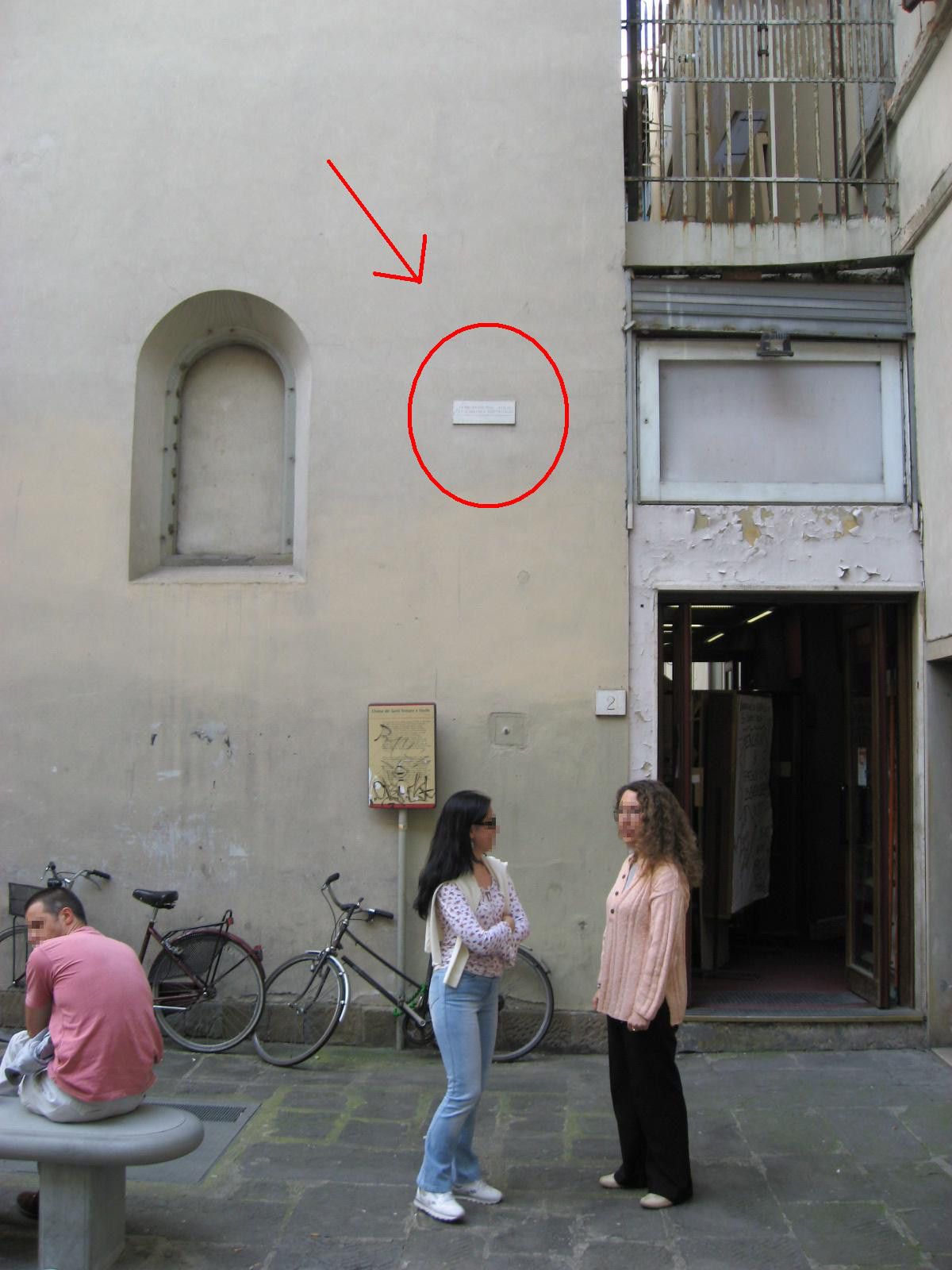
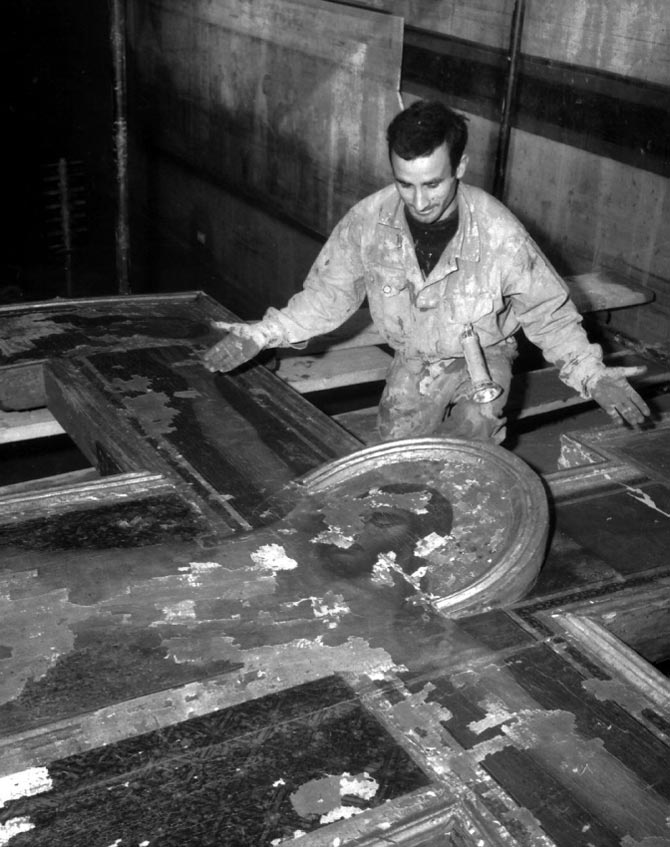
The 1966 flood of the Arno (Italian: Alluvione di Firenze del 4 novembre 1966) in Florence killed 35 people and damaged or destroyed millions of masterpieces of art and rare books. It is considered the worst flood in the city's history since 1557. With the combined effort of Italian and foreign volunteers alike, or angeli del fango ("Mud Angels"), many of these fine works have been restored. New methods in conservation were devised and restoration laboratories established. However, even decades later, much work remains to be done.
Overview
Located in the Tuscany region of Central Italy, the river Arno is approximately 240 kilometres (150 mi) long. It flows from the Mount Falterona hills of the Apennine Mountains to the Ligurian Sea, just 11 kilometres (7 mi) west of Pisa. Lush vineyards and olive groves line the river's scenic course to the west, out to sea. Principally utilized for irrigation purposes, only 32 kilometres (20 mi) of the river is used for navigation.
The highest flows of the river generally occur in spring and autumn of every year, when rainfall in the Apennines is at its greatest. The intensity of the 1966 flood was further increased by both the topography of the Apennines, which contributed to the high run-off rates and river discharges, and urban development. Roads, such as the Via dei Calzaiuoli, served as narrow channels for floodwaters, allowing for their greater speed and destruction within the city; bridges, on the other hand, hindered river flow where it was needed, allowing water to pour over the floodplain with great force.
Played with your browser's voice. Studio-quality audio can be added with a text-to-speech service.
Ask about this article
📝 Quick Quiz1 / 3
What is "1966 flood of the Arno" primarily known for?
Vocix Daily — In Your Inbox
Top stories, deep-dive articles, and "On This Day" history — one crisp digest delivered every morning.
Sources & references
Reference material for this entry is drawn from the open encyclopedic record, including Wikipedia , available under the CC BY-SA 4.0 license. Images are credited individually beside each photo.
After a long period of steady rain, the Levane and La Penna dams in Valdarno began to discharge more than 2,000 cubic metres (71,000 cu ft) of water per second toward Florence.
At 14:30, the Civil Engineering Department reported "'an exceptional quantity of water.'"
Cellars in the Santa Croce and San Frediano areas began to flood.
Police received calls for assistance from villagers up the Arno Valley.
The flood's first victim, a 52-year-old worker, died at the Anconella water treatment plant.
4 November
At 04:00, engineers, fearing that the Valdarno dam would burst, discharged a mass of water that eventually reached the outskirts of Florence at a rate of 60 kilometres per hour (37 mph).
Landslides obstructed roads leading to Florence, while narrow streets within city limits funneled floodwaters, increasing their height and velocity.
By 09:45, the Piazza del Duomo was flooded.
The powerful waters ruptured central heating oil tanks, and the oil mixed with the water and mud, causing greater damage.
Florence was divided in two, and officials were unable to immediately reach citizens of the city past the Piazzale Michelangelo.
At its highest, the water reached over 6.7 metres (22 ft) in the Santa Croce area.
By 20:00, the water began to lower.
Impact
The flood has had a lasting impact on Florence, economically and culturally. City officials and citizens were unprepared for the storm and the widespread devastation that it caused. There were virtually no emergency measures in place, at least partially because Florence is located in an area where the frequency of flooding is relatively low. In fact, approximately 90% of the city's population were completely unaware of the imminent disaster.
Residents were set to celebrate their country's World War I victory over Austria on 4 November, Armed Forces Day. In commemoration, businesses were closed and many of their employees were out of town for the public holiday. While many lives were likely spared as a result, the locked buildings greatly inhibited the salvaging of valuable materials from numerous institutions and shops, with the exception of a number of jewellery stores whose owners were warned by their nightwatchmen.
5,000 families were left homeless by the storm, and 6,000 stores were forced out of business. Approximately 600,000 tons of mud, rubble and sewage severely damaged or destroyed numerous collections of books, manuscripts and fine art. It is estimated that between 3 and 4 million books and manuscripts were damaged, as well as 14,000 movable works of art.
Artist Marco Sassone, in a 1969 interview, recalled the impact of the flood on Florence's residents: "The only thing you could do was watch and be helpless. Nature was master...the women became crazy with fear. They began throwing things from the windows and screaming 'who is going to save my children?'" It was reported that 101 people lost their lives in the flood waters.
Paul Conway, in Flood in Florence, 1966: Fifty-Year Retrospective (2018), note that "the broad effects of the Florence Flood from 1966 to the present, fifty years later, are perhaps not clearly measurable," yet emphasise that "many changes in professional practice can be attributed to the work of recovery."
Collections affected
Archives of the Opera del Duomo (Archivio di Opera del Duomo): 6,000 volumes of documents and 55 illuminated manuscripts were damaged.
Gabinetto Vieusseux Library (Biblioteca del Gabinetto Vieusseux): All 250,000 volumes were damaged, including titles of romantic literature and Risorgimento history; submerged in water, they became swollen and distorted. Pages, separated from their text blocks, were found pressed upon the walls and ceiling of the building.
National Central Library (Biblioteca Nazionale Centrale Firenze): Located alongside the Arno, the National Library was cut off from the rest of the city by the flood. 1,300,000 items (a third of their holdings) were damaged, including prints, maps, posters, newspapers and a majority of works in the Palatine and Magliabechi collections.
The State Archives (Archivio di Stato): Roughly 40% of the collection was damaged, including property and financial records; birth, marriage and death records; judicial and administrative documents; and police records, among others.
Biblioteca e Archivio del Risorgimento (Library and Archive of the Italian Unification): 7,000 volumes were inundated. The facility and collections were restored and the Library and Archive reopened in 1969.
Others:
Academy of Agriculturists (Accademia dei Georgofili)
Historic Institute of the Resistance (Istituto Storico della Resistenza)
Hospital of the Innocents (Ospedale degli Innocenti)
Institute and Museum of the History of Science (Istituto e Museo di Storia della Scienza)
Uffizi Gallery
Book shops and antique book dealers, many in possession of rare materials
Numerous private collections
The collections of numerous churches and cathedrals
Works affected
Crucifix by Giovanni Cimabue
Gates of Paradise by Lorenzo Ghiberti
Magdalene Penitent by Donatello
Funding and assistance
Realizing the immense wealth and importance of Florentine culture in a global context, many individuals and organizations contributed to the conservation mission, providing both funding and manpower. Art historian and professor Carlo Ludovico Ragghianti assembled an Italian committee (Comitato Fondo Internazionale per Firenze) with Mayor Piero Bargellini as chairman to raise awareness of the needs of Florence's art and academic institutions. Members included prominent figures from around the world, representatives of their own respective institutions.
The recovery of Florence's cultural heritage involved an extensive international network of scholars, conservators, and organisations. A number of other international committees were formed with the intention of sponsoring various institutions in Florence:
The Franco-Italian Committee aided the Church of Santa Maria Maddalena di Pazzi in Borgo Pinti.
The U.S. Committee to Rescue Italian Art. One of the most significant was the Committee to Rescue Italian Art (CRIA), established shortly after the flood.CRIA included figures such as Bates Lowry (chairman), Sydney J. Freedberg (vice chairman), and Eve Borsook, and played a major role in fundraising and coordinating international support. Public figures including Jacqueline Kennedy Onassis also helped raise awareness and mobilise financial support in the United States. Conservators such as Carolyn Price Horton and Richard Young contributed to translating emergency salvage operations into long-term conservation practices, particularly in book and paper conservation.
The Viennese armory was responsible for restoring the arms and armor of the Bargello Museum.
A Dutch committee sponsored the Buonarroti House Museum.
A group of Germans repaired the musical instruments of the Bardini Museum.
The UK Italian Art and Archives Rescue Fund (IAARF), which became the Venice in Peril Fund in 1971, under the chairmanship of Sir Ashley Clarke, former Ambassador to Rome and chairman of the British Italian Society.
The work of and contributions made by these committees were supervised by a central committee in Rome.
National committees and different support mechanisms (comparative overview)
The flood prompted the creation of national committees in multiple countries to support heritage rescue and recovery in Florence. Scholars have described differences between national responses in terms of organisational form, public engagement, and the relative emphasis placed on fundraising, coordination, and longer-term support. In the United States, the Committee to Rescue Italian Art (CRIA) is described as a prominent, media-facing initiative that mobilised public appeals and fundraising, while in the United Kingdom the Italian Art and Archives Rescue Fund (IAARF) is documented as part of the broader relief and support efforts discussed in public and parliamentary records.
Media, public appeals, and fundraising
Sources on the heritage response emphasise that media circulation and public-facing fundraising were important tools for mobilising international support beyond the immediate emergency phase. Kumar (2023) identifies recurring frames used in CRIA communications and U.S. press coverage—emphasising damage, rescue and restoration, the committee's actions, and the cultural value of Florence—to encourage donations and participation. Retrospective accounts also describe how Franco Zeffirelli's film Florence: Days of Destruction circulated through fundraising networks and associated screenings, helping sustain attention and support for recovery efforts.