
The 1905 French law on the Separation of the Churches and State (French: Loi du 9 décembre 1905 concernant la séparation des Églises et de l'État) was passed by the Chamber of Deputies on 3 July 1905. Enacted during the Third Republic, it established state secularism in France. At the time, France was governed by the Bloc des gauches (Left Coalition) led by Émile Combes. The law was based on three principles: the neutrality of the state, the freedom of religious exercise, and public powers related to the church. This law is seen as the backbone of the French principle of laïcité (secularism). It is, however, not applicable in Alsace and Moselle, which were part of Germany when it was enacted.
History
Prior to the French Revolution of 1789—since the days of the conversion of Clovis I to Christianity in 508 AD—Catholicism had been the state religion of France, and closely identified with the Ancien Régime. However, the revolution led to various policy changes, including a brief separation of church and state in 1795, ended by Napoleon's re-establishment of the Catholic Church as the national religion with the Concordat of 1801. An important document in the evolution toward religious liberty was Article Ten of the 1789 Declaration of the Rights of Man and of the Citizen, stating that "No one may be disturbed on account of his opinions, even religious ones, as long as the manifestation of such opinions does not interfere with the established Law and Order." The 1871 Paris Commune had proclaimed state secularism on 3 April 1871, but it had been cancelled following the Commune's defeat.
After the 16 May 1877 crisis and the victory of the republicans at the following elections, various draft laws requesting the suppression of the Concordat of 1801 were deposed, starting with the 31 July 1879 proposition of Charles Boysset. Beginning in 1879, the French state began a gradual national secularization program starting with the removal of priests from the administrative committees of hospitals and boards of charity, and in 1880 with the substitution of lay women for nuns in hospitals. Thereafter, the Third Republic established secular education with the Jules Ferry laws in 1881–1882, which were a significant part of the firm establishment of the republican regime in France, with religious instruction in all schools forbidden.
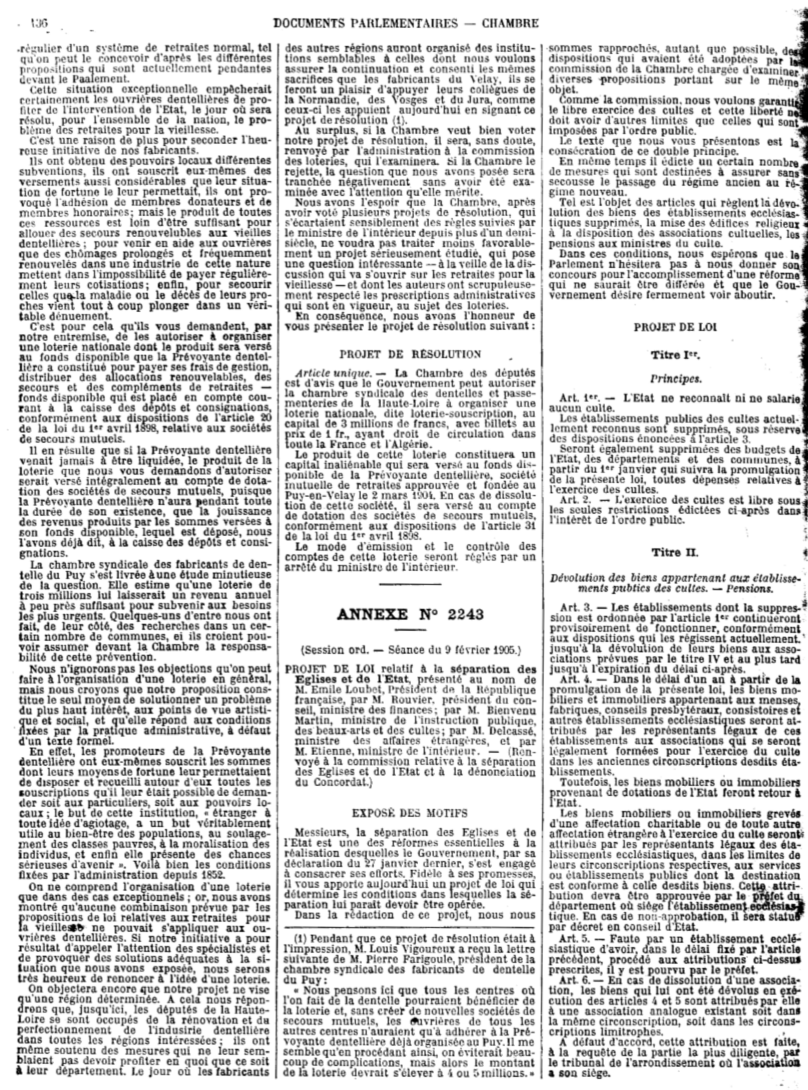
In 1886, another law ensured secularisation of the teaching staff of the National Education.
Other moves towards secularism included:
the introduction of divorce and a requirement that civil marriages be performed in a civil ceremony

legalizing work on Sundays
making seminarians subject to conscription
secularising schools and hospitals
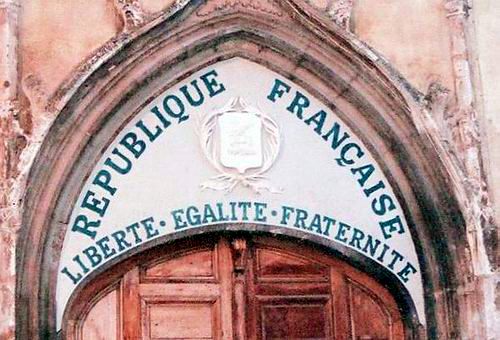
abolishing the law ordaining public prayers at the beginning of each parliamentary session and of the assizes
ordering soldiers not to frequent Catholic clubs
removing the religious character from the judicial oath and religious symbols from courtrooms
forbidding the participation of the armed forces in religious processions
The 1901 Law of Associations, which guaranteed freedom of association, also enabled the control of religious communities and, notably, limited their influence on education. In 1903, while former Catholic seminarian Émile Combes was minister, a commission was selected to draft a bill that would establish a comprehensive separation between the state and the churches. Its president was the former Protestant pastor Ferdinand Buisson, and its minute writer was Aristide Briand.
On 30 July 1904, the Chamber of Deputies voted to sever diplomatic relations with the Holy See following the sanctioning by the Holy See of two French bishops (Albert-Léon-Marie Le Nordez and Pierre Joseph Geay) who had declared themselves republicans and in favour of conciliation with the Republic. The relationship was not reestablished until 1921, after the Senate accepted a proposition brought by Aristide Briand.
Provisions
Title I: Principles
Article 1 described the purpose of the act as to ensure "freedom of conscience" and to guarantee "the free exercise of religion under the provisos enacted hereafter in the interest of public order."
Article 2 stated "The Republic does not recognize, pay, or subsidize any religious sect. Accordingly, from 1 January following the enactment of this law, there will be removed from state budgets, departments and municipalities, all expenses related to the exercise of religion." Exceptions are ennumerated regarding "schools, colleges, hospitals, asylums and prisons" so as "to ensure the free exercise of religion in public institutions".
Title II: Allocation of property, pensions
Article 3 required that an inventory be made of all houses of worship previously supported by the government.
Article 4 established a one-year period during which all "movable and immovable property of manses, factories, priests' councils, presbyteries and other public institutions of worship" was to comply with the rules for establishing legal associations under Article 19.
Article 5 turned over to the government all property found during the inventory "not subject to a pious foundation created after the law of 18 Germinal Year X".
Article 6 required that all loans made to religious organizations previously supported by the state must still be repaid.
Article 7 gave authority to assess properties of the religious organizations to the prefect governing the department in which the property was located.
Article 8 spelt out the consequences for non-compliance with the above articles.
Article 9 (modified in 2015) detailed the methods of distribution of properties not claimed by the religious institutions to charitable organizations and local municipalities.
Article 10 (modified in 2015) made provision regarding the taxation of mortgages and transfers of property.
Article 11 (repealed in 2011) established pensions for certain clerics and employees of religious institutions.
Title III: Buildings of worship
Article 12 (amended in 1998) declared all buildings which the state had made available to religious organizations the property of the state, pursuant to the following articles.
Article 13 (modified in 2015) specified that the "buildings used for public worship, and movable objects furnishing them will be left free of charge to public institutions of worship", detailed the methods by which disputed ownership might be determined, and described procedures for reclamation of properties and fixtures abandoned by religious organizations.
Article 14 provided the same as Article 13 for "Archdioceses, bishoprics, parsonages and their dependencies, major seminaries and faculties of Protestant theology".
Article 15 specified that, "in the departments of the Savoy, the Haute Savoie and Alpes-Maritimes", buildings used "for the exercise of worship or for the accommodation of their ministers" might be "allocated by villages on the territory from which they are" pursuant to Article 12, while "cemeteries remain the property of the villages".
Article 16 created a special category for "buildings for public religious worship (cathedrals, churches, chapels, temples, synagogues, archbishops, bishops, presbyters, seminaries), in which will be included all of these buildings representative in whole or in part, artistic or historical value."
Article 17 required that any buildings covered by the articles be offered to: "1 religious associations; 2 communes; 3 departments; 4 museums and art and archaeology societies; 5 to the state," in that order.
Title IV: Associations for the exercise of religion
Article 18 declared religious associations formed consistent "with Articles 5 and following of Title I of the Act of July 1, 1901" "further subject to the requirements of this law."
Article 19 (modified in 2009 and in 2011) detailed the types and size of organizations to which this law applied.
Article 20 allowed associations compliant with "Article 7 of Decree of 16 August 1901" to form unions.
Article 21 (modified in 2015) required inventory reporting and auditing of associations and unions.
Article 22 (modified in 2015) restricted reserve funds to the "costs and maintenance of worship".
Article 23 (modified in 2015) stated the consequences of failure to comply.
Article 24 exempted buildings used for religious purposes from certain property taxes.
Title V: Regulation of religious associations
Article 25 declared all worship services open to the people.
Article 26 banned "political meetings on the premises normally used for the exercise of worship".
Article 27 (amended in 1996) regulated bell ringing.
Article 28 banned religious symbols "on public monuments or in any public place whatsoever, except for buildings used for worship, burial grounds in cemeteries, monuments and museums or exhibitions."
Article 29 held both ministers and congregants responsible for obeying these regulations.
Article 30 (repealed in 2000) forbade religious instruction in state schools for students between six and thirteen years of age.
Article 31 set out criminal penalties for any person "who, by assault, violence or threats against an individual or by making him afraid of losing his job or expose to damage his person, his family or his wealth" prevents another person from practising or contributing to a religious organization. The same holds for any person forcing another to participate in or contribute to any religious organization.
Article 32 specified punishment for "those who have prevented, delayed or interrupted the exercises of worship".
Article 33 stated that Articles 31 and 32 only apply to situations that do not qualify for "more severe penalties under the provisions of the Penal Code."
Article 34 made religious ministers liable for defamatory and libellous statements made in places of worship. (This article was amended in 2000.)
Article 35 provided for criminal penalties for seditious statements made by religious ministers in places of worship.
Article 36 held liable for any damages the association involved in any conviction under Articles 25, 26, 34, and 35 civilly.
Title VI: General Provisions
Article 37 related to the applicability of "Section 463 of the Penal Code and the Act of March 26, 1891" to this Act.