
Presidential elections were held in the United States on November 7, 1876. The Republican ticket of Governor Rutherford B. Hayes of Ohio and House Representative William A. Wheeler of New York very narrowly defeated the Democratic ticket of Governor Samuel J. Tilden of New York and Governor Thomas A. Hendricks of Indiana.
Following President Ulysses S. Grant's decision to retire after his second term, U.S. Representative James G. Blaine emerged as frontrunner for the Republican nomination; however, Blaine was unable to win a majority at the 1876 Republican National Convention, which settled on Hayes as a compromise candidate. The 1876 Democratic National Convention nominated Tilden on the second ballot.
The election was among the most contentious in American history, and was widely speculated to have been resolved by the Compromise of 1877, in which Hayes supposedly agreed to end Reconstruction in exchange for the presidency. In the first count, Tilden had 184 electoral votes (one vote short of a majority) to Hayes's 165, with the 20 votes from Florida, Louisiana, South Carolina, and Oregon disputed. To address this constitutional crisis, Congress established the Electoral Commission, which awarded all twenty votes and thus the presidency to Hayes in a strict party-line vote. Some Democratic representatives filibustered the commission's decision, hoping to prevent Hayes's inauguration; their filibuster was ultimately ended by party leader Samuel J. Randall. On March 2, 1877, the House and Senate confirmed Hayes as president. This was the last election taken under Reconstruction, in which some Southern states voted for a Republican candidate. Following the election, Southern states were able to fully implement Jim Crow laws, disenfranchising black Americans, and beginning a period of Democratic domination known as the Solid South. No Republican presidential nominee would win a former Confederate state until Warren G. Harding in the 1920 United States presidential election.

It was the fifth of six consecutive presidential election victories for the Republican Party and the second of five U.S. presidential elections in which the winner did not win a plurality of the national popular vote, after the 1824 election. Although Tilden defeated Hayes in the official popular vote tally, the election involved substantial electoral fraud, voter intimidation by paramilitary groups such as the Red Shirts, and disenfranchisement of black Republicans. The election had the highest voter turnout of the eligible voting-age population in American history, at 82.6%. Tilden's share of the popular vote, 50.9%, is the largest received by a candidate who was not elected to the presidency, and he was the first losing candidate in a U.S. presidential election who won a majority of the popular vote. Tilden was also the last person to win an outright majority of the popular vote until William McKinley in 1896. As of 2024, this remains the only presidential election in which both candidates were sitting governors, and was the last presidential election during which the presidential electors of a state (Colorado) were appointed at the discretion of the state legislature rather than by popular vote.
Nominations
Republican Party nomination
It was widely assumed during the year 1875 that incumbent President Ulysses S. Grant would run for a third term as president despite the poor economic conditions, the numerous political scandals that had developed since he assumed office in 1869, and despite a longstanding tradition set by George Washington not to stay in office for more than two terms. Grant's inner circle advised him to go for a third term and he almost did so, but on December 15, 1875, the House, by a sweeping 233–18 vote, passed a resolution declaring that the two-term tradition was to prevent a dictatorship. Later that year, Grant ruled himself out of running in 1876. He instead tried to persuade Secretary of State Hamilton Fish to run for the presidency, but the 67-year-old Fish declined since he believed himself too old for that role. Grant nonetheless sent a letter to the convention imploring them to nominate Fish, but the letter was misplaced and never read to the convention. Fish later confirmed that he would have declined the presidential nomination even if it had been offered to him.
When the Sixth Republican National Convention assembled in Cincinnati, Ohio, on June 14, 1876, James G. Blaine appeared to be the presidential nominee. On the first ballot, Blaine was just 100 votes short of a majority. His vote began to slide after the second ballot, however, as many Republicans feared that Blaine could not win the general election. Anti-Blaine delegates could not agree on a candidate until his total rose to 41% on the sixth ballot. Leaders of the reform Republicans met privately and considered alternatives. They chose the reforming Ohio Governor Rutherford B. Hayes, who had been gradually building support during the convention until he finished second on the sixth ballot. On the seventh ballot, Hayes was nominated for president with 384 votes, compared to 351 for Blaine and 21 for Benjamin Bristow. New York Representative William A. Wheeler was nominated for vice president by a much larger margin (366–89) over his chief rival, Frederick Theodore Frelinghuysen, who later served as a member of the Electoral Commission, which awarded the election to Hayes.
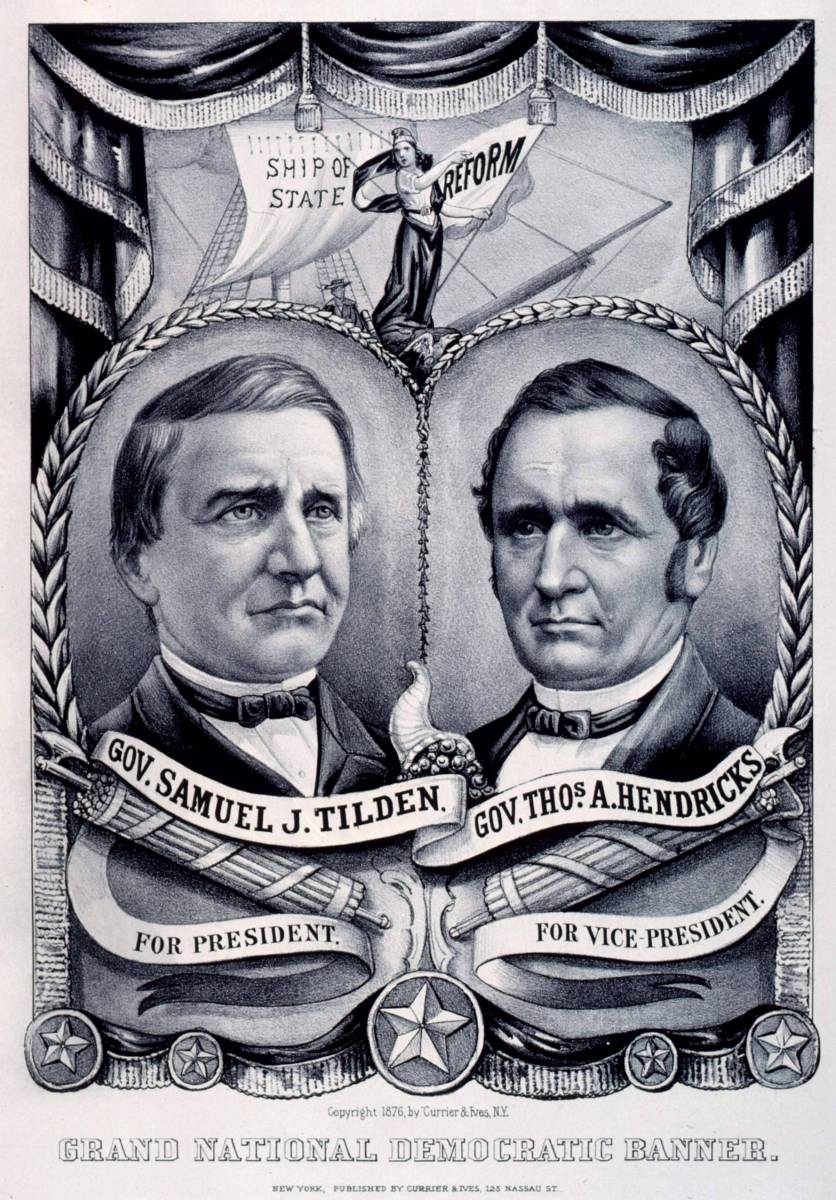
Democratic Party nomination
Democratic candidates:
Samuel J. Tilden, governor of New York
Thomas A. Hendricks, governor of Indiana

Winfield Scott Hancock, United States Army major general from Pennsylvania
William Allen, former governor of Ohio
Thomas F. Bayard, U.S. senator from Delaware

Joel Parker, former governor of New Jersey
The Democratic Party's failure to nominate its own ticket in the previous presidential election, in which they had instead endorsed the Liberal Republican candidacy of Horace Greeley, had resulted in much debate about the party's viability. Any doubts about the party's future were dispelled firstly by the collapse of the Liberal Republicans in the aftermath of that election, and secondly by significant Democratic gains in the 1874 mid-term elections, which saw them take control of the House of Representatives for the first time in sixteen years.
The 12th Democratic National Convention assembled in St. Louis, Missouri, in June 1876, which was the first political convention ever held by one of the major American parties west of the Mississippi River. There were 5000 people jammed inside the auditorium in St. Louis amid hopes for the Democratic Party's first presidential victory in 20 years. The platform called for immediate and sweeping reforms in response to the scandals that had plagued the Grant administration. Tilden won more than 400 votes on the first ballot and the presidential nomination by a landslide on the second.

Tilden defeated Thomas A. Hendricks, Winfield Scott Hancock, William Allen, Thomas F. Bayard, and Joel Parker for the presidential nomination. Tilden overcame strong opposition from "Honest John" Kelly, the leader of New York's Tammany Hall, to obtain the presidential nomination. Thomas Hendricks was nominated for vice president since he was the only person to put forward for that position.
The Democratic platform pledged to replace the corruption of the Grant administration with honest, efficient government and to end "the rapacity of carpetbag tyrannies" in the South. It also called for treaty protection for naturalized United States citizens visiting their homelands, restrictions on Asian immigration, tariff reform, and opposition to land grants for railroads. It has been claimed that the voting Democrats received Tilden's presidential nomination with more enthusiasm than any leader since Andrew Jackson.
Source: Official proceedings of the National Democratic convention, held in St. Louis, Mo., June 27th, 28th and 29th, 1876. (September 3, 2012).

Source: Official proceedings of the National Democratic convention, held in St. Louis, Mo., June 27th, 28th and 29th, 1876. (September 3, 2012).
Source: Official proceedings of the National Democratic convention, held in St. Louis, Mo., June 27th, 28th and 29th, 1876 (September 3, 2012).
Greenback Party nomination
Greenback candidates:
Peter Cooper, U.S. philanthropist from New York
Andrew Curtin, former governor of Pennsylvania
William Allen, former governor of Ohio
Alexander Campbell, U.S. representative from Illinois
Candidates gallery
The Greenback Party had been organized by agricultural interests in Indianapolis, Indiana, in 1874 to urge the federal government to inflate the economy through the mass issuance of paper money called greenbacks. Its first national nominating convention was held in Indianapolis during the month of May 1876. Peter Cooper was nominated for president with 352 votes to 119 for three other candidates. The convention nominated Anti-Monopolist Senator Newton Booth of California for vice president. After Booth declined to run, the national committee chose Samuel Fenton Cary as his replacement on the ticket.
Prohibition Party nomination
The Prohibition Party, in its second national convention in Cleveland, nominated Green Clay Smith as its presidential candidate and Gideon T. Stewart as its vice presidential candidate.
American National Party nomination
This small political party used several different names, often with different names in different states. It was a continuation of the Anti-Masonic Party that met in 1872 and nominated Charles Francis Adams Sr., for president. When Adams declined to run, the party did not contest the 1872 election.
The convention was held from June 8 to 10, 1875 in Liberty Hall, Pittsburgh, Pennsylvania. B.T. Roberts of New York served as chairman, and Jonathan Blanchard was the keynote speaker.
The platform supported the Reconstruction Amendments to the Constitution, international arbitration, the reading of the scriptures in public schools, specie payments, justice for Native Americans, abolition of the Electoral College, and prohibition of the sale of alcoholic beverages. It declared the first day of the week to be a day of rest for the United States. The platform opposed secret societies and monopolies.
The convention considered three potential presidential candidates: Charles F. Adams, Jonathan Blanchard, and James B. Walker. When Blanchard declined to run, Walker was unanimously nominated for president. The convention then nominated Donald Kirkpatrick of New York unanimously for vice president.
General election
Campaign
Tilden, who had prosecuted machine politicians in New York and sent the political boss William M. Tweed to jail, ran as a reform candidate against the background of the corruption of the Grant administration. Both parties backed civil service reform. Both sides mounted mudslinging campaigns, with Democratic attacks on Republican corruption being countered by Republicans raising the Civil War issue, a tactic that was ridiculed by Democrats, who called it "waving the bloody shirt". Republicans chanted, "Not every Democrat was a rebel, but every rebel was a Democrat."
Hayes was a virtual unknown outside his home state of Ohio, where he had served two terms as a U.S. representative and then two terms as governor. Henry Adams called Hayes "a third-rate nonentity whose only recommendations are that he is obnoxious to no one". Hayes had served in the Civil War with distinction as colonel of the 23rd Ohio Regiment and was wounded several times, which made him marketable to veterans. He had later been brevetted as a major-general. His most important asset was his help to the Republican ticket in carrying Ohio, a crucial swing state. On the other side, the newspaperman John D. Defrees described Tilden as "a very nice, prim, little, withered-up, fidgety old bachelor, about one-hundred and twenty-pounds avoirdupois, who never had a genuine impulse for many nor any affection for woman".
The Democratic strategy for victory in the South relied on paramilitary groups such as the Red Shirts and the White League. These groups saw themselves as the military wing of the Democrats. Using the strategy of the Mississippi Plan, they actively suppressed both black and white Republican voting. They violently disrupted meetings and rallies, attacked party organizers, and threatened potential voters with retaliation for voting Republican.
Because it was considered improper for a candidate to pursue the presidency actively, neither Tilden nor Hayes appeared publicly during the campaign. Speaking and leading rallies were left to their surrogates.
Colorado
Colorado was admitted to the Union as the 38th state on August 1, 1876; this was the first presidential election in which the state sent electors. There was insufficient time or money to organize a presidential election in the new state. Therefore, Colorado's state legislature selected the state's three members of the Electoral College. The Republican Party held a slim majority in the state legislature following a closely contested election on October 3, 1876. Many of the seats in that election had been decided by only a few hundred votes. On November 7, 1876, in a 50 to 24 vote, the state legislature chose Otto Mears, William Hadley, and Herman Beckurts to serve as the state's electors for president. All three of the state's electors cast their votes for Hayes. This was the last election in which any state chose electors through its state legislature, rather than by popular vote.
Electoral disputes and Compromise of 1877
Florida (with four electoral votes) and Louisiana (with eight) reported returns that favored Tilden, while Hayes led in South Carolina (with seven). However, the elections in each state were marked by electoral fraud and threats of violence against Republican voters. The most extreme case was in South Carolina, where an impossible 101 percent of all eligible voters in the state had their votes counted, and an estimated 150 Black Republicans were murdered. One of the points of contention revolved around the design of ballots. At the time, parties would print ballots or "tickets" to enable voters to support them in the open ballots. To aid illiterate voters, the parties would print symbols on the tickets, and in this election, many Democratic ballots were printed with the Republican symbol of Abraham Lincoln on them. The Republican-dominated state electoral commissions subsequently rejected enough Democratic votes to award their electoral votes to Hayes.
In two Southern states, the governor recognized by the United States had signed the Republican certificates; the Democratic certificates from Florida were signed by the state attorney-general and the newly elected Democratic governor. Those from Louisiana were signed by the Democratic gubernatorial candidate and those from South Carolina by no state official. The Tilden electors in South Carolina claimed that they had been chosen by the popular vote although they were rejected by the state election board.
Meanwhile, in Oregon, the vote of a single elector was disputed. The statewide result clearly favored Hayes, but the state's Democratic governor, La Fayette Grover, claimed that one of the Republican electors, Ex-Postmaster John Watts, was ineligible under Article II, Section 1, of the United States Constitution since he had been a "person holding an office of trust or profit under the United States." Grover substituted a Democratic elector in Watts's place.
The two Republican electors dismissed Grover's action and reported three votes for Hayes. However, the Democratic elector, C. A. Cronin, reported one vote for Tilden and two votes for Hayes. The two Republican electors presented a certificate signed by the secretary of state of Oregon, and Cronin and the two electors whom he appointed (Cronin voted for Tilden while his associates voted for Hayes) presented a certificate signed by the governor and attested by the secretary of state.
Ultimately, all three of Oregon's votes were awarded to Hayes, who had a majority of one in the Electoral College. The Democrats claimed fraud, and suppressed excitement pervaded the country. Threats were even muttered that Hayes would never be inaugurated. In Columbus, Ohio, a shot was fired at Hayes's residence as he sat down to dinner. After supporters marched to his home to call for the President, Hayes urged the crowd that "it is impossible, at so early a time, to obtain the result". Grant quietly strengthened the military force in and around Washington.
The Constitution provides that "the President of the Senate shall, in presence of the Senate and House of Representatives, open all the [electoral] certificates, and the votes shall then be counted." The Republicans held that the power to count the votes lay with the President of the Senate, with the House and Senate being mere spectators. The Democrats objected to that construction, since the President Pro Tempore of the Senate, the Republican Thomas W. Ferry, could then count the votes of the disputed states for Hayes.
The Democrats insisted that Congress should continue the practice followed since 1865: no vote objected to should be counted except by the concurrence of both houses. Since the House had a solid Democratic majority, rejecting the vote of one state, therefore, would elect Tilden.
Facing an unprecedented constitutional crisis, the Congress passed a law on January 29, 1877, to form a 15-member Electoral Commission, which would settle the result. Five members were selected from each house of Congress, and they were joined by five members of the United States Supreme Court, with William M. Evarts serving as counsel for the Republican Party.
The majority party in each house named three members and the minority party two members. As the Republicans controlled the Senate and the Democrats controlled the House of Representatives, that yielded five Democratic and five Republican members of the commission. Of the Supreme Court justices, two Republicans and two Democrats were chosen, with the fifth to be selected by those four.
The justices first selected the independent Justice David Davis. According to one historian, "No one, perhaps not even Davis himself, knew which presidential candidate he preferred." Just as the Electoral Commission Bill was passing Congress, the Illinois Legislature elected Davis to the Senate, and Democrats in the legislature believed that they had purchased Davis's support by voting for him. However, they had miscalculated, as Davis promptly excused himself from the commission and resigned as a Justice to take his Senate seat. As all of the remaining available Justices were Republicans, Republican Justice Joseph P. Bradley, who was considered the most impartial remaining member of the court was selected. That selection proved decisive.
It was drawing perilously near to Inauguration Day, and thus the commission met on January 31. Each of the disputed state election cases (Florida, Louisiana, Oregon, and South Carolina) was respectively submitted to the commission by Congress. Eminent counsel appeared for each side, and there were double sets of returns from every one of the states named.
The commission first decided not to question any returns that were prima facie lawful. Bradley then joined the other seven Republican committee members in a series of 8–7 votes that gave all 20 disputed electoral votes to Hayes, which gave Hayes a 185–184 electoral vote victory. The commission adjourned on March 2. Hayes privately took the oath of office the next day and was publicly sworn into office on March 5, 1877, and Hayes was inaugurated without disturbance.
The Compromise of 1877 might be a reason for the Democrats accepting the Electoral Commission. During intense closed-door meetings, Democratic leaders agreed reluctantly to accept Hayes as president in return for the withdrawal of federal troops from the last two Southern states that were still occupied: South Carolina and Louisiana. Republican leaders in return agreed on a number of handouts and entitlements, including federal subsidies for a transcontinental railroad line through the South. Although some of the promises were not kept, particularly the railroad proposal, that was enough for the time being to avert a dangerous standoff.