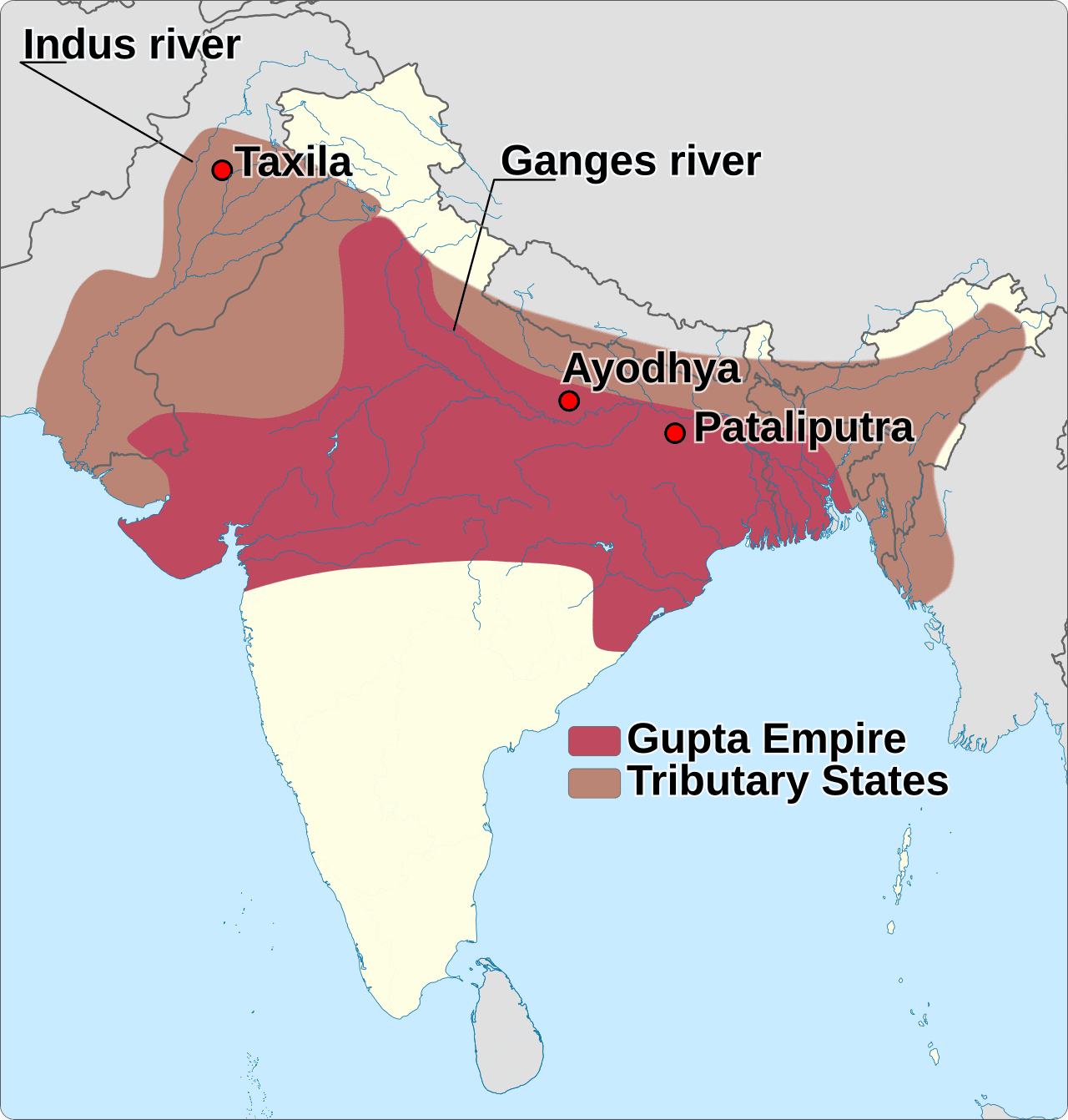
The Gupta Empire, which flourished from approximately 320 CE to 550 CE across the Indian subcontinent, is widely regarded as ancient India's 'Golden Age'—a period of unparalleled achievement in mathematics, astronomy, literature, medicine, and the arts. Founded by Chandragupta I in the Ganges Plain of northeastern India, the empire at its height stretched from modern-day Pakistan in the west to Bengal in the east, and from the Himalayan foothills in the north to the Deccan Plateau in the south, encompassing an estimated population of between 30 and 40 million people. The intellectual and cultural innovations produced during Gupta rule—including the concept of zero, the decimal system, and Sanskrit literature's greatest works—shaped civilizations far beyond India's borders and continue to influence the modern world.
How Did the Gupta Empire Rise to Power?
The Gupta dynasty emerged from the political vacuum left by the decline of the Kushan Empire in the northwest and the Satavahana dynasty in the Deccan. The dynasty's origins are somewhat obscure, but Srigupta, considered the dynasty's founder, ruled a modest territory in the Magadha region (modern Bihar) around 240–280 CE. His successors consolidated power incrementally, but it was Chandragupta I (reigned c. 320–335 CE) who dramatically elevated the family's fortunes through a politically strategic marriage to Kumaradevi, a princess of the powerful Lichchhavi clan of Nepal. This alliance gave Chandragupta I legitimacy, resources, and control of the vital Ganges trade routes. He adopted the grandiose title 'Maharajadhiraja' (King of Kings), marking the formal beginning of the Gupta imperial era around 320 CE—a date so pivotal that it anchors the Gupta Era calendar. His son, Samudragupta (reigned c. 335–375 CE), then launched a series of brilliant military campaigns documented in the Allahabad Pillar inscription, conquering over twenty kingdoms across India and earning the epithet 'Napoleon of India' from Victorian historian V. A. Smith.
Who Were the Greatest Gupta Rulers?
Samudragupta's Allahabad Pillar inscription, composed by his court poet Harishena, records victories against nine kings of northern India and twelve rulers of the south, portraying a monarch who was simultaneously a warrior, poet, and musician. His successor, Chandragupta II (reigned c. 375–415 CE), known as Vikramaditya ('Sun of Power'), brought the empire to its territorial and cultural zenith. He conquered the wealthy Western Kshatrapas of Gujarat and Malwa around 388–409 CE, gaining access to lucrative Arabian Sea trade ports. It was during Chandragupta II's reign that the Chinese Buddhist pilgrim Faxian (Fa-Hien) visited India (399–414 CE) and described a prosperous, well-governed kingdom where hospitals served the poor free of charge and crime was minimal. Kumaragupta I (reigned c. 415–455 CE) maintained this prosperity and founded the Nalanda University complex in Bihar, which would become the ancient world's greatest centre of learning, eventually hosting over 10,000 students and 2,000 teachers at its peak centuries later. The final major ruler, Skandagupta (reigned c. 455–467 CE), successfully repelled the first wave of Huna (Hephthalite) invasions but depleted the treasury in doing so, setting the stage for decline.
What Were the Gupta Empire's Greatest Achievements in Science and Mathematics?
The Gupta period produced scientific breakthroughs that rank among humanity's most consequential intellectual achievements. The mathematician and astronomer Aryabhata (born 476 CE) wrote the Aryabhatiya at age 23, proposing that the Earth rotates on its axis, calculating the length of the solar year as 365.358 days (remarkably close to the modern value of 365.256 days), and providing a value for pi (π) accurate to four decimal places at 3.1416. Brahmagupta (598–668 CE), working in the tradition established during the Gupta era, formalized rules for arithmetic operations involving zero and negative numbers—a conceptual revolution without which modern computing would be impossible. The decimal place-value system, developed and perfected during the Gupta period, was transmitted to the Islamic world and then to Europe, where it replaced cumbersome Roman numerals and became the universal numerical language of science and commerce. In medicine, the physician Sushruta's texts—compiled and refined during this era—described over 300 surgical procedures and 120 surgical instruments, including techniques for rhinoplasty (nose reconstruction) that anticipated modern plastic surgery by more than a millennium. The metallurgical expertise of Gupta craftsmen is dramatically demonstrated by Delhi's Iron Pillar, cast around 415 CE during Chandragupta II's reign: standing 7.2 metres tall and weighing approximately 6 tonnes, this pillar of 99.7% pure wrought iron has resisted corrosion for over 1,600 years, a feat modern metallurgists did not replicate until the 20th century.
How Did Gupta Art, Literature, and Religion Shape Indian Culture?
The Gupta period established the classical standards for Indian art, literature, and religious expression that dominated the subcontinent for centuries. Sanskrit literature reached its pinnacle through Kalidasa, the court poet of Chandragupta II, whose plays Abhijnanashakuntalam (The Recognition of Shakuntala) and Meghaduta (The Cloud Messenger) are considered masterworks of world literature—Goethe praised Shakuntala extravagantly after reading a translation in 1791. The Puranas, a genre of encyclopedic Hindu religious texts, were compiled and codified during this era, and the two great Sanskrit epics, the Mahabharata and Ramayana, received their near-final literary forms under Gupta patronage. Artistically, Gupta sculptors developed a refined, serene aesthetic that became the template for Buddhist and Hindu iconography across Asia. The rock-cut cave temples at Ajanta (Maharashtra), whose breathtaking murals date from the 5th and 6th centuries CE, showcase Gupta-era painting at its most sophisticated, depicting scenes from Buddhist Jataka tales with extraordinary psychological depth and technical mastery. In architecture, the Gupta period saw the construction of the earliest freestanding Hindu stone temples, replacing earlier wooden structures and establishing the nagara (northern) temple style. Religion during the Gupta era was characterised by remarkable pluralism: the ruling family favoured Vaishnavism (devotion to Vishnu), but Buddhism, Jainism, and Shaivism were all supported and practised freely.
| Ruler | Reign (CE) | Key Achievement |
|---|---|---|
| Chandragupta I | c. 320–335 | Founded the empire; married Lichchhavi princess; adopted 'Maharajadhiraja' title |
| Samudragupta | c. 335–375 | Military campaigns across India; Allahabad Pillar inscription; patron of arts |
| Chandragupta II (Vikramaditya) | c. 375–415 | Conquered Gujarat; Delhi Iron Pillar; Kalidasa's patronage; Faxian's visit |
| Kumaragupta I | c. 415–455 | Founded Nalanda University complex; maintained peace and prosperity |
| Skandagupta | c. 455–467 | Repelled Huna invasions; last powerful emperor; empire began fragmentation |
What Was the Gupta Empire's Economy and Administrative System?
The Gupta economy was among the most sophisticated of the ancient world, fuelled by fertile agriculture in the Ganges Plain, extensive internal trade networks, and lucrative maritime commerce. Roman sources and archaeological finds of Roman gold coins across Gupta territories confirm active trade with the Mediterranean world in luxury goods including cotton textiles, spices, ivory, and gems. The empire exported silk and fine fabrics to Southeast Asia, where Gupta cultural influence spread alongside commerce, giving rise to what historians call 'Indianisation'—the voluntary adoption of Indian scripts, religions, and artistic styles by kingdoms in Cambodia, Java, and Vietnam. Gupta governance was deliberately decentralised compared to the earlier Mauryan Empire; the emperor ruled directly over the imperial heartland while peripheral territories were governed by feudatory kings who acknowledged Gupta suzerainty and paid tribute. This system granted local rulers autonomy in exchange for loyalty, making the empire relatively stable but also dependent on the personal authority of strong central emperors. Land grants to Brahmin priests and Buddhist monasteries, recorded on copper plates, became an important tool of political legitimacy and helped spread literacy and Sanskritic culture into rural areas.
Why Did the Gupta Empire Decline and Fall?
The Gupta Empire's decline resulted from a convergence of external invasions, internal fragmentation, and economic strain beginning in the mid-5th century CE. The most devastating external threat came from the Huna (also called Hephthalites or White Huns), Central Asian nomadic confederations who began raiding northwestern India around 455 CE. Although Skandagupta repelled the first major incursion, the military expenditure crippled the imperial treasury, evidenced by a sharp debasement of Gupta gold coinage from nearly pure gold to coins with significantly lower metal content. After Skandagupta's death in approximately 467 CE, a succession crisis fragmented the royal family, with multiple claimants ruling simultaneously over diminishing territories. The Huna chieftain Toramana conquered large portions of northwestern India around 500 CE, and his son Mihirakula (reigned c. 515–540 CE) is described in contemporary accounts as a particularly brutal ruler who persecuted Buddhists and devastated cities. Simultaneously, feudatory kings in Bengal, Malwa, and the Deccan asserted independence, no longer sending tribute to a weakened central authority. By approximately 550 CE, the last nominal Gupta kings controlled only a small territory in Bengal, and by 600 CE the dynasty had effectively ceased to exist as a political entity, giving way to the fragmented post-Gupta regional kingdoms that characterized medieval India.
What Was the Gupta Empire's Legacy and Long-Term Influence?
The Gupta Empire's legacy is disproportionate to its relatively brief 230-year existence. The mathematical and astronomical innovations of Gupta-era scholars—especially the decimal number system and the concept of zero—are foundational to all modern science, engineering, and digital technology. The artistic and architectural standards established during the Gupta period defined South and Southeast Asian visual culture for over a thousand years, and Gupta-era Sanskrit literature remains canonical in Indian cultural education. Nalanda University, institutionalised during Kumaragupta I's reign, became the world's first residential university, attracting scholars from China, Korea, Japan, Persia, and Turkey before its destruction by Bakhtiyar Khilji's forces in 1193 CE. The Gupta model of a cosmopolitan, Sanskrit-speaking, Brahminical Hindu culture supported by royal patronage became the template for subsequent Indian dynasties from the Chalukyas to the Cholas. Internationally, the transmission of Gupta mathematical knowledge through Arab scholars like Al-Khwarizmi in the 9th century CE directly enabled the European scientific revolution: the algorithms and algebra that underpin modern computing trace a direct lineage to the Gupta scholars working in Pataliputra (modern Patna) fifteen centuries ago.
How Does the Gupta Empire Compare to Other Ancient Civilizations?
Contemporary with the late Western Roman Empire (which fell in 476 CE), the Han dynasty's successors in China, and the Sassanid Persian Empire, the Gupta Empire stands as one of the great civilizations of late antiquity. Unlike the Roman Empire, which projected power primarily through military conquest and law, or Han China, which emphasised bureaucratic centralism, the Gupta Empire achieved its influence primarily through cultural and intellectual radiation—its ideas and artistic forms spread voluntarily across Asia because they were genuinely admired and adopted. Compared to the earlier Mauryan Empire (322–185 BCE), which controlled a similar geographic footprint through more authoritarian governance, the Gupta state was considerably more pluralistic religiously and more permissive economically, allowing merchant guilds (shrenis) substantial autonomy. The Gupta period's scientific output arguably surpassed any comparable civilization of its era: no contemporary European, Chinese, or Mesopotamian society produced innovations of equivalent mathematical sophistication to those of Aryabhata and his successors. This combination of political stability, religious tolerance, economic prosperity, and intellectual freedom created the conditions for the extraordinary flowering of human creativity that historians rightly call India's Golden Age.