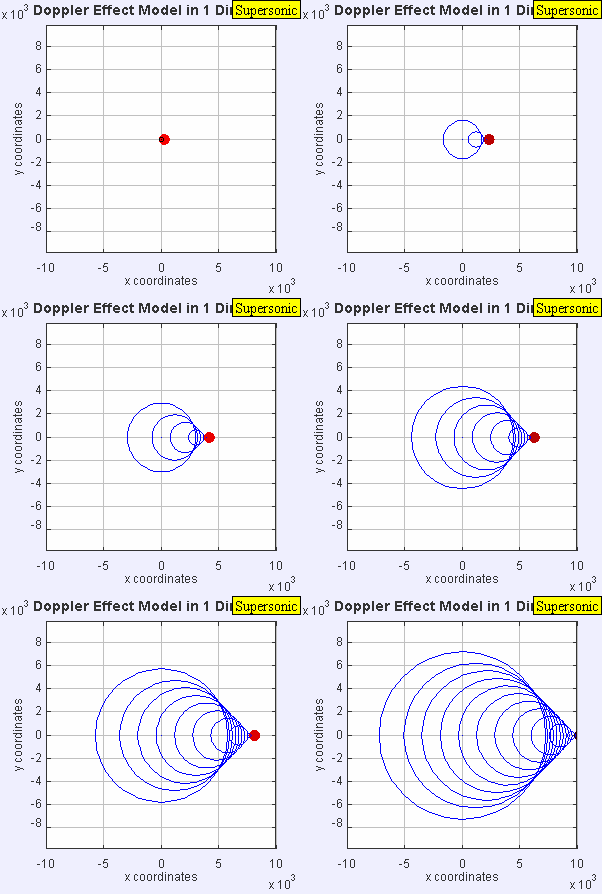
Supersonic speed refers to any velocity exceeding Mach 1 — the speed of sound, approximately 343 metres per second (1,235 km/h or 767 mph) at sea level. On 14 October 1947, U.S. Air Force pilot Chuck Yeager became the first person to officially break the sound barrier, flying the Bell X-1 rocket plane over the Mojave Desert at Mach 1.06. That moment ended decades of uncertainty about whether supersonic flight was even survivable, and launched a new era in aviation, military technology, and aerospace engineering.
What Is Supersonic Speed and How Is It Measured?
Speed is measured in Mach numbers, a ratio named after Austrian physicist Ernst Mach. Mach 1 equals the local speed of sound, which varies with altitude and temperature — at 35,000 feet, it drops to roughly 295 m/s (1,062 km/h) because the air is colder. Supersonic flight (Mach 1–5) differs from subsonic (below Mach 1) primarily because an aircraft outruns the pressure waves it creates, producing a shockwave. This shockwave is heard on the ground as a 'sonic boom.' Hypersonic speed begins at Mach 5, where aerodynamic heating becomes the dominant engineering challenge.
| Speed Regime | Mach Range | Example Vehicle |
|---|---|---|
| Subsonic | Below Mach 1 | Boeing 737 (Mach 0.85) |
| Transonic | Mach 0.8–1.2 | Many fighter jets in a dive |
| Supersonic | Mach 1–5 | Concorde (Mach 2.04), F-22 (Mach 2+) |
| Hypersonic | Mach 5+ | Space Shuttle re-entry (~Mach 25) |
How Did Chuck Yeager Break the Sound Barrier in 1947?
Before Yeager's flight, test pilots had reported violent buffeting and loss of control near Mach 1, and several had died attempting to push through. The Bell X-1 — shaped like a .50-calibre bullet for aerodynamic stability — was carried aloft by a B-29 bomber and released at 23,000 feet. Yeager, flying with two broken ribs from a horse-riding accident days earlier, ignited the rocket engine and climbed to 45,000 feet before reaching Mach 1.06. His success proved the 'sound barrier' was an engineering problem, not a physical wall, and declassified the achievement only in June 1948.

Which Aircraft and Vehicles Have Achieved Supersonic Speed?
Military jets led the way: the F-100 Super Sabre (1953) became the first supersonic aircraft in level flight for the U.S. Air Force. The iconic Concorde, operated by Air France and British Airways from 1976 to 2003, carried passengers at Mach 2.04, crossing the Atlantic in under 3.5 hours. The SR-71 Blackbird reconnaissance aircraft holds the air-breathing aircraft speed record at Mach 3.3 (3,540 km/h), set in 1976. More recently, NASA's X-59 QueSST is designed to produce a quieter 'sonic thump' rather than a boom, reviving interest in commercial supersonic travel.
What Is the Future of Supersonic and Hypersonic Travel?
Companies including Boom Supersonic (Overture, targeting Mach 1.7) and Aerion (before its 2021 closure) have pursued commercial supersonic revival. Meanwhile, hypersonic weapons programmes — the U.S. AGM-183A ARRW and Russia's Avangard glide vehicle — have reshaped military strategy. The core challenge remains: sustained supersonic flight produces extreme heat, enormous fuel consumption, and sonic booms that restrict overland routes. Advances in scramjet technology and heat-resistant materials are gradually eroding these barriers, making Mach 5+ passenger travel a realistic — if distant — prospect.