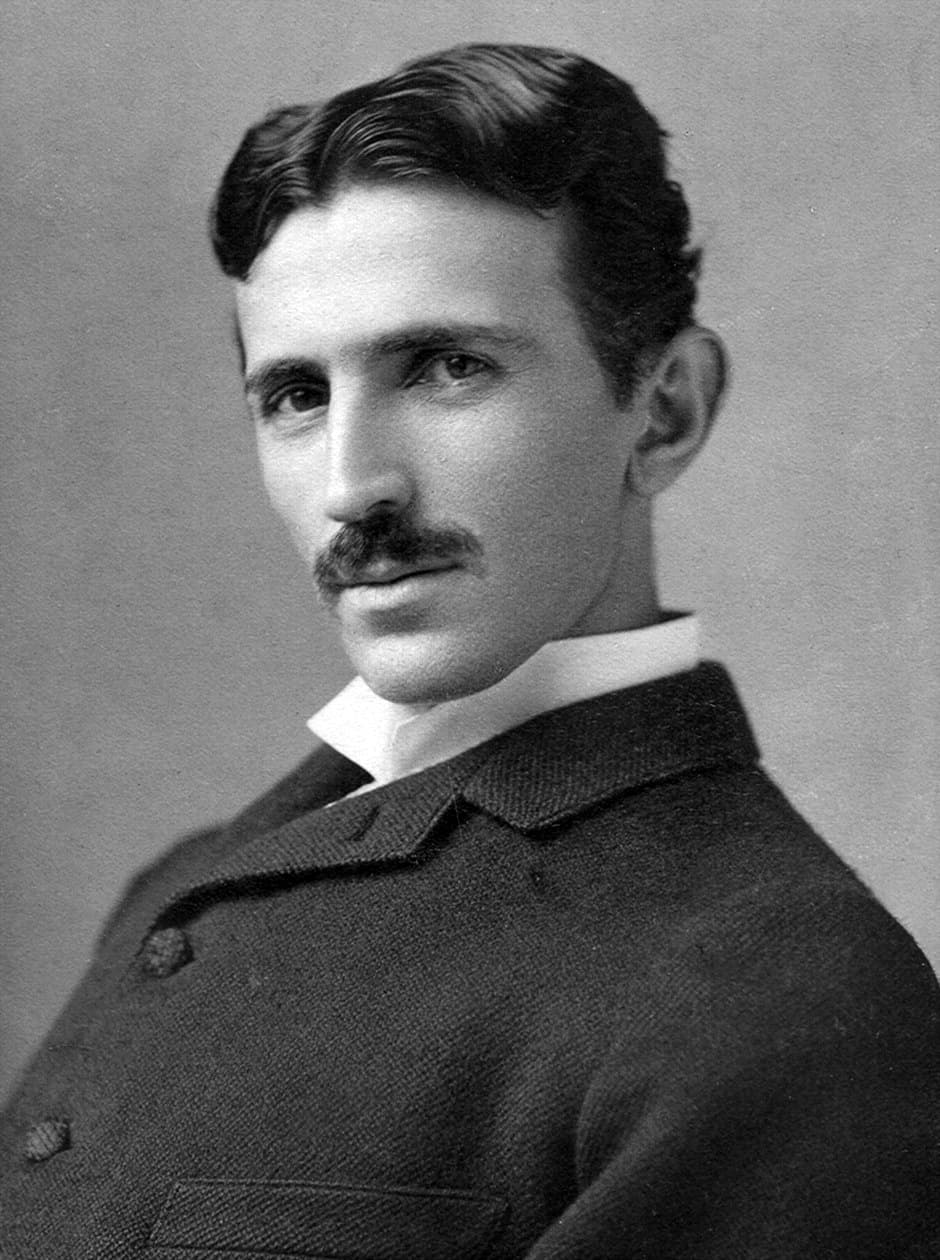
In the annals of scientific history, few figures burn as brightly — or as tragically — as Nikola Tesla. Born in the Serbian village of Smiljan in 1856, Tesla possessed an intellect so far ahead of its time that many of his contemporaries dismissed him as a dreamer. Yet the world he envisioned — one lit by alternating current, connected by wireless signals, and powered by forces drawn from the earth itself — became the world we inhabit today. Tesla did not merely contribute to the electrical age; in many ways, he invented it.
From the Mountains of Serbia to the Halls of Edison
Nikola Tesla was born on the night of July 10, 1856, in Smiljan, then part of the Austrian Empire (modern-day Croatia). His father was a Serbian Orthodox priest, and from an early age, Tesla demonstrated a photographic memory and an extraordinary capacity for mental arithmetic. He claimed he could visualize entire machines in his mind before committing a single line to paper — a faculty he called 'the mental laboratory.' After studying electrical engineering at the Austrian Polytechnic in Graz and later briefly at the Charles-Ferdinand University in Prague, Tesla worked for telegraph companies across Europe before emigrating to the United States in 1884.
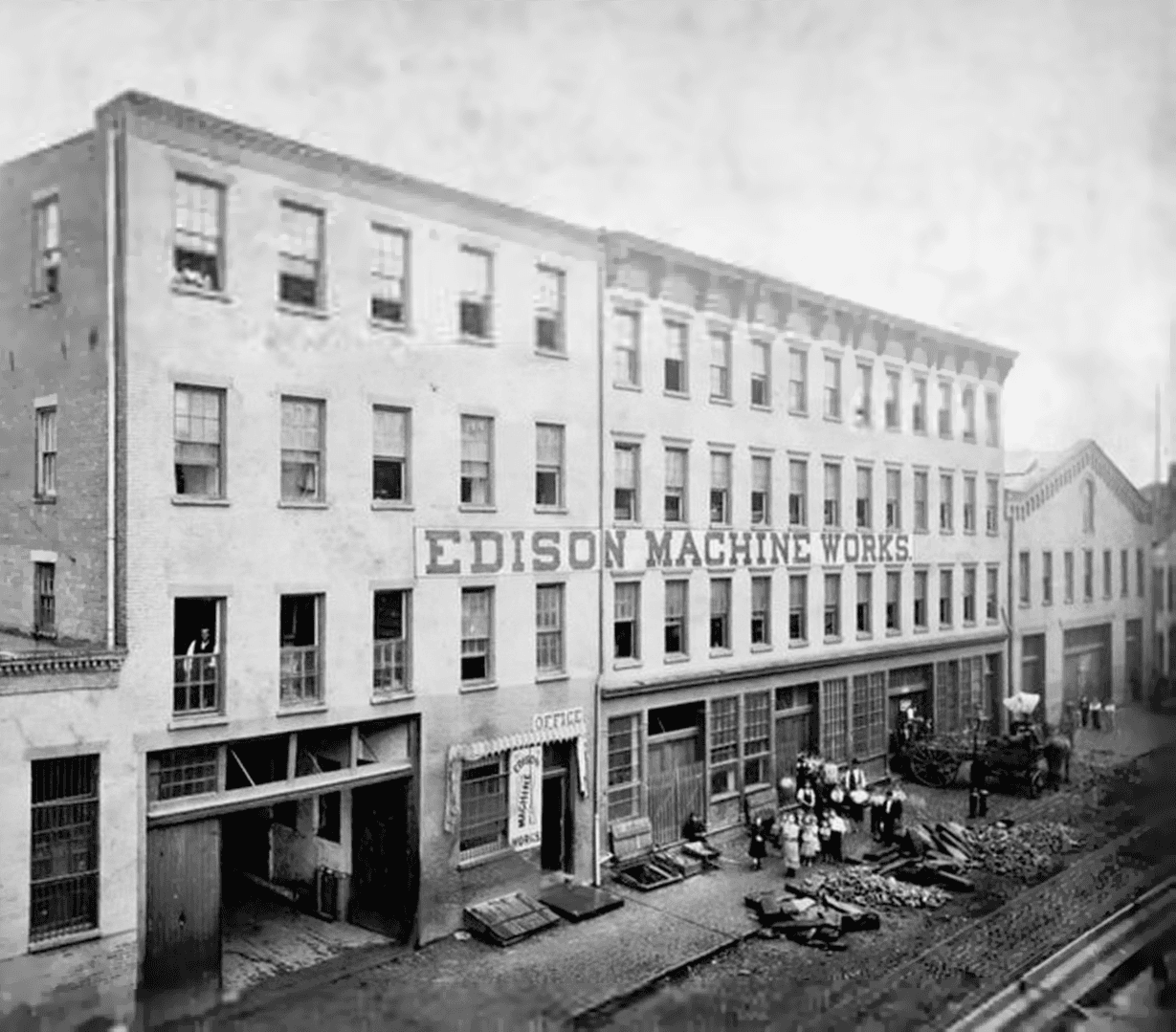
Arriving in New York with four cents in his pocket, a letter of recommendation, and a head full of revolutionary ideas, Tesla secured a position working directly for Thomas Edison. The two men could not have been more different in temperament or method. Edison was an empiricist who favored brute-force experimentation; Tesla was a theorist who solved problems in his mind before ever entering the laboratory. Their collaboration was short-lived and stormy. When Tesla claimed Edison had promised him $50,000 for solving a series of engineering problems — a promise Edison reportedly dismissed as a joke — Tesla resigned and briefly found himself digging ditches to survive.
The War of Currents
The rupture with Edison set the stage for one of the most consequential technological battles in history: the War of Currents. Edison championed direct current (DC), which he had commercialized across American cities. Tesla believed, with mathematical certainty, that alternating current (AC) was superior — it could be transmitted over far greater distances at far lower cost. In 1887, backed by entrepreneur George Westinghouse, Tesla filed a series of patents for a complete AC electrical system, including the polyphase induction motor and the transformer system that bears his name.
Edison fought back ferociously, staging public demonstrations in which animals were electrocuted with AC current to frighten the public. But the economics were undeniable. AC could travel hundreds of miles along high-voltage transmission lines and be stepped down for safe household use — something DC simply could not replicate economically. The decisive battle came in 1893, when Westinghouse and Tesla won the contract to illuminate the World's Columbian Exposition in Chicago using AC power. The following year, their turbines at Niagara Falls began transmitting electricity to Buffalo, New York, marking the dawn of the modern electrical grid. Tesla and Westinghouse had won. The world would run on alternating current.
Wireless Dreams and the Tower at Wardenclyffe
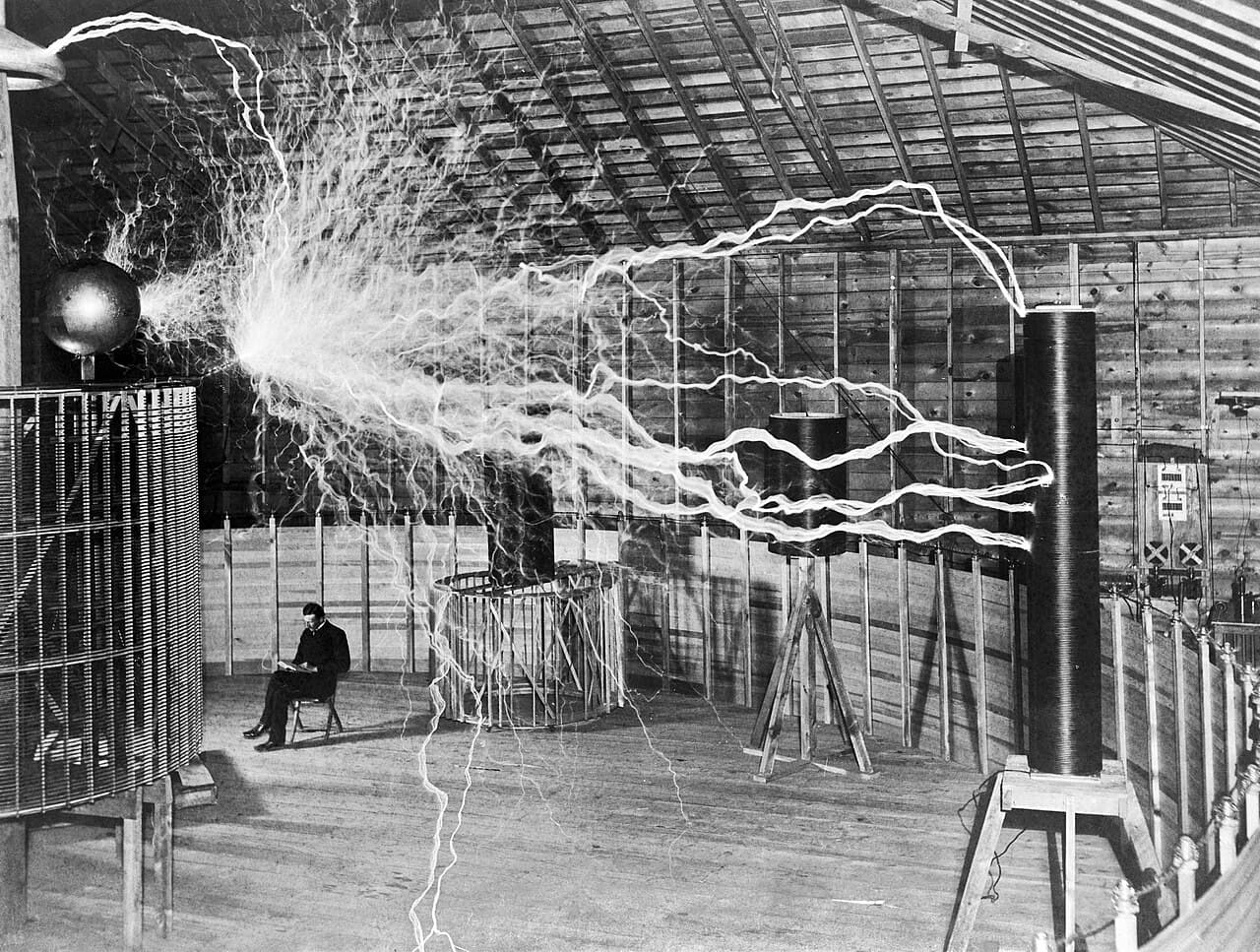
Victory in the current wars might have secured Tesla a comfortable life. Instead, his ambitions expanded dramatically. In the late 1890s, his experiments at a laboratory in Colorado Springs demonstrated that the Earth itself could conduct electricity. He claimed to have transmitted electrical energy without wires across considerable distances and recorded what he believed were signals from other planets — almost certainly atmospheric interference, though the experiments were genuinely pioneering. Tesla filed patents for radio transmission and wireless communication that would later become the subject of intense legal dispute with Guglielmo Marconi.
His grandest project was Wardenclyffe Tower, a 57-meter transmission tower constructed on Long Island between 1901 and 1902, financed initially by banker J.P. Morgan. Tesla envisioned it as the first node in a global wireless transmission network — capable of delivering not just messages but electric power to any point on Earth, free of charge. Morgan, who could not see a way to meter and profit from such a system, withdrew funding in 1903. Without capital, construction halted. The tower was demolished in 1917 to pay debts. The dream of free global wireless energy died with it — though Tesla's core patents on radio were upheld by the U.S. Supreme Court in 1943, just months after his death.
The Lonely Genius: Later Life and Legacy
Tesla spent the final decades of his life in increasing poverty and isolation, residing in a series of New York hotels, most notably the Hotel New Yorker where he died alone on January 7, 1943, at the age of 86. He never married, claiming that celibacy sharpened his scientific faculties. He developed obsessive-compulsive tendencies and an acute aversion to human hair, pearls, and the number 13. His eccentricities fed a popular mythology that has, at times, obscured the genuine magnitude of his contributions.
The SI unit of magnetic flux density — the Tesla (T) — was named in his honor in 1960, a belated recognition of his foundational work in electromagnetism. His inventions or foundational research underpin AC power systems, electric motors, radio, radar, neon lighting, remote control, X-ray experimentation, and early robotics. Elon Musk's electric vehicle company, named Tesla Inc., has introduced his name to new generations, though the man himself was deeply skeptical of the combustion engine and would likely have marveled more at the wireless transmission of energy than at the car itself.
A Reckoning With Genius
The story of Nikola Tesla is inseparable from questions of credit, capital, and cultural memory. Edison, who commercialized and marketed brilliantly, died a celebrated titan of industry. Tesla, who perhaps imagined more clearly and more boldly, died in debt. History has gradually corrected this imbalance. Tesla's notebooks — seized by the U.S. government after his death and later partially declassified — reveal a mind decades ahead of its era, sketching concepts that resemble modern wireless charging, particle beam weapons, and even early ideas about resonant frequency communication. He was not merely an inventor; he was a prophet of the electrical age who never quite lived to see the full realization of his prophecies.
| Invention / Contribution | Year | Significance |
|---|---|---|
| AC Induction Motor | 1887 | Foundation of modern electric power systems |
| Tesla Coil | 1891 | High-frequency, high-voltage resonant transformer |
| Radio Patents (disputed) | 1897 | Supreme Court upheld in 1943 over Marconi |
| Niagara Falls AC Power Plant | 1895 | First large-scale AC hydroelectric transmission |
| Remote Control (radio-guided boat) | 1898 | Demonstrated at Madison Square Garden |
| Wardenclyffe Tower | 1901–1902 | Attempted global wireless power transmission node |