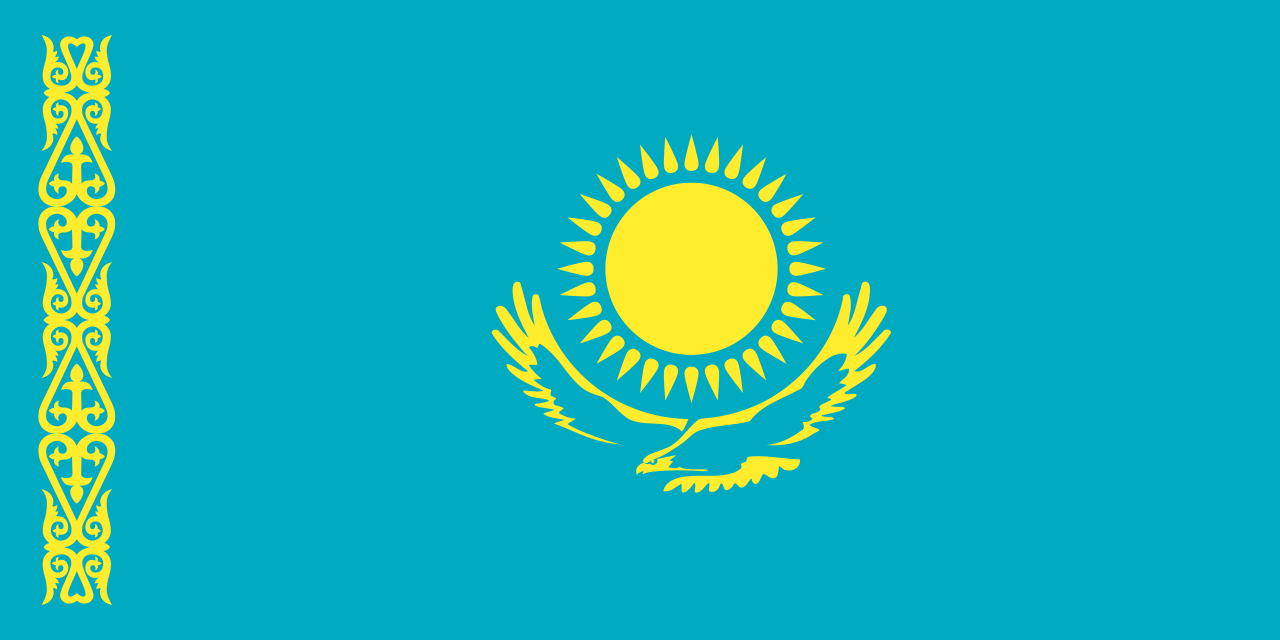
Kazakhstan is the world's largest landlocked country, covering 2.72 million square kilometres across Central Asia and stretching from the Caspian Sea in the west to the Altai Mountains in the east. Home to 19 million people and vast reserves of oil, gas, and uranium, it declared independence from the Soviet Union on December 16, 1991, and has since transformed into one of the most strategically significant nations in Eurasia.
What Is Kazakhstan's History and Origins?
The Kazakh people emerged as a distinct ethnic group in the 15th century when Kazakh khans broke away from the Uzbek Khanate around 1465, establishing the Kazakh Khanate across the vast steppes of Central Asia. For centuries, Kazakh society was organised around nomadic tribes — the Great, Middle, and Little Zhuz (hordes) — herding livestock across the grasslands. Russian imperial expansion began in earnest in the 18th century: by 1848, Russia had absorbed virtually all Kazakh territory, ending the Khanate's sovereignty. Soviet collectivisation under Stalin in the late 1920s and early 1930s proved catastrophic — forced sedentarisation and the seizure of livestock triggered a famine (the Asharshylyk) that killed an estimated 1.5 million Kazakhs, roughly 40 percent of the entire ethnic Kazakh population. The Soviet era also brought industrialisation, the Baikonur Cosmodrome (from which Yuri Gagarin launched in 1961), and the infamous Semipalatinsk nuclear test site, where the USSR conducted 456 nuclear tests between 1949 and 1989.
How Did Kazakhstan Become an Economic Powerhouse?
Independence in 1991 brought severe economic hardship, but the discovery and development of massive oil fields — particularly Tengiz (1993), Kashagan (2000), and Karachaganak — transformed Kazakhstan's fortunes. By the mid-2000s, Kazakhstan was attracting billions in foreign direct investment annually. GDP per capita rose from under $700 in 1995 to over $10,000 by 2023. The country holds the world's second-largest uranium reserves and produces roughly 43 percent of global uranium supply. Nursultan Nazarbayev, who ruled from 1991 to 2019, pursued a multi-vector foreign policy — balancing ties with Russia, China, the United States, and the European Union — while maintaining authoritarian control. In January 2022, protests over fuel price rises escalated into the bloodiest unrest since independence, killing at least 238 people before President Kassym-Jomart Tokayev requested Russian-led CSTO troops to restore order.

| Indicator | Detail |
|---|---|
| Capital | Astana (renamed from Nur-Sultan in 2022) |
| Population | ~19.2 million (2024) |
| Area | 2,724,900 km² — 9th largest country on Earth |
| GDP (nominal) | ~$260 billion USD (2023) |
| Main exports | Oil, uranium, copper, wheat, steel |
| Official languages | Kazakh (state), Russian (official) |
| Independence | December 16, 1991 |
What Makes Kazakhstan's Culture and Geography Unique?
Kazakhstan's landscape is extraordinarily diverse: the northern steppes give way to deserts in the south (including part of the Kyzylkum Desert), the shrunken Aral Sea in the west — an environmental catastrophe caused by Soviet-era irrigation — and snow-capped peaks in the southeast near Almaty, the country's largest city. Nomadic heritage remains central to Kazakh identity: the yurt (called a 'yurt' or 'ger') is a national symbol, eagle hunting is a UNESCO-listed tradition, and fermented mare's milk (kumiss) is a cultural staple. Kazakhstan is also the likely origin of the domestic apple — the city of Almaty derives its name from the Kazakh word for apple. Islam, introduced in the 8th century, is the majority religion, practised by roughly 70 percent of the population, though Soviet rule left a largely secular society.
