
The ZX81 is a home computer developed by Sinclair Research and manufactured in Dundee, Scotland, by Timex Corporation. It was launched in the United Kingdom in March 1981 as the successor to Sinclair's ZX80 and designed to be a low-cost introduction to home computing for the general public. It was hugely successful; more than 1.5 million units were sold. In the United States it was initially sold as the ZX-81 under licence by Timex. Timex later produced its own versions of the ZX81: the Timex Sinclair 1000 and Timex Sinclair 1500. Unauthorized ZX81 clones were produced in several countries.
The ZX81 was designed to be small, simple, and above all, inexpensive. Video output is for a television set rather than a dedicated monitor. It contains only four silicon chips and 1 KB of RAM. It has no power switch or moving parts, excepting a VHF TV channel selector switch in some models. It has a pressure-sensitive membrane keyboard. Programs and data are loaded and saved onto compact audio cassettes. The ZX81's limitations prompted a market in third-party peripherals to improve its capabilities. Its distinctive case and keyboard brought designer Rick Dickinson a Design Council award.
The ZX81 could be bought by mail order preassembled or, for a lower price, in kit form. It was the first inexpensive mass-market home computer to be sold by high street stores, led by W. H. Smith and soon many other retailers. The ZX81 marked the point when computing in Britain became an activity for the general public rather than businessmen and electronics hobbyists. It produced a community of enthusiasts, some of whom founded businesses developing software and hardware for the ZX81. Many went on to have roles in the British computer industry. The ZX81's commercial success made Sinclair Research one of Britain's leading computer manufacturers and earned a fortune and an eventual knighthood for the company's founder, Sir Clive Sinclair. The system was discontinued in 1984.

Features
The ZX81 has a base configuration of 1 KB of on-board RAM that can officially be expanded externally to 16 KB. Its single circuit board is housed inside a wedge-shaped plastic case measuring 167 millimetres (6.6 in) wide by 40 millimetres (1.6 in) high. The memory is provided by either a single 4118 (1024 bit × 8) or two 2114 (1024 bit × 4) RAM chips. There are only three other onboard chips: a 3.5 MHz Z80A 8-bit microprocessor from NEC, an uncommitted logic array (ULA) chip from Ferranti, and an 8 KB ROM providing a simple Sinclair BASIC interpreter. The entire machine weighs just 350 grams (12 oz). Early versions of the external RAM cartridge contain 15 KB of memory using an assortment of memory chips, while later versions contain 16 KB chips with the lowest addressed kilobyte disabled.
The front part of the case is an integrated 40-key membrane keyboard. It is mechanically simple, consisting of 40 pressure-pad switches and 8 diodes under a plastic overlay, connected in a matrix of 8 rows and 5 columns.
The ZX81 uses a QWERTY keyboard layout displaying 20 graphic and 54 inverse video characters. However ZX81 BASIC commands are not typed in letter by letter, instead each key has up to five key functions. This is how the user displays the ZX81's BASIC keywords, functions, mathematical operations, and graphics.
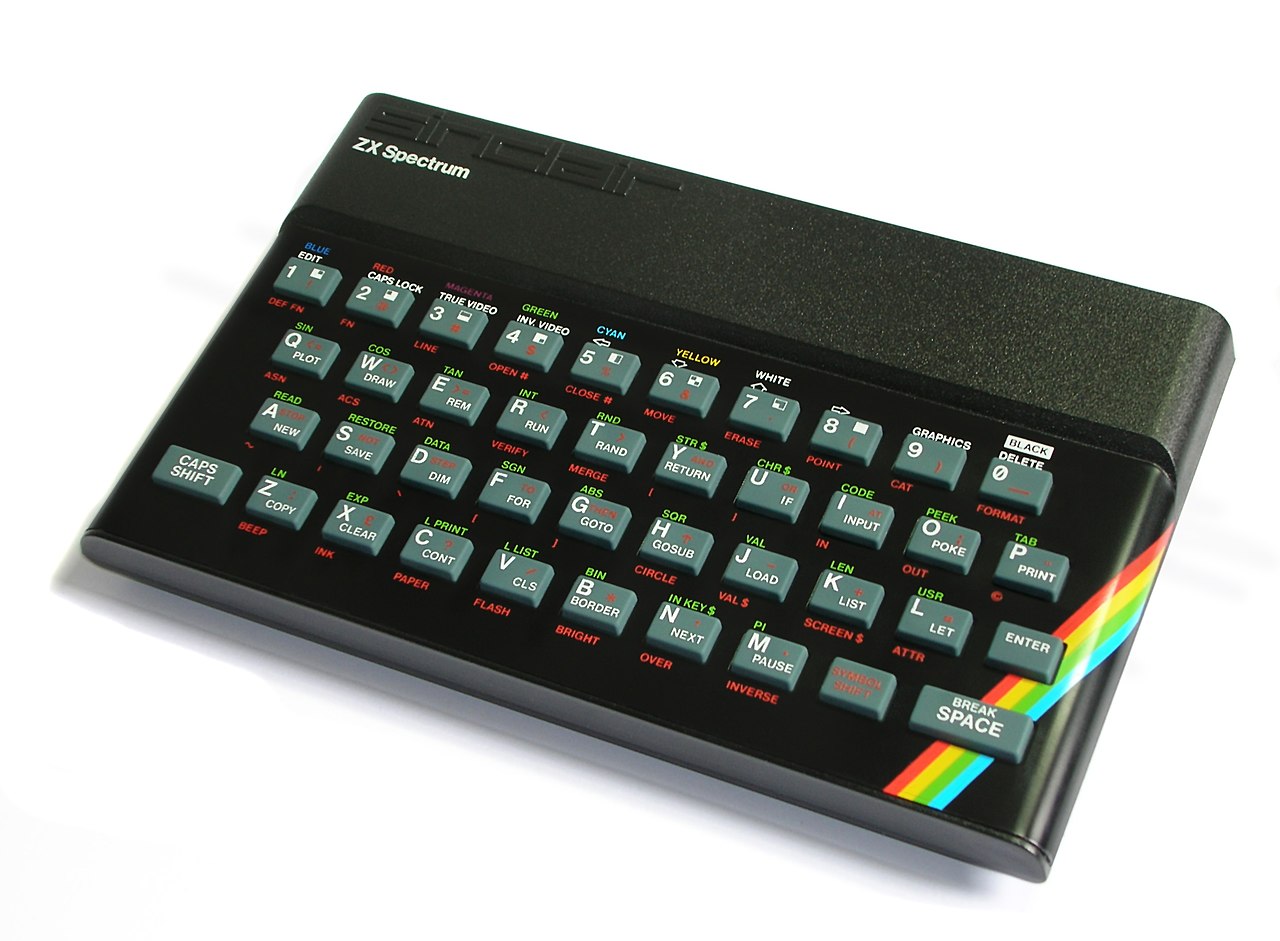
The ZX81 key's function is determined by a combination of context in the command and mode selection e.g. SHIFT and FUNCTION keys to select the under key keyboard functions. For example, the P key combines the letter P, the " character, and the BASIC commands PRINT and TAB.
Context mode feedback is displayed by the cursor displaying an inverted letter;
K for Keywords (above key),

L for Letters,
F for Functions (under key) or
G for Graphics characters.

The fact that to effect a RUBOUT or backspace/delete operation took 2 key presses encouraged ZX81 programmers to be brief and type carefully when entering text or code.
The ZX81's primary input/output is delivered via four sockets on the left side of the case. The machine uses an ordinary UHF television set to deliver a monochrome picture via a built-in RF modulator. It can display 24 lines of 32 characters each, and by using the selection of 2 × 2 block character graphics from the machine's character set offers an effective 64 × 44 pixel graphics mode, also directly addressable via BASIC using the PLOT and UNPLOT commands, leaving 2 lines free at the bottom. Two 3.5 mm jacks connect the ZX81 to the EAR (output) and MIC (input) sockets of an audio cassette recorder, enabling data to be saved or loaded. This stores each data bit as a number of pulses followed by an inter-bit silence of 1300 μs. Each pulse is a 150 μs 'high' then a 150 μs 'low'. A '0' bit consists of four pulses while a '1' bit is nine pulses, so the baud rate varies between 400 bps (50 Bps) for all '0's and 250 bps (31.25 Bps) for all '1's. A file with equal amounts of '0's and '1's would be stored at 307 bps (38 Bps). This provides a somewhat temperamental storage medium for the machine, which has no internal non-volatile storage. The ZX81 requires 420 mA of current at 7–11 V DC, delivered via a custom 9 V Sinclair DC power supply.
The ULA chip, described by the ZX81 manual as the "dogsbody" of the system, has a number of key functions that competing computers share between multiple chips and integrated circuits. These comprise the following:

Synchronising the screen display;
Generating a 6.5 MHz clock, from which a 3.25 MHz clock is derived for the processor;
Outputting an audio signal to a cassette recorder in SAVE mode;

Processing the incoming cassette audio signal in LOAD mode;
Sensing keystrokes;
Using memory addresses provided by the CPU to decide when ROM and RAM should be active;
Controlling general system timing.
The ZX81's built-in RF modulator can output a video picture to a UHF 625-line television (used in the UK, Australia, and most western European countries). France and Luxembourg required a slightly modified version of the machine to match the positive video modulation of CCIR System L sets, while the United States and Canada required a resistor adding to link a ULA pin to ground and different modulator to cope with their 525-line VHF (NTSC) television systems. Both the ZX81 and its predecessor, the ZX80, have a significant drawback in the way that they handle visual output. Neither machine has enough processing power to run at full speed and simultaneously maintain the screen display. On the ZX80, this means that the screen goes blank every time the machine carries out a computation and causes a distracting flicker whenever a shorter computation – such as processing a keystroke – takes place.
The ZX81's designers adopted an improved approach, involving the use of two modes called SLOW and FAST respectively. In SLOW mode, also called "compute and display" mode, the ZX81 concentrates on driving the display. It runs the current program for only about a quarter of the time – in effect slowing the machine down fourfold, although in practice the speed difference between FAST and SLOW modes depends on what computation is being done. In FAST mode, processing occurs continuously, but the display is abandoned to its own devices – equivalent to the ZX80's standard operating mode.
Another hardware quirk produced one of the most distinctive aspects of the ZX81's screen display – during loading or saving, moving zigzag stripes appear across the screen. The same pin on the ULA is used to handle the video signal and the tape output, producing the stripes as an interference pattern of sorts. The ULA cannot maintain the display during SAVE and LOAD operations, as it has to operate continuously to maintain the correct baud rate for data transfers. The interference produces the zigzag stripes.
The unexpanded ZX81's tiny memory presents a challenge to programmers. Simply displaying a full screen takes up to 793 bytes, the system variables take up another 125 bytes, and the program, input buffer and stacks need more memory on top of that. Nonetheless, ingenious programmers are able to achieve a surprising amount with just 1 KB. One example is 1K ZX Chess by David Horne, which includes most of the rules of chess in 672 bytes. The ZX81 conserves its memory to a certain extent by representing entire BASIC commands as one-byte tokens, stored as individual "characters" in the upper reaches of the machine's unique (non-ASCII) character set.
The edge connector or external interface at the rear of the ZX81 is an extension of the main printed circuit board. This provides a set of address, control, and data lines that can be used to communicate with external devices. Enthusiasts and a variety of third-party companies make use of this facility to create a wide range of add-ons for the ZX81.
Comparisons with other computing devices
The following table provides a comparison between the capabilities of the ZX81 and various other competing microcomputers that were available in June 1981, about the time that the first ZX81 orders were delivered. The prices given are as of June 1981 from Your Computer UK.
History
Background
Clive Sinclair, a former radio kit salesman, established his first company, Sinclair Radionics, in 1962. The company made its name producing a wide range of cheap electronics aimed at the hobbyist market. Its products include amplifiers, radios, multimeters and other items which were generally sold in kit form to hi-fi enthusiasts and other electronics hobbyists. The company entered a new market in 1972 when it launched the first "slimline" pocket calculator, the Sinclair Executive. Radionics followed up by launching a wide range of pocket calculators. The company's subsequent expansion made it Europe's biggest calculator manufacturer by 1975.
By the late 1970s, however, Sinclair Radionics was experiencing serious difficulties. It lost its ability to compete effectively in the calculator market following the launch of a new generation of Japanese-produced calculators with liquid-crystal displays, which were much more capable and power-efficient than Sinclair's LED calculators. Projects to develop a pocket television and digital watch turned out to be expensive failures. The company made losses of more than £350,000 in 1975–76, bringing it to the edge of bankruptcy. In July 1977 Radionics was rescued by a state agency, the National Enterprise Board (NEB), which recapitalised it, provided a loan facility and took effective control of the company by acquiring a 73% stake.
Clive Sinclair's relationship with the NEB was fraught due to conflicting notions about which direction the company should go. Radionics had begun a project to develop a home computer but the NEB wanted to concentrate on the instrument side of the business, which was virtually the only area where Radionics was profitable. Sinclair disagreed vehemently with what he characterised as the view "that there was no future in consumer electronics". This and other disputes led to Sinclair resigning from Radionics in July 1979.
While he was struggling with the NEB, Clive Sinclair turned to a "corporate lifeboat" in the shape of an existing corporate shell under his exclusive control – a company called Ablesdeal Ltd, which he had established in 1973 and later renamed Science of Cambridge. It became a vehicle through which he could pursue his own projects, free of the interference of the NEB. Despite his later success in the field, Sinclair saw computers as merely a means to an end. As he told the Sunday Times in April 1985, "We only got involved in computers in order to fund the rest of the business", specifically the development of the ultimately unsuccessful TV80 pocket television and C5 electric vehicle. In an interview with Practical Computing, Sinclair explained:
I make computers because they are a good market, and they are interesting to design. I don't feel bad about making them or selling them for money or anything, there is a demand for them and they do no harm; but I don't think they are going to save the world.
Precursors: the MK14 and ZX80
By the late 1970s, American companies were producing simple home computer kits such as the MITS Altair and IMSAI 8080. This aroused interest among electronics hobbyists in the UK but relatively high prices and lower disposable income reduced the appeal of the American products. New Scientist stated in 1977 that "the price of an American kit in dollars rapidly translates into the same figure in pounds sterling by the time it has reached the shores of Britain". Off-the-shelf personal computers were also available for the high end of the market but were extremely expensive; Olivetti's offering cost £2,000, and the Commodore PET, launched in 1979, sold for £700. There was nothing for the hobbyist at the low end of the market. Sinclair realised that this provided a useful commercial opportunity.
Sinclair's first home computer was the MK14, which was launched in kit form in June 1978. It was a long way from being a mass-market product. Its very name – MK standing for "Microcomputer Kit" – was indicative of its origins as a product developed by, and for, hobbyists.
It had no screen but instead used an LED segment display (though Science of Cambridge did produce an add-on module allowing it to be hooked up to a UHF TV); it had no case, consisting of an exposed circuit board; it had no built-in storage capabilities and only 256 bytes of memory; and input was via a 20-key hexadecimal keyboard.
Despite the limitations of the machine it sold a respectable 10–15,000 units; by comparison, the much more expensive Apple II had only sold 9,000 units in the United States, a much bigger market, in 1978. This success convinced Clive Sinclair that there was an untapped market for low-cost computers that could profitably be exploited.
Sinclair followed up the MK14 by producing the ZX80, at the time the world's smallest and cheapest computer, which was launched in January 1980 costing £99.95 (equivalent to £390 at 2021 prices.) The company conducted no market research whatsoever prior to the launch of the ZX80; according to Clive Sinclair, he "simply had a hunch" that the general public was sufficiently interested to make such a project feasible and went ahead with ordering 100,000 sets of parts so that he could launch at high volume.
The ZX80's design introduced many key features that were carried over to the ZX81; as Sinclair himself later said, "the ZX80 was very much a stepping stone to the ZX81". The design was driven entirely by the desired price – the machine had to cost less than £100 but still make a healthy profit. Its distinctive wedge-shaped white case concealing the circuitry and the touch-sensitive membrane keyboard were the brainchild of Rick Dickinson, a young British industrial designer who had recently been hired by Sinclair. As he later recalled of Sinclair's approach, "Everything was cost driven. The design was the face of the machine." The unconventional keyboard was the outcome of Sinclair's cost-cutting. It made use of a sheet of plastic, on which the keys were printed, overlaying a metallic circuit that registered when a key was pressed. This avoided the expense of providing a typewriter-style keyboard, though the design had many drawbacks when it came to usability and "feel".
Inside the case, there were many more similarities with the ZX81. Like its successor, it used the Z80A microprocessor and had only 1 KB of on-board RAM. It came with a specially written BASIC interpreter on a dedicated ROM chip and could use a television as a display. It relied on an ordinary cassette tape recorder for data storage. The main difference between the two machines lay in the internal software; when the ZX81 was released, ZX80 owners were able to upgrade by the relatively simple expedient of plugging a new ROM onto the circuit board.
The ZX80 was an immediate success, selling 20,000 units over the following nine months. Science of Cambridge was producing ZX80s at the rate of 9,000 a month by the end of 1980 and within 18 months of its launch the company had sold 100,000 units. The commercial success of the ZX80 made a follow-up product inevitable. The company was renamed Sinclair Computers in November 1980, reflecting its new focus, and became Sinclair Research in March 1981.
BBC Micro bid
The launch of the ZX81 was catalysed in part by the BBC Computer Literacy Project's plan to produce The Computer Programme TV series, to be broadcast in 1982, aimed at popularising computing and programming. The BBC intended to commission an existing manufacturer to provide it with a BBC-branded home computer to tie in with the series. When Clive Sinclair heard of the project in December 1980, he wrote to the BBC informing them that he would be announcing a new version of the ZX80, to be called the ZX81, in early 1981. It would remedy some of the ZX80's deficiencies and would be both cheaper and more advanced. Sinclair wanted the ZX81 to be a candidate for the BBC contract and lobbied for its adoption. He pointed out that there were already 40,000 users of the ZX80 and that by the time the series was broadcast there were likely to be upwards of 100,000 ZX81 users.
A prototype ZX81 was demonstrated to BBC representatives in January 1981, while Sinclair's local rival Acorn Computers put forward their proposed Proton computer, a design – of which a prototype did not yet exist – based on the Acorn Atom. To Sinclair's dismay, the contract to produce the BBC Micro went to Acorn, which launched the machine in January 1982. Paul Kriwaczek, the producer of The Computer Programme, explained his reservations in a March 1982 interview with Your Computer:
I would have been very reluctant for the BBC to sell something like the Sinclair [ZX81] because it is so limited. The Sinclair cannot be expanded; it is fundamentally a throw-away consumer product. Its usefulness lies in learning about programming, but I do not believe that the future of computers lies in everyone learning to program in BASIC.
Sinclair was critical of the BBC's decision, accusing it of incompetence and arrogance. Shortly after Acorn won the BBC contract the Government issued a recommended list of computers, including the BBC Micro and Research Machines 380Z, that schools could purchase, with the aid of a grant, for half price; Sinclair's computers were not included on the list. Sinclair responded by launching his own half-price deal, offering schools the chance to buy a ZX81 and 16 KB RAM pack for £60, plus a ZX Printer at half price, for a total cost of £90. As the cheapest Government-approved system was £130, this was an attractive offer for some schools and about 2,300 bought Sinclair's package, although 85% adopted the BBC Micro.
Development and manufacture
The development of the ZX81 got under way even before the ZX80 had been launched. Sinclair's chief engineer, Jim Westwood, was given the task of improving the ZX80's hardware to reduce the number of components and thus bring down the cost. He also sought to fix some of the more annoying problems with the ZX80. Westwood and his colleagues found that the component count could be reduced greatly by combining eighteen of the ZX80's chips into a single uncommitted logic array (ULA), a type of general-purpose chip full of logic gates that were connected up as the customer required during chip manufacture. This short-lived technology of the day was cheaper and quicker than the design of a customised logic chip, which typically required very high volumes to recoup its development cost. Ferranti produced the new chip for Sinclair, who hailed Westwood's design as a triumph of innovation: "The ZX81 had four chips when our nearest competitor in this respect, the TRS-80, had 44." Only 70% of the logic gates on the ULA were supposed to be used, but Sinclair decided to use them all to squeeze more functions in. This resulted in the machine becoming uncomfortably warm during usage. Computing folklore held that the ZX81 had to be refrigerated by balancing a carton of cold milk on top of the case.
The ZX81's ROM was doubled to 8 KB, from the ZX80's 4 KB ROM. This enabled a fuller implementation of a version of ANSI Minimal BASIC (termed Sinclair BASIC by the company). Clive Sinclair re-commissioned a company called Nine Tiles, which had produced the ZX80 ROM, to develop the new ROM software for the ZX81. The code was written by John Grant, the owner of Nine Tiles, and Steve Vickers, who had joined the company in January 1980. Grant concentrated on the software that drove the ZX81's hardware, while Vickers developed the new BASIC and the accompanying manual. Sinclair's brief to the pair was fairly non-specific but primarily concerned remedying a key defect of the ZX80 so that the new machine could be used for practical programming and calculations. Vickers later recalled:
As far as Clive was concerned, it wasn't a question of what the machine ought to be able to do, but more what could be crammed into the machine given the component budget he'd set his mind on. The only firm brief for the '81 was that the '80s math package must be improved.
The new ROM incorporated trigonometric and floating-point functions, which its predecessor had lacked – the ZX80 could only deal with whole numbers. Grant came up with one of the ZX81's more novel features, a syntax checker that indicated errors in BASIC code as soon as it was entered (rather than, as was standard at the time, only disclosing coding errors when a program was run). Unfortunately for Vickers, he introduced a briefly notorious error – the so-called "square-root bug" that caused the square root of 0.25 to be returned erroneously as 1.3591409 – as a result of problems with integrating the ZX Printer code into the ROM. Although it was eventually fixed, the bug became the subject of controversy and Sinclair was forced to replace some of the ZX81s sold to early customers. On a more positive note, Vickers' work on the manual was received favourably, being described in 1983 as "one of the classic texts on BASIC". Max Phillips commented in a What Micro? retrospective:
It does a reasonable job and sensibly provides lots for the reader to do. It's quite honest about the [ZX81]'s shortcomings and provides hints and tips for ways round them ... Best of all, the manual is complete and comprehensive. There's some fairly advanced and often undisclosed information in there. The beginner won't understand it for a long time but if he or she learns some more advanced ideas, the manual is ready for them.
The task of designing the ZX81's case again fell to Rick Dickinson, who produced an updated version of the ZX80's wedge-shaped case. This time round, the design team were able to use injection moulding, which enabled them to deliver a higher-quality case. Dickinson originally envisaged the ZX81 as "an expandable range of boxes following a vaguely modular approach with a common width", though this approach was eventually dropped. From start to finish, the design process took about six months.
The ZX81 was launched on 5 March 1981 in two versions (though with identical components) – a pre-assembled machine or a cheaper kit version, which the user could assemble themself. Both versions were manufactured in Dundee, Scotland by Timex Corporation at the company's Dryburgh factory. Timex had not been an obvious choice of manufacturing subcontractor, as the company had little previous experience in assembling electronics. It was a well-established manufacturer of mechanical watches but was facing a crisis at the beginning of the 1980s. Profits had dwindled to virtually zero as the market for mechanical watches stagnated in the face of competition from the digital and quartz watches. Recognising the trend, Timex's director, Fred Olsen, determined that the company would diversify into other areas of business.
This shift by Timex came at an ideal time for Sinclair. The ZX80 had proved more popular than expected and Sinclair's existing manufacturer, a small electronics company in St Ives, lacked the resources to deal with the demand. Timex took over production of the ZX80 late in 1980. The arrangement worked well for both companies and Timex took on the manufacture of the ZX81, aided by capital investment in its Dundee plant. Sinclair initially planned to produce 10,000 ZX81s a month, rising to 30,000 a month within a year. However, Timex initially had significant problems in producing enough ZX81s to satisfy demand. As a consequence, it took up to nine weeks for ZX81s to be delivered by mail order. It was not until September 1981, five months after the launch of the ZX81, that the delivery times finally came down to the promised twenty-eight days. Those who already owned or had recently ordered the ZX80 were not excluded; anyone who had ordered a ZX80 in the two weeks before the ZX81's launch would receive the newer machine, while existing owners were able to upgrade their ZX80s by plugging an extra £20 ROM chip into the circuit board.