
West Berlin (German: Berlin (West) or West-Berlin, German pronunciation: [ˈvɛstbɛʁˌliːn] ) was a political enclave which comprised the western part of Berlin from 1948 until 1990, during the Cold War. Although West Berlin was de jure not part of West Germany, lacked any sovereignty, and was under military occupation until German reunification in 1990, the territory was claimed by the Federal Republic of Germany (FRG). The legality of this claim was contested by the Soviet Union and other Eastern Bloc countries, although West Berlin de facto aligned itself politically with the FRG from May 1949, was thereafter directly or indirectly represented in its federal institutions, and most of its residents were citizens of the FRG.
West Berlin was formally controlled by the Western Allies and entirely surrounded by East Berlin and East Germany. West Berlin had great symbolic significance during the Cold War, as it was widely considered by westerners an "island of freedom". It was heavily subsidized by West Germany as a "showcase of the West". A wealthy city, West Berlin was noted for its distinctly cosmopolitan character, and as a centre of education, research and culture. With about two million inhabitants, West Berlin had the largest population of any city in Germany during the Cold War era.
West Berlin was 160 km (100 mi) east and north of the inner German border and only accessible by land from West Germany by narrow rail and highway corridors. It consisted of the American, British, and French occupation sectors established in 1945. The Berlin Wall, built in 1961, physically separated West Berlin from both the eastern half of the city and its hinterland in Brandenburg, until it fell in 1989. On 3 October 1990, the day Germany was officially reunified, East and West Berlin united, joined the Federal Republic as a Stadtstaat (city-state) and eventually became the capital of Germany again.

Origins
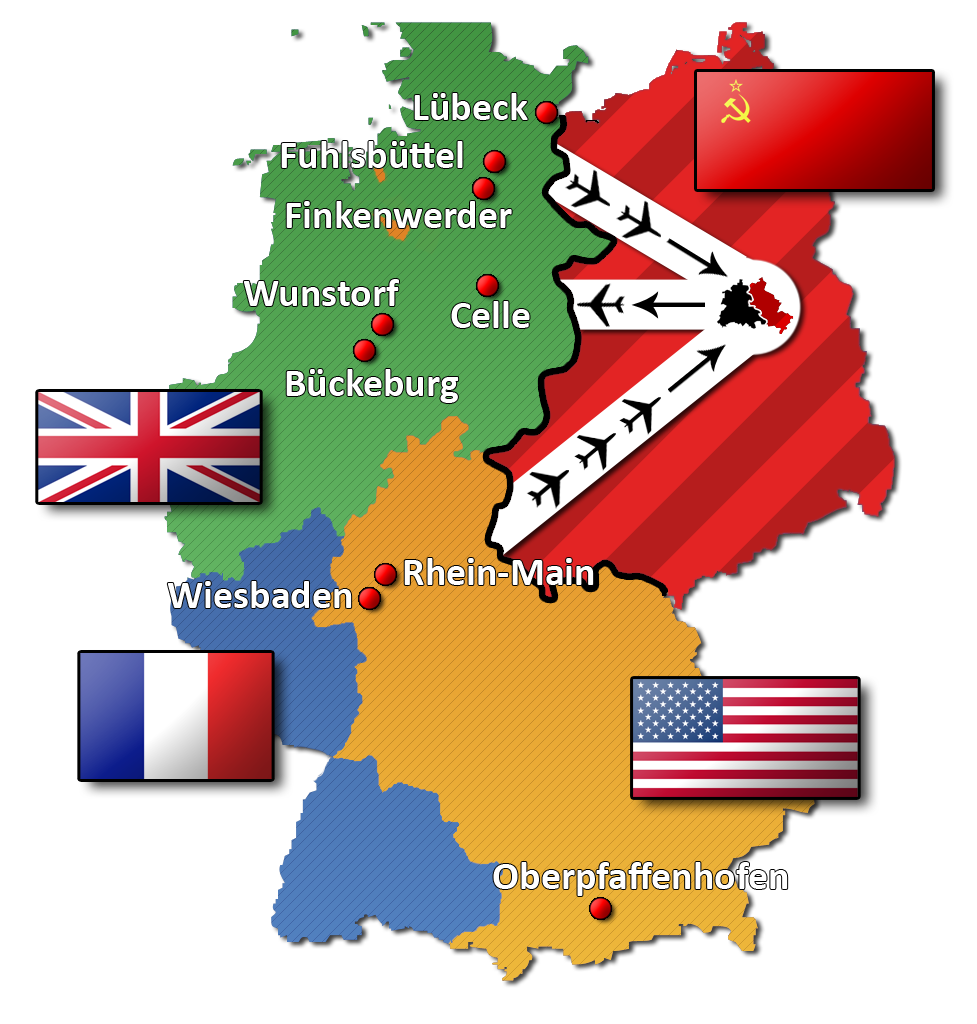
The London Protocol of 1944 and the Potsdam Agreement established the legal framework for the occupation of Germany in the wake of World War II. According to these agreements, Germany would be formally under the administration of four Allies (the United States, the United Kingdom, the Soviet Union, and France) until a German government "acceptable to all parties" could be established. The territory of Germany, as it existed in 1937, would be reduced by most of Eastern Germany thus creating the former eastern territories of Germany. The remaining territory would be divided into four zones, each administered by one of the four allied countries. Berlin, which was surrounded by the Soviet zone of occupation—newly established in most of Middle Germany—would be similarly divided, with the Western Allies occupying an enclave consisting of the western parts of the city. According to the agreement, the occupation of Berlin could end only as a result of a quadripartite agreement. The Western Allies were guaranteed three air corridors to their sectors of Berlin, and the Soviets also informally allowed road and rail access between West Berlin and the western parts of Germany.
At first, this arrangement was intended to be of a temporary administrative nature, with all parties declaring that Germany and Berlin would soon be reunited. However, as the relations between the Western Allies and the Soviet Union soured and the Cold War began, the joint administration of Germany and Berlin broke down. Soon, Soviet-occupied Berlin and western-occupied Berlin had separate city administrations. In 1948, the Soviets tried to force the Western Allies out of Berlin by imposing a land blockade on the western sectors—the Berlin Blockade. The West responded by using its air corridors for supplying their part of the city with food and other goods through the Berlin Airlift. In May 1949, the Soviets lifted the blockade, and West Berlin as a separate city with its own jurisdiction was maintained.
Following the Berlin Blockade, normal contacts between East and West Berlin resumed. This was temporary until talks were resumed. In 1952, the East German government began sealing its borders, further isolating West Berlin. As a direct result, electrical grids were separated and phone lines were cut. The Volkspolizei and Soviet military personnel also continued the process of blocking all the roads leading away from the city, resulting in several armed standoffs and at least one skirmish with the French Gendarmerie and the Bundesgrenzschutz that June. However, the culmination of the schism did not occur until 1961 with the construction of the Berlin Wall.

Legal status
From the legal theory followed by the Western Allies, the occupation of most of Germany ended in 1949 with the establishment of the Federal Republic of Germany (West Germany) on 23 May and of the German Democratic Republic (East Germany) on 7 October. Under Article 127 of the Basic Law (or constitution) of the Federal Republic, provision was made for federal laws to be extended to Greater Berlin (as Berlin was called during the 1920 expansion of its municipal boundaries) as well as Baden, Rhineland-Palatinate and Württemberg-Hohenzollern within one year of its promulgation. However, because the occupation of Berlin could be ended only by a quadripartite agreement, Berlin remained an occupied territory under the formal sovereignty of the allies. Hence, the Basic Law was not fully applicable to West Berlin.
On 4 August 1950, the House of Representatives, the city's legislature, passed a new constitution, declaring Berlin to be a state of the Federal Republic and the provisions of the Basic Law as binding law superior to Berlin state law (Article 1, clauses 2 and 3). However, that became statutory law only on 1 September and only with the inclusion of the western Allied provision according to which Art. 1, clauses 2 and 3, were deferred for the time being; the clauses became valid law only on 3 October 1990 (the day of Germany's unification). It stated:
Article 87 is interpreted as meaning that during the transitional period Berlin shall possess none of the attributes of a twelfth Land. The provision of this Article concerning the Basic Law will only apply to the extent necessary to prevent a conflict between this Law and the Berlin Constitution....
Thus, civic liberties and personal rights (except for the privacy of telecommunications) guaranteed by the Basic Law were also valid in West Berlin.
In addition, West German federal statutes could only take effect in West Berlin with the approval of the city's legislature.
The ambiguous legal status of the city, then still legally styled as Greater Berlin (although technically only comprising the western sectors), meant that West Berliners were not eligible to vote in federal elections. In their notification of permission of 12 May 1949 the three western military governors for Germany explained their proviso in No. 4, as follows:
A third reservation concerns the participation of Greater Berlin in the Federation. We interpret the effect of Articles 23 and 144 (2) of the Basic Law as constituting acceptance of our previous request that while Berlin may not be accorded voting membership in the Bundestag or Bundesrat nor be governed by the Federation she may, nevertheless, designate a small number of representatives to the meetings of those legislative bodies.
Consequently, West Berliners were indirectly represented in the Bundestag in Bonn by 22 non-voting delegates chosen by the House of Representatives. Similarly, the Senate (the city's executive) sent four non-voting delegates to the Bundesrat. In addition, when the first direct elections to the European Parliament were held in 1979, West Berlin's three members were instead indirectly elected by the House of Representatives.
However, as West German citizens, West Berliners were able to stand for election in West Germany. For example, Social Democrat Willy Brandt, who eventually became Chancellor, was elected via his party's list of candidates. The West German government considered all West Berliners as well as all citizens of the GDR to be citizens of West Germany. Male residents of West Berlin were exempt from the Federal Republic's compulsory military service. This exemption made the city a popular destination for West German young people, which resulted in a flourishing counterculture, which in turn became one of the defining features of the city.

The Western Allies remained the ultimate political authorities in West Berlin. All legislation of the House of Representatives, whether of the West Berlin legislature or adopted federal law, only applied under the proviso of confirmation by the three Western Allied commanders-in-chief. If they approved a bill, it was enacted as part of West Berlin's statutory law. If the commanders-in-chief rejected a bill, it did not become law in West Berlin; this, for example, was the case with West German laws on military duty. West Berlin was run by the elected Governing Mayor and Senate seated at Rathaus Schöneberg. The Governing Mayor and Senators (ministers) had to be approved by the Western Allies and thus derived their authority from the occupying forces, not from their electoral mandate.
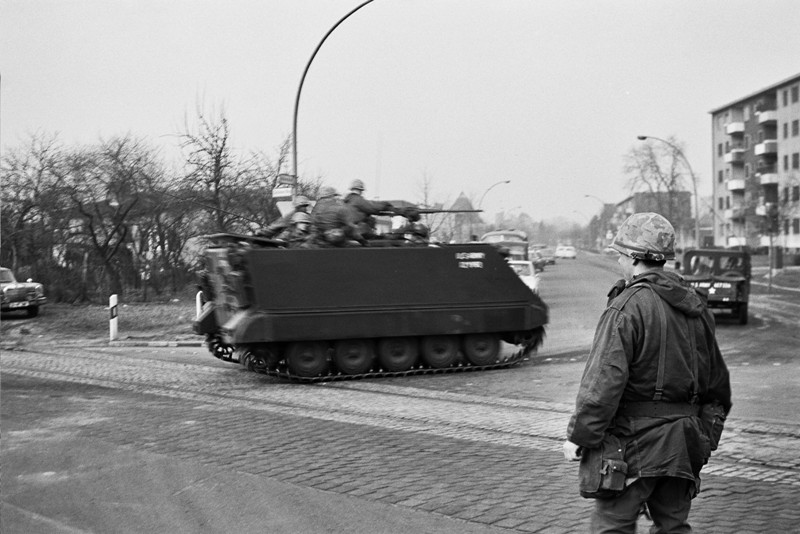
The Soviets unilaterally declared the occupation of East Berlin at an end along with the rest of East Germany. This move was, however, not recognised by the Western Allies, who continued to view all of Berlin as a jointly occupied territory belonging to neither of the two German states. This view was supported by the continued practice of patrols of all four sectors by soldiers of all four occupying powers. Thus, occasionally Western Allied soldiers were on patrol in East Berlin as were Soviet soldiers in West Berlin. After the Wall was built, East Germany wanted to control Western Allied patrols upon entering or leaving East Berlin, a practice that the Western Allies regarded as unacceptable. After protests to the Soviets, the patrols continued uncontrolled on both sides, with the tacit agreement that the western Allies would not use their patrolling privileges for helping Easterners to flee to the West.
In many ways, West Berlin functioned as the de facto 11th state of West Germany and was depicted on maps published in the West as being a part of West Germany. There was freedom of movement (to the extent allowed by geography) between West Berlin and West Germany. There were no separate immigration regulations for West Berlin, all immigration rules for West Germany being followed in West Berlin. West German entry visas issued to visitors were stamped with "for the Federal Republic of Germany, including the State of Berlin" (German: für die Bundesrepublik Deutschland einschl. [einschließlich] des Landes Berlin), prompting complaints from the Soviet Union. However, this wording remained on the visas throughout the rest of the entire period of West Berlin's existence.

West Berlin remained under military occupation until 3 October 1990, the day of unification of East Germany, East and West Berlin with the Federal Republic of Germany. The West German Federal Government, as well as the governments of most western nations, considered East Berlin to be a "separate entity" from East Germany, and while the Western Allies later opened embassies in East Berlin, they recognised the city only as the seat of government of the GDR, not as its capital.
Communist countries, however, did not recognise West Berlin as part of West Germany and usually described it as a "third" German jurisdiction, called an "independent political unit" (German: selbständige politische Einheit). On maps of East Berlin, West Berlin often did not appear as an adjacent urban area but as a monochrome terra incognita, sometimes showing the letters WB, meaning "Westberlin" (German: Westberlin) or overlaid with a legend or pictures. It was often labelled "Westberlin special political area" (German: Besonderes politisches Gebiet Westberlin).
Immigration
The Federal Republic of Germany issued West German passports to West Berliners on request that showed West Berlin as their place of residence. However, West Berliners could not use their passports for crossing East German borders and were denied entrance by any country of the Eastern Bloc, since governments of these countries held the view that West Germany was not authorized to issue legal papers for West Berliners.
Since West Berlin was not a sovereign state, it did not issue passports. Instead, West Berliners were issued with "auxiliary identity cards" by the West Berlin authorities. These differed visually from the regular West German identity cards, with green bindings instead of the grey standard, they did not show the "Federal Eagle" or coat of arms, and contained no indications as to the issuing State. However, they did have a statement that the holder of the document was a German citizen. From 11 June 1968, East Germany made it mandatory that West Berlin and West German "transit passengers" obtain a transit visa, issued upon entering East Germany, because under its second constitution East Germany considered West Germans and West Berliners foreigners. Since identity cards had no pages to stamp visas, issuers of East German visas stamped their visas onto separate leaflets which were loosely stuck into the identity cards, which, until the mid-1980s, were little booklets. Although the West German government subsidized visa fees, they were still payable by individual travellers.
In order to enter visa-requiring Western countries, such as the US, West Berliners commonly used West German passports. However, for countries which did not require stamped visas for entry, including Switzerland, Austria, and many members of the then European Economic Community, including the United Kingdom, West Berlin identity cards were also acceptable for entry.
Active immigration and asylum politics in West Berlin triggered waves of immigration in the 1960s and 1970s, which led, in 2017, to Berlin becoming home to at least 178,000 Turkish and Turkish German residents, and making it the largest Turkish community outside of Turkey.
West Berlin was also a destination for many people fleeing East Germany both before and after the construction of the Berlin Wall. As many immigrants from East Germany did not intend to stay in Berlin, flights – the only option for those people to reach West Germany without coming into contact with East German authorities – were subsidized by the West German government despite being operated only by companies registered in and owned by nationals of the western occupying powers.
Naming conventions
Most Westerners called the Western sectors Berlin unless further distinction was necessary. The West German Federal government officially called West Berlin Berlin (West), although it also used the hyphenated West-Berlin, whereas the East German government commonly referred to it as Westberlin. Starting from 31 May 1961, East Berlin was officially called Berlin, Hauptstadt der DDR ('Berlin, Capital of the GDR'), replacing the formerly used term Demokratisches Berlin ('Democratic Berlin'), or simply Berlin, by East Germany, and Berlin (Ost) by the West German Federal government. Other names used by West German media included Ost-Berlin, Ostberlin, or Ostsektor. These different naming conventions for the divided parts of Berlin, when followed by individuals, governments, or media, commonly indicated their political leanings, with the centre-right Frankfurter Allgemeine Zeitung using Ost-Berlin and the centre-left Süddeutsche Zeitung using Ostberlin.
Period following the building of the Berlin Wall
After the Berlin Wall was constructed in 1961, West German Chancellor Konrad Adenauer suggested to U.S. President John F. Kennedy that the United States propose a swap of West Berlin with Thuringia and parts of Saxony and Mecklenburg; the city's population would have been relocated to West Germany. Adenauer did not believe that the Soviets would accept the offer because East Germany would lose important industry, but hoped that making the proposal would reduce tensions between the western and eastern blocs, and perhaps hurt relations between the USSR and East Germany if they disagreed on accepting the offer. While the Kennedy administration seriously considered the idea, it did not make the proposal to the Soviet Union.
NATO also took an increased interest in the specific issue related to West Berlin, and drafted plans to ensure to defend the city against a possible attack from the East. A tripartite planning group known as LIVE OAK, working together with NATO, was entrusted with potential military responses to any crisis.
On 26 June 1963, President Kennedy visited West Berlin. On his triumphant tour, cheered by hundred of thousands of West Berliners in the streets, he stopped at the Congress Hall, near the Brandenburg Gate, and at Checkpoint Charlie, before delivering at West Berlin's city hall a speech, which became famous for its phrase "Ich bin ein Berliner" and a hallmark of America's solidarity with the city.
The Four Power Agreement on Berlin (September 1971) and the Transit Agreement (May 1972) helped to significantly ease tensions over the status of West Berlin. While many restrictions remained in place, it also made it easier for West Berliners to travel to East Germany and it simplified the regulations for Germans travelling along the autobahn transit routes.
At the Brandenburg Gate in 1987, U.S. President Ronald Reagan provided a challenge to the then Soviet leader:
General Secretary Gorbachev, if you seek peace, if you seek prosperity for the Soviet Union and Eastern Europe, if you seek liberalization: Come here to this gate! Mr. Gorbachev, open this gate! Mr. Gorbachev, tear down this wall!
On 9 November 1989, the Wall was opened, and the two parts of the city were once again physically—though at this point not legally—united. The Two Plus Four Treaty, signed by the two German states and the four wartime allies, paved the way for German reunification and an end to the Western Allies' occupation of West Berlin. On 3 October 1990—the day Germany was officially reunified—East and West Berlin formally reunited as the city of Berlin, which then joined the enlarged Federal Republic as a city-state along the lines of the existing West German city-states of Bremen and Hamburg. Walter Momper, the mayor of West Berlin, became the first mayor of the reunified city in the interim. City-wide elections in December 1990 resulted in the first "all Berlin" mayor being elected to take office in January 1991, with the separate offices of mayors in East and West Berlin expiring by that time, and Eberhard Diepgen (a former mayor of West Berlin) became the first elected mayor of a reunited Berlin.
Boroughs
West Berlin comprised the following boroughs (Bezirke):
In the American sector:
Neukölln
Kreuzberg
Schöneberg
Steglitz
Tempelhof
Zehlendorf
In the British sector:
Charlottenburg
Tiergarten
Wilmersdorf
Spandau
In the French sector:
Reinickendorf
Wedding
Exclaves
West Berlin's border was identical to the municipal boundary of Berlin as defined in the Greater Berlin Act of 1920 and amended in 1938, and the border between the Soviet sector and the French, British, and American sectors respectively, which followed the boundaries of Berlin administrative boroughs as defined in the same years. Another amendment was added in 1945 at the border between the British sector of Berlin (ceding West-Staaken) and the Soviet zone (ceding the Seeburg Salient) so that the Wehrmacht airfield at Berlin-Gatow became part of the British sector and the airfield at Berlin-Staaken became part of the Soviet sector. The resulting borderline was further complicated with a lot of geographical oddities, including a number of exclaves and enclaves that Greater Berlin had inside some neighbouring municipalities since 1920, all of which happened to become part of the British or American sectors after 1945, so that parts of West Berlin came to be surrounded by East Germany
Furthermore, the Gatow/Staaken exchange in August 1945 resulted in the geographically western half of Berlin-Staaken, which was located in the western outskirts of the city, becoming de jure Soviet occupied. However, the de facto administration remained with the Borough of Spandau in the British sector. Therefore, all inhabitants of Staaken could vote in West Berlin's city state elections in 1948 and 1950. On 1 February 1951, East German Volkspolizei surprised the people of western Staaken by occupying the area and ended its administration by the Spandau Borough; instead, western Staaken became an exclave of the Soviet occupied borough Berlin-Mitte in the city centre. However, on 1 June 1952, western Staaken's de facto administration was placed with neighbouring East German Falkensee in the East German district Nauen.
Post and telecommunications
West Berlin had its own postal administration first called Deutsche Post Berlin (1947–1955) and then Deutsche Bundespost Berlin, separate from West Germany's Deutsche Bundespost, and issuing its own postage stamps until 1990. However, the separation was merely symbolic; in reality, West Berlin's postal service was completely integrated with West Germany's, using the same postal code system.