
The Volkswagen emissions scandal, sometimes known as Dieselgate or Emissionsgate, began in September 2015, when the United States Environmental Protection Agency (EPA) issued a notice of violation of the Clean Air Act to German automaker Volkswagen Group. The agency had found that Volkswagen had intentionally programmed turbocharged direct injection (TDI) diesel engines to activate their emissions controls only during laboratory emissions testing, which caused the vehicles' NOx output to meet US standards during regulatory testing. However, the vehicles emitted up to 40 times more NOx in real-world driving. Volkswagen deployed this software in about 11 million cars worldwide, including 500,000 in the United States, in model years 2009 through 2015.
Background
Introduction
In 2013, the International Council on Clean Transportation (ICCT) commissioned the West Virginia University Center for Alternative Fuels Engines and Emissions (WVU CAFEE) to test on-road emissions of diesel cars sold in the U.S. Researchers at WVU CAFEE, who conducted live road tests in California using a Japanese on-board emission testing system, detected additional nitrogen oxide (NOx) emissions from two out of three tested vehicles, both made by Volkswagen. In May 2014, ICCT published WVU CAFEE's findings and reported them to the California Air Resources Board (CARB) and the United States Environmental Protection Agency (EPA).
In September 2015, the EPA announced that Volkswagen had violated the Clean Air Act by installing unlawful software into their diesel vehicles. Regulators in multiple countries began to investigate the automaker, and its stock price fell in value by a third in the days immediately after the news. Volkswagen Group CEO Martin Winterkorn resigned, and the head of brand development Heinz-Jakob Neusser, Audi research and development head Ulrich Hackenberg, and Porsche research and development head Wolfgang Hatz were suspended.

Volkswagen announced plans in April 2016 to spend €16.2 billion (US$18.32 billion at April 2016 exchange rates) in relation to the scandal, and agreed in June 2016 to pay up to $14.7 billion to settle civil charges in the United States. In January 2017, Volkswagen pleaded guilty to criminal charges and signed an agreed Statement of Facts, which set out how the company's management asked engineers to develop the defeat devices, because its diesel models could not pass US emissions tests without them, and deliberately sought to conceal their use. In April 2017, a US federal judge ordered Volkswagen to pay a $2.8 billion criminal fine for "rigging diesel-powered vehicles to cheat on government emissions tests".
Winterkorn was charged in the United States with fraud and conspiracy on 3 May 2018. As of 1 June 2020, the scandal had cost VW $33.3 billion in fines, penalties, financial settlements and buyback costs. Government and civil actions were taken in the U.S. and the European Union, where most of the affected vehicles were located. While these vehicles remained legal to drive in both regions, consumer groups and governments sought to ensure that Volkswagen had compensated affected owners, as it had been required to do in the United States.
The scandal raised awareness over the higher levels of pollution emitted by all diesel-powered vehicles from a wide range of car makers, which under real-world driving conditions exceeded legal emission limits. A study conducted by ICCT and ADAC showed the biggest deviations from Volvo, Renault, Jeep, Hyundai, Citroën and Fiat, resulting in investigations opening into other diesel emissions scandals. A discussion was sparked on the topic of software-controlled machinery being generally prone to cheating, and a way out would be to open source the software for public scrutiny.

NOx and Volkswagen Diesel anti-pollution system
In general, diesel engines have better fuel efficiency and less carbon dioxide (CO2) emission than petrol engines, but they emit 20 times more nitrogen oxide (NOx) unless somehow treated. Three-way catalytic converters, which have been very effective at reducing NOx in petrol engine exhaust, do not function well for them. As NOx are harmful air pollutants, regulators in the United States and Europe have implemented increasingly stringent NOx emission standards for passenger cars since the early 2000s.
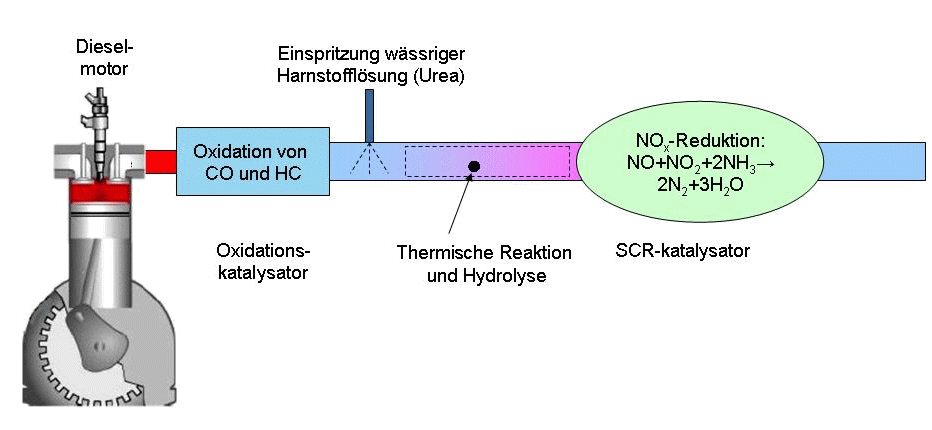
To deal with this problem, in 2005 Volkswagen licensed Mercedes' urea-based selective catalytic reduction (SCR) system called BlueTec for future diesel engine development. While effective at reducing NOx, an SCR system like Bluetec was expensive, high-maintenance and required more space than other methods, making it unsuitable for Volkswagen's compact cars such as Golf or Jetta. Some managers at Volkswagen rejected BlueTec, and preferred to develop their own inexpensive "lean NOx trap" system. In 2007, Volkswagen canceled the licensing deal for BlueTec and announced that it would use its own pollution control technology.
Volkswagen chose the "lean NOx trap" system for its turbo-diesel Golf and Jetta models, but the solution did not work well as it required a fuel-rich exhaust gas in the purification process and fuel economy suffered as a result. Despite these issues, the company continued to market its diesel technology as an affordable and eco-friendly innovation, but this impression projected to the public did not reflect the reality. In reality, the system failed to combine lower fuel consumption with compliant NOx emissions, and Volkswagen chose around 2006 to program the Engine Control Unit (ECU) to switch from lower fuel consumption and high NOx emissions to low-emission compliant mode when it detected an emissions test, particularly for the EA 189 engine. This caused the engine to emit NOx levels above limits in daily operation, but comply with US NOx standards when being tested, constituting a defeat device. In 2015 the news magazine Der Spiegel reported that at least 30 people at management level in Volkswagen knew about the deceit for years, which Volkswagen denied in 2015.

Starting in the 2009 model year, Volkswagen Group began migrating its light-duty passenger vehicle's turbocharged direct injection (TDI) diesel engines to a common-rail fuel injection system. This system allows for higher-precision fuel delivery using electronically controlled fuel injectors and higher injection pressure, theoretically leading to better fuel atomization, better air/fuel ratio control, and by extension, better control of emissions.
Volkswagen described the diesel engines as being as clean as or cleaner than US and Californian requirements, while providing good fuel economy and performance. Due to the good fuel economy provided by its diesel fleet, in 2014 Volkswagen was registered with a Corporate Average Fuel Economy (CAFE) of 34 mpg‑US (6.9 L/100 km; 41 mpg‑imp). The low emissions levels of Volkswagen vehicles tested with the defeat device in operation enabled the company to receive green car subsidies and tax exemptions in the US.
Underlying U.S. and EU emission standards
The Volkswagen and Audi cars identified as violators had been certified to meet either the US EPA Tier 2 / Bin 5 emissions standard or the California LEV-II ULEV standard. Either standard requires that nitrogen oxide emissions not exceed 0.043 grams per kilometre (0.07 g/mi) for engines at full useful life which is defined as either 190,000 kilometres (120,000 mi) or 240,000 kilometres (150,000 mi) depending on the vehicle and optional certification choices.
This standard for nitrogen oxide emissions is among the most stringent in the world. For comparison, the contemporary European standards known as Euro 5 (2008 "EU5 compliant", 2009–2014 models) and Euro 6 (2015 models) only limit nitrogen oxide emissions to 0.18 grams per kilometre (0.29 g/mi) and 0.08 grams per kilometre (0.13 g/mi) respectively. Defeat devices are forbidden in the EU. The use of a defeat device is subject to a penalty.
Nature reported in 2015 that 20 percent of European city dwellers were exposed to unhealthy levels of nitrogen dioxide, and that in London, where diesel road traffic was responsible for 40 percent of NOx emissions, 3,000 deaths per year could be attributed to air pollution. A Channel 4 documentary in January 2015 referred to the UK government moving to a CO2 emission band system for road tax, which favoured diesel power, as the "great car con", with Barry Gardiner MP, former member of the Blair government, stating that the policy, which lowered CO2 emissions yet increased NOx pollution, was a mistake.
Early warnings 1998–2013
In 1998, a Swedish researcher criticized the New European Driving Cycle standard for allowing large emission differences between test and reality. The Washington Post also reported that in the late 1990s, EPA engineers at Virginia Testing Laboratory had built a system called ROVER, designed to test a car's emissions on the road. The project was shut down in 2001, despite preliminary tests indicating gaps between emissions from lab tests and real world tests of about 10 to 20 percent.

In 2011, the European Commission's Joint Research Centre published a report which found the average on-road NOx emission of all tested diesel vehicles to be 0.93 ± 0.39 g/km, and that of tested Euro 5 diesel vehicles to be 0.62 ± 0.19 g/km. Those numbers substantially exceeded the respective Euro 3–5 emission limit. In 2013, the research center then warned:
Sensors and electronic components in modern light-duty vehicles are capable of 'detecting' the start of an emissions test in the laboratory (e.g., based on acceleration sensors or not-driven/not-rotating wheels). Some vehicle functions may only be operational in the laboratory, if a predefined test mode is activated. Detecting emissions tests is problematic from the perspective of emissions legislation, because it may enable the use of defeat devices that activate, modulate, delay, or deactivate emissions control systems with the purpose of either enhancing the effectiveness of these systems during emissions testing or reducing the effectiveness of these systems under normal vehicle operation and use. While the use of defeat devices is generally prohibited, exceptions exist in cases where it is necessary to protect the engine against damage and to ensure safe vehicle operation (EC, 2007). These exceptions leave room for interpretation and provide scope, together with the currently applied test procedure, for tailoring the emissions performance [...].
The European Commission and European governments could not agree upon who was responsible for taking action. In the United Kingdom, the Department for Transport received a report from the International Council on Clean Transportation (ICCT) in October 2014, which stated there was a "real world nitrogen oxides compliance issue" with diesel passenger cars. The UK's DEFRA research indicated a significant reduction in NOx and particulate matter from 1983 to 2014. Respirable suspended particles with a diameter of 10 micrometres – also known as PM10 (including diesel particulates) – halved since 1996 despite the increased number and size of diesel cars in the UK.

ICCT's emission testing, 2013–14
In late 2012, the independent body International Council on Clean Transportation (ICCT) was seeking proposals from research facilities to study on-road emissions of so-called "clean diesel" cars sold in the US. Researchers at West Virginia University's Center for Alternative Fuels Engines and Emissions (WVU CAFEE) submitted a proposal to ICCT, and were awarded a US$70,000 grant for a study where they had to test US-spec diesel vehicles with two different emission reduction technologies: lean NOx trap (LNT) and selective catalyst reduction (SCR). John German, co-lead of the US branch of ICCT, said the idea for this "very ordinary" test came from Peter Mock, managing director ICCT in Europe, and they chose to put US vehicles through on-the-road tests because their emissions regulations are more stringent than those in the European Union. The ICCT expected the cars to pass, and thought they would be able to use the results to demonstrate to Europeans that it was possible to run diesel cars with cleaner emissions.
In early 2013, researchers at WVU CAFEE began testing emissions from the three diesel cars: a Volkswagen Passat, a Volkswagen Jetta, and a BMW X5, on the road in California. They wanted to test a Mercedes as well, but could not obtain one. They used a portable emissions measurement system, making it possible to collect real world driving emissions data, for comparison with laboratory dynamometer testing. The three vehicles were all certified at a California Air Resources Board facility before the tests as falling below the emissions limits when using the standard laboratory testing protocols. They put 2,400 kilometres (1,500 mi) on the Jetta and X5. For their final test, they wanted to put even more mileage on the Passat and drove it from Los Angeles to Seattle and back again, virtually the entire West Coast of the United States, over 3,200 kilometres (2,000 mi). The BMW was "at or below the standard ... with exception of rural-up/downhill driving conditions". But the researchers found that under real-world driving conditions the Jetta exceeded US emissions limits "by a factor of 15 to 35" while the Passat exceeded the limit "by a factor of 5 to 20".
The emissions far exceeded legal limits set by both European and US standards. One of the testers said, "... we did so much testing that we couldn't repeatedly be doing the same mistake again and again." John German said the deceit required more effort than merely adding some code to the engine software, as the code would also have to be validated. The US test results confirmed the ICCT's findings in Europe. ICCT also purchased data from two other sources. The new road testing data and the purchased data were generated using Portable Emissions Measurement Systems (PEMS) developed by multiple individuals in the mid-late 1990s and published in May 2014. The West Virginia scientists did not identify the defeat device, but they reported their findings in a study they presented to the EPA and CARB in May 2014. In May 2014 Colorado's RapidScreen real-world emissions test data reinforced the suspected abnormally high emissions levels. After a year-long investigation, an international team of investigators identified the defeat device as a piece of code labelled "acoustic condition" which activated emissions-curbing systems when the car's computer identified it was undergoing a test.
EPA Notice of Violation, 2015
On 18 September 2015, the US Environmental Protection Agency served a Notice of Violation (NOV) of the Clean Air Act on Volkswagen Group alleging that Volkswagen and Audi automobiles equipped with 2-litre TDI diesel engines, and sold in the US between 2009 and 2015, had an emissions-compliance "defeat device" installed, and ordered a recall of 482,000 vehicles. A Notice of Violation is a notification to the recipient that the EPA believes it has committed violations and is not a final determination of liability.
Volkswagen's "defeat device" is specially-written engine-management-unit firmware that detects "the position of the steering wheel, vehicle speed, the duration of the engine's operation, and barometric pressure" when positioned on a dynamometer using the FTP-75 test schedule. These criteria very closely match the EPA's required emissions testing protocol which allowed the vehicle to comply with emissions regulations by properly activating all emissions control during testing. The EPA's NOV alleged that under normal driving conditions, the software suppressed the emissions controls, allowing better fuel economy, at the expense of emitting up to 40 times more nitrogen oxides than allowed by law.
Intelligence agencies, 2015
In February 2017, Der Spiegel reported that in February 2015, former Israeli diplomat Avi Primor had shown Ferdinand Piëch, the Volkswagen chairman of the board at the time, a document in which US agencies warned CEO Martin Winterkorn early about the manipulation. During this meeting at the end of February 2015, Primor introduced Piëch to his friend Yuval Diskin, who after retiring from directing the Israeli secret service of the Interior Shin Bet, had founded a cybersecurity company. Shin Bet apparently knew about the scandal early. Primor confirmed that the meeting took place, but both Primor and Diskin denied tipping off Piech. In early March 2017, Piech asked Winterkorn whether there had been a warning by US agencies, which Winterkorn denied.
Volkswagen's response
According to the EPA, Volkswagen had insisted for a year before the outbreak of the scandal that discrepancies were mere technical glitches. Volkswagen fully acknowledged that they had manipulated the vehicle emission tests only after being confronted with evidence regarding the "defeat device".
The first sign that Volkswagen was ready to come clean reportedly occurred on 21 August 2015 at a conference on green transportation in Pacific Grove, California, where an unnamed company representative approached Christopher Grundler, director of the EPA Office of Transportation and Air Quality, and surprised him by informally admitting that the company had been deceiving regulators. A CARB official was standing next to Grundler at the time.
Formal acknowledgement of the deception was made by Volkswagen executives in Germany and the United States to EPA and California officials during a 3 September conference call, during which Volkswagen executives discussed written materials provided to the participants demonstrating how Volkswagen's diesel engine software circumvented US emissions tests. That admission came after the EPA threatened to withhold approval for the company's 2016 Volkswagen and Audi diesel models.
Volkswagen's CEO Martin Winterkorn said: "I personally am deeply sorry that we have broken the trust of our customers and the public." Winterkorn was in charge at Volkswagen from the start of 2008 to September 2015. He attributed the admitted wrongdoing to "the terrible mistakes of a few people". Winterkorn initially resisted calls to step down from his leadership role at VW, but then resigned as CEO on 23 September 2015.
Volkswagen Group of America CEO Michael Horn was more direct, saying, "We've totally screwed up." Horn added, "Our company was dishonest with the EPA, and the California Air Resources Board and with all of you." Olaf Lies, a Volkswagen board member and economy minister of Lower Saxony, later told the BBC that the people "who allowed this to happen, or who made the decision to install this software" acted criminally, and must be held personally accountable. He also said the board found out about the problems only "shortly before the media did", and expressed concerns over "why the board wasn't informed earlier about the problems when they were known about over a year ago in the United States".
Volkswagen announced that 11 million cars were involved in the falsified emission reports, and that over seven billion dollars would be earmarked to deal with the costs of rectifying the software at the heart of the pollution statements. The newly appointed CEO of Volkswagen Mathias Müller stated that the software was activated in only a part of those 11 million cars, which has yet to be determined. The German tabloid Bild claimed that top management had been aware of the software's use to manipulate exhaust settings as early as 2007. Bosch provided the software for testing purposes and warned Volkswagen that it would be illegal to use the software to avoid emissions compliance during normal driving. Der Spiegel followed Bild with an article dated 30 September 2015 to state that some groups of people were aware of this in 2005 or 2006. Süddeutsche Zeitung had similarly reported that Heinz-Jakob Neusser, one of Volkswagen's top executives, had ignored at least one engineer's warnings over "possibly illegal" practices in 2011.
On 28 September 2015, it was reported that Volkswagen had suspended Heinz-Jakob Neusser, head of brand development at its core Volkswagen brand, Ulrich Hackenberg, the head of research and development at its brand Audi who oversees technical development across the Volkswagen group, and Wolfgang Hatz, research and development chief at its sports-car brand Porsche who also heads engine and transmissions development of the Volkswagen group. On the same day it was reported that besides the internal investigation of the incidents, the supervisory board of Volkswagen had hired American law firm Jones Day to carry out an independent investigation. Computerworld suggested that a software audit trail and test logs were ways to investigate what took place when. In February 2016 Volkswagen also contracted three public relations firms (Kekst in the United States, Hering Schuppener in Germany, Finsbury in Britain), in addition to its usual US-retained firm Edelman. To further help deal with the scandal, Volkswagen hired ex-FBI director Louis Freeh, alongside former German constitutional judge Christine Hohmann-Dennhardt previously employed by Daimler, and as of 2016 on Volkswagen's board as its director of integrity and legal affairs.
Other irregularities, November 2015
CO2 emissions
On 3 November 2015, Volkswagen revealed that its internal investigation found that CO2 emissions and fuel consumption figures were also affected by "irregularities". These new issues, first estimated to cost up to €2 billion to repair, involved mainly diesel, but also some petrol models, with initial estimates suggesting that approximately 800,000 vehicles equipped with 1.4, 1.6 and 2.0 litre motors from VW, Skoda, Audi and SEAT might be affected. On 9 December 2015, Volkswagen revised these estimates, saying that only around 36,000 vehicles are affected by the irregularities, while also affirming that it had found no evidence of unlawful changing of CO2 emissions data. The news prompted a 7.3 percent increase in Volkswagen preference shares on the same day.
In November 2016, California regulators claimed to have discovered software installed on some Audi models that allowed the manufacturer to cheat CO2 emissions during standard testing, thereby also masking the cars' contribution to global warming.
3.0 litre TDI emissions
On 20 November 2015, the EPA said Volkswagen officials told the agency that all 3.0-litre TDI diesel engines sold in the US from 2009 through 2015 were also fitted with emissions-cheating software, in the form of "alternate exhaust control devices". These are prohibited in the United States; however, the software is legal in Europe. Volkswagen acknowledges these devices' existence, but maintains that they were not installed with a "forbidden purpose". On 4 January 2016, the US Department of Justice filed a complaint in a federal court against VW, alleging that the respective 3.0-litre diesel engines meet the legal emission requirements in only a "temperature conditioning" mode that is automatically switched on during testing conditions, while at "all other times, including during normal vehicle operation, the vehicles operate in a 'normal mode' that permits NOx emissions of up to nine times the federal standard". The complaint covers around 85,000 3.0 litre diesel vehicles sold in the United States since 2009, including the Volkswagen Touareg, Porsche Cayenne, Audi A6 Quattro, Audi A7 Quattro, Audi A8, Audi A8L, Audi Q5, and Audi Q7 models.
Affected Volkswagen and Audi TDI models
Vehicle recall and consequences
On 29 September 2015, Volkswagen announced plans to refit up to 11 million affected vehicles, fitted with Volkswagen's EA 189 diesel engines, including 5 million at Volkswagen brand, 2.1 million at Audi, 1.2 million at Škoda and 1.8 million light commercial vehicles. SEAT said that 700,000 of its diesel models were affected. In Europe alone, a total of 8 million vehicles are affected. In Germany, 2.8 million vehicles will have to be recalled, followed by the UK, with 1.2 million. In France, 984,064 vehicles were affected, in Austria around 360,000, while in the Czech Republic 148,000 vehicles were involved (of which 101,000 were Škodas). In Portugal, Volkswagen said it had sold 94,400 vehicles with the software. The repair may not require a formal recall; in the UK, for example, the company will simply offer to repair the cars free of charge; a recall is required only "when a defect is identified that... could result in serious injury". As the rules violation involved enabling emission controls during testing, but turning it off under normal conditions to improve performance or fuel mileage, it has been speculated that the software update might make cars perform less efficiently and impair fuel economy; according to VW, however, its proposed solutions will be designed to achieve legal EU emissions compliance without impairing engine performance or consumption.
As of September 2015 it was unclear whether the repair would include hardware modifications, such as selective catalytic reduction (SCR) upgrades. The recall was scheduled to start in January 2016, with all affected cars projected to be fixed by the end of the year. The company also announced a review of all of its brands and models, including its supercar marque Bugatti.
On 8 October 2015, Volkswagen US CEO Michael Horn said in testimony before the US Congress that it could take years to repair all the cars, especially the older models, due to the required complex hardware and software changes. He said that the fixes would likely preserve fuel economy ratings but, "there might be a slight impact on performance".
On 12 October 2015, Paul Willis, Volkswagen UK managing director, told the Commons Transport Select Committee that about 400,000 Volkswagen cars in the UK will need fuel injectors altered as well as a software fix. The vehicles requiring the hardware fix are the 1.6 litre diesel models. The 1.2 litre and 2.0 litre diesel models will require only a software fix.
On the same day, Volkswagen announced it would overhaul its entire diesel strategy, saying that in Europe and North America it will switch "as soon as possible" to the use of selective catalytic reduction technology to improve diesel emissions. It also announced plans to accelerate the development of electric cars and plug-in hybrids, as well as petrol, instead of diesel engines for smaller cars.
On 12–13 October 2015, Volkswagen Group vehicle drivers in the UK started receiving notification letters, to "rectify the issue". Volkswagen later announced a timeline for UK diesel recalls, citing March 2016 for 2.0-litre engines, June 2016 for 1.2-litre engines, and October 2016 for 1.6-litre engines.
At the beginning of October 2015, Volkswagen suggested to let car owners decide whether to take their cars for rectification. However, the German Federal Motor Transport Authority (Kraftfahrt-Bundesamt, or KBA) views the software as illegal, and has ordered a full recall of all affected cars in Germany. Volkswagen then decided to recall around 8.5 million cars in Europe, about a third of all its car deliveries since 2009. KBA requires Volkswagen to send a recall plan to KBA before the end of October for 2.0-litre cars, and end of November for 1.2 and 1.6-litre cars. If KBA approves a plan, Volkswagen can then start handling the cars. The German authorities require that Volkswagen remove the software and that Volkswagen ensures that emission rules are fulfilled. Media estimates that the KBA procedure sets a precedent for how authorities in other countries handle the case.
On 18 November 2015, Autoblog reported that the KBA was reviewing a Volkswagen fix for the affected 1.6 diesel engine. On 25 November 2015, Volkswagen said the fix involved a minor hardware modification to the car's air intake system, alongside a software update. This low-cost solution contradicted earlier speculation regarding the possible fitting of new injection nozzles and catalytic converters. In December 2015, Volkswagen said that the affected 1.2-litre and 2.0-litre diesel engines needed only a software update. As of November 2015, the KBA had approved the fixes with the first recalls likely to begin in January 2016. According to VW, the measures aimed to achieve legal EU emissions compliance without impairing engine output, fuel consumption, or performance. The simple fixes with inexpensive parts and software were then possible though not available when the engines were developed, because engine technology understanding and intake flow simulation capabilities had matured in the meantime, to address the burning of diesel and air mixtures via intake flow shaping. As of December 2015, due to stricter environmental legislation, fixes for US vehicles were expected to take longer to produce and be more technically complex.
As of February 2016, there were three sizes of affected diesel engines, and more than a dozen variations to the repairs exist, prompting Volkswagen to roll out the recalls in waves for each cluster of vehicle; the first model to be repaired was the low-volume Volkswagen Amarok. Classified as a light commercial vehicle, the Amarok pickup has a higher Euro 5 NOx emissions limit than the passenger cars that are yet to have an available approved fix. German motoring journal Auto Motor und Sport tested two Amarok TDI pickups pre and post software update and found that whilst engine power had remained the same, fuel consumption had increased by 0.5 litres/100 km. This is believed in turn to have delayed the next wave of updates to the larger volume Passat model which had been expected to start on 29 February 2016 due to the further testing of the update by the KBA. Volkswagen confirmed on 11 April 2016 that the Passat recall would be delayed as testing had revealed higher fuel consumption. In 2017 Swedish auto journal Teknikens Värld performed tests on 10 different models and most of them showed a reduction in power output and increase in fuel consumption after having the update applied.
Advertising, 2015
In France, the MediaCom media agency, which buys advertising for Volkswagen, warned the French newspapers on 22 September 2015 that it would cancel planned Volkswagen and Audi campaigns in case they would cover the emission violations. Given the scale that the scandal had already taken by that time, the threat had little effect on its coverage.
On the occasion of German Unity Day, Volkswagen launched an ad campaign in German Sunday newspapers, that it wanted to express its joy about the 25th anniversary of German reunification, its pride about having shaped the country together with all people for the last 25 years, to give thanks for the confidence of the customers it had experienced during all this time and that it wanted to thank all its employees and trade partners in Germany, and that in one sentence, that "it would do everything to win back the confidence of its customers".