
A typewriter is a mechanical or electromechanical machine for typing characters. Typically, a typewriter has an array of keys, and each one causes a different single character to be produced on paper by striking an inked ribbon selectively against the paper with a type element. Thereby, the machine produces a legible written document composed of ink and paper. By the end of the 19th century, a person who used such a device was also referred to as a typewriter.
The first commercial typewriters were introduced in 1874, but did not become common in offices in the United States until after the mid-1880s. The typewriter quickly became an indispensable tool for practically all writing other than personal handwritten correspondence. It was widely used by professional writers, in offices, in business correspondence in private homes, and by students preparing written assignments.
The typewriter was an early accessibility tool, and its use for the blind accelerated its development.

Typewriters were a standard fixture in most offices up to the 1980s. After that, they began to be largely supplanted by personal computers running word processing software. Nevertheless, typewriters remain common in some parts of the world. For example, typewriters are still used in many Indian cities and towns, especially in roadside and legal offices, due to a lack of continuous, reliable electricity.
QWERTY, developed for typewriters in the 1870s, remains the de facto standard keyboard layout for English‑language computer keyboards. The original design intentions remain unclear. Similar typewriter keyboards, with layouts optimised for other languages and orthographies, emerged soon afterward and set respective standards.
History
Although many modern typewriters have one of several similar designs, their invention was incremental, developed by numerous inventors working independently or in competition with each other over a series of decades. As with the automobile, the telephone, and telegraph, several people contributed insights and inventions that eventually resulted in ever more commercially successful instruments. Historians have estimated that some form of the typewriter was invented 52 times as thinkers and tinkerers tried to come up with a workable design.

Some early typing instruments include:
In 1575, an Italian printmaker, Francesco Rampazetto, invented the scrittura tattile, a machine to impress letters in papers.
In 1714, Henry Mill obtained a patent in Great Britain for a machine that, from the patent, appears to have been similar to a typewriter. The patent shows that this machine was created: "[he] hath by his great study and paines & expence invented and brought to perfection an artificial machine or method for impressing or transcribing of letters, one after another, as in writing, whereby all writing whatsoever may be engrossed in paper or parchment so neat and exact as not to be distinguished from print; that the said machine or method may be of great use in settlements and public records, the impression being deeper and more lasting than any other writing, and not to be erased or counterfeited without manifest discovery."

In 1802, Agostino Fantoni developed a particular typewriter to enable his blind sister to write.
Between 1801 and 1808, Pellegrino Turri invented a typewriter for his blind friend Countess Carolina Fantoni da Fivizzano.
In 1823, Pietro Conti da Cilavegna invented a new model of the typewriter, the tachigrafo, also known as tachitipo.

In 1829, American William Austin Burt patented a machine called the "Typographer" which, in common with many other early machines, is listed as the "first typewriter". The London Science Museum describes it merely as "the first writing mechanism whose invention was documented", but even that claim may be excessive since Turri's invention pre-dates it.
By the mid-19th century, the increasing pace of business communication had created a need to mechanize the writing process. Stenographers and telegraphers could take down information at rates up to 130 words per minute, whereas a writer with a pen was limited to a maximum of 30 words per minute (the 1853 speed record).
From 1829 to 1870, many printing or typing machines were patented by inventors in Europe and America, but none went into commercial production.

American Charles Thurber developed multiple patents, of which his first in 1843 was created as an aid to blind people, such as the 1845 Chirographer.
In 1850, British inventor William Hughes invented the Typograph, which was displayed at the World's Fairs of 1851 and 1862. It allowed blind people to use typewriters because of its raised keys. It became a standard tool in British schools for the blind throughout the 1850s. Hughes also served as the first governor of Henshaw's Blind Asylum in Manchester, which was dedicated to training and paid employment for blind people.
In 1855, the Italian Giuseppe Ravizza created a prototype typewriter called Cembalo scrivano o macchina da scrivere a tasti ("Scribe harpsichord, or machine for writing with keys"). It was an advanced machine that let the user see the writing as it was typed.
In 1861, Father Francisco João de Azevedo, a Brazilian priest, made his typewriter with basic materials and tools, such as wood and knives. In that same year, the Brazilian emperor Pedro II, presented a gold medal to Father Azevedo for this invention. Many Brazilian people, as well as the Brazilian federal government recognize Fr. Azevedo as the inventor of the typewriter, a claim that has been the subject of some controversy.
In 1865, John Pratt, of Centre, Alabama (US), built a machine called the Pterotype which appeared in an 1867 Scientific American article and inspired other inventors.
Between 1864 and 1867, Peter Mitterhofer, a carpenter from South Tyrol (then part of Austria) developed several models and a fully functioning prototype typewriter in 1867.
Hansen Writing Ball
In 1865, Rev. Rasmus Malling-Hansen of Denmark invented the Hansen Writing Ball, which went into commercial production in 1870 and was the first commercially sold typewriter. It was a success in Europe and was reported as being used in offices on the European continent as late as 1909.
Malling-Hansen used a solenoid escapement to return the carriage on some of his models, which makes him a candidate for the title of inventor of the first "electric" typewriter.
The Hansen Writing Ball was produced with only upper-case characters. The Writing Ball was a template for inventor Frank Haven Hall to create a derivative that would produce letter prints cheaper and faster.
Malling-Hansen developed his typewriter further through the 1870s and 1880s and made many improvements, but the writing head remained the same. On the first model of the writing ball from 1870, the paper was attached to a cylinder inside a wooden box. In 1874, the cylinder was replaced by a carriage, moving beneath the writing head. Then, in 1875, the well-known "tall model" was patented, which was the first of the writing balls that worked without electricity. Malling-Hansen attended the world exhibitions in Vienna in 1873 and Paris in 1878 and he received the first-prize for his invention at both exhibitions.
Sholes and Glidden typewriter
The first typewriter to be commercially successful was patented in 1868 by Americans Christopher Latham Sholes, Frank Haven Hall, Carlos Glidden and Samuel W. Soule in Milwaukee, Wisconsin. The working prototype was made by clock-maker and machinist Matthias Schwalbach. Hall, Glidden and Soule sold their shares in the patent (US 79,265) to Sholes and James Densmore, who made an agreement with E. Remington and Sons (then famous as a manufacturer of sewing machines) to commercialize the machine as the Sholes and Glidden Type-Writer. This was the origin of the term typewriter.
Remington began production of its first typewriter on March 1, 1873, in Ilion, New York. It had a QWERTY keyboard layout, which, because of the machine's success, was slowly adopted by other typewriter manufacturers. As with most other early typewriters, because the typebars struck upwards, the typist could not see the characters as they were typed. This arrangement, retronymically known as understrike would eventually give way to so-called frontstrike mechanisms in later, competing machines.
Index typewriter
The index typewriter came into the market in the early 1880s. The index typewriter uses a pointer or stylus to choose a letter from an index. The pointer is mechanically linked so that the letter chosen could then be printed, most often by the activation of a lever.
The index typewriter was briefly popular in niche markets. Although they were slower than keyboard type machines, they were mechanically simpler and lighter. They were therefore marketed as being suitable for travellers and, because they could be produced more cheaply than keyboard machines, as budget machines for users who needed to produce small quantities of typed correspondence. For example, the Simplex Typewriter Company made index typewriters for 1/40 the price of a Remington typewriter.
The index typewriter's niche appeal however soon disappeared as, on the one hand new keyboard typewriters became lighter and more portable, and on the other refurbished second-hand machines began to become available. The last widely available western index machine was the Mignon typewriter produced by AEG which was produced until 1934. Considered one of the very best of the index typewriters, part of the Mignon's popularity was that it featured interchangeable indexes as well as type, fonts and character sets. This is something very few keyboard machines were capable of—and only at considerable added cost.
Although they were pushed out of the market in most of the world by keyboard machines, successful Japanese and Chinese typewriters are of the index type—albeit with a very much larger index and number of type elements.
Embossing tape label makers are the most common index typewriters today, and perhaps the most common typewriters of any type still being manufactured.
The platen was mounted on a carriage that moved horizontally to the left, automatically advancing the typing position, after each character was typed. The carriage-return lever at the far left was then pressed to the right to return the carriage to its starting position and rotating the platen to advance the paper vertically. A small bell was struck a few characters before the right hand margin was reached to warn the operator to complete the word and then use the carriage-return lever.
Other typewriters
1884 – Hammond "Ideal" typewriter with case, by Hammond Typewriter Company Limited, United States. Despite an unusual, curved keyboard (see pictures in Gallery and citation), the Hammond became popular because of its superior print quality and changeable typeface. Invented by James Hammond of Boston, Massachusetts in 1880, and commercially released in 1884. The type is carried on a pair of interchangeable rotating sectors, one controlled by each half of the keyboard. A small hammer pushes the paper against the ribbon and type sector to print each character. The mechanism was later adapted to give a straight QWERTY keyboard and proportional spacing.
This typewriter was adapted with a tactile interface and Braille output to allow the production and consumption of text by and for blind people. This adaptation was initiated in 1875 by Sir Francis Campbell, co-founder of the Royal National College for the Blind.
1888 – Fitch typewriter – made by the Fitch Typewriter Company, Brooklyn, N.Y. and later in the UK with a slightly different look. Operators of the early typewriters had to work "blind": the typed text emerged only after several lines had been completed or the carriage was lifted to look underneath at the page. The Fitch was one of the first machines to allow prompt correction of mistakes with its visible writing; it was said to be the second machine operating on the visible writing system. The typebars were positioned behind the paper and the writing area faced upwards so that the result could be seen instantly. A curved frame kept the emerging paper from obscuring the keyboard, but the Fitch was soon eclipsed by machines in which the paper could be fed more conveniently at the rear.
1893 – Gardner typewriter. This typewriter, patented by Mr J Gardner in 1893, was an attempt to reduce the size and cost. Although it prints 84 symbols, it has only 14 keys and two change-case keys. Several characters are indicated on each key and the character printed is determined by the position of the case keys, which choose one of six cases.
1896 – the "Underwood 1 typewriter, 10" Pica, No. 990". This was the first typewriter with a typing area fully visible to the typist until a key is struck. These features, copied by all subsequent typewriters, allowed the typist to see and if necessary correct the typing as it proceeded. The mechanism was developed in the US by Franz X. Wagner from about 1892 and taken up, in 1895, by John T. Underwood (1857–1937), a producer of office supplies.
Standardization
By about 1910, the "manual" or "mechanical" typewriter had reached a somewhat standardized design. There were minor variations from one manufacturer to another, but most typewriters followed the concept that each key was attached to a typebar that had the corresponding letter molded, in reverse, into its striking head. When a key was struck briskly and firmly, the typebar hit a ribbon (usually made of inked fabric), making a printed mark on the paper wrapped around a cylindrical platen.
The platen was mounted on a carriage that moved horizontally to the left, automatically advancing the typing position, after each character was typed. The carriage-return lever at the far left was then pressed to the right to return the carriage to its starting position and rotating the platen to advance the paper vertically. A small bell was struck a few characters before the right hand margin was reached to warn the operator to complete the word and then use the carriage-return lever. Typewriters for languages written right-to-left operate in the opposite direction.
By 1900, notable typewriter manufacturers included E. Remington and Sons, IBM, Godrej, Imperial Typewriter Company, Oliver Typewriter Company, Olivetti, Royal Typewriter Company, Smith Corona, Underwood Typewriter Company, Facit, Adler, and Olympia-Werke.
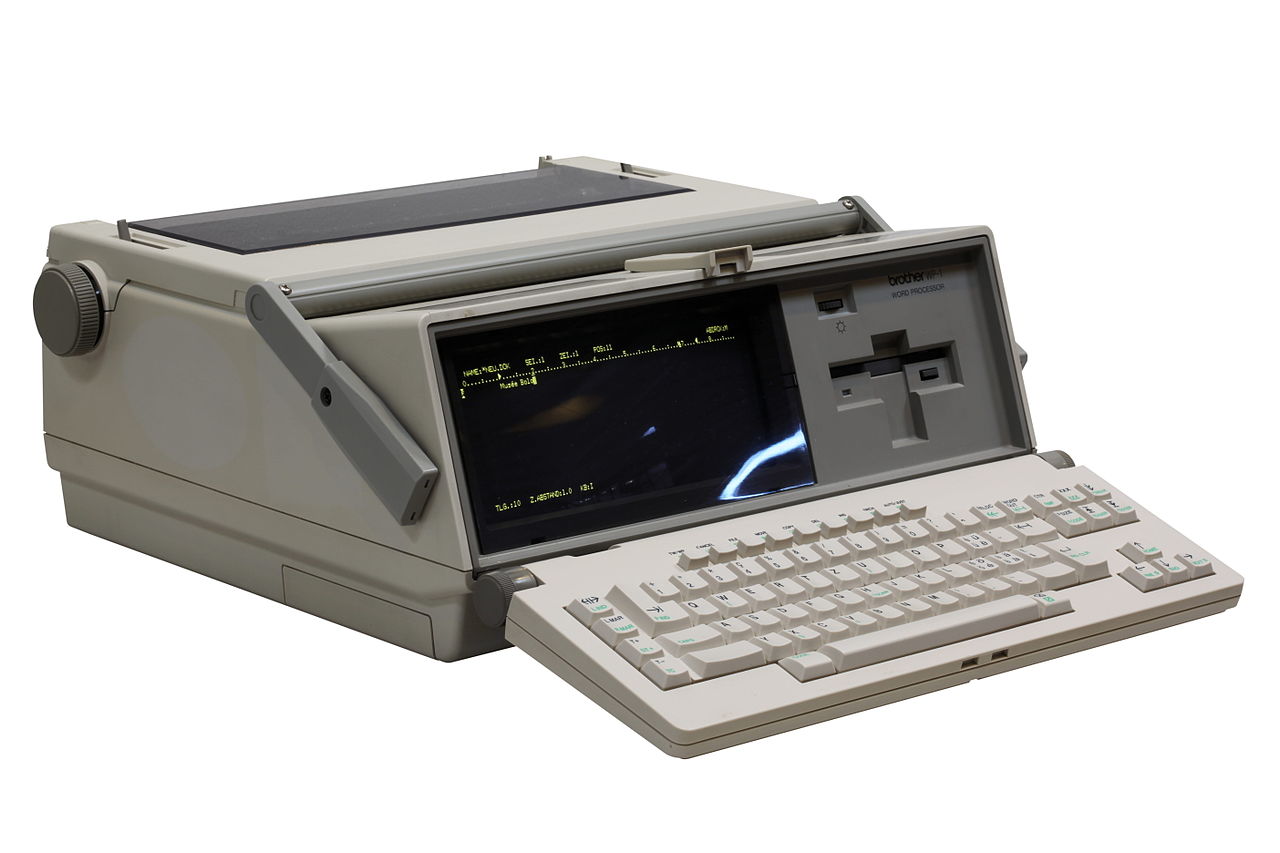
After the market had matured under the market dominance of large companies from Britain, Europe and the United States—but before the advent of daisywheel and electronic machines—the typewriter market faced strong competition from less expensive typewriters from Asia, including Brother Industries and Silver Seiko Ltd. of Japan.
Frontstriking
In most of the early typewriters, the typebars struck upward against the paper and pressed against the bottom of the platen (understrike), so the typist could not see the text as it was typed. What was typed was not visible until a carriage return caused it to scroll into view.
The difficulty with any other arrangement was ensuring the typebars fell back into place reliably when the key was released. This was eventually achieved with various ingenious mechanical designs and so-called "visible typewriters" which used frontstriking, in which the typebars struck forward against the front side of the platen, which became standard. One of the first front-strike typewriters was the Daugherty Visible, introduced in 1893.
Four-bank keyboard
The Daugherty Visible also introduced the four-bank keyboard, which also became standard, although the Underwood, which came out two years later, was the first major typewriter to support frontstriking and a four-bank keyboard.
Shift key
A significant innovation was the shift key, introduced with the Remington No. 2 in 1878. This key physically "shifted" either the basket of typebars, in which case the typewriter is described as "basket shift", or the paper-holding carriage, in which case the typewriter is described as "carriage shift". Either mechanism caused a different portion of the typebar to come in contact with the ribbon/platen.
The result is that each typebar could type two different characters, cutting the number of keys and typebars in half (and simplifying the internal mechanisms considerably). The obvious use for this was to allow letter keys to type both upper and lower case, but normally the number keys were also duplexed, allowing access to special symbols such as percent, %, and ampersand, &.
Before the shift key, typewriters had to have a separate key and typebar for upper-case letters; in essence, the typewriter had two full keyboards, one above the other. With the shift key, manufacturing costs (and therefore purchase price) were greatly reduced, and typist operation was simplified; both factors contributed greatly to mass adoption of the technology.
Three-bank typewriters
Certain models further reduced the number of keys and typebars by making each key perform three functions—each typebar could type three different characters. These little three-row machines were portable and could be used by journalists.
Such three-row machines were popular with WWI journalists because they were lighter and more compact than four-bank typewriters, while they could type just as fast and use just as many symbols. To include those symbols, three-row machines like the Bar-Let and the Corona No. 3 Typewriter had two distinct shift keys performing different functions, a "CAP" shift (for uppercase) and a "FIG" shift (for numbers and symbols). They were thus also known as double-shift typewriters.