
The Tempest is a play by William Shakespeare, probably written in 1610–1611, and thought to be one of the last plays he wrote alone. After the first scene, which takes place on a ship at sea during a storm, the rest of the play is set on a remote island, where Prospero, a magician, lives with his daughter Miranda and his two servants: Caliban, a savage monster figure, and Ariel, an airy spirit. The play contains music and songs that evoke the spirit of enchantment on the island. It explores many themes, including magic, betrayal, revenge, forgiveness, and family. In Act IV, a wedding masque serves as a play-within-a-play and contributes spectacle, allegory, and elevated language.
Although The Tempest is listed in the First Folio as the first of Shakespeare's comedies, it deals with both tragic and comic themes. Modern criticism has created the category of late romance for this and other later plays by Shakespeare. The Tempest has been widely interpreted in later centuries. Its central character, Prospero, has been identified with Shakespeare, with Prospero's renunciation of magic signaling Shakespeare's farewell to the stage. The play has also been seen as an allegory of Europeans colonising foreign lands.
The play has had a varied afterlife, inspiring artists in many nations and cultures through stage and screen adaptations, literature, music (especially opera), and the visual arts.
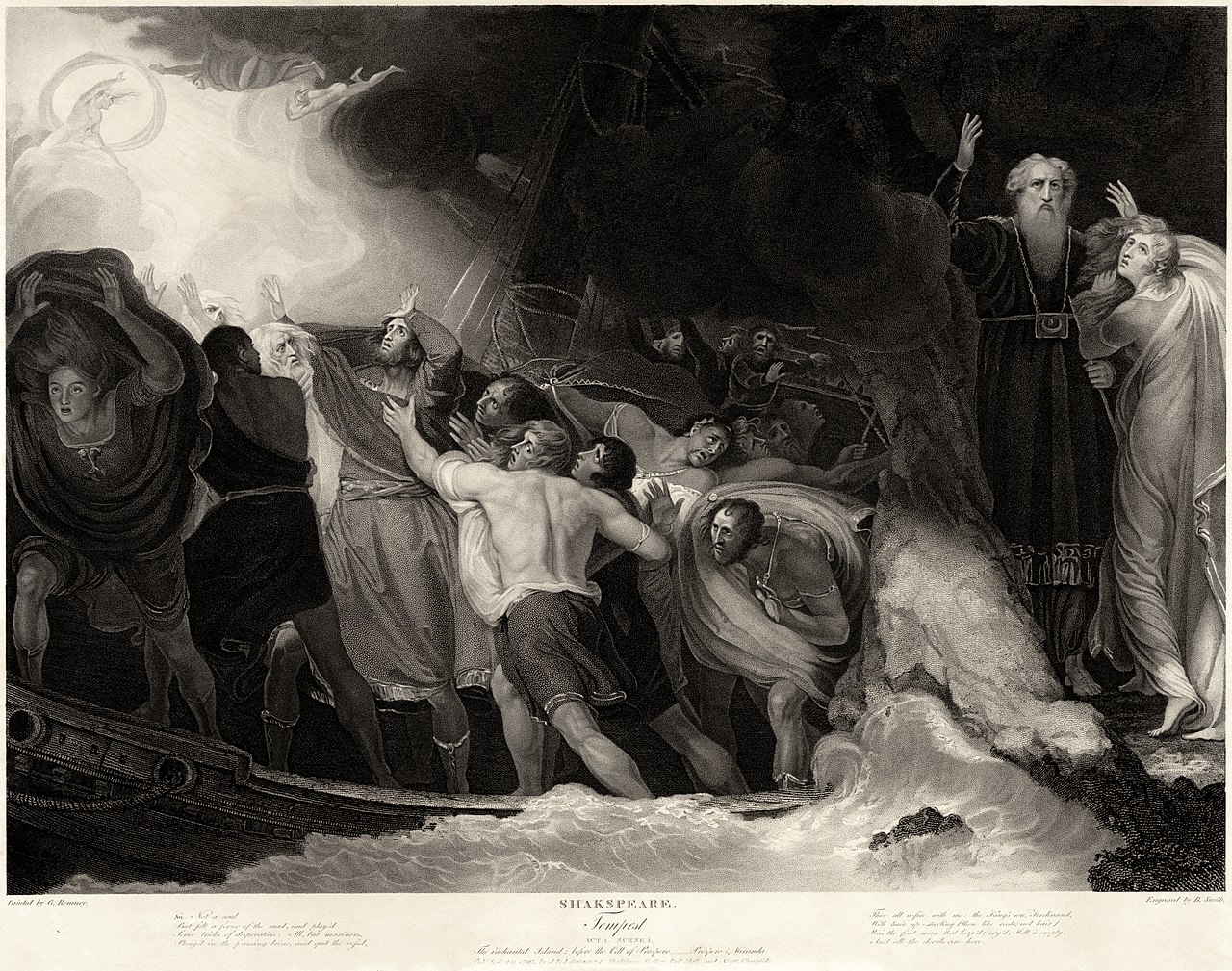
Characters
Plot
Act I
Twelve years before the action of the play, Prospero, formerly Duke of Milan and a gifted sorcerer, had been usurped by his treacherous brother Antonio with the aid of Alonso, King of Naples. Escaping by boat with his infant daughter Miranda, Prospero flees to a remote island where he has been living ever since. There he used his magic to force the island's only inhabitant, Caliban, to protect him and Miranda. He also frees the spirit Ariel and binds him into servitude.
When a ship carrying his brother Antonio passes nearby, Prospero conjures up a storm with help from Ariel and the ship is destroyed. Antonio is shipwrecked, along with Alonso, Ferdinand (Alonso's son and heir to the throne), Sebastian (Alonso's brother), Gonzalo (Prospero's trustworthy minister), Adrian, and other court members.
Acts II and III
Prospero enacts a sophisticated plan to take revenge on his usurpers and regain his dukedom. Using magic, he separates the shipwreck survivors into groups on the island:

Ferdinand, who is rescued by Prospero and Miranda and given shelter. Prospero successfully manipulates the youth into a romance with Miranda.
Trinculo, the king's jester, and Stephano, the king's drunken butler, who encounter Caliban. Recognizing his miserable state, the three stage an unsuccessful "rebellion" against Prospero. Their actions provide the comic relief of the play.
Alonso, Sebastian, Antonio, Gonzalo, and two attendant lords (Adrian and Francisco). Antonio and Sebastian conspire to kill Alonso and Gonzalo so Sebastian can become King; Prospero and Ariel thwart the conspiracy. Later, Ariel takes the form of a harpy and chastises Antonio, Alonso, and Sebastian for their crimes against Prospero and each other.

The ship's captain and boatswain, along with the other surviving sailors, are placed into a magical sleep until the final act.
Act IV
Prospero intends that Miranda, now aged 15, will marry Ferdinand, and he instructs Ariel to bring some other spirits and produce a masque.
The masque features the classical goddesses Juno, Ceres, and Iris, who bless and celebrate the betrothal. The masque also instructs the young couple on marriage, and on the value of chastity until then.

The masque is suddenly interrupted when Prospero realises he had forgotten the plot against his life. Once Ferdinand and Miranda are gone, Prospero orders Ariel to deal with the nobles' plot. Caliban, Trinculo, and Stephano are then chased off into the swamps by goblins in the shape of hounds.
Act V and Epilogue
Prospero vows that once he achieves his goals, he will set Ariel free, and abandon his magic, saying:
Ariel brings on Alonso, Antonio, and Sebastian. Prospero forgives all three. Prospero's former title, Duke of Milan, is restored. Ariel fetches the sailors from the ship, and then Caliban, Trinculo, and Stephano. Caliban, seemingly filled with regret, promises to be good. Stephano and Trinculo are ridiculed and sent away in shame by Prospero. Before the reunited group (all the noble characters with the addition of Miranda and Prospero) leave the island, Ariel is instructed to provide good weather to guide the king's ship back to the royal fleet and then to Naples, where Ferdinand and Miranda will be married. After this, Ariel is set free.

In an epilogue, Prospero requests that the audience set him free – with their applause.
Date and sources
Date
It is not known for certain exactly when The Tempest was written, but evidence supports the idea that it was probably composed sometime between late 1610 to mid-1611. Evidence supports composition perhaps occurring before, after, or at the same time as The Winter's Tale. It is considered one of the last plays that Shakespeare wrote alone. But it was not, as is sometimes claimed, Shakespeare's last play, since it is post-dated by his collaborations with John Fletcher: Henry VIII, Cardenio and The Two Noble Kinsmen. Edward Blount entered The Tempest into the Stationers' Register on 8 November 1623. It was one of 16 Shakespeare plays that Blount registered on that date.
Text
The Tempest first appeared in print in 1623 in the collection of 36 of Shakespeare's plays titled, Mr. William Shakespeare's Comedies, Histories, & Tragedies; Published according to the True and Original Copies, which is known as the First Folio. The plays, including The Tempest, were gathered and edited by John Heminges and Henry Condell.
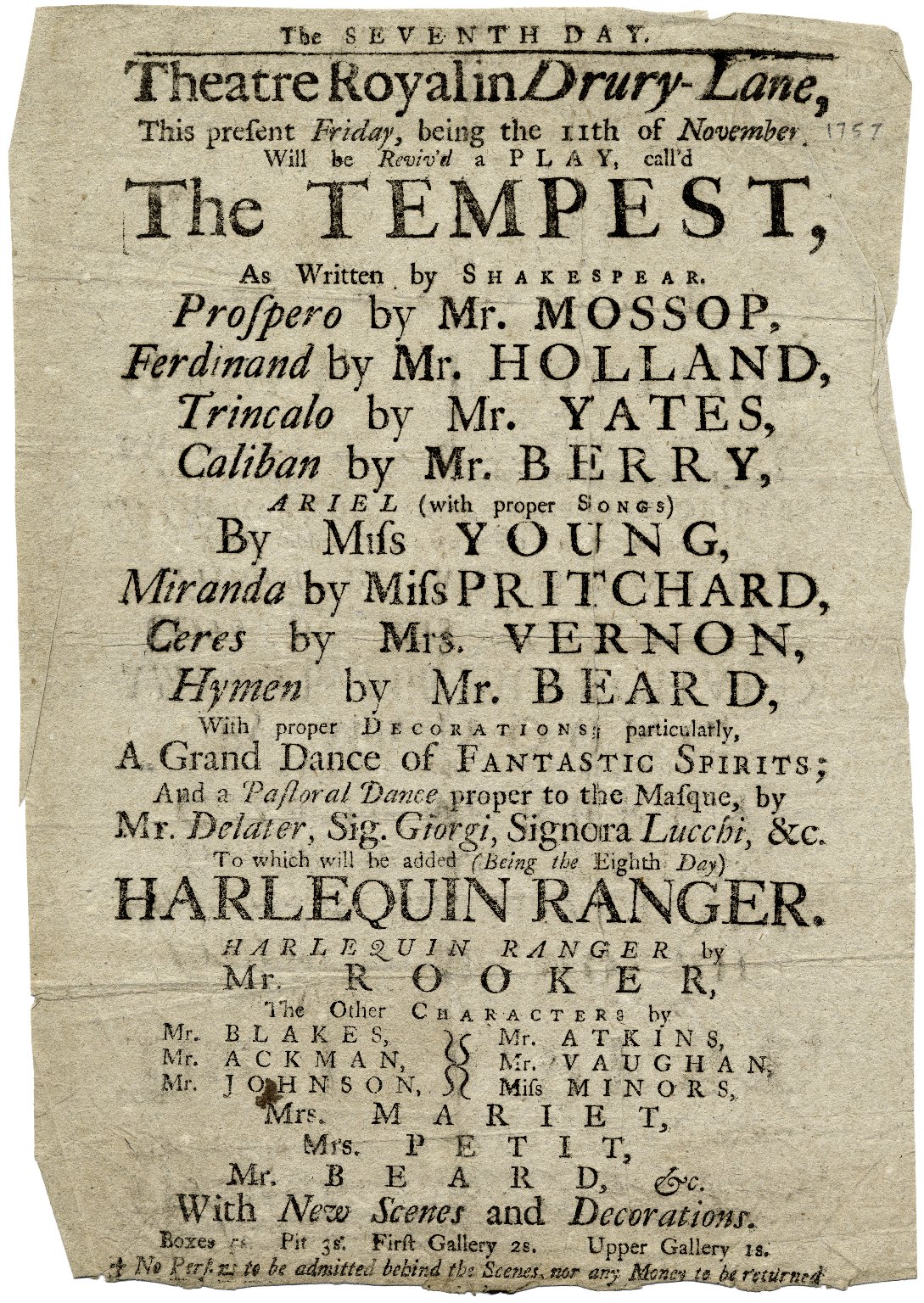
The Folio text was based on a handwritten manuscript of The Tempest prepared by Ralph Crane, a scrivener employed by the King's Men. Crane probably copied from Shakespeare's rough draft, and based his style on Ben Jonson's Folio of 1616. Crane is thought to have neatened texts, edited the divisions of acts and scenes, and sometimes added his own improvements. He was fond of joining words with hyphens, and using elisions with apostrophes, for example by changing "with the king" to read: "wi'th' King". The elaborate stage directions in The Tempest may have been due to Crane; they provide evidence regarding how the play was staged by the King's Men.
The entire First Folio project was delivered to the blind printer, William Jaggard, and printing began in 1622. The Tempest is the first play in the publication. It was proofread and printed with special care; it is the most well-printed and the cleanest text of the thirty-six plays. To do the work of setting the type in the printing press, three compositors were used for The Tempest. In the 1960s, a landmark bibliographic study of the First Folio was accomplished by Charlton Hinman. Based on distinctive quirks in the printed words on the page, the study was able to individuate the compositors, and reveal that three compositors worked on The Tempest, who are known as Compositor B, C, and F. Compositor B worked on The Tempest's first page as well as six other pages. He was an experienced journeyman in Jaggard's printshop, who occasionally could be careless. In his role, he may have had a responsibility for the entire First Folio. The other two, Compositors C and F, worked full-time and were experienced printers.
At the time, spelling and punctuation were not standardized, and varied from page to page, because each compositor had their individual preferences and styles. There is evidence that the press run was stopped at least four times, which allowed proofreading and corrections. However, a page with an error would not be discarded, so pages late in any given press run are the most accurate, and each of the final printed folios may vary in this regard. This was the common practice at the time. There is also an instance of a letter (a metal sort or a type) being damaged (possibly) during the course of a run and changing the meaning of a word: After the masque Ferdinand says,
The word "wise" at the end of line 123 was printed with the traditional long "s" that resembles an "f". But in 1978 it was suggested that during the press run, a small piece of the crossbar on the type had broken off, and the word should be "wife". Modern editors have not come to an agreement—Oxford says "wife", Arden says "wise".
Themes and motifs
The theatre
The Tempest is explicitly concerned with its own nature as a play, frequently drawing links between Prospero's art and theatrical illusion. The shipwreck was a spectacle that Ariel performed. Prospero may even refer to the Globe Theatre when he describes the whole world as an illusion: "the great globe ... shall dissolve ... like this insubstantial pageant". Ariel frequently disguises himself as figures from Classical mythology, for example a nymph, a harpy, and Ceres, acting as the latter in a masque that Prospero creates.
The masque
The masque in The Tempest is not an actual masque; rather, it is a dramatisation of a masque, while serving the narrative of the drama that contains it. It is an example of Prospero's magic art: a performance in which Ariel and his fellows play the roles. In it, the goddesses Iris, Ceres and Juno celebrate the betrothal of Miranda and Ferdinand.
The language of the masque is stylized and artificial, to the point that some twentieth-century critics dispraised it or considered it the work of another writer.
The Tempest as a whole contains elements derived from the masque as its leading practitioner, Ben Jonson, was developing it. Specifically, a masque is a movement from conflict to harmony centered on antitheses. This is seen in The Tempest in the contrast between Ariel, who represents beauty, gratitude, and air, and Caliban, who represents monstrosity, ingratitude, and earth.
Revenge and forgiveness
The tone of Prospero's speech towards his three enemies Antonio, Alonso and Sebastian throughout the play is of rage and vengeance. However, in the final act, Prospero tells Ariel "They being penitent, the sole drift of my purpose doth extend not a frown further." But as Stephen Orgel notes in his introduction to the Oxford edition of the play, there is a condition in this speech which is not fulfilled: that Antonio is given no speech of remorse or contrition at the end of the play.
Prospero freely forgives Alonso. But in his final speeches towards Antonio, Prospero's attitude vascillates: "You, brother mine, that entertained ambition ... I do forgive thee" but then immediately reverses himself: "Unnatural though thou art!" and reconsiders upon remembering the conspiracy to kill Alonso: "At this time I will tell no tales" then almost reverses himself with: "Most wicked sir, whom to call brother would even infect my mouth" and only then confirms his forgiveness, while giving Antonio no opportunity to repent: "I do forgive thy rankest fault - all of them; and require my dukedom of thee, which perforce I know thou must restore."
The spareness of Shakespeare's writing in the last act give scope to the actor playing Prospero to decide whether it was always the intention to forgive his enemies or whether he is influenced by Ariel's advice to be "tender", and similarly whether the change is gradual, is sudden, or is forced upon him by shame or expediency.
Chastity
An important aspect of Prospero's project is to secure his dynasty by marrying his daughter, Miranda, to the heir of Naples, Ferdinand, for whom she is only a suitable bride if she is a virgin. Chastity had also become embodied as a royal virtue through the reign of Elizabeth, the "Virgin Queen".
Miranda is seen as a sexual object by three characters:
Caliban, who according to Prospero "didst seek to violate the honour of mine child";
Stephano, to whom Caliban says "she will become thy bed, I warrant, and bring thee forth brave brood"; and
Ferdinand, whose mutual love with Miranda is the most immediate threat to her chastity.
The latter leads to chastity becoming the primary theme of the masque in Act IV, prefixed by Prospero's warning to Ferdinand: "But if thou dost break her virgin-knot before all sanctimonious ceremonies may with full and holy rite be ministered, no sweet aspersion shall the heavens let fall to make this contract grow." Venus and Cupid (who, in the mythology, initiated the abduction of Proserpina) are banished from the masque, and the songs of Ceres and Juno celebrate chaste love.
Magic
Prospero has been described as practicing "theurgy", white magic, known in Shakespeare's time from neo-Platonic writers, and contrasted with "goety", black magic. Contemporary Dr John Dee regarded himself as practicing this white magic, but all magic was condemned by the church and the state: King James in his book Daemonologie having declared it punishable by death. Early modern plays about magic had portrayed it negatively: most famously in Marlowe's Doctor Faustus, but also, quite recently at the time The Tempest was written, in Jonson's satire The Alchemist, played by Shakespeare's own company, The King's Men, in which the central magician character, Subtle, is merely a con man.
In another more positive interpretation, Prospero's magic is an extension of science. Francis Bacon (who was at the time King James's Attorney-General) had written in his Magnalia Naturae of the possibility of the new philosophy giving humans powers over storms, seasons, germination and harvests.
Prospero often invokes the language of alchemy but his project is to transform not metals, but people: especially Caliban, and Prospero's former enemies Antonio, Sebastian and Alsonso. And he has the signifiers that Elizabethan audiences would have associated with magical power: his books, his staff and his robe.
In the end Prospero must abandon his magic. He must free himself from the temptation to use magic for revenge, and from the distraction from his ducal duties which had caused his fall from power twelve years earlier.
Prospero and Sycorax
Related to Prospero's magic is the contrast between him and the unseen character Sycorax, Caliban's mother, an Algerian witch who inhabited the island and died prior to Prospero and Miranda's arrival. Prospero himself makes much of the distinction between his own magical skill and that of Sycorax - both in moral terms (his white magic against her black magic) and in terms of his greater powers - exemplified by the fact that Sycorax "could not again undo" Ariel's imprisonment in a cloven pine and "It was mine [Prospero's] art ... that made gape the pine and let thee out."
Scholar Stephen Orgel concludes that "attitudes towards magic in the play ... range from the most positive to the most negative" but that twentieth century criticism emphasised the virtuous aspects of Prospero's magic: citing Frances Yates and Frank Kermode among those who praise Prospero's theurgy over the goety of Sycorax. But Orgel goes on to reject this view as an oversimplification: pointing out that there is no evidence that the spirits controlled by Sycorax are any lower than (or, indeed, any other than) those controlled by Prospero, and also that Ariel is the unwilling servant of both.
The moral superiority of Prospero over Sycorax is also undermined in Prospero's speech renouncing his magic, which many in Shakespeare's audiences would have known (see "Sources" above) was a quotation from the witch Medea in Ovid's Metamorphoses.
Prospero as Shakespeare
Thomas Campbell in 1838 was the first to consider that Prospero was meant to partially represent Shakespeare, but then abandoned that idea when he came to believe that The Tempest was an early play. Even so, the idea has persisted in the critical canon that Prospero may be partly autobiographical.