
A synagogue or synagog, 'Beit Kneset'—"house of gathering" in Hebrew, also called a shul (meaning school in Yiddish) or a temple, is a place of worship for Jews or Samaritans.
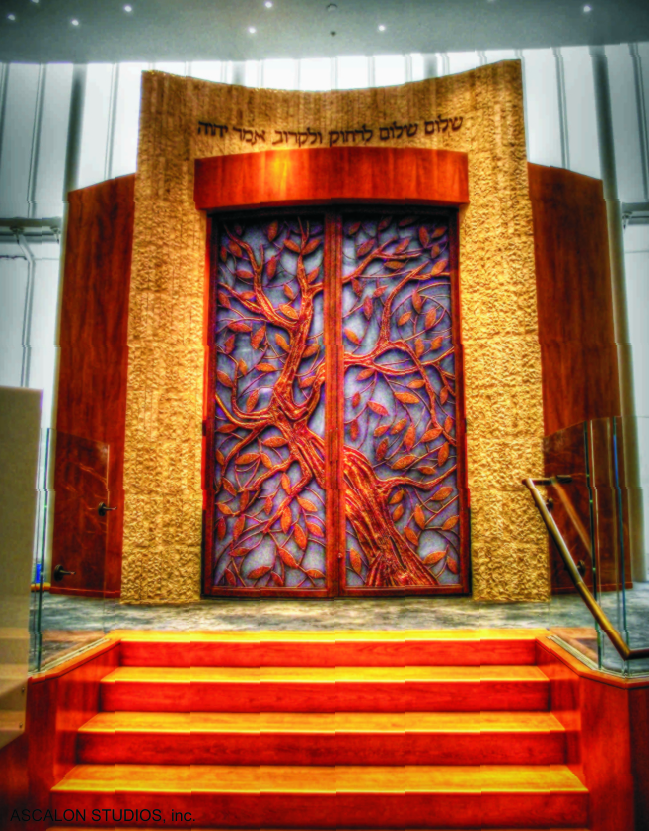
It serves as a house of prayer. It includes a main sanctuary with the Torah ark where the Torah scrolls are kept (called an Holy Closet aron qodesh (Hebrew: אָרוֹן קׄדֶש) by Ashkenazi Jews and a hekhal (היכל) by Sephardic Jews), and a stage called bema in front of it as well as raised galleries for female worshipers. Synagogues have religious services or ceremonies such as Daily prayers, Shabbat prayers (Saturday) weddings, bar and bat mitzvahs. Synagogues often also contain study rooms, social halls, administrative and charitable offices, classrooms for religious and Hebrew studies, and spaces for community gatherings. They frequently display commemorative, historic, or modern artwork alongside items of Jewish historical significance or exhibits about the synagogue itself.
Synagogues are buildings used for Jewish prayer, study, assembly, and reading of the Torah. The Torah (Pentateuch or Five Books of Moses) is traditionally read in its entirety over a period of a year in weekly portions during services, or in some synagogues on a triennial cycle. However, the edifice of a synagogue as such is not essential for holding Jewish worship. Halakha (Jewish law from the Mishnah—the "Oral Torah") states that communal Jewish worship can be carried out wherever a minyan, a group of at least 10 Jewish adults, is assembled, often (but not necessarily) led by a rabbi. This minyan is the essence of Jewish communal worship, which can also be conducted alone or with fewer than ten people, but that excludes certain prayers as well as communal Torah reading. In terms of its specific ritual and liturgical functions, the synagogue does not replace the long-destroyed Temple in Jerusalem.

Any Jew or group of Jews can build a synagogue. Synagogues have been constructed by ancient Jewish leaders, wealthy patrons, and as part of a wide range of human institutions, including secular educational institutions, governments, and hotels. They have been built by the entire Jewish community living in a particular village or region, or by sub-groups of Jewish people organized by occupation, tradition/background (e.g., the Sephardic, Yemenite, Romaniote or Persian Jews of a town), style of religious observance (e.g., Orthodox or Reform synagogues), or by the followers of a particular rabbi, such as the shtiebelekh (Yiddish: שטיבעלעך, romanized: shtibelekh, singular שטיבל shtibl) of Hasidic Judaism.
Terminology
The Hebrew term is bet knesset (בית כנסת) or "house of assembly". The Koine Greek-derived word synagogue (συναγωγή) also means "assembly" and is commonly used in English, with its earliest mention in the 1st century Theodotos inscription in Jerusalem. Ashkenazi Jews have traditionally used the Yiddish term shul (from the Greek schola, which is also the source of the English "school") in everyday speech, and many continue to do so in English.
Sephardi Jews and Romaniote Jews generally use the term kal (from the Hebrew qahal "community"). Spanish and Portuguese Jews call the synagogue an esnoga and Portuguese Jews may call it a sinagoga. Persian Jews and some Karaite Jews also use the term kenesa, which is derived from Aramaic, and some Mizrahi Jews use kenis or qnis, the Arabic word for a synagogue, or ṣla, the Arabic word for prayer.

History
In the First Temple period, Jewish communal worship revolved around the Temple in Jerusalem, serving as a central focal point and significant symbol for the entire Jewish nation. As such, it was the destination for Jews making pilgrimages during the three major annual festivals commanded by the Torah: Passover, Shavuot and Sukkot. There is no evidence of non-sacrificial worship during this period. There are several known cases of Jewish communities in Egypt with their own temples, such as the Temple at Elephantine established by refugees from the Kingdom of Judah during the Twenty-seventh Dynasty of Egypt, and a few centuries later, the Temple of Onias in the Heliopolite Nome.
The first synagogues emerged in the Jewish diaspora, probably after the Babylonian Exile of Judaea in 586 BCE, several centuries before their introduction to the Land of Israel. Evidence points to their existence as early as the Hellenistic period, notably in Alexandria, Ptolemaic Egypt, the world's foremost Greek-speaking city at the time. There, the first proseukhái (Koine Greek: προσευχαί, lit. 'places of prayer'; singular προσευχή proseukhē) were built to provide a place for communal prayer and reading and studying the Torah. Alexandrian Jews also made a Koine Greek translation of the Torah, the Septuagint. The earliest archaeological evidence for the existence of synagogues is stone dedication inscriptions from the third century BCE prove that proseukhái existed by that date. Philo and Josephus mention lavishly adorned synagogues in Alexandria and in Antioch, respectively.
More than a dozen Second Temple period synagogues in use by Jews and Samaritans have been identified by archaeologists in Israel and other countries of the Hellenistic world. Following the destruction of the Second Temple in 70 CE, Rabbi Yohanan ben Zakkai, who is often credited with reformulating Judaism for the post-Temple era, advocated for the establishment of individual houses of worship since the Temple was no longer accessible.
It has been theorized that the synagogue became a place of worship in the region upon the destruction of the Second Temple during the First Jewish–Roman War; however, others speculate that there had been places of prayer, apart from the Temple, during the Hellenistic period. The popularization of prayer over sacrifice during the years prior to the destruction of the Second Temple in 70 CE had prepared the Jews for life in the diaspora, where prayer would serve as the focus of Jewish worship.
Despite the certain existence of synagogue-like spaces prior to the First Jewish–Roman War, the synagogue emerged as a focal point for Jewish worship upon the destruction of the Temple. For Jews living in the wake of the Revolt, the synagogue functioned as a "portable system of worship". Within the synagogue, Jews worshipped by way of prayer rather than sacrifices, which had previously served as the main form of worship within the Second Temple.
Second Temple period
In 2018, Mordechai Aviam reported that there were now at least nine synagogues excavated known to pre-date the destruction of the Jerusalem Temple in 70 CE, including in Magdala, Gamla, Masada, Herodium, Modi'in (Khan Umm el-'Umdan), Qiryat Sepher (Khan Bad 'Issa), and Khan Diab. Aviam concluded that he thought almost every Jewish settlement at the time, whether it was a polis or a village, had a synagogue.

Gamla – a synagogue was discovered near the city gate at Gamla, a site in the Golan northeast of the Sea of Galilee. This city was destroyed by the Roman army in 67 CE and was never rebuilt.
Masada – a synagogue was discovered on the western side of Masada, just south of the palace complex at the northern end of the site. One of the unique finds at this synagogue was a group of 14 scrolls, which included biblical, sectarian, and apocryphal documents.
Herodium – a synagogue from the 1st century was discovered in Herod's palace fortress at Herodium.

Magdala – also known as the Migdal Synagogue, this synagogue was discovered in 2009. One of the unique features of this synagogue, which is located on the western shore of the Sea of Galilee, is an intricately carved stone block that was found in the center of the main room.
Modi'in – Discovered between Modi'in and Latrun is the oldest synagogue within modern Israel that has been found to date, built during the second century BCE. It includes three rooms and a nearby mikve.
Talmudic period
Following the destruction of the Temple, the synagogue became the focal point of Jewish worship and communal life. Lester L. Grabbe writes: "The rise of the synagogue was a fortuitous but vital development which paved the way for a post-temple Judaism which became necessary after 70 [...] Synagogues were not planned as a substitute for the temple but they were a useful vehicle to make the transition." Over time, prayers, rituals, and customs once performed in the Temple were adapted for synagogue use. Traditional forms of synagogal worship, including sermons and the reading of scripture, were preserved, while new forms of worship, such as piyyut and organized prayer, developed. Rabbinic instruction, however, maintained that certain practices should remain exclusive to the Temple. The Mishnah directed prayers toward Jerusalem, and most synagogues face the Temple site rather than mirroring its orientation, establishing them as extensions of its sanctity, not replicas.
During Late antiquity (third to seventh century CE), literary sources attest to the existence of a large number of synagogues across the Roman-Byzantine and Sasanian Empires. Archaeological evidence indicates the presence of synagogues in at least thirteen places across the diaspora, spanning from Dura-Europos in Syria to Elche in Hispania (modern-day Spain). An especially sizable and monumental synagogue dating from this period is the Sardis Synagogue. Additionally, many inscriptions pertaining to synagogues and their officials have been discovered.
In the Land of Israel, late antiquity witnessed a significant increase in synagogue construction, in Galilee and Golan in the north and the southern hills of Judea, in the south. Each synagogue was constructed according to the means and religious customs of the local community. Notable examples include Capernaum, Bar'am, Beth Alpha, Maoz Haim, Meroth and Nabratein in the north, and Eshtemoa, Susya, Anim, and Maon in the south.
Middle Ages
Rabbi and philosopher Maimonides (1138–1204) described the various customs in his day with respect to local synagogues:
Synagogues and houses of study must be treated with respect. They are swept and sprinkled [with water] to lay the dust. In Spain and the Maghreb, in Babylonia and in the Holy Land, it is customary to kindle lamps in the synagogues and to spread mats on the floor upon which the worshippers sit. In the lands of Edom (Christendom), they sit in synagogues upon chairs [or benches].
Samaritan synagogues
Name and history
The Samaritan house of worship is also called a synagogue. During the third and second centuries BCE, the Hellenistic period, the Greek word used in the Diaspora by Samaritans and Jews was the same, proseukhē Koine Greek: προσευχή, lit. 'place of prayer', plural προσευχαί prosukhái); a third or fourth century inscription uses a similar term, εὑκτήριον euktērion.
The oldest Samaritan synagogue discovered so far is from Delos in the Aegean Islands, with an inscription dated between 250 and 175 BCE, while most Samaritan synagogues excavated in the wider Land of Israel and ancient Samaria in particular, were built in the fourth to seventh centuries at the very end of the Roman Empire and throughout the Byzantine period.
Distinguishing elements
The elements which distinguish Samaritan synagogues from contemporary Jewish ones are:
Alphabet: the use of the Samaritan script
Orthography: When the Samaritan script is used, there are some Hebrew words which would be spelled in a way typical only for the Samaritan Pentateuch, for instance, "forever" is written ʿlmw instead of lʿlm. When Greek is the language used in inscriptions, typically, Samaritans may contract two Hebrew words into one, such har "mountain" and Gerizim becoming Ancient Greek: Άργαρίζειν, romanized: Árgarízein. This is an archaic practice that was primarily maintained by Samaritans.
Orientation: The façade, or entrance, of the Samaritan synagogue, typically faces Mount Gerizim, which is the holiest site to Samaritans, while Jewish synagogues are oriented towards Jerusalem and the Temple Mount.
Decoration: The mosaic floor and other architectural elements or artifacts are sometimes decorated with typical symbols.
As the Samaritans have historically adhered more strictly to the commandment forbidding the creation of any "graven image", they would not use any depictions of man or beast. Representations of the signs of the zodiac, of human figures or even Greek deities such as the god Helios, as seen in Byzantine-period Jewish synagogues, would be unimaginable in Samaritan buildings of any period.
A representation of Mount Gerizim is a clear indication of Samaritan identity. On the other hand, although the existence of a Samaritan temple on Mount Gerizim is both mentioned by Josephus and confirmed by archaeological excavation at its summit, the temple's early destruction in the second century BCE led to its memory disappearing from Samaritan tradition. No temple-related items would be found in Samaritan synagogue depictions. Religious implements, such as are also known from ancient Jewish synagogue mosaics (the temple menorah, shofar, showbread table, trumpets, incense shovels, and specifically the façade of what looks like a temple or a Torah shrine) are also present in Samaritan ones, but the objects are always related to the Tabernacle, the Ark of the Covenant within the Tabernacle, or the Torah shrine in the synagogue itself. Samaritans believe that at the end of time, the Tabernacle and its utensils will be recovered from the place they were buried on Mount Gerizim, and as such they play an important role in Samaritan beliefs. Since the same artists, such as mosaicists, worked for all ethno-religious communities of the time, some depictions might be identical in Samaritan and Jewish synagogues, Christian churches, and pagan temples, but their significance would differ.
Missing from Samaritan synagogue floors would be images often found in Jewish ones: The lulav (palm-branch) and etrog (citron fruit) have a different ritual use by Samaritans celebrating Sukkot and do not appear on mosaic floors.
Mikvehs near the synagogue after 70 CE: Jews abandoned the habit of building mikvehs next to their houses of worship after the 70 CE destruction of the Jerusalem Temple, but Samaritans continued the practice.
Archaeological finds
Ancient Samaritan synagogues are mentioned by literary sources or have been found by archaeologists in the Diaspora, in the wider Holy Land, and specifically in Samaria.
Diaspora
Delos Synagogue: a Samaritan inscription has been dated to between 250 and 175 BCE.
Rome and Tarsus: ancient literature offers hints that Samaritan synagogues may have existed in these cities between the fourth and sixth centuries CE.
Thessaloniki and Syracuse: short inscriptions found there and using the Samaritan and Greek alphabet may originate from Samaritan synagogues.
The wider Holy Land
Synagogue of Salbit (now Sha'alvim), excavated by Eleazar Sukenik in 1949 northwest of Jerusalem. It was about 8 by 15.5 metres (26 by 51 ft) in size, was two stories tall, and was oriented towards Mount Gerizim. Two mosaics remain, one atop the other; one contained the Samaritan version of the Song of the Sea in Exodus 15:18. It was probably built in the 4th or 5th century and destroyed in the 5th or 6th.
The synagogue at Tell Qasile, which was built at the beginning of the seventh century.
Synagogue A at Beit She'an (Beisan) was a room added to an existing building in the late 6th or early 7th century and served as a Samaritan synagogue. Beisan is famous for Synagogue B, the Beth Alpha synagogue, which faced Jerusalem and was not a Samaritan synagogue.
Samaria
El-Khirbe synagogue, discovered c. 3 km from Sebaste, was built in the 4th century CE and remained in use into the Early Islamic period, with a break during the late 5th–early 6th century
Khirbet Samara synagogue, c. 20 km northwest of Nablus and built in the 4th century CE
Tzur Natan synagogue, c. 29 km west of Nablus and built in the 5th century CE
Christianity
In the New Testament, the word appears 56 times, mostly in the Synoptic Gospels, but also in the Gospel of John (John 9:22; 18:20) and the Book of Revelation (Rev. 2:9; 3:9). It is used in the sense of 'assembly' in the Epistle of James (James 2:2). Alternatively, the epistle of James (in Greek, clearly Ἰάκωβος or יעקב, anglicized to Jacob) refers to a place of assembly that was indeed Jewish, with Jacob ben Joseph perhaps an elder there. The specific word in James (Jacob) 2:2 could easily be rendered "synagogue", from the Greek συναγωγὴν.
In 1995, Howard Clark Kee argued that synagogues were not a developed feature of Jewish life prior to the First Jewish–Roman War (66-73 CE) and that the mentions of synagogues in the New Testament, including Jesus's visitations of synagogues in various Jewish settlements in Israel, were anachronistic. However, archaeologists have discovered first-century synagogues, and Chris Keith and Anders Runesson find it almost certain that the historical Jesus preached in synagogues in Galilee.
During the first Christian centuries, Jewish Christians are hypothesized to have used houses of worship known in academic literature as synagogue-churches. Scholars have claimed to have identified such houses of worship of the Jews who had accepted Jesus as the Messiah in Jerusalem and Nazareth.
Architectural design
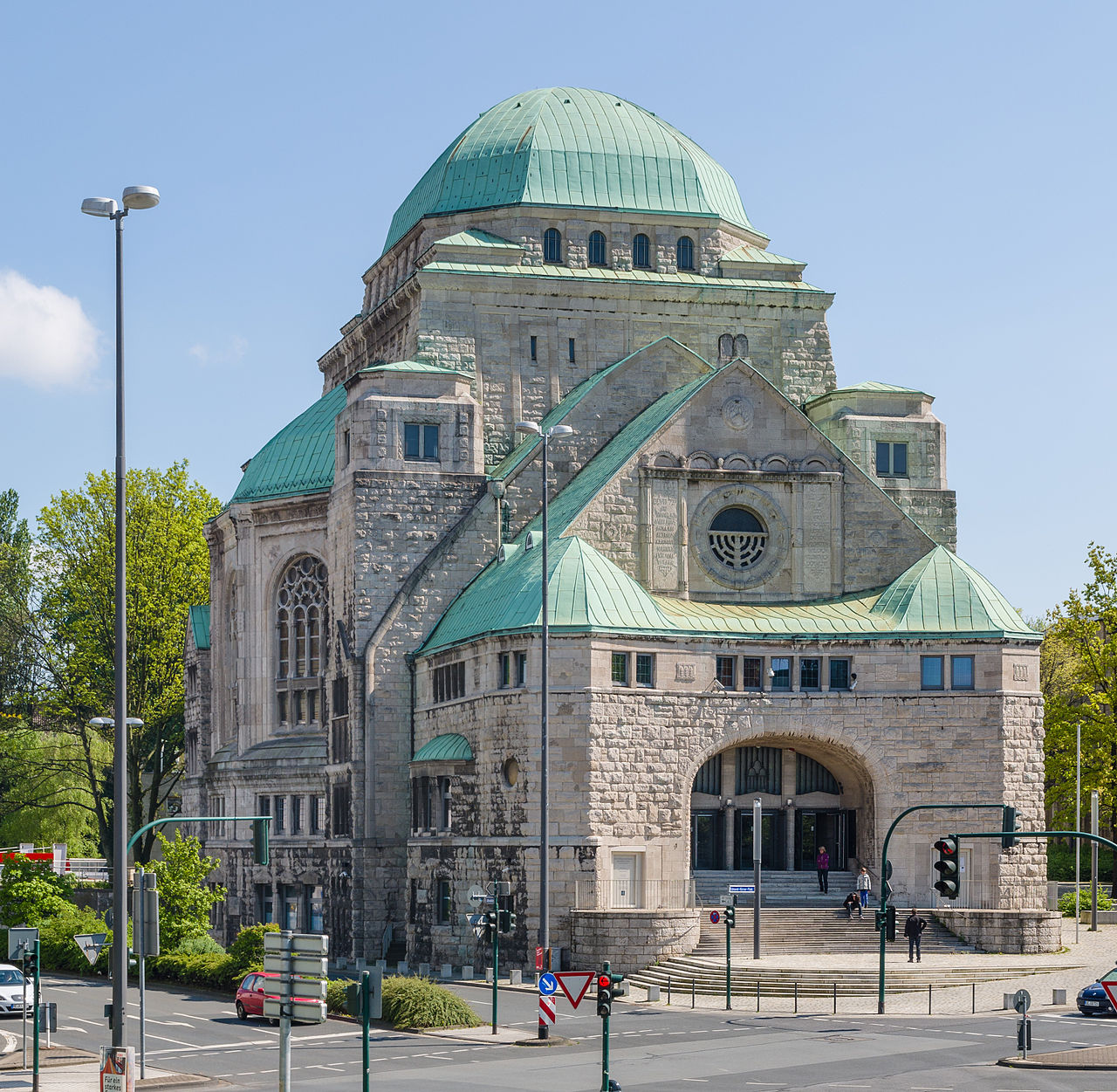
There is no set blueprint for synagogues and the architectural shapes and interior designs of synagogues vary greatly. In fact, the influence from other local religious buildings can often be seen in synagogue arches, domes and towers.