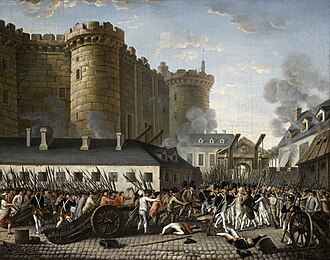
The Storming of the Bastille, which occurred in Paris, France, on 14 July 1789, was an act of political violence by revolutionary insurgents who attempted to storm and seize control of the medieval armoury, fortress, and political prison known as the Bastille. After four hours of fighting and 94 deaths, the insurgents were able to enter the Bastille. The governor of the Bastille, Bernard-René Jourdan de Launay, and several members of the garrison were killed after surrendering. At the time, the Bastille represented royal authority in the centre of Paris. The prison contained only seven inmates at the time of its storming and was already scheduled for demolition but was seen by the revolutionaries as a symbol of the monarchy's abuse of power. Its fall was the flashpoint of the French Revolution.
Key Facts
| Subject | Storming of the Bastille |
| Category | Major event of the French Revolution |
| Reading time | 1 min · Advanced |
| Key date | 1789 |
People Mentioned
Reading level
Audio Summary
Played with your browser's voice. Studio-quality audio can be added with a text-to-speech service.
Ask about this article
📝 Quick Quiz1 / 3
What is "Storming of the Bastille" primarily known for?
Vocix Daily — In Your Inbox
Top stories, deep-dive articles, and "On This Day" history — one crisp digest delivered every morning.
Sources & references
Reference material for this entry is drawn from the open encyclopedic record, including Wikipedia , available under the CC BY-SA 4.0 license. Images are credited individually beside each photo.