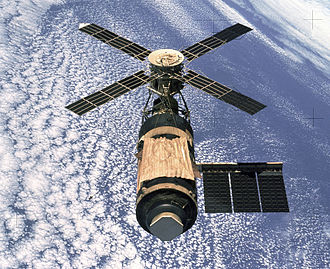
Skylab was the United States' first space station, launched by NASA, occupied for about 24 weeks between May 1973 and February 1974. It was operated by three trios of astronaut crews: Skylab 2, Skylab 3, and Skylab 4.
The manifestation of the Apollo Applications Program, Skylab was constructed from a repurposed Saturn V third stage (the S-IVB), a dry workshop, and took the place of the stage during launch. Operations included an orbital workshop, a solar observatory, Earth observation, ten spacewalks, and hundreds of experiments. NASA's station concept had competed with the Department of Defense's Manned Orbiting Laboratory concept from 1963 to 1969.
Skylab was the world's second space station, after the Soviet space program's Salyut 1. Its pressurized volume of over 350 m3 was not rivalled until the completion of the first modular space station, Mir, in 1996; the central Orbital Workshop, at 270 m3, dwarfed subsequent station modules, including the largest on the International Space Station (ISS), Kibō, at 150 m3.

A successor station, Skylab B, was concurrently constructed in 1970 and considered for integration with Salyut and Soyuz, but cancelled in 1973. Plans for Skylab to be boosted and reused with the Space Shuttle were abandoned after it became clear that the shuttle would not be ready by 1979. Skylab's orbit eventually decayed and it disintegrated in the atmosphere on July 11, 1979, scattering debris across the Indian Ocean and Western Australia. Unity became the second US-built space station element, joining the ISS in 1998.
Overview
Skylab had a mass of 199,750 pounds (90,610 kg) with a 31,000-pound (14,000 kg) Apollo command and service module (CSM) attached and included a workshop, a solar observatory, and several hundred life science and physical science experiments. It was launched uncrewed into low Earth orbit by a Saturn V rocket modified to be similar to the Saturn INT-21, with the S-IVB, with Skylab itself being the repurposed third stage. This was the final flight for the rocket more commonly known for carrying the crewed Apollo Moon landing missions. Three subsequent missions delivered three-astronaut crews in the Apollo CSM launched by the smaller Saturn IB rocket.
Configuration
Skylab included the Apollo Telescope Mount (a multi-spectral solar observatory), a multiple docking adapter with two docking ports, an airlock module with extravehicular activity (EVA) hatches, and the orbital workshop, the main habitable space inside Skylab. Electrical power came from solar arrays and fuel cells in the docked Apollo CSM. The rear of the station included a large waste tank, propellant tanks for maneuvering jets, and a heat radiator. Astronauts conducted numerous experiments aboard Skylab during its operational life.

Background
Rocket engineer Wernher von Braun, science fiction writer Arthur C. Clarke, and other early advocates of crewed space travel, expected until the 1960s that a space station would be an important early step in space exploration. Von Braun participated in the publishing of a series of influential articles in Collier's magazine from 1952 to 1954, titled "Man Will Conquer Space Soon!". He envisioned a large, circular station 250 feet (75 m) in diameter that would rotate to generate artificial gravity and require a fleet of 7,000 short tons (6,400 metric tons) space shuttles for construction in orbit. The 80 men aboard the station would include astronomers operating a telescope, meteorologists to forecast the weather, and soldiers to conduct surveillance. Von Braun expected that future expeditions to the Moon and Mars would leave from the station.
The development of the transistor, the solar cell, and telemetry led, in the 1950s and early 1960s, to uncrewed satellites that could take photographs of weather patterns or enemy nuclear weapons and send them to Earth. A large station was no longer necessary for such purposes, and the United States Apollo program to send men to the Moon chose a mission mode that would not need in-orbit assembly. A smaller station that a single rocket could launch retained value, however, for scientific purposes.
Early studies
In 1959, von Braun, head of the Development Operations Division at the Army Ballistic Missile Agency, submitted his final Project Horizon plans to the U.S. Army. The overall goal of Horizon was to place men on the Moon, a mission that would soon be taken over by the rapidly forming NASA. Although concentrating on the Moon missions, von Braun also detailed an orbiting laboratory built out of a Horizon upper stage, an idea used for Skylab. A number of NASA centers studied various space station designs in the early 1960s. Studies generally looked at platforms launched by the Saturn V, followed up by crews launched on Saturn IB using an Apollo command and service module, or a Gemini capsule on a Titan II-C, the latter being much less expensive in the case where cargo was not needed. Proposals ranged from an Apollo-based station with two to three men, or a small "canister" for four men with Gemini capsules resupplying it, to a large, rotating station with 24 men and an operating lifetime of about five years. A proposal to study the use of a Saturn S-IVB as a crewed space laboratory was documented in 1962 by the Douglas Aircraft Company.

Air Force plans
The Department of Defense (DoD) and NASA cooperated closely in many areas of space. In September 1963, NASA and the DoD agreed to cooperate in building a space station. The DoD wanted its own crewed facility, however, and in December 1963 it announced Manned Orbiting Laboratory (MOL), a small space station primarily intended for photo reconnaissance using large telescopes directed by a two-person crew. The station was the same diameter as a Titan II upper stage, and would be launched with the crew riding atop in a modified Gemini capsule with a hatch cut into the heat shield on the bottom of the capsule. MOL competed for funding with a NASA station for the next five years and politicians and other officials often suggested that NASA participate in MOL or use the DoD design. The military project led to changes to the NASA plans so that they would resemble MOL less.
Operations
For the final two crewed missions to Skylab, NASA assembled a backup Apollo CSM/Saturn IB in case an in-orbit rescue mission was needed, but this vehicle was never flown. The station was damaged during launch when the micrometeoroid shield tore away from the workshop, taking one of the main solar panel arrays with it and jamming the other main array. This deprived Skylab of most of its electrical power and also removed protection from intense solar heating, threatening to make it unusable. The first crew deployed a replacement heat shade and freed the jammed solar panels to save Skylab. This was the first time that a repair of this magnitude was performed in space.
The Apollo Telescope significantly advanced solar science, and observation of the Sun was unprecedented. Astronauts took thousands of photographs of Earth, and the Earth Resources Experiment Package (EREP) viewed Earth with sensors that recorded data in the visible, infrared, and microwave spectral regions. The record for human time spent in orbit was extended beyond the 23 days set by the Soyuz 11 crew aboard Salyut 1 to 84 days by the Skylab 4 crew.

Later plans to reuse Skylab were stymied by delays in the development of the Space Shuttle, and Skylab's decaying orbit could not be stopped. Skylab's atmospheric reentry began on July 11, 1979, amid worldwide media attention. Before re-entry, NASA ground controllers tried to adjust Skylab's orbit to minimize the risk of debris landing in populated areas, targeting the south Indian Ocean, which was partially successful. Debris showered Western Australia, and recovered pieces indicated that the station had disintegrated lower than expected. As the Skylab program drew to a close, NASA's focus had shifted to the development of the Space Shuttle. NASA space station and laboratory projects included Spacelab, Shuttle-Mir, and Space Station Freedom, which was merged into the International Space Station.
Development
Apollo Applications Program
NASA management was concerned about losing the 400,000 workers involved in Apollo after landing on the Moon in 1969. A reason von Braun, head of NASA's Marshall Space Flight Center during the 1960s, advocated a smaller station after his large one was not built was that he wished to provide his employees with work beyond developing the Saturn rockets, which would be completed relatively early during Project Apollo. NASA set up the Apollo Logistic Support System Office, originally intended to study various ways to modify the Apollo hardware for scientific missions. The office initially proposed a number of projects for direct scientific study, including an extended-stay lunar mission which required two Saturn V launchers, a "lunar truck" based on the Lunar Module (LM), a large, crewed solar telescope using an LM as its crew quarters, and small space stations using a variety of LM or CSM-based hardware. Although it did not look at the space station specifically, over the next two years the office became increasingly dedicated to this role. In August 1965, the office was renamed, becoming the Apollo Applications Program (AAP).
As part of their general work, in August 1964 the Manned Spacecraft Center (MSC) presented studies on an expendable lab known as Apollo X, short for Apollo Extension System. Apollo X would have replaced the LM carried on the top of the S-IVB stage with a small space station slightly larger than the CSM's service area, containing supplies and experiments for missions between 15 and 45 days' duration. Using this study as a baseline, several mission profiles were looked at over the next six months.

Wet workshop
In November 1964, von Braun proposed a more ambitious plan to build a much larger station built from the S-II second stage of a Saturn V. His design replaced the S-IVB third stage with an aeroshell, primarily as an adapter for the CSM on top. Inside the shell was a 10 feet (3.0 m) cylindrical equipment section. On reaching orbit, the S-II second stage would be vented to remove any remaining hydrogen fuel, then the equipment section would be slid into it via a large inspection hatch. This became known as a "wet workshop" concept, because of the conversion of an active fuel tank. The station filled the entire interior of the S-II stage's hydrogen tank, with the equipment section forming a "spine" and living quarters located between it and the walls of the booster. This would have resulted in a very large 33 by 45 feet (10 by 14 m) living area. Power was to be provided by solar cells lining the outside of the S-II stage.
One problem with this proposal was that it required a dedicated Saturn V launch to fly the station. At the time the design was being proposed, it was not known how many of the then-contracted Saturn Vs would be required to achieve a successful Moon landing. However, several planned Earth-orbit test missions for the LM and CSM had been canceled, leaving some Saturn IBs free for use. Further work led to the idea of building a smaller "wet workshop" based on the S-IVB, launched as the second stage of a Saturn IB.
A number of S-IVB-based stations were studied at MSC from mid-1965, which had much in common with the Skylab design that eventually flew. An airlock would be attached to the hydrogen tank, in the area designed to hold the LM, and a minimum amount of equipment would be installed in the tank in order to avoid taking up too much fuel volume. Floors of the station would be made from an open metal framework that allowed the fuel to flow through it. After launch, a follow-up mission launched by a Saturn IB would launch additional equipment, including solar panels, an equipment section and docking adapter, and various experiments. Douglas Aircraft Company, builder of the S-IVB stage, was asked to prepare proposals along these lines. The company had for several years been proposing stations based on the S-IV stage, before it was replaced by the S-IVB.

On April 1, 1966, MSC sent out contracts to Douglas, Grumman, and McDonnell for the conversion of an S-IVB spent stage, under the name Saturn S-IVB spent-stage experiment support module (SSESM). In May 1966, astronauts voiced concerns over the purging of the stage's hydrogen tank in space. Nevertheless, in late July 1966, it was announced that the Orbital Workshop would be launched as a part of Apollo mission AS-209, originally one of the Earth-orbit CSM test launches, followed by two Saturn I/CSM crew launches, AAP-1 and AAP-2.
The Manned Orbiting Laboratory (MOL) remained AAP's chief competitor for funds, although the two programs cooperated on technology. NASA considered flying experiments on MOL or using its Titan IIIC booster instead of the much more expensive Saturn IB. The agency decided that the Air Force station was not large enough and that converting Apollo hardware for use with Titan would be too slow and too expensive. The DoD canceled MOL in June 1969.
Dry workshop
Design work continued over the next two years, in an era of shrinking budgets. (NASA sought US$450 million for Apollo Applications in fiscal year 1967, for example, but received US$42 million.) In August 1967, the agency announced that the lunar mapping and base construction missions examined by the AAP were being canceled. Only the Earth-orbiting missions remained, namely the Orbital Workshop and Apollo Telescope Mount solar observatory. The success of Apollo 8 in December 1968, launched on the third flight of a Saturn V, made it likely that one would be available to launch a dry workshop. Later, several Moon missions were canceled as well, originally to be Apollo missions 18 through 20. The cancellation of these missions freed up three Saturn V boosters for the AAP program. Although this would have allowed them to develop von Braun's original S-II-based mission, by this time so much work had been done on the S-IV-based design that work continued on this baseline. With the extra power available, the wet workshop was no longer needed; the S-IC and S-II lower stages could launch a "dry workshop", with its interior already prepared, directly into orbit.
Habitability
A dry workshop simplified plans for the interior of the station. Industrial design firm Raymond Loewy/William Snaith recommended emphasizing habitability and comfort for the astronauts by providing a wardroom for meals and relaxation and a window to view Earth and space, although astronauts were dubious about the designers' focus on details such as color schemes. Habitability had not previously been an area of concern when building spacecraft due to their small size and brief mission durations, but the Skylab missions would last for months. NASA sent a scientist on Jacques Piccard's Ben Franklin submarine in the Gulf Stream in July and August 1969 to learn how six people would live in an enclosed space for four weeks.
Astronauts were uninterested in watching movies on a proposed entertainment center or in playing games, but they did want books and individual music choices. Food was also important; early Apollo crews complained about its quality, and a NASA volunteer found it intolerable to live on the Apollo food for four days on Earth. Its taste and composition were unpleasant, in the form of cubes and squeeze tubes. Skylab food significantly improved on its predecessors by prioritizing palatability over scientific needs.
For sleeping in space, each astronaut had a private area the size of a small walk-in closet, with a curtain, sleeping bag, and locker. Designers also added a shower and a toilet for comfort and to obtain precise urine and feces samples for examination on Earth. The waste samples were so important that they would have been priorities in any rescue mission.
Skylab did not have recycling systems such as the conversion of urine to drinking water; it also did not dispose of waste by dumping it into space. The S-IVB's 73,280 liters (16,120 imp gal; 19,360 U.S. gal) liquid oxygen tank below the Orbital Work Shop was used to store trash and wastewater, passed through an airlock.
Operational history
Completion and launch
On August 8, 1969, the McDonnell Douglas Corporation received a contract for the conversion of two existing S-IVB stages to the Orbital Workshop configuration. One of the S-IV test stages was shipped to McDonnell Douglas for the construction of a mock-up in January 1970. The Orbital Workshop was renamed "Skylab" in February 1970 as a result of a NASA contest. The actual stage that flew was the upper stage of the AS-212 rocket (the S-IVB stage, S-IVB 212). The mission computer used aboard Skylab was the IBM System/4Pi TC-1, a relative of the AP-101 Space Shuttle computers. The Saturn V with serial number SA-513, originally produced for the Apollo program – before the cancellation of Apollo 18, 19, and 20 – was repurposed and redesigned to launch Skylab. The Saturn V's third stage was removed and replaced with Skylab, but with the controlling instrument unit remaining in its standard position.
Skylab was launched on May 14, 1973, by the modified Saturn V. The launch is sometimes referred to as Skylab 1. Severe damage was sustained during launch and deployment, including the loss of the station's micrometeoroid shield/sun shade and one of its main solar panels. Debris from the lost micrometeoroid shield became tangled in the remaining solar panel, preventing its full deployment and thus leaving the station with a huge power deficit.
Immediately following Skylab's launch, Pad 39A at Kennedy Space Center was deactivated, and construction proceeded to modify it for the Space Shuttle program, originally targeting a maiden launch in March 1979. The crewed missions to Skylab would occur using a Saturn IB rocket from Launch Pad 39B.
Skylab 1 was the last uncrewed launch from LC-39A until February 19, 2017, when SpaceX CRS-10 was launched from there.
Crewed missions
Three crewed missions, designated Skylab 2, Skylab 3, and Skylab 4, were made to Skylab in Apollo command and service modules. The first crewed mission, Skylab 2, was launched on May 25, 1973, by a Saturn IB and involved extensive repairs to the station. The crew deployed a parasol-like sunshade through a small instrument port from the inside of the station, bringing station temperatures down to acceptable levels and preventing overheating that would have melted the plastic insulation inside the station and released poisonous gases. This solution was designed by Jack Kinzler, who won the NASA Distinguished Service Medal for his efforts. The crew conducted further repairs via two spacewalks (extravehicular activity or EVA). The crew stayed in orbit with Skylab for 28 days. Two additional missions followed, with the launch dates of July 28, 1973, (Skylab 3) and November 16, 1973, (Skylab 4), and mission durations of 59 and 84 days, respectively. The last Skylab crew returned to Earth on February 8, 1974.
In addition to the three crewed missions, there was a rescue mission on standby that had a crew of two, but could take five back down.
Skylab 2: launched May 25, 1973
Skylab 3: launched July 28, 1973
Skylab 4: launched November 16, 1973
Skylab 5: cancelled
Skylab Rescue on standby
Also of note was the three-man crew of Skylab Medical Experiment Altitude Test (SMEAT), who spent 56 days in 1972 at low-pressure on Earth to evaluate medical experiment equipment. This was a spaceflight analog test in full gravity, but Skylab hardware was tested and medical knowledge was gained.
Orbital operations
Originally intended to be visited by one 28–day and two 56–day missions for a total of 140 days, Skylab was ultimately occupied for 171 days and 13 hours during its three crewed expeditions, orbiting the Earth 2,476 times. Each of these extended the human record of 23 days for amount of time spent in space set by the Soviet Soyuz 11 crew aboard the space station Salyut 1 on June 30, 1971. Skylab 2 lasted 28 days, Skylab 3 – 56 days, and Skylab 4 – 84 days. Astronauts performed ten spacewalks, totaling 42 hours and 16 minutes. Skylab logged about 2,000 hours of scientific and medical experiments, 127,000 frames of film of the Sun and 46,000 of Earth. Solar experiments included photographs of eight solar flares and produced valuable results that scientists stated would have been impossible to obtain with uncrewed spacecraft. The existence of the Sun's coronal holes was confirmed because of these efforts. Many of the experiments conducted investigated the astronauts' adaptation to extended periods of microgravity.
A typical day began at 6 a.m. Central Time Zone. Although the toilet was small and noisy, both veteran astronauts – who had endured earlier missions' rudimentary waste-collection systems – and rookies complimented it. The first crew enjoyed taking a shower once a week, but found drying themselves in weightlessness and vacuuming excess water difficult; later crews usually cleaned themselves daily with wet washcloths instead of using the shower. Astronauts also found that bending over in weightlessness to put on socks or tie shoelaces strained their abdominal muscles.
Breakfast began at 7 a.m. Astronauts usually stood to eat, as sitting in microgravity also strained their abdominal muscles. They reported that their food – although greatly improved from Apollo – was bland and repetitive, and weightlessness caused utensils, food containers, and bits of food to float away; also, gas in their drinking water contributed to flatulence. After breakfast and preparation for lunch, experiments, tests and repairs of spacecraft systems and, if possible, 90 minutes of physical exercise followed; the station had a bicycle and other equipment, and astronauts could jog around the water tank. After dinner, which was scheduled for 6 p.m., crews performed household chores and prepared for the next day's experiments. Following lengthy daily instructions (some of which were up to 15 meters long) sent via teleprinter, the crews were often busy enough to postpone sleep. The station offered what a later study called "a highly satisfactory living and working environment for crews", with enough room for personal privacy. Although it had a dart set, playing cards, and other recreational equipment in addition to books and music players, the window with its view of Earth became the most popular way to relax in orbit.
Experiments
Prior to departure about 80 experiments were named, although they are also described as "almost 300 separate investigations".
Experiments were divided into six broad categories:
Life science – human physiology, biomedical research; circadian rhythms (mice, gnats)
Solar physics and astronomy – sun observations (eight telescopes and separate instrumentation); Comet Kohoutek (Skylab 4); stellar observations; space physics