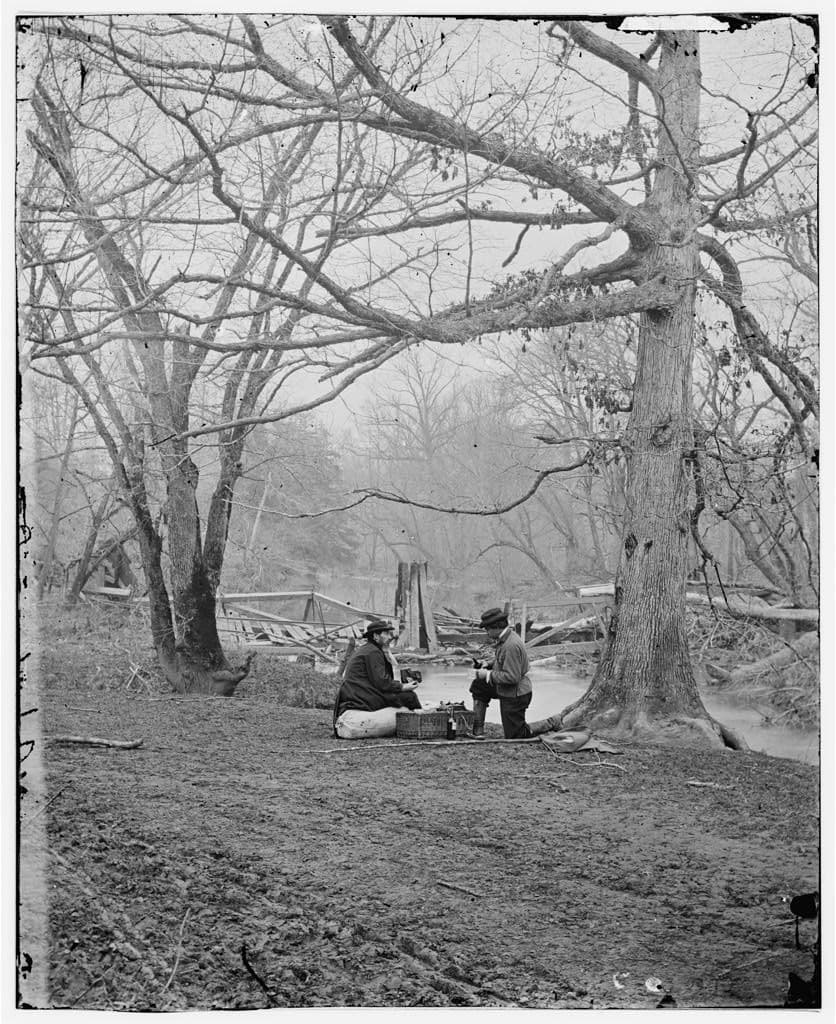
The Second Battle of Bull Run or Battle of Second Manassas was fought August 28–30, 1862, in Prince William County, Virginia, as part of the American Civil War. It was the culmination of the Northern Virginia campaign waged by Confederate Gen. Robert E. Lee's Army of Northern Virginia against Union Maj. Gen. John Pope's Army of Virginia, and a battle of much larger scale and numbers than the First Battle of Bull Run (or First Manassas) fought on July 21, 1861, on the same ground.
Following a wide-ranging flanking march, Confederate Maj. Gen. Thomas J. "Stonewall" Jackson captured the Union supply depot at Manassas Junction, threatening Pope's line of communications with Washington, D.C. Withdrawing a few miles to the northwest, Jackson took up strong concealed defensive positions on Stony Ridge and awaited the arrival of the wing of Lee's army commanded by Maj. Gen. James Longstreet. On August 28, 1862, Jackson attacked a Union column just east of Gainesville, at Brawner's Farm, resulting in a stalemate but successfully getting Pope's attention. On that same day, Longstreet broke through light Union resistance in the Battle of Thoroughfare Gap and approached the battlefield.
Pope became convinced that he had trapped Jackson and concentrated the bulk of his army against him. On August 29, Pope launched a series of assaults against Jackson's position along an unfinished railroad grade. The attacks were repulsed with heavy casualties on both sides. At noon, Longstreet arrived on the field from Thoroughfare Gap and took position on Jackson's right flank. On August 30, Pope renewed his attacks, seemingly unaware that Longstreet was on the field. When massed Confederate artillery devastated a Union assault by Maj. Gen. Fitz John Porter's V Corps, Longstreet's wing of 25,000 men in five divisions counterattacked in the largest simultaneous mass assault of the war. The Union left flank was crushed and the army was driven back to Bull Run. Only an effective Union rear guard action prevented a replay of the First Manassas defeat. Pope's retreat to Centreville was nonetheless precipitous.
Played with your browser's voice. Studio-quality audio can be added with a text-to-speech service.
Ask about this article
📝 Quick Quiz1 / 4
What is "Second Battle of Bull Run" primarily known for?
Vocix Daily — In Your Inbox
Top stories, deep-dive articles, and "On This Day" history — one crisp digest delivered every morning.
Sources & references
Reference material for this entry is drawn from the open encyclopedic record, including Wikipedia , available under the CC BY-SA 4.0 license. Images are credited individually beside each photo.
Success in this battle emboldened Lee to initiate the ensuing Maryland campaign.
Background
Military situation
After the collapse of Maj. Gen. George B. McClellan's Peninsula campaign in the Seven Days Battles of June 1862, President Abraham Lincoln appointed John Pope to command the newly formed Army of Virginia. Pope had achieved some success in the Western Theater, and Lincoln sought a more aggressive general than McClellan.
Plans
Pope's mission was to fulfill two basic objectives: protect Washington and the Shenandoah Valley; and draw Confederate forces away from McClellan by moving in the direction of Gordonsville. Based on his experience fighting McClellan in the Seven Days, Robert E. Lee perceived that McClellan was no further threat to him on the Virginia Peninsula, so he felt no compulsion to keep all of his forces in direct defense of Richmond. This allowed him to relocate Jackson to Gordonsville to block Pope and protect the Virginia Central Railroad.
Lee had larger plans in mind. Since the Union army was split between McClellan and Pope and they were widely separated, Lee saw an opportunity to destroy Pope before returning his attention to McClellan. He committed Maj. Gen. A.P. Hill to join Jackson with 12,000 men.
Initial movements in the Northern Virginia campaign
On August 3, General-in-Chief Henry Halleck directed McClellan to begin his final withdrawal from the Peninsula and to return to Northern Virginia to support Pope. McClellan protested and did not begin his redeployment until August 14.
On August 9, Nathaniel Banks's corps attacked Jackson at Cedar Mountain, gaining an early advantage, but a Confederate counterattack led by A.P. Hill drove Banks back across Cedar Creek. Jackson's advance was stopped, however, by the Union division of Brig. Gen. James B. Ricketts. By now Jackson had learned that Pope's corps were all together, foiling his plan of defeating each in separate actions. He remained in position until August 12, then withdrew to Gordonsville. On August 13, Lee sent Longstreet to reinforce Jackson.
From August 22 to 25, the two armies fought a series of minor actions along the Rappahannock River. Heavy rains had swollen the river and Lee was unable to force a crossing. By this time, reinforcements from the Army of the Potomac were arriving from the Peninsula. Lee's new plan in the face of all these additional forces outnumbering him was to send Jackson and Stuart with half of the army on a flanking march to cut Pope's line of communication, the Orange & Alexandria Railroad. Pope would be forced to retreat and could be defeated while moving and vulnerable. Jackson departed on August 25 and reached Salem (present-day Marshall) that night.
On the evening of August 26, after passing around Pope's right flank via Thoroughfare Gap, Jackson's wing of the army struck the Orange & Alexandria Railroad at Bristoe Station and before daybreak on August 27 marched to capture and destroy the massive Union supply depot at Manassas Junction. This surprise movement forced Pope into an abrupt retreat from his defensive line along the Rappahannock. During the night of August 27–28, Jackson marched his divisions north to the First Bull Run (Manassas) battlefield, where he took position behind an unfinished railroad grade below Stony Ridge. The defensive position was a good one. The heavy woods allowed the Confederates to conceal themselves, while maintaining good observation points of the Warrenton Turnpike, the likely avenue of Union movement, only a few hundred yards to the south. There were good approach roads for Longstreet to join Jackson, or for Jackson to retreat to the Bull Run Mountains if he could not be reinforced in time. Finally, the unfinished railroad grade offered cuts and fills that could be used as ready-made entrenchments.
In the Battle of Thoroughfare Gap on August 28, Longstreet's wing broke through light Union resistance and marched through the gap to join Jackson. This seemingly inconsequential action virtually ensured Pope's defeat during the coming battles because it allowed the two wings of Lee's army to unite on the Manassas battlefield.
The III Corps, Maj. Gen. Irvin McDowell, who had led the losing Union army at First Bull Run, consisted of the divisions of:
Brig Gen. Rufus King (brigades of Brig Gen. John P. Hatch, Brig Gen. Abner Doubleday, Brig Gen. Marsena R. Patrick, and Brig Gen. John Gibbon)
Brig Gen. James B. Ricketts (brigades of Brig Gen. Abram Duryée, Brig Gen. Zealous B. Tower, Col. John W. Stiles, and Col. Joseph Thoburn)
The Kanawha Division (detachment) and parts of three army corps of Gen. McClellan's Army of the Potomac, eventually joined Pope for combat operations, raising his strength to 77,000:
The III Corps, under Maj. Gen. Samuel P. Heintzelman, consisted of the divisions of:
Maj. Gen. Philip Kearny (brigades of Brig Gen. John C. Robinson, Brig Gen. David B. Birney, Col. Orlando Poe)
Maj. Gen. Joseph Hooker (brigades of Col. Cuvier Grover, Col. Nelson Taylor, and Col. Joseph B. Carr)
The V Corps under Maj. Gen. Fitz John Porter, consisted of the divisions of:
Brig Gen. Daniel Butterfield (brigades of Col. Charles W. Roberts and Col. Henry S. Lansing)
Brig Gen. George Sykes (brigades of Brig. Gen. Abram S. Piatt, Lt. Col. Robert C. Buchanan, Lt. Col. William Chapman, Col. Gouverneur K. Warren, and Cpt. Stephen H. Weed)
The VI Corps under Maj. Gen. William B. Franklin
The IX Corps under Maj. Gen. Jesse L. Reno, consisted of the divisions of:
Brig Gen. Isaac I. Stevens (brigades of Col. Benjamin C. Christ, Col. Daniel Leasure and Col. Addison Farnsworth)
Maj. Gen. Jesse L. Reno (brigades of Col. James Nagle and Col. Edward Ferrero)
Confederate
On the Confederate side, Gen. Robert E. Lee's Army of Northern Virginia was organized into two "wings" or "commands" totaling about 55,000 men:
Maj. Gen. James Longstreet's Right Wing or Command consisted of the following divisions:
Maj. Gen. Richard H. Anderson (brigades of Brig Gen. Lewis A. Armistead, Brig Gen. William Mahone, Brig Gen. Ambrose R. Wright, and Col. Stephen D. Lee)
Brig Gen. David R. Jones (brigades of Col. Henry L. Benning, Brig Gen. Thomas F. Drayton, and Col. George T. Anderson)
Brig Gen. Cadmus M. Wilcox (brigades of Brig Gen. Cadmus M. Wilcox, Brig Gen. Roger A. Pryor, and Brig Gen. Winfield S. Featherston)
Brig Gen. John B. Hood (brigades of Brig Gen. John B. Hood, Col. Evander M. Law, Maj. Bushrod W. Frobel
Brig Gen. James L. Kemper (brigades of Col. Montgomery D. Corse, Brig Gen. Micah Jenkins, Col. Eppa Hunton
Reporting Directly (Brig Gen. Nathan G. Evans)
Reserve Artillery of James B. Walton
Maj. Gen. Stonewall Jackson's Left Wing or Command consisted of the following divisions:
Brig Gen. William B. Taliaferro (brigades of Col. William S. Baylor, Col. Bradley T. Johnson, Col. Alexander G. Taliaferro, Brig Gen. William E. Starke and Maj. Lindsey M. Shumaker)
Maj. Gen. A. P. Hill (brigades of Brig Gen. Lawrence O. Branch, Brig Gen. William D. Pender, Col. Edward L. Thomas, Brig Gen. Maxcy Gregg, Brig Gen. James J. Archer, Brig Gen. Charles W. Field and Lt. Col. R. Lindsay Walker)
Maj. Gen. Richard S. Ewell (brigades of Brig Gen. Alexander R. Lawton, Brig Gen. Isaac R. Trimble, Brig Gen. Jubal A. Early and Col. Henry Forno)
The Cavalry Division, under Maj. Gen. J.E.B. Stuart was attached to Jackson's wing.
An exact estimate of both armies' strength at the battle is not possible as different reports and returns provide differing figures. The total strength of the Army of Northern Virginia, cavalry and artillery included, was slightly less than 55,000 men. Factoring in only infantry, the effective Confederate strength was probably about 50,000 men, possibly as low as 47,000. Union strength was around 63,000 men if Banks's corps is excluded as it was not present at the battle aside from a few detachments. The total Union strength with Banks added in was approximately 70,000 men.
Battle
August 28: Brawner's Farm (Groveton)
The Second Battle of Bull Run began on August 28 as a Federal column, under Jackson's observation just outside Gainesville, near the farm of the John Brawner family, moved along the Warrenton Turnpike. It consisted of units from Brig. Gen. Rufus King's division: the brigades of Brig. Gens. John P. Hatch, John Gibbon, Abner Doubleday, and Marsena R. Patrick, marching eastward to concentrate with the rest of Pope's army at Centreville. King was not with his division because he had suffered a serious epileptic attack earlier that day.
Jackson, who had been relieved to hear earlier that Longstreet's men were on their way to join him, displayed himself prominently to the Union troops, by riding up next to the marching Federals in his horse as a farmer, to the horror of his aides, but his presence was disregarded, as the Federals had no interest in a seemingly harmless farmer. Concerned that Pope might be withdrawing his army behind Bull Run to link up with McClellan's arriving forces, Jackson determined to attack. Returning to his position behind the tree line, he told his subordinates, "Bring out your men, gentlemen." At about 6:30 p.m., Confederate artillery began shelling the portion of the column to their front, John Gibbon's Black Hat Brigade (later to be named the Iron Brigade). Gibbon, a former artilleryman, responded with fire from Battery B, 4th U.S. Artillery. The artillery exchange halted King's column. Hatch's brigade had proceeded past the area and Patrick's men, in the rear of the column, sought cover, leaving Gibbon and Doubleday to respond to Jackson's attack. Gibbon assumed that, since Jackson was supposedly at Centreville (according to Pope), and having just seen the 14th Brooklyn of Hatch's Brigade reconnoiter the position, that these were merely horse artillery cannons from Jeb Stuart's cavalry. Gibbon sent aides out to the other brigades with requests for reinforcements, and sent his staff officer Frank A. Haskell to bring the veteran 2nd Wisconsin Infantry up the hill to disperse the harassing cannons. Gibbon met the 2nd in the woods saying, "If we can get you up there quietly, we can capture those guns."