
Robin Hood is a legendary heroic outlaw originally depicted in English folklore and subsequently featured in literature, theatre, and cinema. According to legend, he was a highly skilled archer and swordsman. In some versions of the legend, he is depicted as being of noble birth, and in modern retellings he is sometimes depicted as having fought in the Crusades before returning to England to find his lands taken by the Sheriff of Nottingham. In the oldest known versions, he is instead a member of the yeoman class. He is traditionally depicted dressed in Lincoln green. Today, he is most closely associated with his stance of "robbing the rich to give to the poor".
Through retellings, additions, and variations, a body of familiar characters associated with Robin Hood has been created. These include his lover, Maid Marian; his band of outlaws, the Merry Men; and his chief opponent, the Sheriff of Nottingham. The Sheriff is often depicted as assisting Prince John in usurping the rightful but absent King Richard, to whom Robin Hood remains loyal. He became a popular folk figure in the Late Middle Ages, and his partisanship of the common people and opposition to the Sheriff are some of the earliest-recorded features of the legend, whereas his political interests and setting during the Angevin era developed in later centuries. The earliest known ballads featuring him are from the 15th century.
There have been numerous variations and adaptations of the story over the subsequent years, and the story continues to be widely represented in literature, film, and television media today. Robin Hood is considered one of the best-known tales of English folklore. In popular culture, the term "Robin Hood" is often used to describe a heroic outlaw or rebel against tyranny.

The origins of the legend as well as the historical context have been debated for centuries. There are numerous references to historical figures with similar names that have been proposed as possible evidence of his existence, some dating back to the late 13th century. At least eight plausible origins to the story have been mooted by historians and folklorists, including suggestions that "Robin Hood" was a stock alias used by or in reference to bandits.
Ballads and tales
The first clear reference to "rhymes of Robin Hood" is from the alliterative poem Piers Plowman, thought to have been composed in the 1370s, followed shortly afterwards by a quotation of a later common proverb, "many men speak of Robin Hood and never shot his bow", in Friar Daw's Reply (c. 1402) and a complaint in Dives and Pauper (1405–1410) that people would rather listen to "tales and songs of Robin Hood" than attend Mass. Robin Hood is also mentioned in a Lollard tract dated to the first half of the 15th century (thus also possibly predating his other earliest historical mentions) alongside several other folk heroes such as Guy of Warwick, Bevis of Hampton, and Sir Lybeaus.
However, the earliest surviving copies of the narrative ballads date to the second half of the 15th century or the first decade of the 16th century. In these early accounts, Robin Hood's partisanship of the lower classes, his devotion to the Virgin Mary and associated special regard for women, his outstanding skill as an archer, his anti-clericalism, and his particular animosity towards the Sheriff of Nottingham are already clear. They also feature Little John, Much the Miller's Son, and Will Scarlet (as Will "Scarlok" or "Scathelocke"), although not yet Maid Marian or Friar Tuck. The friar has been part of the legend since at least the later 15th century, when he is mentioned in a Robin Hood play script.

In modern popular culture, Robin Hood is typically seen as a contemporary and supporter of the late-12th-century King Richard the Lionheart, Robin being driven to outlawry during the misrule of Richard's brother John while Richard was away at the Third Crusade. This view first gained currency in the 16th century although it is not supported by the earliest ballads. The early compilation, A Gest of Robyn Hode, names the king as 'Edward'; and while it does show Robin Hood accepting the king's pardon, he later repudiates it and returns to the greenwood. The oldest surviving ballad, Robin Hood and the Monk, gives even less support to the picture of Robin Hood as a partisan of the true king. The setting of the early ballads is usually attributed by scholars to either the 13th or 14th century, although it is recognised they are not necessarily historically consistent.
The early ballads are also quite clear on Robin Hood's social status: he is a yeoman. While the meaning of this term changed over time, including free retainers of an aristocrat and small landholders, it always referred to commoners. The essence of it in the present context was "neither a knight nor a peasant or 'husbonde' but something in between". Artisans (such as millers) were among those regarded as 'yeomen' in the 14th century. From the 16th century on, there were attempts to elevate Robin Hood to the nobility, such as in Richard Grafton's Chronicle at Large; Anthony Munday presented him at the end of the century as the Earl of Huntingdon in two extremely influential plays, as he is still commonly presented in modern times.
The legend was also transmitted by 'Robin Hood games' or plays that were an important part of the late medieval and early modern May Day festivities. The first record of a Robin Hood game was in 1426 in Exeter, but the reference does not indicate how old or widespread this custom was at the time. The Robin Hood games are known to have flourished in the later 15th and 16th centuries. It is commonly stated as fact that Maid Marian and a jolly friar (at least partly identifiable with Friar Tuck) entered the legend through the May Games.

Early ballads
The earliest surviving text of a Robin Hood ballad is the 15th-century "Robin Hood and the Monk". This is preserved in Cambridge University manuscript Ff.5.48. Written after 1450, it contains many of the elements still associated with the legend, from the Nottingham setting to the bitter enmity between Robin and the local sheriff.
The first printed version is A Gest of Robyn Hode (c. 1500), a collection of separate stories that attempts to unite the episodes into a single continuous narrative. After this comes "Robin Hood and the Potter", contained in a manuscript of c. 1503. "The Potter" is markedly different in tone from "The Monk": whereas the earlier tale is "a thriller", the latter is more comic, its plot involving trickery and cunning rather than straightforward force. Other early texts are dramatic pieces, the earliest being the fragmentary Robyn Hod and the Shryff off Notyngham (c. 1475). These are particularly noteworthy as they show Robin's integration into May Day rituals towards the end of the Middle Ages; Robyn Hod and the Shryff off Notyngham, among other points of interest, contains the earliest reference to Friar Tuck. The plots of neither "the Monk" nor "the Potter" are included in the Gest; and neither is the plot of "Robin Hood and Guy of Gisborne", which is probably at least as old as those two ballads although preserved in a more recent copy. Each of these three ballads survived in a single copy, so it is unclear how much of the medieval legend has survived, and what has survived may not be typical of the medieval legend. It has been argued that the fact that the surviving ballads were preserved in written form in itself makes it unlikely they were typical; in particular, stories with an interest for the gentry were by this view more likely to be preserved. The story of Robin's aid to the 'poor knight' that takes up much of the Gest may be an example.
The character of Robin in these first texts is rougher edged than in his later incarnations. In "Robin Hood and the Monk", for example, he is shown as quick-tempered and violent, assaulting Little John for defeating him in an archery contest; in the same ballad, Much the Miller's Son casually kills a "little page" in the course of rescuing Robin Hood from prison. No extant early ballad actually shows Robin Hood "giving to the poor", although in "A Gest of Robyn Hode" Robin does make a large loan to an unfortunate knight, which he does not in the end require to be repaid; and later in the same ballad Robin Hood states his intention of giving money to the next traveller to come down the road if he happens to be poor.
As it happens, the next traveller is not poor, but it seems in context that Robin Hood is stating a general policy. The first explicit statement to the effect that Robin Hood habitually robbed from the rich to give the poor can be found in John Stow's Annales of England (1592), about a century after the publication of Gest. But from the beginning Robin Hood is on the side of the poor; Gest quotes Robin Hood as instructing his men that when they rob:
And in its final lines Gest sums up:
Within Robin Hood's band, medieval forms of courtesy rather than modern ideals of equality are generally in evidence. In the early ballad, Robin's men usually kneel before him in obedience: in Gest, the king even observes that "His men are more at his byddynge/Then my men be at myn." Their social status, as yeomen, is shown by their weapons: they use swords rather than quarterstaffs. The only character to use a quarterstaff in the early ballads is the Potter, and Robin Hood does not take to a staff until the 17th-century Robin Hood and Little John.

The political and social assumptions underlying the early Robin Hood ballads have long been controversial. J. C. Holt influentially argued that the Robin Hood legend was cultivated in the households of the gentry, and that it would be mistaken to see in him a figure of peasant revolt. He is not a peasant but a yeoman, and his tales make no mention of the complaints of the peasants, such as oppressive taxes. He appears not so much as a revolt against societal standards as an embodiment of them, being generous, pious, and courteous, opposed to stingy, worldly, and churlish foes. Other scholars have, by contrast, stressed the subversive aspects of the legend, and see in the medieval Robin Hood ballads a plebeian literature, hostile to the feudal order.
Early plays, May Day games, and fairs
By the early 15th century at the latest, Robin Hood had become associated with May Day celebrations, with revellers dressing as Robin or as members of his band for the festivities. This was not common throughout England, but in some regions the custom lasted until Elizabethan times, and, during the reign of Henry VIII, was briefly popular at court. Henry disguised himself as Robin in January 1510, with eleven courtiers and a Maid Marian to surprise Catherine of Aragon in her chamber.
Robin was often allocated the role of a May King, presiding over games and processions, but plays were also performed with the characters in the roles, sometimes performed at church ales, a means by which churches raised funds. A complaint of 1492, brought to the Star Chamber, accuses men of acting riotously by coming to a fair as Robin Hood and his men; the accused defended themselves on the grounds that the practice was a long-standing custom to raise money for churches, and they had not acted riotously but peaceably.

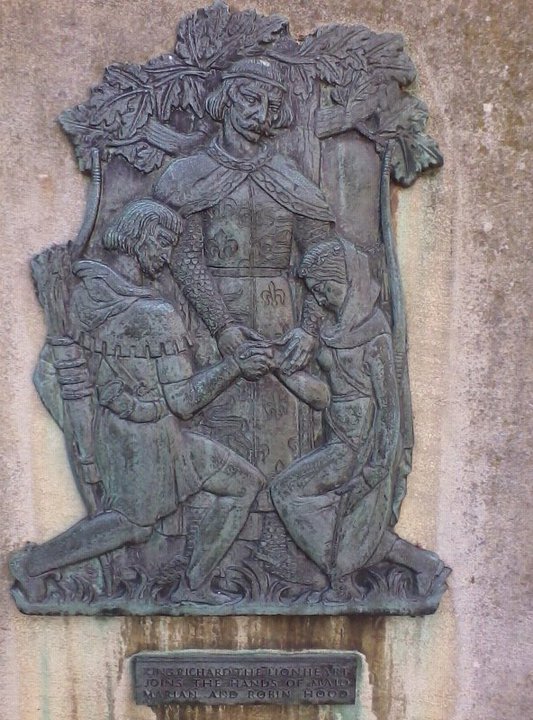
It is from the association with the May Games that Robin's romantic attachment to Maid Marian (or Marion) apparently stems. A "Robin and Marion" figured in 13th-century French 'pastourelles' (of which Jeu de Robin et Marion c. 1280 is a literary version) and preside over the French May festivities; "This Robin and Marion tended to preside, in the intervals of the attempted seduction of the latter by a series of knights, over a variety of rustic pastimes." In the Jeu de Robin and Marion, Robin and his companions have to rescue Marion from the clutches of a "lustful knight". This play is distinct from the English legends, although Dobson and Taylor regard it as 'highly probable' that this French Robin's name and functions travelled to the English May Games, where they fused with the Robin Hood legend. Both Robin and Marian were certainly associated with May Day festivities in England (as was Friar Tuck), but these may have been originally two distinct types of performance. Alexander Barclay in his Ship of Fools, writing in c. 1500, refers to 'some merry fytte of Maid Marian or else of Robin Hood' – but the characters were brought together. Marian did not immediately gain the unquestioned role; in Robin Hood's Birth, Breeding, Valor, and Marriage, his sweetheart is "Clorinda the Queen of the Shepherdesses". Clorinda survives in some later stories as an alias of Marian.
Robyn Hod and the Shryff off Notyngham appears to tell the story of Robin Hood and Guy of Gisborne. There is also an early playtext appended to a 1560 printed edition of Gest. This includes a dramatic version of the story of Robin Hood and the Curtal Friar and a version of the first part of the story of Robin Hood and the Potter. (Neither of these ballads is known to have existed in print at the time, and there is no earlier record known of the "Curtal Friar" story.) The publisher describes the text as a 'playe of Robyn Hood, verye proper to be played in Maye games', but does not seem to be aware that the text actually contains two separate plays. An especial point of interest in the "Friar" play is the appearance of a ribald woman who is unnamed but apparently to be identified with the bawdy Maid Marian of the May Games. She does not appear in extant versions of the ballad.
Early modern stage
In May 1585, James VI of Scotland was entertained by a Robin Hood play at Dirleton Castle, produced by his favourite, the Earl of Arran, while there was plague in Edinburgh. In 1598, Anthony Munday wrote a pair of plays on the Robin Hood legend, The Downfall and The Death of Robert Earl of Huntington (published 1601). These plays drew on a variety of sources, including apparently Gest, and were influential in fixing the story of Robin Hood to the period of Richard I. Stephen Thomas Knight has suggested that Munday drew heavily on Fulk Fitz Warin, a historical 12th century outlawed nobleman and enemy of King John, in creating his Robin Hood. The play identifies Robin Hood as Robert, Earl of Huntingdon, following in Richard Grafton's association of Robin Hood with the gentry, and identifies Maid Marian with "one of the semi-mythical Matildas persecuted by King John". The plays are complex in plot and form, the story of Robin Hood appearing as a play-within-a-play presented at the court of Henry VIII and written by the poet, priest and courtier John Skelton, with Skelton playing Friar Tuck. Some scholars have conjectured that Skelton may have indeed written a lost Robin Hood play for Henry VIII's court, and that this play may have been one of Munday's sources. Henry VIII with eleven of his nobles had impersonated "Robyn Hodes men" as part of his "Maying" in 1510. Robin Hood is known to have appeared in a number of other lost and extant Elizabethan plays. In 1599, the play George a Green, the Pinner of Wakefield places Robin Hood in the reign of Edward IV. Edward I, a play by George Peele first performed in 1590–91, incorporates a Robin Hood game played by the characters. Llywelyn the Great, the independent Prince of Wales, is presented playing Robin Hood.
Fixing the Robin Hood story to the 1190s had been first proposed by John Major in his Historia Majoris Britanniæ (1521), (and he also may have been influenced in so doing by the story of FitzWarin); this was the period in which King Richard was absent from the country, fighting in the Third Crusade.
William Shakespeare makes reference to Robin Hood in his late-16th-century play The Two Gentlemen of Verona. In it, the character Valentine is banished from Milan and driven out through the forest where he is approached by outlaws who, upon meeting him, desire him as their leader. They comment, "By the bare scalp of Robin Hood's fat friar, This fellow were a king for our wild faction!" Robin Hood is also mentioned in As You Like It. When asked about the exiled Duke Senior, the character of Charles says that he is "already in the forest of Arden, and a many merry men with him; and there they live like the old Robin Hood of England". Justice Silence sings a line from an unnamed Robin Hood ballad, the line is "Robin Hood, Scarlet, and John" in Act 5 scene 3 of Henry IV, part 2. In Henry IV part 1 Act 3 scene 3, Falstaff refers to Maid Marian, implying she is a by-word for unwomanly or unchaste behaviour.
Ben Jonson produced the incomplete masque The Sad Shepherd, or a Tale of Robin Hood in part as a satire on Puritanism. It is about half finished, and his death in 1637 may have interrupted writing. Jonson's only pastoral drama, it was written in sophisticated verse and included supernatural action and characters. It has had little impact on the Robin Hood tradition but earns mention as the work of a major dramatist.
The 1642 London theatre closure by the Puritans interrupted the portrayal of Robin Hood on the stage. The theatres would reopen with the Restoration in 1660. Robin Hood did not appear on the Restoration stage, except for "Robin Hood and his Crew of Souldiers" acted in Nottingham on the day of the coronation of Charles II in 1661. This short play adapts the story of the king's pardon of Robin Hood to refer to the Restoration. However, Robin Hood appeared on the 18th-century stage in various farces and comic operas. Alfred, Lord Tennyson would write a four-act Robin Hood play at the end of the 19th century, "The Forrestors". It is fundamentally based on Gest but follows the traditions of placing Robin Hood as the Earl of Huntingdon in the time of Richard I and making the Sheriff of Nottingham and Prince John rivals with Robin Hood for Maid Marian's hand. The return of King Richard brings a happy ending.
Broadside ballads and garlands
With the advent of printing came the Robin Hood broadside ballads. When they displaced the oral tradition of Robin Hood ballads is unknown but the process seems to have been completed by the end of the 16th century. Near the end of the 16th century an unpublished prose life of Robin Hood was written and included in the Sloane Manuscript. Largely a paraphrase of Gest, it also contains material revealing that the author was familiar with early versions of a number of the Robin Hood broadside ballads. Not all of the medieval legend was preserved in the broadside ballads; there is no broadside version of "Robin Hood and Guy of Gisborne" or of Robin Hood and the Monk, which did not appear in print until the 18th and 19th centuries respectively. However, Gest was reprinted from time to time throughout the 16th and 17th centuries.
No surviving broadside ballad can be dated with certainty before the 17th century, but during that century, the commercial broadside ballad became the main vehicle for the popular Robin Hood legend. These broadside ballads were in some cases newly fabricated but were mostly adaptations of the older verse narratives. The broadside ballads were fitted to a small repertoire of pre-existing tunes resulting in an increase of "stock formulaic phrases" making them "repetitive and verbose", they commonly feature Robin Hood's contests with artisans: tinkers, tanners, and butchers. Among these ballads is "Robin Hood and Little John," telling the famous story of the quarterstaff fight between the two outlaws.
Dobson and Taylor wrote, 'More generally the Robin of the broadsides is a much less tragic, less heroic and in the last resort less mature figure than his medieval predecessor'. In most of the broadside ballads Robin Hood remains a plebeian figure, a notable exception being Martin Parker's attempt at an overall life of Robin Hood, "A True Tale of Robin Hood," which also emphasises the theme of Robin Hood's generosity to the poor more than the broadsheet ballads do in general. The 17th century introduced the minstrel Alan-a-Dale. He first appeared in a 17th-century broadside ballad and, unlike many of the characters thus associated, managed to adhere to the legend. The prose life of Robin Hood in Sloane Manuscript contains the substance of the Alan-a-Dale ballad but tells the story about Will Scarlet.
In the 18th century, the stories began to develop a slightly more farcical vein. From this period there are a number of ballads in which Robin is severely 'drubbed' by a succession of tradesmen including a tanner, a tinker, and a ranger. In fact, the only character who does not get the better of Robin Hood is the luckless Sheriff. Yet even in these ballads Robin is more than a mere simpleton: on the contrary, he often acts with great shrewdness. The tinker, setting out to capture Robin, only manages to fight with him after he has been cheated out of his money and the arrest warrant he is carrying. In Robin Hood's Golden Prize, Robin disguises himself as a friar and cheats two priests out of their cash. Even when Robin is defeated, he usually tricks his foe into letting him sound his horn, summoning the Merry Men to his aid. When his enemies do not fall for this ruse, he persuades them to drink with him instead (see Robin Hood's Delight).
In the 18th and 19th centuries, the Robin Hood ballads were mostly sold in "Garlands" of 16 to 24 Robin Hood ballads; these were crudely printed chap books aimed at the poor. The garlands added nothing to the substance of the legend but ensured that it continued after the decline of the single broadside ballad. In the 18th century also, Robin Hood frequently appeared in criminal biographies and histories of highwaymen compendia.
Rediscovery: Percy and Ritson
In 1765, Thomas Percy (bishop of Dromore) published Reliques of Ancient English Poetry, including ballads from the 17th-century Percy Folio manuscript which had not previously been printed, most notably Robin Hood and Guy of Gisborne which is generally regarded as in substance a genuine late medieval ballad.
In 1795, Joseph Ritson published an enormously influential edition of the Robin Hood ballads Robin Hood: A collection of all the Ancient Poems Songs and Ballads now extant, relative to that celebrated Outlaw. 'By providing English poets and novelists with a convenient source book, Ritson gave them the opportunity to recreate Robin Hood in their own imagination,' Ritson's collection includes Gest and put the Robin Hood and the Potter ballad in print for the first time. The only significant omission was Robin Hood and the Monk which would eventually be printed in 1806. In all, Ritson printed 33 Robin Hood ballads (and a 34th, now commonly known as Robin Hood and the Prince of Aragon that he included as the second part of Robin Hood Newly Revived which he had retitled "Robin Hood and the Stranger"). Ritson's interpretation of Robin Hood was also influential, having influenced the modern concept of stealing from the rich and giving to the poor as it exists today. Himself a supporter of the principles of the French Revolution and admirer of Thomas Paine, Ritson held that Robin Hood was a genuinely historical and heroic character who had stood up against tyranny in the interests of the common people. J. C. Holt has been quick to point out, however, that Ritson "began as a Jacobite and ended as a Jacobin," and "certainly reconstructed him [Robin] in the image of a radical."
In his preface to the collection, Ritson assembled an account of Robin Hood's life from the various sources available to him and concludes that Robin Hood was born in around 1160, and thus had been active in the reign of Richard I. He thought that Robin was of aristocratic extraction, with at least 'some pretension' to the title of Earl of Huntingdon, that he was born in an unlocated Nottinghamshire village of Locksley and that his original name was Robert Fitzooth. Ritson gives the date of Robin Hood's death as 18 November 1247, when he would have been around 87 years old. In copious and informative notes Ritson defends every point of his version of Robin Hood's life. In reaching his conclusion Ritson relies or gives weight to a number of unreliable sources, such as the Robin Hood plays of Anthony Munday and the Sloane Manuscript. Nevertheless, Dobson and Taylor credit Ritson with having 'an incalculable effect in promoting the still continuing quest for the man behind the myth', and note that his work remains an 'indispensable handbook to the outlaw legend even now'. Ritson's friend Walter Scott used Ritson's anthology collection as a source for his picture of Robin Hood in Ivanhoe, written in 1818, which did much to shape the modern legend.
Child ballads
In the decades following the publication of Ritson's book, other ballad collections would occasionally publish stray Robin Hood ballads Ritson had missed. In 1806, Robert Jamieson published the earliest known Robin Hood ballad, Robin Hood and the Monk in Volume II of his Popular Ballads and Songs From Tradition. In 1846, the Percy Society included The Bold Pedlar and Robin Hood in its collection, Ancient Poems, Ballads, and Songs of the Peasantry of England. In 1850, John Mathew Gutch published his own collection of Robin Hood ballads, Robin Hood Garlands and Ballads, with the tale of the lytell Geste, that in addition to all of Ritson's collection, also included Robin Hood and the Pedlars and Robin Hood and the Scotchman.
In 1858, Francis James Child published his English and Scottish Ballads which includes a volume grouping all the Robin Hood ballads in one volume, including all the ballads published by Ritson, the four stray ballads published since then, as well as some ballads that either mentioned Robin Hood by name or featured characters named Robin Hood but were not traditional Robin Hood stories. For his more scholarly work, The English and Scottish Popular Ballads, in his volume dedicated to the Robin Hood ballads, published in 1888, Child removed the ballads from his earlier work that were not traditional Robin Hood stories, gave the ballad Ritson titled Robin Hood and the Stranger back its original published title Robin Hood Newly Revived, and separated what Ritson had printed as the second part of Robin Hood and the Stranger as its own separate ballad, Robin Hood and the Prince of Aragon. He also included alternate versions of ballads that had distinct, alternate versions. He numbered these 38 Robin Hood ballads among the 305 ballads in his collection as Child Ballads Nos. 117–154, which is how they are often referenced in scholarly works.
19th century
In the 19th century, the Robin Hood legend was first specifically adapted for children. Children's editions of the garlands were produced, and in 1820 a children's edition of Ritson's Robin Hood collection was published. Children's novels began to appear shortly thereafter. It is not that children did not read Robin Hood stories before, but this is the first appearance of a Robin Hood literature specifically aimed at them. A very influential example of these children's novels was Pierce Egan the Younger's Robin Hood and Little John (1840). This was adapted into French by Alexandre Dumas in Le Prince des Voleurs (1872) and Robin Hood Le Proscrit (1873). Egan made Robin Hood of noble birth but raised by the forestor Gilbert Hood.
Another very popular version for children was Howard Pyle's The Merry Adventures of Robin Hood, which influenced accounts of Robin Hood through the 20th century. Pyle's version firmly stamps Robin as a staunch philanthropist, a man who takes from the rich to give to the poor. Nevertheless, the adventures are still more local than national in scope: while King Richard's participation in the Crusades is mentioned in passing, Robin takes no stand against Prince John and plays no part in raising the ransom to free Richard. These developments are part of the 20th-century Robin Hood myth. Pyle's Robin Hood is a yeoman and not an aristocrat.
The idea of Robin Hood as a high-minded Saxon fighting Norman lords also originates in the 19th century. The most notable contributions to this idea of Robin are Jacques Nicolas Augustin Thierry's Histoire de la Conquête de l'Angleterre par les Normands (1825) and Sir Walter Scott's Ivanhoe (1819). In this last work in particular, the modern Robin Hood—'King of Outlaws and prince of good fellows!' as Richard the Lionheart calls him—makes his debut.
Forresters Manuscript
In 1993, a previously unknown manuscript of 21 Robin Hood ballads (including two versions of "The Jolly Pinder of Wakefield") turned up in an auction house and eventually wound up in the British Library. Called The Forresters Manuscript, after the first and last ballads which are both titled Robin Hood and the Forresters, it was published in 1998 as Robin Hood: The Forresters Manuscript. It appears to have been written in the 1670s. While all the ballads in the manuscript had already been known and published during the 17th and 18th centuries (although most of the ballads in the manuscript have different titles than ones they have listed under the Child Ballads), 13 of the ballads in Forresters are noticeably different from how they appear in the broadsides and garlands. Nine of these ballads are significantly longer and more elaborate than the versions of the same ballads found in the broadsides and garlands. For four of these ballads, the Forresters Manuscript versions are the earliest known versions.
20th century onwards
The 20th century grafted still further details on to the original legends. The 1938 film The Adventures of Robin Hood, starring Errol Flynn and Olivia de Havilland, portrays Robin as a hero on a national scale, leading the oppressed Saxons in revolt against their Norman overlords while Richard the Lionheart fought in the Crusades; this film established itself so definitively that many studios resorted to films about his son (invented for that purpose) rather than compete with the image of this one.
In 1953 a Republican member of the Indiana Textbook Commission called for a ban of Robin Hood from all Indiana school books for its alleged communist connotations. This proposal prompted a short-lived college protest against McCarthyism and book censorship in the United States that was launched on the Indiana University Bloomington campus and within a course of weeks had grown into a nationwide campus movement, known as the Green Feather Movement.
In the 1973 animated Disney film Robin Hood, the title character is portrayed as an anthropomorphic fox voiced by Brian Bedford. Years before Robin Hood had even entered production, Disney had considered doing a project on Reynard the Fox; however, due to concerns that Reynard was unsuitable as a hero, animator Ken Anderson adapted some elements from Reynard into the Disney character Robin Hood, making him a fox.
The 1976 British-American film Robin and Marian, starring Sean Connery as Robin Hood and Audrey Hepburn as Maid Marian, portrays the figures in later years after Robin has returned from service with Richard the Lionheart in a foreign crusade and Marian has gone into seclusion in a nunnery. This is the first in popular culture to portray King Richard as less than perfect.
Since the 1980s, it has become commonplace to include a Saracen (Arab/Muslim) among the Merry Men, a trend that began with the character Nasir in the 1984 ITV Robin of Sherwood television series. Later versions of the story have followed suit: a version of Nasir appears in the 1991 movie Robin Hood: Prince of Thieves (Azeem) and the 2006 BBC TV series Robin Hood (Djaq). Spoofs have also followed this trend, with the 1990s BBC sitcom Maid Marian and her Merry Men parodying the Moorish character with Barrington, a Rastafarian rapper played by Danny John-Jules, and the Mel Brooks comedy Robin Hood: Men in Tights featuring Isaac Hayes as Asneeze and Dave Chappelle as his son Ahchoo. The 2018 adaptation Robin Hood portrays the character of Little John as a Muslim named Yahya, played by Jamie Foxx.
Between 1963 and 1966, French television broadcast a medievalist series entitled Thierry La Fronde (Thierry the Sling). This successful series, which was also shown in Canada, Poland (Thierry Śmiałek), Australia (The King's Outlaw), and the Netherlands (Thierry de Slingeraar), transposes the English Robin Hood narrative into late medieval France during the Hundred Years' War. The original ballads and plays, including the early medieval poems and the latter broadside ballads and garlands, have been edited and translated for the first time in French in 2017 by Jonathan Fruoco. Until then, the texts had been unavailable in France.
Historicity
The historicity of Robin Hood has been debated for centuries. A difficulty with any such historical research is that Robert was a very common given name in medieval England, and 'Robin' (or Robyn) was its very common diminutive, especially in the 13th century; it is a French hypocorism, already mentioned in the Roman de Renart in the 12th century. The surname Hood (by any spelling) was also fairly common because it referred either to a hooder, who was a maker of hoods, or alternatively to somebody who wore a hood as a head covering. It is therefore unsurprising that medieval records mention a number of people called "Robert Hood" or "Robin Hood", some of whom are known criminals.
Another view on the origin of the name is expressed in the 1911 Encyclopædia Britannica which remarks that "hood" was a common dialectical form of "wood" (compare Dutch hout, hʌut, also meaning "wood"), and that the outlaw's name has been given as "Robin Wood". There are a number of references to Robin Hood as Robin Wood, or Whood, or Whod, from the 16th and 17th centuries. The earliest recorded example, in connection with May games in Somerset, dates from 1518.
Early references
The oldest references to Robin Hood are not historical records or even ballads recounting his exploits, but hints and allusions found in various works. From 1261 onward, the names "Robinhood", "Robehod", or "Robbehod" occur in the rolls of several English justices as nicknames or descriptions of malefactors. The majority of these references date from the late 13th century. Between 1261 and 1300, there are at least eight references to "Rabunhod" in various regions across England, from Berkshire in the south to York in the north.