
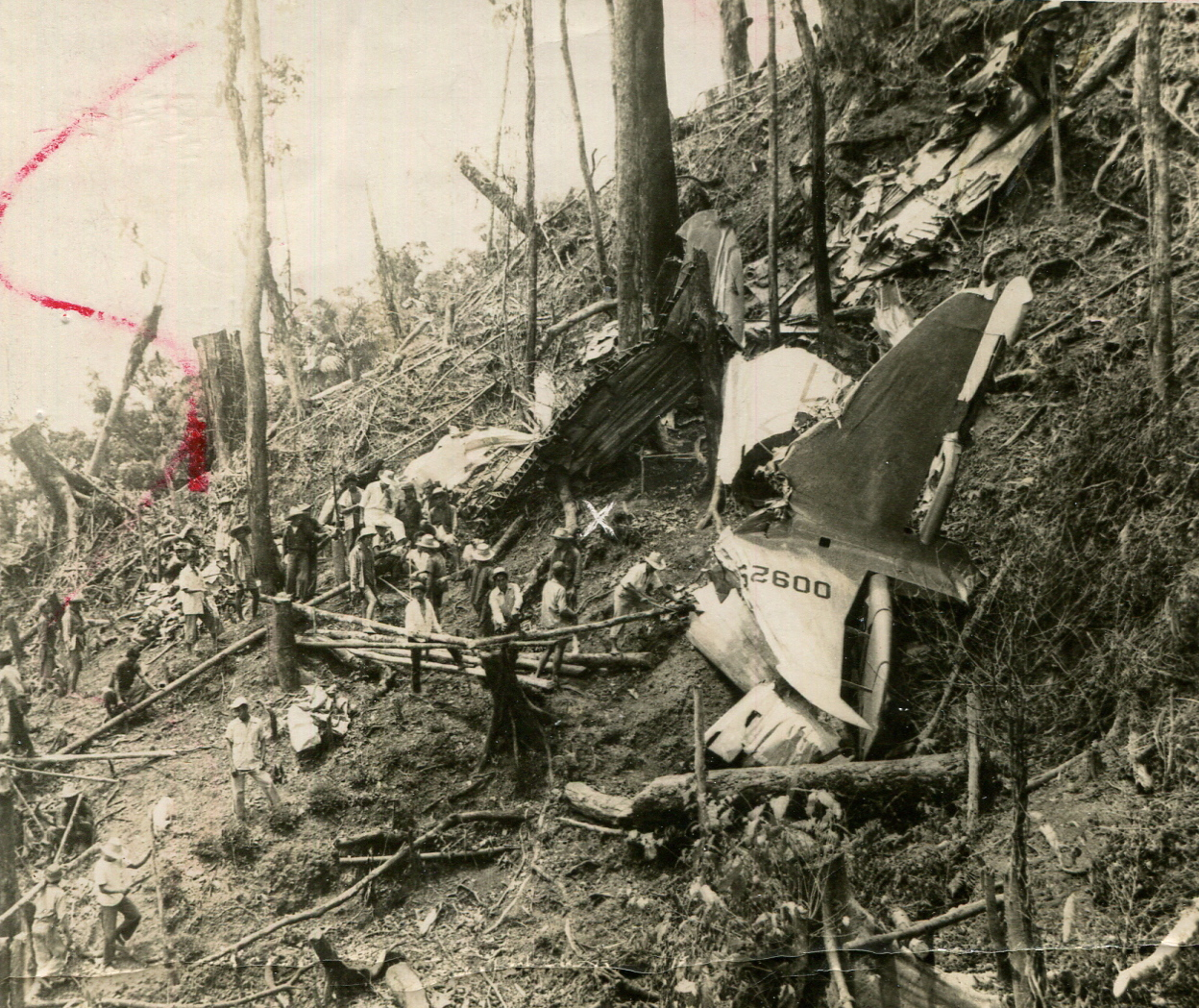
Ramon del Fierro Magsaysay Sr. (August 31, 1907 – March 17, 1957) was a Filipino politician and military officer who was the seventh president of the Philippines, serving from 1953 until his death in 1957. An automobile mechanic by profession, Magsaysay was appointed military governor of Zambales after serving as a guerrilla leader during the Pacific War. He then served two terms as Liberal Party congressman for Zambales's at-large district before being appointed Secretary of National Defense by President Elpidio Quirino. He was eventually elected as president under the banner of the Nacionalista Party, the youngest to be elected to the position, and second youngest overall (after Emilio Aguinaldo). He was the first Philippine president born in the 20th century and the first to be born after the Spanish colonial era. Magsaysay died in a plane crash on March 17, 1957, in Cebu. His successor, Carlos P. Garcia, assumed the presidency. He is the most recent Philippine president to have died in office.
Biography
Early life and education
Ramon del Fierro Magsaysay, of mixed Tagalog, Visayan, Spanish, and Chinese descent, was born in Iba on August 31, 1907, to Exequiel Magsaysay y de los Santos (April 18, 1874, in San Marcelino, Zambales – January 24, 1969, in Manila), a blacksmith, and Perfecta del Fierro y Quimson (April 18, 1886, in Castillejos, Zambales – May 5, 1981, in Manila), a Chinese mestizo schoolteacher, nurse.
He spent his grade school life somewhere in Castillejos and his high school life at Zambales Academy in San Narciso, Zambales. After college, Magsaysay entered the University of the Philippines in 1927, where he enrolled in a Mechanical Engineering course. He first worked as a chauffeur to support himself as he studied engineering; and later, he transferred to the Institute of Commerce at José Rizal College (now José Rizal University) from 1928 to 1932, where he received a baccalaureate in commerce. He then worked as an automobile mechanic for a bus company and shop superintendent.

Career during World War II
At the outbreak of World War II, he joined the motor pool of the 31st Infantry Division of the Philippine Army. When Bataan surrendered in 1942, Magsaysay escaped to the hills, narrowly evading Japanese arrest on at least four occasions. There he organised the Western Luzon Guerrilla Forces, and was commissioned captain on April 5, 1942. For three years, Magsaysay operated under Col. Richard Nixon's famed guerrilla outfit and saw action at Sawang, San Marcelino, Zambales, first as a supply officer codenamed Chow and later as commander of a 10,000-strong force.
Magsaysay was among those instrumental in clearing the Zambales coast of the Japanese prior to the landing of American forces together with Philippine Commonwealth troops on January 29, 1945.
Family
He was married to Luz Rosauro Banzon on June 16, 1933, and they had three children: Teresita (1934–1979), Milagros (b. 1936) and Ramon Jr. (b. 1938).
Several of Magsaysay's relatives became prominent public figures in their own right:
Ramon "Jun" Banzon Magsaysay Jr., son; former Congressman and Senator
Francisco "Paco" Delgado Magsaysay, entrepreneur

Genaro Magsaysay, brother; former Senator
Vicente Magsaysay, nephew; Former Governor of Zambales
JB Magsaysay, grandnephew; actor, politician, and businessman

Antonio Magsaysay Diaz, nephew; former Congressman and Assemblyman of Zambales
Anita Magsaysay-Ho, cousin; painter
House of Representatives (1945–1950)
On April 22, 1946, Magsaysay, encouraged by his fellow ex-guerrillas, was elected under the Liberal Party to the Philippine House of Representatives. In 1948, President Manuel Roxas chose Magsaysay to go to Washington, D.C. as Chairman of the Committee on Guerrilla Affairs, to help secure the passage of the Rogers Veterans Bill, giving benefits to Philippine veterans. In the so-called "dirty election" of 1949, he was re-elected to a second term in the House of Representatives. During both terms, he was Chairman of the House National Defense Committee.

Secretary of National Defense (1950–1953)
In early August 1950, he offered President Elpidio Quirino a plan to fight the communist guerrillas, using his own experiences in guerrilla warfare during World War II. After some hesitation, Quirino realized that there was no alternative and appointed Magsaysay Secretary of National Defense in September 1950. He intensified the campaign against the Hukbalahap guerrillas. This success was due in part to the unconventional methods he took up from a former advertising expert and CIA agent, Colonel Edward Lansdale. In the counterinsurgency the two utilized deployed soldiers distributing relief goods and other forms of aid to outlying, provincial communities. Prior to Magsaysay's appointment as Defense Secretary, rural citizens perceived the Philippine Army with apathy and distrust. However, Magsaysay's term enhanced the Army's image, earning them respect and admiration.
In June 1952, Magsaysay made a goodwill tour to the United States and Mexico. He visited New York, Washington, D.C. (with a medical check-up at Walter Reed Hospital) and Mexico City, where he spoke at the Annual Convention of Lions International.
By 1953, President Quirino thought the threat of the Huks was under control and Secretary Magsaysay was becoming too weak. Magsaysay met with interference and obstruction from the President and his advisers, in fears they might be unseated at the next presidential election. Although Magsaysay had at that time no intention to run, he was urged from many sides and finally was convinced that the only way to continue his fight against communism, and for a government for the people, was to be elected president, ousting the corrupt administration that, in his opinion, had caused the rise of the communist guerrillas by bad administration. He resigned his post as defense secretary on February 28, 1953, and became the presidential candidate of the Nacionalista Party, disputing the nomination with Senator Camilo Osías at the Nacionalista national convention.

1951 Padilla incident
When news reached Magsaysay that his political ally Moises Padilla was being tortured by men of provincial governor Rafael Lacson, he rushed to Negros Occidental, but was too late. He was then informed that Padilla's body was drenched in blood, pierced by fourteen bullets, and was positioned on a police bench in the town plaza. Magsaysay himself carried Padilla's corpse with his bare hands and delivered it to the morgue, and the next day, news clips showed pictures of him doing so. Magsaysay even used this event during his presidential campaign in 1953.
The trial against Lacson started in January 1952; Magsaysay and his men presented enough evidence to convict Lacson and his 26 men for murder. In August 1954, Judge Eduardo Enríquez ruled the men were guilty and Lacson, his 25 men and three other mayors of Negros Occidental municipalities were condemned to the electric chair.
Manila Railroad leadership
Magsaysay was also the general manager of the Manila Railroad Company between October and December 1951. His tenure later motivated him to modernize the rail operator's fleet after stepping into presidency. He also set the first steps in building what has been the discontinued Cagayan Valley Railroad Extension project.
1953 presidential campaign
Presidential elections were held on November 10, 1953, in the Philippines. Incumbent President Elpidio Quirino lost his opportunity for a second full term as President of the Philippines to former Defense Secretary Magsaysay. His running mate, Senator José Yulo lost to Senator Carlos P. García. Vice President Fernando López did not run for re-election. This was the first time that an elected Philippine President did not come from the Senate. Moreover, Magsaysay began the practice in the Philippines of "campaign jingles" during elections, for one of his inclinations and hobbies was dancing. The jingles that were used during the election period was "Mambo Magsaysay"", "We Want Magsaysay", and "The Magsaysay Mambo"
The United States government, including the Central Intelligence Agency, had strong influence on the 1953 election, and candidates in the election fiercely competed with each other for U.S. support.
Presidency (1953–1957)
In the election of 1953, Magsaysay was decisively elected president over the incumbent Elpidio Quirino. He was sworn into office on Wednesday, December 30, 1953, at the Independence Grandstand in Manila. He was wearing the barong tagalog, a first by a Philippine President and a tradition that still continues up to this day. He was then called "Mambo Magsaysay". Also dressed in barong tagalog was the elected vice-president Carlos P. Garcia. The oath of office was administered by Chief Justice of the Supreme Court of the Philippines Ricardo Paras. For the first time, a Philippine president swore on the Bible on an inauguration. He swore on two Bibles, from each parents' side.
As President, he was a close friend and supporter of the United States and a vocal spokesman against communism during the Cold War. He led the foundation of the Southeast Asia Treaty Organization, also known as the Manila Pact of 1954, that aimed to defeat communist-Marxist movements in Southeast Asia, South Asia, and the Southwestern Pacific.
During his term, he made Malacañang literally a "house of the people," opening its gates to the public. One example of his integrity followed a demonstration flight aboard a new plane belonging to the Philippine Air Force (PAF): President Magsaysay asked what the operating costs per hour were for that type of aircraft, then wrote a personal check to the PAF, covering the cost of his flight. He restored the people's trust in the military and in the government.
Administration and cabinet
Domestic policies
Presidential Inauguration Day
Ushering a new era in Philippine government, President Magsaysay placed emphasis upon service to the people by bringing the government closer to the former.
This was symbolically seen when, on inauguration day, President Magsaysay ordered the gates of Malacañang Palace be opened to the general public, who were allowed to freely visit all parts of the palace complex. Later, this was regulated to allow weekly visitation.
He created the Presidential Complaints and Action Committee. This body immediately proceeded to hear grievances and recommend remedial action. Headed by Manuel Manahan, this committee would come to hear nearly 60,000 complaints in a year, of which more than 30,000 would be settled by direct action and a little more than 25,000 would be referred to government agencies for appropriate follow-up. This new entity proved to be a success, increasing approval rates.
Agrarian reform
To amplify and stabilize the functions of the Economic Development Corps (EDCOR), President Magsaysay worked for the establishment of the National Resettlement and Rehabilitation Administration (NARRA). This body took over from the EDCOR and helped in giving sixty-five thousand acres to 3000 indigent families for settlement purposes. It allocated some 1,500 to 25,000 landless families, who subsequently became farmers.
As further aid to the rural people, the president established the Agricultural Credit and Cooperative Financing Administration (ACCFA). The idea was for this entity to make available rural credits. Records show that it granted almost ten million dollars. This administrative body then devoted its attention to cooperative marketing.
Along this line of help to the rural areas, President Magsaysay initiated the artesian wells campaign. A group-movement known as the Liberty Wells Association was formed and in record time managed to raise a considerable sum for the construction of as many artesian wells as possible. The socio-economic value of the had a profound effect, and the people were welcoming in their gratitude.
Vast irrigation projects, as well as enhancement of the Ambuklao Power plant and other similar ones, went a long way towards bringing to reality the rural improvement program advocated by Magsaysay.
Magsaysay enacted the following laws as part of his Agrarian Reform Program:
Republic Act No. 1160 of 1954 – Abolished the LASEDECO and established the National Resettlement and Rehabilitation Administration (NARRA) to resettle dissidents and landless farmers. It was particularly aimed at rebel returnees providing home lots and farmlands in Palawan and Mindanao.
Republic Act No. 1199 (Agricultural Tenancy Act of 1954) – governed the relationship between landowners and tenant farmers by organizing share-tenancy and leasehold system. The law provided the security of tenure of tenants. It also created the Court of Agrarian Relations.
Republic Act No. 1400 (Land Reform Act of 1955) – Created the Land Tenure Administration (LTA) which was responsible for the acquisition and distribution of large tenanted rice and corn lands over 200 hectares for individuals and 600 hectares for corporations.
Republic Act No. 821 (Creation of Agricultural Credit Cooperative Financing Administration) – Provided small farmers and share tenants loans with low interest rates of six to eight percent.
Hukbong Bayan Laban sa Hapon
In early 1954, Benigno Aquino Jr. was appointed by President Magsaysay to act as his personal emissary to Luis Taruc, leader of the rebel group, Hukbalahap. Under Lt. Col. Laureño Maraña, the former head of Force X of the 16th PC Company, assumed command of the 7th BCT, which had become one of the most effective forces against the Huks. Force X employed psychological warfare through combat intelligence and infiltration that relied on secrecy in planning, training, and execution of attack. The lessons learned from Force X and Nenita were combined in the 7th BCT.
With the all out anti-dissidence campaigns against the Huks, they numbered less than 2,000 by 1954 and without the protection and support of local supporters, active Huk resistance no longer presented a serious threat to Philippine security. From February to mid-September 1954, the largest anti-Huk operation, "Operation Thunder-Lightning" was conducted that resulted in Taruc's surrender on May 17. Further cleanup operations of the remaining guerrillas lasted throughout 1955, cutting their number to less than 1,000 by year's end.
Foreign policy
Southeast Asia Treaty Organization
The administration of President Magsaysay was active in the fight against the expansion of communism in Asia. He made the Philippines a member of the Southeast Asia Treaty Organization (SEATO), which was established in Manila on September 8, 1954, during the "Manila Conference". Members of SEATO were alarmed at the possible victory of North Vietnam over South Vietnam, which could spread communist ideology to other countries in the region. The possibility that a communist state can influence or cause other countries to adopt the same system of government is called the domino theory.
The active coordination of the Magsaysay administration with the Japanese government led to the Reparation Agreement. This was an agreement between the two countries, obligating the Japanese government to pay $550 million as reparation for war damages to the Philippines.
The SEATO agreement have proved to be unpopular among the Philippines' Asian neighbors, considering its original members were the U.S., France, the U.K., Australia, Pakistan and New Zealand, with the U.S. as its driving force. His support for South Vietnamese president Ngo Dinh Diem became unpopular to the Vietnamese public especially those in the north. Magsaysay also pressured Cambodian Prince Norodom Sihanouk for Cambodia to join SEATO and claimed that the prince was violating Cambodia's non-alignment policy.