
The National Football League All-Star Game (1939–1942), Pro Bowl (1951–2022), or Pro Bowl Games (since 2023) is an annual event held by the National Football League (NFL) featuring the league's star players.
The format has changed throughout the years. From 1939 through 1942, the NFL experimented with all-star games putting the league's champion against a team of all-stars. The first official Pro Bowl was played in January 1951, matching the top players in the American/Eastern Conference against those in the National/Western Conference. From the merger with the rival American Football League (AFL) in 1970 up through 2013 and also in 2017, it was officially called the AFC–NFC Pro Bowl, matching the top players in the American Football Conference (AFC) against those in the National Football Conference (NFC). From 2014 through 2016, the NFL experimented with a non-conferenced format, where the teams were selected by two honorary team captains (who are each in the Hall of Fame), instead of selecting players from each conference. The players were picked in a televised "schoolyard pick" prior to the game.
For years, the game suffered from lack of interest for its perceived low quality, with observers and commentators expressing their disfavor with it. It drew lower television ratings than regular season NFL games, although the game drew similar ratings to the all-star games of the other major North American sports leagues, such as the Major League Baseball All-Star Game. However, the biggest concern was to avoid injuries to the star players. The Associated Press wrote that players in the 2012 game were "hitting each other as though they were having a pillow fight". Despite these criticisms, however, players who were selected to the Pro Bowl were nonetheless honored in a similar standing to their counterparts in the other leagues, and being named to it is considered to be a significant accomplishment for any player. In September 2022, the NFL announced that the Pro Bowl game would switch to a non-contact flag football game in 2023, as well as a partnership with Peyton Manning's Omaha Productions to revamp Pro Bowl week as the "Pro Bowl Games".

Unlike the other major North American sports leagues, which hold their all star weekends roughly midway through their regular seasons, the NFL has held its at or near the end of the season. Before the merger, the game was played annually after the NFL Championship Game. Between 1967 and 2009, the Pro Bowl was usually held the weekend after the Super Bowl. In 2010, it was moved to the Sunday before the Super Bowl; as a result, players from the two teams competing in the Super Bowl no longer participated in the Pro Bowl. When the format was changed in 2023, the skills competitions and the flag football game was held on the first Thursday and first Sunday, respectively, of February during the week before the Super Bowl. In 2026, the Pro Bowl Games will be downsized into a smaller-scale event and integrated into the Super Bowl's festivities.
History of the Pro Bowl
The first "Pro All-Star Game", featuring the all-stars of the 1938 season (as well as three players from the Los Angeles Bulldogs and Hollywood Bears, who were not members of the league), was played on January 15, 1939, at Wrigley Field in Los Angeles. The NFL All-Star Game was played again in Los Angeles in 1940 and then in New York and Philadelphia in 1941 and 1942 respectively. Although originally planned as an annual contest, the all-star game was discontinued after 1942 because of travel restrictions put in place during World War II. During the first five all-star games, an all-star team would face that year's league champion. The league champion won the first four games before the all-stars were victorious in the final game of this early series.
The concept of an all-star game was not revived until June 1950, when the newly christened "Pro Bowl" was approved. The game was sponsored by the Los Angeles Publishers Association. It was decided that the game would feature all-star teams from each of the league's two conferences rather than the league champion versus all-star format which had been used previously. This was done to avoid confusion with the Chicago College All-Star Game, an annual game which featured the league champion against a collegiate all-star team. The teams would be led by the coach of each of the conference champions. Immediately prior to the Pro Bowl, following the 1949 season, the All-America Football Conference, which contributed three teams to the NFL in a partial merger in 1950, held its own all-star game, the Shamrock Bowl.
The first 21 games of the series (1951–1972) were played in Los Angeles. The site of the game was changed annually for each of the next seven years before the game was moved to Aloha Stadium in Halawa, Hawaii, for 30 straight seasons from 1980 through 2009. The 2010 Pro Bowl was played at Sun Life Stadium, the home stadium of the Miami Dolphins and host site of Super Bowl XLIV, on January 31, the first time ever that the Pro Bowl was held before the championship game (a decision probably due to increasingly low Nielsen ratings from being regarded as an anti-climax to the Super Bowl). With the new rule being that the conference teams do not include players from the teams that will be playing in the Super Bowl, the Pro Bowl then returned to Hawaii in 2011 but was again held during the week before the Super Bowl, where it remained for three more years.
The 2012 game was met with criticism from fans and sports writers for the lack of quality play by the players. On October 24, 2012, NFL Commissioner Roger Goodell had second thoughts about the Pro Bowl, telling a SiriusXM show that if the players did not play more competitively [in the 2013 Pro Bowl], he was "not inclined to play it anymore". During the ensuing off-season, the NFL Players Association lobbied to keep the Pro Bowl, and negotiated several rule changes to be implemented for the 2014 game. Among them, the teams would no longer be AFC vs. NFC, and instead be selected by captains in a fantasy draft. For the 2014 game, Jerry Rice and Deion Sanders were chosen as alumni captains, while their captains were Drew Brees and Robert Quinn (Rice), along with Jamaal Charles and J. J. Watt (Sanders).
On April 9, 2014, the NFL announced that the 2015 Pro Bowl would be played the week before the Super Bowl at University of Phoenix Stadium in Glendale, Arizona, on January 25, 2015. The game returned to Hawaii in 2016, and the "unconferenced" format was its last.
For 2017, the league considered hosting the game at Maracanã Stadium in Rio de Janeiro, Brazil, which would have been the first time the game had been hosted outside the United States. The NFL was also considering future Pro Bowls in Mexico and Germany to leverage international markets. A report released May 19, 2016, indicated that the 2017 Pro Bowl would instead be hosted at a newly renovated Camping World Stadium in Orlando, Florida; Orlando beat out Brazil (which apparently did not make the final round of voting), Honolulu, Super Bowl host site Houston, and a bid from Sydney, Australia, for the hosting rights. On June 1, 2016, the league announced that it was restoring the old conference format.
Since the 2017 Pro Bowl, the NFL has also hosted a series of side events leading up to the game called the Pro Bowl Skills Showdown, which includes competitions like passing contests and dodgeball among the players.
The 2021 Pro Bowl game was canceled due to the COVID-19 pandemic, and new host Allegiant Stadium in Las Vegas was held over to the 2022 Pro Bowl. The roster was still voted on and named, and alternative broadcast and streaming events were held during the week that the game was originally scheduled (including a Madden NFL 21 multiplayer game played using the Pro Bowl rosters, controlled by teams of players and celebrity guests).
In May 2022, Commissioner Roger Goodell questioned the future of the Pro Bowl, arguing that it "doesn't work", and that "another way to celebrate the players" was needed. On September 26, 2022, it was announced that the NFL would revamp the 2023 event as "The Pro Bowl Games" in partnership with Peyton Manning's Omaha Productions; the event was reformatted to consist of the two teams competing to earn points across a series of skills challenges, and a series of flag football games held on the culminating Sunday (with all points scored across the prior events carried into the final flag football game) to determine the winner.
In October 2025, it was announced that the 2026 Pro Bowl Games would be integrated into the Super Bowl's festivities rather than be a standalone event, with the 2026 edition scheduled to be held on the Tuesday prior to Super Bowl LX at Moscone Center (which also hosted the Super Bowl Experience). The change to a smaller-scale event during Super Bowl week was intended to make the Pro Bowl a television-oriented event.
Player selection
Players are voted into the Pro Bowl by the coaches, the players themselves, and the fans. Each group's ballots count for ⅓, or 33.3%, of the votes. Fans vote on their preferred players at NFL.com. Replacements are selected should any selected player be unable to play for injuries, self-withdrawal, or Super Bowl contention. Prior to 1995, only the coaches and the players made Pro Bowl selections.
In order to be considered a Pro Bowler for a given year, a player must either have been one of the initial players selected to the team, or a player who accepts an invitation to the Pro Bowl as an alternate; invited alternates who decline to attend are not considered Pro Bowlers. Since 2010, players of the two teams that advance to the Super Bowl will not play in the Pro Bowl, and they are replaced by alternate players. Players who would have been invited as an alternate but could not play because they were slated to play in that season's Super Bowl are also considered Pro Bowlers (for example, Tom Brady in 2016).
From 2014 to 2016, the Pro Bowl used a fantasy draft format, in which the two teams were drafted by a pair of team captains.
Coaching staff
When the Pro Bowl was held after the Super Bowl, the head coaches were traditionally the head coaches of the teams that lost in the AFC and NFC championship games for the same season of the Pro Bowl in question. From 1978 through 1982, the head coaches of the highest ranked divisional champion that lost in the Divisional Playoff Round were chosen. For the 1983 Pro Bowl, the NFL resumed selecting the losing head coaches in the conference championship games. In the 1999 Pro Bowl, New York Jets head coach Bill Parcells, after his team lost to the Denver Broncos in the AFC Championship Game, had to decline for health reasons and Jets assistant head coach Bill Belichick took his place.
When the Pro Bowl was moved to the weekend between the Conference Championship games and the Super Bowl in 2009, the team that lost in the Divisional Playoff Round with the best regular season record would have their coaching staffs lead their respective conference Pro Bowl team returning to the format used from 1978 to 1982. It remained that way through 2013; it resumed in 2017. If the losing teams of each conference had the same regular season record the coaches from the higher-seeded team will get the Pro Bowl honor. From 2014 to 2016, the Pro Bowl coaches came from the two teams with the best records that lost in the Divisional Playoffs. (In the 2015 Pro Bowl, when John Fox left his coaching job with Denver after his playoff loss to Indianapolis that year, John Harbaugh of Baltimore took over. The next year saw Green Bay's assistant coach Winston Moss took over as Mike McCarthy resigned from coaching for illness.)
After changing to the Pro Bowl Games format in 2022, Manningcast hosts Peyton Manning and Eli Manning served as the "honorary" coaches for the AFC and NFC respectively. Peyton spent his entire playing career exclusively in the AFC with the Indianapolis Colts and Denver Broncos, while Eli played his whole career with the New York Giants in the NFC.
Game honors
A Player of the Game was honored 1951–1956. 1957–1971, awards were presented to both an Outstanding Back and an Outstanding Lineman. In 1972 and since 2014, there are awards for both an Outstanding Offensive Player and an Outstanding Defensive Player. 1973–2007, only one Player of the Game award was honored (though thrice this award has been presented to multiple players in a single game). In 2008 the award was changed to Most Valuable Player (MVP).
Players are paid for participating in the game with the winning team receiving a larger payout. The chart below shows how much the players of their respective teams earn:
Rule differences
Although there is no official rule against tackling, the players in the Pro Bowl have come to a gentlemen's agreement to do little if any tackling. On the vast majority of plays, the ball carrier either gives up as soon as a defensive player grabs him, or goes out of bounds to avoid contact. In that sense it is essentially a two-hand touch football game.
In addition to the above, the Pro Bowl does have different rules from regular NFL games to make the game safer with a view towards incorporating some of these rules to future NFL regular season games.
No motion or shifting by the offense
Offense must have a running back and tight end in all formations
Offense may have up to three receivers on the same side
Intentional grounding is legal
No rushing the passer
More than one forward pass thrown on the same play is allowed
Defense must run a 4–3 at all times, though the Cover 2 and press coverage is allowed
No blitz; DEs and tackles can rush on passing plays, provided they are on same side of ball
No blindside or below the waist blocks
No rushing the punter
No rushing the kicker
No rushing the holder
Coin toss determines who receives first; loser receives to start third period. Procedure repeats at the start of first overtime.
Kickoffs are eliminated (including free kicks)
Punt returns are eliminated by the automatic fair catch
Teams will start on their own 25-yard line after any score or at the start of each half/odd overtime
If a team that would otherwise be kicking off wants to attempt to retain possession (situations where an onside kick would be attempted if there were kickoffs), they may run a single scrimmage play from their own 25-yard line; should the ball be advanced 15 yards forward, the team retains possession
Receivers may flinch or raise either foot without incurring penalty
35-second play clock to run plays
Deep middle safety must be aligned within hash marks
Replay reviews are allowed
44-player roster per team
Two-minute warning in effect for all quarters, plus overtime
Game clock runs on incompletions except at two minutes left in half or overtime period
Very limited contact is allowed much like touch football, provided the ball carrier is surrounded by opponents
In case of a tie after regulation, multiple 15-minute OT periods will be played (with each team receiving two time-outs per period), and in the first overtime teams receive one possession to score unless one of them scores a safety on its first possession. True sudden death rules apply thereafter if both teams have had their initial possession and the game remains tied. The Pro Bowl is not allowed to end in a tie, unlike preseason and regular season games. (In general, beyond the first overtime, whoever scores first wins. The first overtime starts as if the game had started over, like the NFL Playoffs.)
In the Pro Bowl Games format, the AFC and NFC teams earn points during skills competitions held over Pro Bowl week. During the Pro Bowl proper in 2023, three flag football games were played; the first two games were worth six points each for the winning team (and being split in the event of a tie). All points earned are carried into the final flag football game; whichever team has the highest point total after the final game was declared the winner of the Pro Bowl Games. In 2024, this was replaced by a single flag football game; similarly to 2023, scores from the first set of skills challenges were carried into the game, while other challenges were interspersed between quarters.
The flag games are played on a 50-yard by 28-yard field (like arena football) with seven players per team on the field. The games consist of two 10-minute halves and a 15-minute halftime. Teams can elect to attempt a 1 point conversion from the 5 yard line or a 2 point conversion from the 10 yard line. In overtime, no matter if a touchdown is scored or not, teams get one possession. If the teams are tied after one possession, true sudden death rules apply. Teams can elect to "punt" on fourth down, which places the ball at the opponent's 5 yard line.
Pro Bowl uniforms
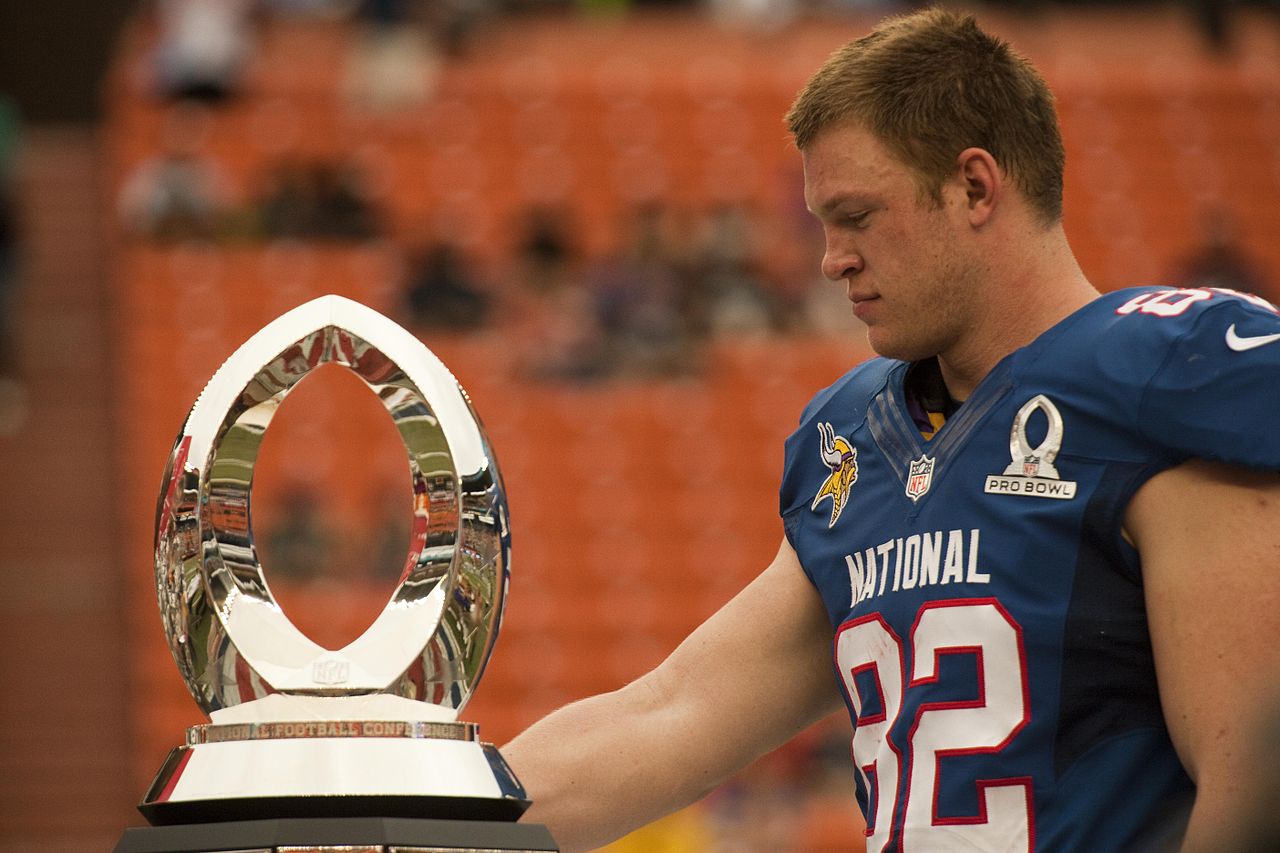
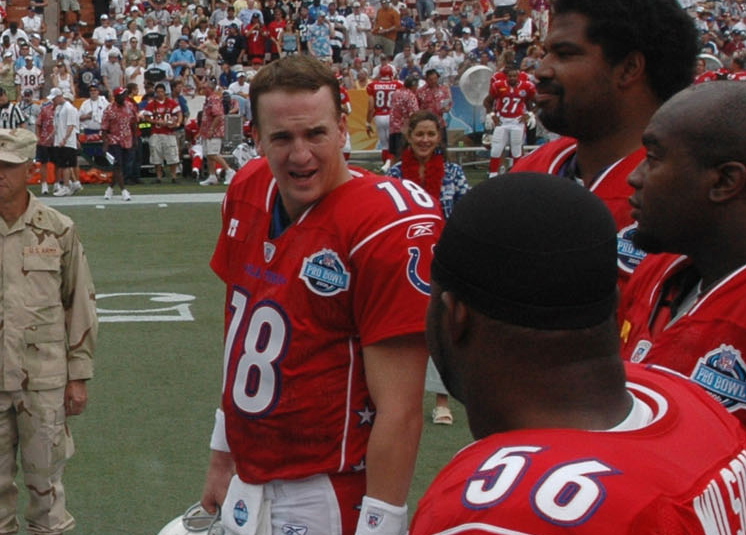
The teams comprise players from different NFL teams, so using their own uniforms would be too confusing. However, the players do wear the helmet of their respective team, but the home jerseys and pants are either a solid blue for the NFC or solid red for the AFC, with white jerseys with blue or red accents, respectively, for the away team.
The early Pro Bowl, contested by the National Football League's Eastern and Western Division stars and played at the Los Angeles Memorial Coliseum, featured the same uniforms from the 1950s to mid-1960s; the Eastern team wore scarlet jerseys with white numerals and a white crescent shoulder stripe, white pants with red stripe, red socks, and a plain red helmet. The Western team wore white jerseys with royal-blue numerals and a Northwestern University-style Ukon triple stripe on the sleeves, white pants with blue stripe and socks and a plain blue helmet. Perhaps oddly, the Eastern team wore home dark jerseys, although the host city team, the Los Angeles Rams, were members of the Western Conference. From January 1967 to January 1970 both teams wore gold helmets with the NFL logo on the sides; the Eastern helmets featured a red-white-red tri-stripe and the Western a similar blue-white-blue tri-stripe. In fact, the players brought their own game helmets to Los Angeles, which were then spray-painted and decorated for the contest. For the 1970 game the helmets featured the '50 NFL' logo, commemorating the league's half-century anniversary.