
Pluto (minor-planet number 134340) is a dwarf planet in the Kuiper belt, a ring of bodies beyond the orbit of Neptune. It is the ninth-largest and tenth-most-massive known object to directly orbit the Sun. It is the largest known trans-Neptunian object by volume by a small margin, but is less massive than Eris. Like other Kuiper belt objects, Pluto is made primarily of ice and rock and is much smaller than the inner planets. Pluto has roughly one-sixth the mass of the Moon and one-third of its volume. Originally considered a planet, its status was changed when astronomers adopted a new definition of the word with new criteria.
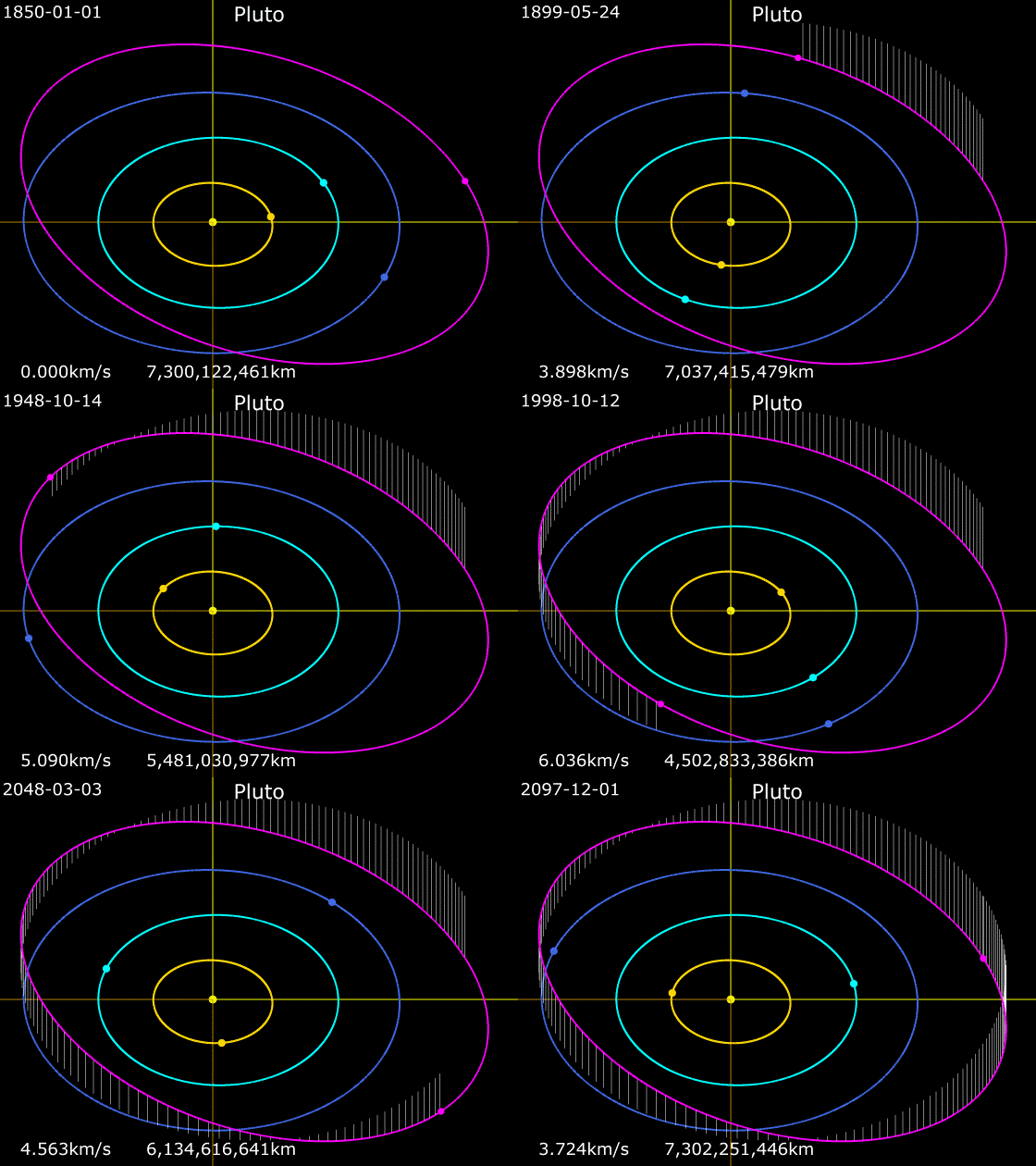
Pluto has a moderately eccentric and inclined orbit, ranging from 30 to 49 astronomical units (4.5 to 7.3 billion kilometres; 2.8 to 4.6 billion miles) from the Sun. Light from the Sun takes 5.5 hours to reach Pluto at its orbital distance of 39.5 AU (5.91 billion km; 3.67 billion mi). Pluto's eccentric orbit periodically brings it closer to the Sun than Neptune, but a stable orbital resonance prevents them from colliding.
Pluto has five known moons: Charon (the largest and the diameter of which is just over half that of Pluto), Styx, Nix, Kerberos, and Hydra. Pluto and Charon are sometimes considered a binary system because the barycenter of their orbits (that is, their center of mass) does not lie within either body, and they are tidally locked. New Horizons was the first spacecraft to visit Pluto and its moons, making a flyby on July 14, 2015, and taking detailed measurements and observations.

Pluto was discovered in 1930 by Clyde W. Tombaugh, making it the first known object in the Kuiper belt. It was immediately hailed as the ninth planet, but its planetary status was questioned when it was found to be much smaller than expected. These doubts increased following the discovery of additional objects in the Kuiper belt starting in the 1990s, particularly the more massive scattered disk object Eris in 2005. In 2006, the International Astronomical Union (IAU) formally redefined the term planet to exclude dwarf planets such as Pluto. Many planetary astronomers, however, continue to consider Pluto and other dwarf planets to be planets.
History
Discovery
In the 1840s, Urbain Le Verrier used Newtonian mechanics to predict the position of the then-undiscovered planet Neptune after analyzing perturbations in the orbit of Uranus. Subsequent observations of Neptune in the late 19th century led astronomers to speculate that Uranus's orbit was being disturbed by another planet besides Neptune.
In 1906, Percival Lowell—a wealthy Bostonian who had founded Lowell Observatory in Flagstaff, Arizona, in 1894—started an extensive project in search of a possible ninth planet, which he termed "Planet X". In 1909, Lowell and William H. Pickering suggested several possible celestial coordinates for such a planet. Lowell and his observatory conducted his search, using mathematical calculations made by Elizabeth Williams, until his death in 1916, but to no avail. Unknown to Lowell, his surveys had captured two faint images of Pluto on March 19 and April 7, 1915, but they were not recognized for what they were. There are fourteen other known precovery observations, with the earliest made by the Yerkes Observatory on August 20, 1909.

Percival's widow, Constance Lowell, entered into a ten-year legal battle with the Lowell Observatory over her husband's legacy, and the search for Planet X did not resume until 1929. Vesto Melvin Slipher, the observatory director, gave the job of locating Planet X to 23-year-old Clyde Tombaugh, who had just arrived at the observatory after Slipher had been impressed by a sample of his astronomical drawings.
Tombaugh's task was to systematically image the night sky in pairs of photographs, then examine each pair and determine whether any objects had shifted position. Using a blink comparator, he rapidly shifted back and forth between views of each of the plates to create the illusion of movement of any objects that had changed position or appearance between photographs. On February 18, 1930, after nearly a year's search, Tombaugh discovered a possible moving object on photographic plates taken on January 23 and 29. A lesser-quality photograph taken on January 21 helped confirm the movement. After the observatory obtained further confirmatory photographs, news of the discovery was telegraphed to the Harvard College Observatory on March 13, 1930.
The object was immediately hailed as the ninth planet. However, its planetary status was questioned when it was found to be much smaller than expected.

One Plutonian year corresponds to 247.94 Earth years; thus, in 2178, Pluto will complete its first orbit since its discovery.
Name
The name Pluto came from the Roman god of the underworld; and it is also an epithet for Hades (the Greek equivalent of Pluto).
Upon the announcement of the discovery, Lowell Observatory received over a thousand suggestions for names. Three names topped the list: Minerva, Pluto and Cronus. 'Minerva' was the Lowell staff's first choice but was rejected because it had already been used for an asteroid; Cronus was disfavored because it was promoted by an unpopular and egocentric astronomer, Thomas Jefferson Jackson See. A vote was then taken and 'Pluto' was the unanimous choice. To make sure the name stuck, and that the planet would not suffer changes in its name as Uranus had, Lowell Observatory proposed the name to the American Astronomical Society and the Royal Astronomical Society; both approved it unanimously. The name was published on May 1, 1930.
The name Pluto had received some 150 nominations among the letters and telegrams sent to Lowell. The first had been from Venetia Burney (1918–2009), an eleven-year-old schoolgirl in Oxford, England, who was interested in classical mythology. She had suggested it to her grandfather Falconer Madan when he read the news of Pluto's discovery to his family over breakfast; Madan passed the suggestion to astronomy professor Herbert Hall Turner, who cabled it to colleagues at Lowell on March 16, three days after the announcement.
The name 'Pluto' was mythologically appropriate: the god Pluto was one of six surviving children of Saturn, and the others had already all been chosen as names of major or minor planets (his brothers Jupiter and Neptune, and his sisters Ceres, Juno and Vesta). Both the god and the planet inhabited "gloomy" regions, and the god was able to make himself invisible, as the planet had been for so long.
The choice was further helped by the fact that the first two letters of Pluto were the initials of Percival Lowell; indeed, 'Percival' had been one of the more popular suggestions for a name for the new planet.
Symbol
Once named, Pluto's planetary symbol ⟨⟩ was then created as a monogram of the letters "PL". This symbol is rarely used in astronomy anymore, though it is still common in astrology. However, the most common astrological symbol for Pluto, occasionally used in astronomy as well, is an orb (possibly representing Pluto's invisibility cap) over Pluto's bident ⟨⟩, which dates to the early 1930s.
The name 'Pluto' was soon embraced by wider culture. In 1930, Walt Disney was apparently inspired by it when he introduced for Mickey Mouse a canine companion named Pluto, although Disney animator Ben Sharpsteen could not confirm why the name was given. In 1941, Glenn T. Seaborg named the newly created element plutonium after Pluto, in keeping with the tradition of naming elements after newly discovered planets, following uranium, which was named after Uranus, and neptunium, which was named after Neptune.
Most languages use the name "Pluto" in various transliterations. In Japanese, Houei Nojiri suggested the calque Meiōsei (冥王星, "Star of the King (God) of the Underworld"), and this was borrowed into Chinese and Korean. Some languages of India use the name Pluto, but others, such as Hindi, use the name of Yama, the God of Death in Hinduism. Polynesian languages also tend to use the indigenous god of the underworld, as in Māori Whiro.

Vietnamese does not follow the Chinese usage due to a phonological constraint: the Sino-Vietnamese word 冥 minh "dark" is homophonous with 明 minh "bright". Instead, Vietnamese uses Yama, which is also a Buddhist deity, in the form of Sao Diêm Vương 星閻王 "Yama's Star", derived from Chinese 閻王 Yán Wáng / Yìhm Wòhng "King Yama".
Planet X disproved
Once Pluto was found, its faintness and lack of a viewable disc cast doubt on the idea that it was Lowell's Planet X. Estimates of Pluto's mass were revised downward throughout the 20th century.
Astronomers initially calculated its mass based on its presumed effect on Neptune and Uranus. In 1931, Pluto was calculated to be roughly the mass of Earth, with further calculations in 1948 bringing the mass down to roughly that of Mars. In 1950, Kuiper observed Pluto's disk for the first time and estimated that its radius is around 2,950 km, or slightly smaller than Mars; the non-observation of a predicted stellar occultation in 1965 affirmed this constraint, setting an upper limit of 3,400 km. A value of 0.11±0.02 Earth masses was found by Seidelmann and colleagues in 1971, based on the assumption that Pluto was perturbing the orbit of Neptune. In 1976, Dale Cruikshank, Carl Pilcher and David Morrison of the University of Hawaiʻi found evidence that Pluto's surface was covered in methane ice; based on this, they were able to calculate Pluto's albedo for the first time. They concluded that Pluto had to be exceptionally luminous for its size, with a geometric albedo between 0.4 and 0.6, and therefore 1,400–1,650 km in radius, smaller than even the Moon. It could not be more than 1 percent the mass of Earth. Cruikshank and colleagues pointed out that Pluto's mass, which they estimated to be a few thousandths the mass of the Earth, was insufficient to have any appreciable effect on the orbits of Uranus or Neptune, and they acknowledged that Tombaugh's discovery was the result of a thorough search rather than any kind of prediction.
In 1978, the discovery of Pluto's moon Charon allowed the measurement of Pluto's mass for the first time: roughly 0.2% that of Earth, and far too small to account for the discrepancies in the orbit of Uranus. Subsequent searches for an alternative Planet X, notably by Robert Sutton Harrington, failed. In 1992, Myles Standish used data from Voyager 2's flyby of Neptune in 1989, which had revised the estimates of Neptune's mass downward by 0.5%—an amount comparable to the mass of Mars—to recalculate its gravitational effect on Uranus. With the new figures added in, the discrepancies, and with them the need for a Planet X, vanished.
As of 2000 the majority of scientists agreed that Planet X, as Lowell defined it, does not exist. Lowell had made a prediction of Planet X's orbit and position in 1915 that was fairly close to Pluto's actual orbit and its position at that time. Ernest W. Brown concluded soon after Pluto's discovery that this was a coincidence.
Classification
From 1992 onward, many bodies were discovered orbiting in the same volume as Pluto, showing that Pluto is part of a population of objects called the Kuiper belt. This made its official status as a planet controversial, with many questioning whether Pluto should be considered together with or separately from its surrounding population. Museum and planetarium directors occasionally created controversy by omitting Pluto from planetary models of the Solar System. In February 2000 the Hayden Planetarium in New York City displayed a Solar System model of only eight planets, which made headlines almost a year later.
Ceres, Pallas, Juno and Vesta lost their planet status among most astronomers after the discovery of many other asteroids in the 1840s. On the other hand, planetary geologists often regarded Ceres, and less often Pallas and Vesta, as being different from smaller asteroids because they were large enough to have undergone geological evolution. Although the first Kuiper belt objects discovered were quite small, objects increasingly closer in size to Pluto were soon discovered, some large enough (like Pluto itself) to satisfy geological but not dynamical ideas of planethood.
In 1998, Brian G. Marsden of Harvard University's Minor Planet Center suggested that Pluto be given the minor planet number 10000 while still retaining its official position as a planet. The prospect of Pluto's "demotion" created a public outcry, and in response the International Astronomical Union (IAU) clarified that it was not at that time proposing to remove Pluto from the planet list.
In the early 2000's, astronomers at Caltech led by Michael E. Brown undertook a wide survey of the skies using digital detection technology, finding numerous Trans-Neptunian objects. Many of these objects were initially measured as larger than or equal in size to Pluto, igniting a debate over whether or not to consider them planets. Later, estimates were revised down due to higher than expected albedos.
The debate became unavoidable when, in July 2005, these astronomers announced the discovery of a new object, Eris, which was substantially more massive than Pluto and the most massive object discovered in the Solar System since Triton in 1846. The press initially called it the tenth planet, although there was no official consensus at the time on whether to call it a planet. Others in the astronomical community considered the discovery the strongest argument for reclassifying Pluto as a minor planet.
IAU classification
The debate came to a head in August 2006 during the triennial meeting of the IAU, when Uruguayan astronomers Julio Ángel Fernández and Gonzalo Tancredi first proposed the new definition for the term "planet". According to their proposal, there are three conditions for an object in the Solar System to be considered a planet:
The object must be in orbit around the Sun.
The object must be massive enough to be rounded by its own gravity. More specifically, its own gravity should pull it into a shape defined by hydrostatic equilibrium.
It must have cleared the neighborhood around its orbit.
Pluto fails to meet the third condition. Its mass is substantially less than the combined mass of the other objects in its orbit: 0.07 times, in contrast to Earth, which is 1.7 million times the remaining mass in its orbit (excluding the moon). The IAU further decided that bodies that, like Pluto, meet criteria 1 and 2, but do not meet criterion 3 would be called dwarf planets. In September 2006, the IAU included Pluto, and Eris and its moon Dysnomia, in their Minor Planet Catalogue, giving them the official minor-planet designations "(134340) Pluto", "(136199) Eris", and "(136199) Eris I Dysnomia". Had Pluto been included upon its discovery in 1930, it would have likely been designated 1164, following 1163 Saga, which was discovered a month earlier.
There has been some resistance within the astronomical community toward the reclassification, and in particular planetary scientists often continue to reject it, considering Pluto, Charon, and Eris to be planets for the same reason they do so for Ceres. In effect, this amounts to accepting only the second clause of the IAU definition. Alan Stern, principal investigator with NASA's New Horizons mission to Pluto, derided the IAU resolution. He also stated that because less than five percent of astronomers voted for it, the decision was not representative of the entire astronomical community. Marc W. Buie, then at the Lowell Observatory, petitioned against the definition. Others have supported the IAU, for example Mike Brown, the astronomer who discovered Eris.
Public reception to the IAU decision was mixed. A resolution introduced in the California State Assembly facetiously called the IAU decision a "scientific heresy". The New Mexico House of Representatives passed a resolution in honor of Clyde Tombaugh, the discoverer of Pluto and a longtime resident of that state, that declared that Pluto will always be considered a planet while in New Mexican skies and that March 13, 2007, was Pluto Planet Day. The Illinois Senate passed a similar resolution in 2009 on the basis that Tombaugh was born in Illinois. The resolution asserted that Pluto was "unfairly downgraded to a 'dwarf' planet" by the IAU."
Some members of the public have also rejected the change, citing the disagreement within the scientific community on the issue, or for sentimental reasons, maintaining that they have always known Pluto as a planet and will continue to do so regardless of the IAU decision. In 2006, in its 17th annual words-of-the-year vote, the American Dialect Society voted plutoed as the word of the year. To "pluto" is to "demote or devalue someone or something". In April 2024, Arizona (where Pluto was first discovered in 1930) passed a law naming Pluto as the official state planet.
Researchers on both sides of the debate gathered in August 2008, at the Johns Hopkins University Applied Physics Laboratory for a conference that included back-to-back talks on the IAU definition of a planet. Entitled "The Great Planet Debate", the conference published a post-conference press release indicating that scientists could not come to a consensus about the definition of planet. In June 2008, the IAU had announced in a press release that the term "plutoid" would henceforth be used to refer to Pluto and other planetary-mass objects that have an orbital semi-major axis greater than that of Neptune, though the term has not seen significant use.
Orbit
Pluto's orbital period is about 248 years. Its orbital characteristics are substantially different from those of the planets, which follow nearly circular orbits around the Sun close to a flat reference plane called the ecliptic. In contrast, Pluto's orbit is moderately inclined relative to the ecliptic (over 17°) and moderately eccentric (elliptical). This eccentricity means a small region of Pluto's orbit lies closer to the Sun than Neptune's. The Pluto–Charon barycenter came to perihelion on September 5, 1989, and was last closer to the Sun than Neptune between February 7, 1979, and February 11, 1999.
Although the 3:2 resonance with Neptune (see below) is maintained, Pluto's inclination and eccentricity behave in a chaotic manner. Computer simulations can be used to predict its position for several million years (both forward and backward in time), but after intervals much longer than the Lyapunov time of 10–20 million years, calculations become unreliable: Pluto is sensitive to immeasurably small details of the Solar System, hard-to-predict factors that will gradually change Pluto's position in its orbit.
The semi-major axis of Pluto's orbit varies between about 39.3 and 39.6 AU with a period of about 19,951 years, corresponding to an orbital period varying between 246 and 249 years. The semi-major axis and period are presently getting longer.
Relationship with Neptune
Despite Pluto's orbit appearing to cross that of Neptune when viewed from north or south of the Solar System, the two objects' orbits do not intersect. When Pluto is closest to the Sun, and close to Neptune's orbit as viewed from such a position, it is also the farthest north of Neptune's path. Pluto's orbit passes about 8 AU north of that of Neptune, preventing a collision.
This alone is not enough to protect Pluto; perturbations from the planets (especially Neptune) could alter Pluto's orbit (such as its orbital precession) over millions of years so that a collision could happen. However, Pluto is also protected by its 2:3 orbital resonance with Neptune: for every two orbits that Pluto makes around the Sun, Neptune makes three, in a frame of reference that rotates at the rate that Pluto's perihelion precesses (about 0.97×10⁻⁴ degrees per year).
Each cycle lasts about 495 years. There are many other objects in this same resonance, called plutinos. At present, in each 495-year cycle, the first time Pluto is at perihelion (such as in 1989), Neptune is 57° ahead of Pluto. By Pluto's second passage through perihelion, Neptune will have completed a further one and a half of its own orbits, and will be 123° behind Pluto. Pluto and Neptune's minimum separation is over 17 AU, which is greater than Pluto's minimum separation from Uranus (11 AU). The minimum separation between Pluto and Neptune actually occurs near the time of Pluto's aphelion.
The 2:3 resonance between the two bodies is highly stable and has been preserved over millions of years. This prevents their orbits from changing relative to one another, so the two bodies can never pass near each other. Even if Pluto's orbit were not inclined, the two bodies could never collide.
When Pluto's period is slightly different from 3/2 of Neptune's, the pattern of its distance from Neptune will drift. Near perihelion Pluto moves interior to Neptune's orbit and is therefore moving faster, so during the first of two orbits in the 495-year cycle, it is approaching Neptune from behind. At present it remains between 50° and 65° behind Neptune for 100 years (e.g. 1937–2036).
The gravitational pull between the two causes angular momentum to be transferred to Pluto. This situation moves Pluto into a slightly larger orbit, where it has a slightly longer period, according to Kepler's third law. After several such repetitions, Pluto is sufficiently delayed that at the second perihelion of each cycle it will not be far ahead of Neptune coming behind it, and Neptune will start to decrease Pluto's period again. The whole cycle takes about 20,000 years to complete.
Other factors
Numerical studies have shown that over millions of years, the general nature of the alignment between the orbits of Pluto and Neptune does not change. There are several other resonances and interactions that enhance Pluto's stability. These arise principally from two additional mechanisms (besides the 2:3 mean-motion resonance).
First, Pluto's argument of perihelion, the angle between the point where it crosses the ecliptic (or the invariant plane) and the point where it is closest to the Sun, librates around 90°. This means that when Pluto is closest to the Sun, it is at its farthest north of the plane of the Solar System, preventing encounters with Neptune. This is a consequence of the Kozai mechanism, which relates the eccentricity of an orbit to its inclination to a larger perturbing body—in this case, Neptune. Relative to Neptune, the amplitude of libration is 38°, and so the angular separation of Pluto's perihelion to the orbit of Neptune is always greater than 52° (90°–38°). The closest such angular separation occurs every 10,000 years.
Second, the longitudes of ascending nodes of the two bodies—the points where they cross the invariant plane—are in near-resonance with the above libration. When the two longitudes are the same—that is, when one could draw a straight line through both nodes and the Sun—Pluto's perihelion lies exactly at 90°, and hence it comes closest to the Sun when it is furthest north of Neptune's orbit. This is known as the 1:1 superresonance. All the Jovian planets (Jupiter, Saturn, Uranus, and Neptune) play a role in the creation of the superresonance.
Rotation
Pluto's rotation period, its day, is equal to 6.387 Earth days. Like Uranus and 2 Pallas, Pluto rotates on its "side" in its orbital plane, with an axial tilt of 120°, and so its seasonal variation is extreme; at its solstices, one-fourth of its surface is in continuous daylight, whereas another fourth is in continuous darkness. The reason for this unusual orientation has been debated. Research from the University of Arizona has suggested that it may be due to the way that a body's spin will always adjust to minimize energy. This could mean a body reorienting itself to put extraneous mass near the equator and regions lacking mass tend towards the poles. This is called polar wander.