
The People's Defense Units, Kurdish abbreviation YPG, also called People's Protection Units, is a libertarian socialist Kurdish militant group in Syria and the primary component of the US-backed Syrian Democratic Forces (SDF).
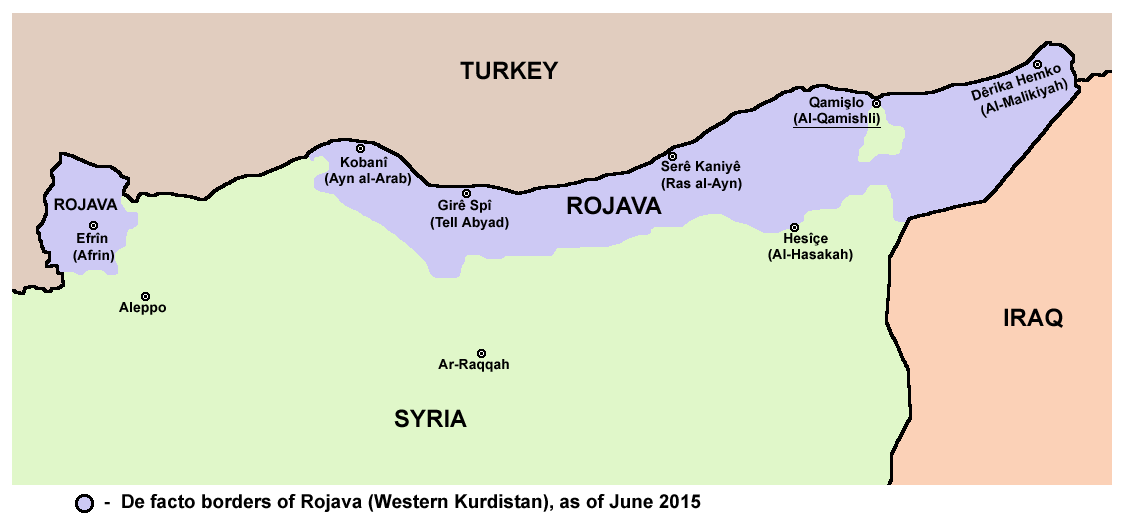
The YPG mostly consists of Kurds, but also includes Arabs and foreign volunteers; it is closely allied to the Syriac Military Council, an Assyrian militia. The YPG was formed in 2011. It expanded rapidly in the Syrian Civil War and came to predominate over other armed Syrian Kurdish groups. A sister militia, the Women's Protection Units (YPJ), fights alongside them. The YPG is active in the Autonomous Administration of North and East Syria (Rojava), particularly in its Kurdish regions.
In early 2015, the group won a major victory over the Islamic State (IS) during the siege of Kobanî, where the YPG began to receive air and ground support from the United States and other Combined Joint Task Force – Operation Inherent Resolve militaries. Since then, the YPG has primarily fought against IS, as well as on occasion fighting other Syrian rebel groups and the Turkish Armed Forces. In late 2015, the YPG became part of the SDF, an umbrella group intended to better incorporate Arabs and minorities into the war effort. In 2016–2017, the SDF's Raqqa campaign led to the liberation of the city of Raqqa, the Islamic State's de facto capital. Several western sources have described the YPG as the "most effective" force in fighting IS in Syria.

According to Turkey and Qatar, the YPG is a terrorist organization due to its association with the Kurdistan Workers' Party (PKK), which is listed as a terrorist organization. The flag of the YPG is also a banned symbol in Germany as per Strafgesetzbuch section 86a, although the organization itself is not recognised as terrorist. The Turkish terror classification is not shared by key international bodies in the fight against the Islamic State in which the YPG takes part. Due to this Turkish view, US Army Special Operations Commander General Raymond Thomas suggested the YPG to change their name, after which the name of the Syrian Democratic Forces (SDF) was founded.
History
Early origins
Kurdish activists attempted to unify themselves following the 2004 Qamishli riots. The riots began as clashes between rival football fans before taking a political turn, with Arab fans raising pictures of Saddam Hussein while the Kurdish fans reportedly proclaimed, "We will sacrifice our lives for Bush". This resulted in clashes between the two groups who attacked each other with sticks, stones and knives. Government security forces entered the city to quell the riot, firing at the crowds. The riots resulted in around 36 dead, most of them Kurds.
They did not, however, emerge as a significant force until the Syrian civil war erupted in 2011.

Establishment
The self-defence committees that were to become the YPG were formed in July and August 2011 as the Self Protection units (YXG).
Existing underground Kurdish political parties, the Democratic Union Party (PYD) and the Kurdish National Council (KNC), joined to form the Kurdish Supreme Committee (KSC) and established the People's Protection Units (YPG) militia to defend Kurdish-inhabited areas in northern Syria, i.e. Syrian Kurdistan and the Kurdish enclave of Sheikh Maqsood in Aleppo. Originally a wholly Kurdish force, the YPG began to recruit Arabs from at least 2012.
Control of Kurdish areas
In July 2012, the YPG had a standoff with Syrian government forces in the Kurdish city of Kobanî and the surrounding areas. After negotiations, government forces withdrew and the YPG took control of Kobanî, Amuda, and Afrin.

By December 2012, it had expanded to eight brigades, which were formed in Qamishlo, Kobanî, and Ras al-Ayn (Serê Kaniyê), and in the districts of Afrin, al-Malikiyah, and al-Bab.
Late 2012: Islamist attacks make YPG dominant
The YPG did not initially take an offensive posture in the Syrian Civil War. Aiming mostly to defend Kurdish-majority areas, it avoided engaging Syrian government forces, which still controlled several enclaves in Kurdish territory. The YPG changed this policy when Ras al-Ayn was taken by the al-Qaeda-affiliated al-Nusra Front. At first the YPG conquered the surrounding government-controlled areas: al-Darbasiyah (Kurdish: Dirbêsî), Tel Tamer and al-Malikiyah (Kurdish: Dêrika Hemko). The subsequent Battle of Ras al-Ayn started in earnest when on 19 November 2012, the al-Nusra Front and a second al-Qaeda affiliate, Ghuraba al-Sham, attacked Kurdish positions in the town. The battle ended with a YPG victory in July 2013.
While many rebel groups clashed with the YPG, jihadist and Salafist groups did so the most often. The YPG proved to be the only Kurdish militia able to effectively resist the fundamentalists. While the YPG protected the Kurdish communities it was able to extract a price: it prevented the emergence of new, rival militias and forced existing ones to cooperate with or join the YPG forces on its terms. This was how the Islamist attacks enabled the YPG to unite the Syrian Kurds under its banner and caused it to become the de facto army of the Syrian Kurds.
2013: Kurdish control of al-Yaarubiyah/Til Koçer
In October 2013, YPG fighters took control of al-Yaarubiyah (Til Koçer) following intense clashes with IS. The clashes lasted about three days, with the Til Koçer border gate to Iraq being taken in a major offensive launched on the night of 24 October. PYD leader Salih Muslim told Stêrk TV that this success created an alternative against efforts to hold the territory under embargo, referring to the fact that the other border crossings with Iraq led to areas controlled by the Kurdistan Regional Government, while al-Yaarubiyah led to areas controlled by the Iraqi central government.
2014: Fight against the Islamic State
In 2014, the Syriac Military Council, a group of Assyrian units, was formally integrated into the YPG's command structure. The inter-rebel conflict during the Syrian Civil War led to open war between the Free Syrian Army and IS in January 2014. The YPG collaborated with FSA groups to fight IS in Raqqa province; the group also formed an operations room with multiple FSA factions, called Euphrates Volcano. However, the general outcome of this campaign was a massive advance by IS, which effectively separated the eastern part of Rojava from the main force of FSA rebels. IS followed up on its success by attacking the YPG and the FSA in Kobanî Canton in March and fighting its way to the gates of the city of Kobanî in September. The actual siege of Kobanî approximately coincided with an escalation in the American-led intervention in Syria. This intervention had started with aiding the FSA against the government, but when the FSA was getting defeated by IS in eastern Syria, it escalated to bombing IS on Syrian territory.
With the world fearing another massacre in Kobanî, American support increased substantially. The US gave intense close air support to the YPG, and in doing so, started military cooperation with one of the factions. While it expected that IS would quickly crush the YPG and the FSA, this alliance was not considered a problem for the US. The YPG won the battle in early 2015.

Meanwhile, the situation had been stable in Afrin and Aleppo. The fight between the FSA and IS had led to a normalization in the relations between FSA and YPG since the end of 2013. In February 2015, the YPG signed a judicial agreement with the Levant Front in Aleppo.
Spring 2015: Offensive operations with coalition support
The YPG was able and willing to offensively engage and put pressure on IS and had built up a track record as a reliable military partner of the US. In 2015, the YPG began its advance on Tel Abyad, a move they have planned for since November 2013. With American close air support, offensives near Hasakah and from Hasakah westward culminated in the conquest of Tell Abyad, linking up Kobanî with Hasakah in July 2015. With the capture of Tell Abyad, the YPG has also broken a major supply route of fighters and goods for the Islamic State.
With these offensives, the YPG had begun to make advances into areas that did not always have a Kurdish majority. When the YPG and the FSA entered the border town of Tell Abyad in June 2015, parts of the population fled the intense fighting and the airstrikes.

Autumn 2015: foundation of the SDF
The Syrian Democratic Forces was established in Hasakah on 11 October 2015. It has its origins in the YPG-FSA collaboration against IS, which had previously led to the establishment of the Euphrates Volcano joint operations room in 2014. Many of the partners are the same, and even the logo / flag with the Blue Euphrates symbol has common traits with that of Euphrates Volcano. The primary difference is that Euphrates Volcano was limited to coordinating the activities of independent Kurdish and Arab groups, while the SDF is a single organisation made up of Kurds, Arabs, and Assyrians.
The first success of the SDF was the capture of the strategic ethnically Arab town of al-Hawl from IS during the al-Hawl offensive in November 2015. This was followed in December by the Tishrin Dam offensive. The dam was captured on 26 December. Participating forces included the YPG, the FSA group Army of Revolutionaries, the tribal group al-Sanadid Forces and the Assyrian Syriac Military Council. The coalition had some heavy weapons and was supported by intense US led airstrikes. The capture of the hydroelectric dam also had positive effects on the economy of Rojava.
2016
In February, the YPG-led SDF launched the al-Shaddadi offensive, followed by the Manbij offensive in May, and the Raqqa and Aleppo offensives in November. These operations extended SDF-controlled territory, usually at IS's expense.
On 7 April 2016, the Kurdish neighborhood of Sheikh Maqsood in Aleppo was shelled with mortars that may have contained chemical agents (160 killed or wounded). Spokesperson for the YPG said that Saudi Arabia-backed Jaysh al-Islam (Army of Islam) rebel group has attacked the Kurdish neighborhood of Aleppo with "forbidden weapons" many times since the war's start.
2018: Turkish military intervention in Afrin region
2019: Turkish offensive into north-eastern Syria
2026: Integration into the Syrian army
In early 2026, with the SDF being incorporated into the Syrian Army, the Ministry of Defense under the Syrian transitional government said on 10 March that Sipan Hamo, commander of the People's Protection Units (YPG), had been appointed deputy defense minister for the country's eastern territories.
Women's Protection Units
The Women's Protection Units (YPJ), also known as the Women's Defense Units, is the YPG's female brigade, which was set up in 2012. Kurdish media have said that YPJ troops became vital during the siege of Kobanî. Consisting of approximately 20,000 fighters, they make up around 40% of the YPG.
Organization
Flags
Units
In 2017, the YPG began to form units called regiments in translation, though they are smaller than comparable units in standard militaries:
Tactics
According to a report in IHS Jane's regarding the YPG,
Relying on speed, stealth, and surprise, it is the archetypal guerrilla army, able to deploy quickly to front lines and concentrate its forces before quickly redirecting the axis of its attack to outflank and ambush its enemy. The key to its success is autonomy. Although operating under an overarching tactical rubric, YPG brigades are inculcated with a high degree of freedom and can adapt to the changing battlefield.
The YPG relies heavily on snipers and backs them by suppressing enemy fire using mobile heavy machine guns. It also uses roadside bombs to prevent outflanking maneuvers, particularly at night. Its lines have generally held when attacked by Islamic State (IS) forces who have better equipment, including helmets and body armor.
The YPG and People's Defense Forces (HPG) have also trained and equipped more than 1,000 Yazidis, who operate in the Mount Sinjar area as local defense units under their supervision.
The YPG calls itself a people's army, and therefore appoints officers by internal elections.
A 20-year-old female YPJ fighter named Zlukh Hamo (Nom de guerre: Avesta Khabur) was reported to have carried out a suicide attack towards Turkish troops and a tank during the early phase of the Afrin Offensive, killing herself and several soldiers in the process. The attack was commended by pro-SDF sources as a courageous attack against a tank using explosives, which killed her in the process.
Equipment
In comparison to the other major factions involved in the Syrian Civil War, the YPG has the least armor. To compensate for the resulting capability gap, the YPG became heavily involved in the production of DIY armoured vehicles, typically based on bulldozers or large trucks. The YPG has traditionally relied on vehicles captured from the Islamic State, AFVs left behind by the Syrian Arab Army (SyAA), equipment turned over by the SyAA in exchange for a safe passage (for example, after retreating from Mennagh airbase in 2014), and armoured vehicles donated by the US for light armoured vehicles and true armour.
While other Syrian Civil War factions, such as the Islamic State, amassed an arsenal of hundreds of tanks and other armored fighting vehicles captured from the Syrian Arab Army, the YPG, which frequently avoided combat with government forces, had to make do with scraps. The YPG was able to acquire several vehicle types, including the BTR-60 and BRDM-2, that had been abandoned in government bases by their previous owners. With no other option, even these abandoned vehicles would be repaired and repurposed by the YPG. Even when the engine couldn't be repaired, the hulls of BTR-60s were strapped to the backs of trucks and used as improvised AFVs.
With little armor and other heavy weaponry, the YPG relied almost entirely on Coalition airpower to destroy Islamic State vehicles and fighting positions. While this meant that Islamic State-operated AFVs were frequently destroyed before they could inflict serious damage on YPG forces, it also meant that most AFVs were completely obliterated by Coalition aircraft, preventing their capture and further use with the YPG.
In order to assist the SDF in its fight against Islamic State forces in northern Syria, the YPG received a large number of infantry mobility vehicles (IMVs) and mine-resistant ambush protected vehicles (MRAPs) from the US, which appear to have replaced some of the YPG's more bizarre homemade armour designs. Surprisingly, the YPG was permitted to keep these vehicles even after IS was defeated as a conventional military force. Even so, there was little doubt that their most likely future application would be against a NATO member (Turkey). Aside from a large fleet of Humvees, IAG Guardians, and M1224 Maxxpros, the US has reportedly transferred a number of M2 Bradley infantry fighting vehicles (IFVs) to the YPG. These reports appear to be based on the sighting of M2s with SDF flags and a video of YPG members training alongside M2s, and there is currently no evidence that such a transfer has occurred.
The YPG's arsenal of ATGMs is without a doubt the most dangerous threat to the Turkish military. Despite capturing only a small number of these missiles from the Syrian Arab Army, the YPG has managed to secure a steady supply of ATGMs obtained on the Syrian black market. These have included models like the 9M113 Konkurs and 9M115 Metis-M, as well as more advanced models like the 9M133 Kornet and even the US TOW ATGM. Despite frequently employing them against the Free Syrian Army and Turkish military, the YPG is likely to keep a significant stock of missiles on hand for future use against Turkish armour and troop concentrations.
International outreach
Foreign volunteers
Ex–U.S. Army soldier Jordan Matson was among the first foreign volunteers of the YPG. Injured by an IS suicide bomb, he developed the "Lions of Rojava" recruitment campaign for foreign volunteers, launched on 21 October 2014 on Facebook. More than 400 volunteers from Europe, the Americas and Australia have joined the YPG as of 11 June 2015, including at least ten U.S. volunteers, three of which were U.S. Army veterans. People from both China and the Chinese diaspora have also joined.
Other prominent foreign volunteers have included Brace Belden, Macer Gifford, Ryan Lock, Michael Israel, Nazzarno Tassone, Dean Evans, Jac Holmes, Konstandinos Erik Scurfield, Anna Campbell, Lorenzo Orsetti, Haukur Hilmarsson and Michael Enright.
Dozens of non-Kurdish Turks (from both Turkey and the European diaspora) have also joined. The Turkish Marxist–Leninist Communist Party (MLKP) has been sending volunteers to fight in the YPG since 2012. At least four have been killed in battle as of February 2015—one during the Battle of Ras al-Ayn and three during the siege of Kobanî. The party released a video in late January 2015 showing several Spanish- and German-speaking volunteers from Europe among its ranks in Jazira Canton; they were reorganised into the International Freedom Battalion on 10 June 2015.