
The Battle of the Scheldt in World War II was a series of military operations to open up the Scheldt river between Antwerp and the North Sea for shipping, so that Antwerp's port could be used to supply the Allies in north-west Europe. The operations were carried out by the First Canadian Army, with assistance from Polish and British units which had been attached. The action was under the acting command of the First Canadian's Lieutenant-General Guy Simonds. The battle took place in the vicinity of the Scheldt river in northern Belgium and southwestern Netherlands from 2 October to 8 November 1944.
The Canadians had been delayed for more than a month, and the need to clear the Scheldt had not yet been addressed, due to Allied decisions to spend September focusing on Arnhem (Operation Market Garden), Boulogne (Operation Wellhit), Calais (Operation Undergo) and the opening weeks of the Siege of Dunkirk. By the time the Canadians were sent into the Battle of the Scheldt, the Wehrmacht defenders had been reinforced. The Germans staged an effective delaying action during which they flooded land areas in the Scheldt estuary and slowed the Allied advance. After five weeks of difficult fighting, the Canadian First Army, at a cost of 20,873 Allied casualties (6,367 of them Canadian), was successful in clearing the Scheldt after numerous amphibious assaults, obstacle crossings and costly assaults over open ground.
Once the German defenders were no longer a threat, it took another three weeks to de-mine the harbours; the first convoy carrying Allied supplies could not unload in Antwerp until 28 November 1944. Once Antwerp was opened, it allowed 2.5 million tons of supplies to arrive at that port between November 1944 and April 1945, which were critical to the successful Allied advance into Germany in 1945.

Background
Following the Allied breakout after success in the battle of Normandy, they began a series of rapid advances into the Low Countries, far from their initial avenues of supply along the northern coast of France. By the autumn of 1944, captured ports like Cherbourg were far away from the front line, stretching Allied supply lines and causing great logistical problems.
Antwerp is a deep-water inland port close to Germany. It is connected to the North Sea via the river Scheldt, which allows the passage of ocean-going ships. Following the destruction of Rotterdam in 1940, Antwerp was the largest surviving port in Western Europe, and the obvious choice to support an invasion of Germany. This had been recognized as early as December 1941, when the Anglo-US armies made their first plans for a European offensive.
The White Brigade of the Belgian resistance seized the port of Antwerp before the Germans could destroy it as they were planning to do. On 4 September, Antwerp was taken by the 11th Armoured Division with its harbour 90% intact. However, the Germans had heavily fortified Walcheren peninsula at the mouth of the Western Scheldt, establishing well dug-in artillery impervious to air attack and controlling access to the river. This made it impossible for Allied minesweepers to clear the river and open the port at Antwerp. As part of the Atlantic Wall, Walcheren peninsula was described as the "strongest concentration of defences the Nazis had ever constructed.

Allied preparations
On 5 September, SHAEF's naval commander, Admiral Sir Bertram Ramsay, advised the Commander of 21st Army Group, General Bernard Montgomery, to make the Scheldt his main priority. He had previously said that as long as the mouth of the river was in German hands, the Port of Antwerp would be as useful as Timbuktoo. That same day, thanks to Ultra intelligence, Montgomery became aware of Hitler's intention to hold the Scheldt at all costs. However, Montgomery was focused on preparations for the ill-fated Operation Market Garden later that month. Among the Allied senior leaders, only Ramsay saw opening Antwerp as crucial to sustaining the advance into Germany.
Montgomery had an additional incentive not to prioritize Antwerp: his apparent desire for the 21st Army Group to spearhead the invasion of Germany and capture Berlin. On 9 September Montgomery wrote to Field Marshal Sir Alan Brooke (the Chief of the Imperial General Staff) that "one good Pas de Calais port" would be able to meet the logistical needs of the 21st Army Group, though not the US armies in France. Three days earlier, on 6 September, Montgomery ordered Canadian General Harry Crerar to prioritize the capture of just such a port, Boulogne-sur-Mer. Montgomery's views obliged Eisenhower to support a plan for the 21st to invade Germany, whereas the use of Antwerp would allow all of the armies to be supplied for such an invasion.
Due to these factors, little was done about Antwerp during September. On 12–13 September, Montgomery ordered the First Canadian Army to clear the Scheldt after taking Boulogne, Calais (Operation Undergo), and Dunkirk (Siege); General Crerar stated that this was impossible because he did not have sufficient manpower. Montgomery refused Crerar's request to have British XII Corps under General Neil Ritchie assigned to help clear the Scheldt, because he needed XII Corps for Operation Market Garden.
Had Montgomery secured the Scheldt Estuary, as Ramsay had advised, Antwerp would have been opened to Allied shipping far earlier than it was, and the escape of the German 15th Army from France could have been stopped. Instead, the delay allowed the German 15th Army to deploy defensively and prepare for the expected advance.
German positions
Walcheren peninsula was held by a mixture of Kriegsmarine (German navy) and Heer (army) personnel, commanded by General Wilhelm Daser. Its garrison consisted of the 202nd Naval Coastal Artillery Battalion, 810th Naval Anti-Aircraft Battalion, 89th Fortress Regiment, and 70th Infantry Division.
Additionally, as part of Operation Fortitude (the deception plan for the Normandy invasion), the Allies had tricked the Germans into believing they would land in the Pas-de-Calais region of France instead of Normandy. As such, the Wehrmacht had reinforced the 15th Army in the Pas-de-Calais, providing a critical mass of troops and materiel close to the mouth of the Scheldt.
Adolf Hitler ordered planning for what became the Ardennes Offensive in September 1944, the objective of which was retaking Antwerp. Hitler ordered the 15th Army to hold the mouth of the river Scheldt at all costs, calling the island "Fortress Walcheren."
The Germans at Walcheren were on the far right of the German line, and were deprived of supplies as the Wehrmacht focused its strength on the planned Ardennes offensive and replacing losses elsewhere. However, the flat polder ground of the Dutch countryside favoured the defensive, and was felt to compensate for the 15th Army's reduced numbers. Field Marshal Gerd von Rundstedt told General Gustav-Adolf von Zangen: "Enemy supplies, and therefore, his ability to fight, is limited by the stubborn defence of the Harbour, as intelligence reports prove. The attempt of the enemy to occupy the Western Scheldt in order to obtain the free use of the harbour of Antwerp must be resisted to the utmost. In his orders to his men, Von Zangen declared:
Therefore, I order all commanders as well as the National Socialist indoctrination officers to instruct the troops in the clearest and most factual manner in the following points: Next to HAMBURG, ANTWERP is the largest port in Europe. Even in the First World War, Churchill, in person, travelled to ANTWERP in order to organize the defence of the harbour because he appreciated it as of vital importance to the struggle on the continent. At that time, Churchill's plan was completely shattered; the same must happen again. After overrunning the SCHELDT fortifications, the English would finally be in a position to land great masses of material in a large and completely protected harbour. With this material they might deliver a death blow at the NORTH GERMAN plain and at BERLIN before the onset of winter...The enemy knows that he must assault the European fortress as speedily as possible before its inner lines of resistance are fully built up and occupied by new divisions. For this, he needs the ANTWERP harbour. And for this reason, we must hold the SCHELDT fortifications to the end. The German people are watching us. In this hour, the fortifications along the SCHELDT occupy a role which is decisive for the future of our people. Each additional day will be vital that you deny the port of ANTWERP to the enemy and the resources he has at his disposal.

(signed) v. ZANGEN General der Infanterie.
Plan of attack
From September, Ramsay was deeply involved in planning the assault on Walcheren peninsula. He appointed Captain Tony Pugsley of the Royal Navy, who landed the 7th Brigade of the 3rd Canadian Division on D-Day, to the First Canadian Army headquarters to start preparations.
After previously ordering the Channel ports to be cleared first, Montgomery decided the importance of Antwerp was such that the capture of Dunkirk could be delayed. The First Canadian Army, under temporary command of Lieutenant-General Guy Simonds, was supplemented by the British I Corps, 2nd Canadian Infantry Division, and II Canadian Corps, with the Polish 1st Armoured Division, British 49th and 52nd Divisions attached. Additionally the 51st (Highland) Infantry Division was to give up its transport to enable the movement of forces into battle positions. Montgomery promised the support of RAF Bomber Command in attacking the German fortifications and that of the USAAF 8th Air Force "on the day concerned".

The plan for opening the Scheldt Estuary involved four main operations, conducted over daunting geography:
Clearing the area north of Antwerp and securing access to the South Beveland peninsula.
Operation Switchback, clearing the Breskens Pocket north of the Leopold canal and south of the Western Scheldt.
Operation Vitality, the capture of the South Beveland peninsula, north of the Scheldt and east of Walcheren peninsula.
Operation Infatuate, the capture of Walcheren.
The first attacks occurred on 13 September. After an attempt by the 4th Canadian Armoured Division to storm the Leopold Canal on its own had ended in bloody repulse, Simonds, commanding the II Canadian Corps, ordered a halt to operations in the Scheldt until the French channel ports had been taken, reporting the Scheldt would need more than one division to clear. The halt allowed the German 15th Army ample time to dig in to its new home by the banks of the Scheldt.
Operation Switchback commenced on 21 September when the 4th Canadian (Armoured) Division moved north roughly along the line of the Ghent–Terneuzen Canal, given the task of clearing an area on the south shore of the Scheldt around the Dutch town of Breskens, called the "Breskens pocket". The Polish 1st Armoured Division simultaneously pushed for the Dutch-Belgian border further east and the crucial area north of Antwerp.
The Canadian 4th Armoured Division advanced from a hard-won bridgehead over the Ghent-Bruges Canal at Moerbrugge to find themselves the first Allied troops facing the formidable obstacle of the double line of the Leopold and Schipdonk Canals. An attack was mounted in the vicinity of Moerkerke, crossing the canals and establishing a bridgehead before counter-attacks forced a withdrawal with heavy casualties.
The 1st Polish Armoured Division enjoyed greater success to the east as it advanced northeast from Ghent. In country unsuitable for armour, and against stiffening resistance, the division advanced to the coast by 20 September, occupying Terneuzen and clearing the south bank of the Scheldt east toward Antwerp.
It became apparent to Simonds that any further gains in the Scheldt would come at heavy cost, as the Breskens pocket, extending from Zeebrugge to the Braakman Inlet and inland to the Leopold Canal, was strongly held by the enemy.
In October, Montgomery detached the British 51st Highland Division, 1st Polish Division, British 49th (West Riding) Division and 2nd Canadian Armoured Brigade from the First Canadian Army so they could help the 2nd British Army to take part in Operation Pheasant, an offensive to liberate North Brabant and expand the Arnhem salient. Simonds saw the Scheldt campaign as a test of his ability, a challenge to be overcome, and he felt he could clear the Scheldt with only three divisions of the 2nd Corps despite having to take on the entire 15th Army, which held strongly fortified positions in a landscape that favoured the defensive. Simonds never registered complaints about his lack of manpower, ammunition, and air support.
Battle
Securing access to South Beveland
On 2 October, the Canadian 2nd Division began its advance north from Antwerp. Stiff fighting ensued on 6 October at Woensdrecht, the objective of the first phase. The Germans, reinforced by Battle Group Chill, saw the priority in holding there, controlling direct access to South Beveland and Walcheren island.
There were heavy casualties as the Canadians attacked over open, flooded land. Canadian historians Terry Copp and Robert Vogel wrote: "the very name Woensdrecht sends shivers down the spines of veterans of the 2nd Canadian Infantry Division". Driving rain, booby traps and land mines made advance very difficult. Attacking on 7 October in heavy mist, the Calgary Highlanders came under heavy fire from German positions. As described in its war diary, "the battle thickened...the Germans forces...hit back with a pugnacity which had not been encountered in the enemy for a long time". The Régiment de Maisonneuve was halted 910 m (1,000 yd) from their target while the next day, the Black Watch of Canada was stopped in its attempt. On 9 October, the Germans counter-attacked and pushed the Canadians back. The war diary of the 85th Infantry Division reported that they were "making very slow progress" in face of tenacious Canadian resistance.
Back at SHAEF headquarters, Ramsay, who was more concerned about the problems facing the Canadians than their own generals, complained to Supreme Allied Commander General Dwight Eisenhower that the Canadians were having to ration ammunition as Montgomery made holding the Arnhem salient his main priority. After Ramsay raised the issue with Eisenhower, the latter informed Montgomery on or about 9 October "the supreme importance of Antwerp. It is reported to me this morning by the Navy that the Canadian Army will not repeat not be able to attack until 1 November unless immediately supplied with ammunition." Montgomery replied by writing: "Request you will ask Ramsay from me by what authority he makes wild statements to you concerning my operations about which he can know nothing repeat nothing...there is no repeat no shortage of ammunition...The operations are receiving my personal attention".
Field Marshal Walter Model, who was commanding Army Group B, ordered: "The corridor to Walcheren will be kept open at any price; if necessary, it will be regained by forces ruthlessly detached from other sectors". Model sent the 256th Volksgrenadier division and assault gun companies to allow the release of Battle Group Chill, the "fire brigade" consisting of 6th Parachute Regiment and assault gun companies. On 10 October, the Royal Regiment of Canada launched a surprise attack against the German lines at Woensdrecht, but for the next days was engaged in heavy fighting against counterattacks from Battle Group Chill. Major-General Charles Foulkes of the 2nd Division sent the Black Watch to support the Royal Regiment. The German forces at Woensdrecht greatly outnumbered the Canadians and had Model known of this, he might have launched a counter-offensive. Instead he used attrition tactics by making piecemeal counterattacks. During this time, war diaries of the Royal Hamilton Light Infantry noted "many snipers in the houses and hedges" had been encountered while the weather was "cold and wet with high winds. Floods rising again".
Simonds had planned to commit the 4th Division to assist the 3rd Division with clearing the Breskens Pocket, but problems faced by the 2nd Division forced Simonds to start peeling off units from the 4th Division. On 9 October 1944, the 29th Armoured Reconnaissance Regiment (The South Alberta Regiment) was ordered to "protect the right flank of 2 Division and prevent infiltration between 2 Div and 1 Polish Armd. Div". The next day, Simonds ordered Major general Harry Foster of the 4th Division "to send 4 Cnd Armd Bde to the Antwerp area at the rate of one get a day, beginning 11 Oct".
On 13 October, that would come to be known as "Black Friday", the Canadian 5th Infantry Brigade's Black Watch was virtually wiped out in an unsuccessful attack. The Black Watch attacked German positions, already known to be well defended, while the rest of the 2nd Division was not engaged, suggesting that neither Foulkes nor Simonds had taken seriously the problem of fighting by the river Scheldt. The Black Watch, whose officers had come from Montreal's Scottish elite, had billed itself as the most exclusive regiment in the Canadian Army. Despite this reputation, the Black Watch was considered to be a "jinxed" regiment which had had more than its fair share of misfortune. One officer of the Black Watch reported that the soldiers sent to replace the Black Watch men killed and wounded in France "had little or no infantry training, and exhibited poor morale" and that the men of C Company had "all been killed or taken prisoner" during "Black Friday". The Black Watch had already taken very heavy losses at the Battle of Verrières Ridge in July 1944 and its heavy losses on "Black Friday" almost finished the regiment's overseas battalion. The Calgary Highlanders followed up with a more successful action, and their Carrier Platoon succeeded in taking the railway station at Korteven, north of Woensdrecht. Fighting at Hoogerheide also ensued. On 16 October, the Royal Hamilton Light Infantry, known as the "Rileys", under the command of Lieutenant Colonel Denis Whitaker, attacked Woensdrecht at night, taking much of the village. However, they were unable to pass beyond the ridge to the west of Woensdrecht. By 16 October, Woensdrecht was secured, cutting the land link to South Beveland and Walcheren. The "Rileys" suffered losses on 16 October equal to those of the Black Watch on "Black Friday". The Canadians achieved their first objective, but had suffered heavy casualties.
On 14 October, Montgomery issued "Notes on Command" that were highly critical of Eisenhower's leadership and asked he be made Land Forces commander again. The next day, Eisenhower replied that the issue was not the command arrangement, but rather the ability and willingness of Montgomery to obey orders, saying he had ordered him to clear the Scheldt and warned if he was unable to obey orders, he would be fired. Stung by Eisenhower's message, a chastised Montgomery promised: "You will hear no more from me on the subject of command...Antwerp top priority in all operations of 21 Army Group". On 16 October, Montgomery issued a directive along that line. To the east, the British Second Army attacked westward to clear the Netherlands south of the Meuse (Maas) during Operation Pheasant, securing the Scheldt region from counter-attacks.
As part of his newly focused efforts to assist Simonds, Montgomery assigned the British 52nd Lowland Division to the First Canadian Army. The 52nd division, recruited in the Lowlands of Scotland, was a mountain division, requiring men with unusual strength and stamina in order to fight in the mountains, making it into something of an elite division within the British Army. Simonds greatly appreciated having the Lowlanders under his command and told Major-General Edmund Hakewill-Smith that the 52nd was to play the decisive role in taking Walcheren island. As such, Simonds ordered Hakewill-Smith to start preparing an amphibious operation as Simonds planned to land the 52nd Division on Walcheren at the same time the Canadians attacked the island.
Meanwhile, Simonds concentrated forces at the neck of the South Beveland peninsula. On 17 October, Foster announced 4th Division would attack on 20 October to take the area known as the Wouwsche Plantage. The offensive began in the early morning of 20 October and was led by the Argyll and Lake Superior regiments. On 22 October, the Lincoln and Welland Regiment, known as the "Lincs" in the Canadian Army, and the Algonquin Regiment took Esschen in a surprise attack. On 23 October, the German 85th Division launched a counterattack led by some self-propelled (SP) guns. The Sherman tanks of the Governor General's Foot Guards and the Lake Superior Regiment were decimated by the German SP guns. For the next days, there occurred what the 85th Division's war diary called "extremely violent fighting". The war diary of the Canadian Argyll and Sutherland Highlanders spoke of "nightmarish fighting" at Wouwsche Plantage. The fighting at Wouwsche Plantage was considered so important that Montgomery arrived at the headquarters of the 4th Canadian Division to press Foster for speed, but Foster protested that the flat polder country made speed impossible. One company of the Lincoln and Welland Regiment lost 50% of its men in a single day's fighting, while an advance company of the Algonquin Regiment was cut off and surrounded by the Wehrmacht, requiring desperate fighting to break out. The Canadians now advanced towards Bergen op Zoom and would take part in Operation Pheasant in an effort to take the city. The advance would force Rundstedt to redeploy the elite 6th Parachute Regiment, which until then had been blocking the 2nd Canadian Division on the Beveland isthmus to the defence of Bergen op Zoom.
By 24 October, Allied lines were pushed out further from the neck of the peninsula, ensuring German counterattacks would not cut off the 2nd Canadian Division, by then moving west along it towards Walcheren island.
Operation Switchback
The second main operation, Operation Switchback, opened with fierce fighting to reduce the Breskens Pocket. Here, the Canadian 3rd Infantry Division encountered tenacious German resistance as it fought to cross the Leopold Canal. An earlier failed attempt by the Canadian 4th Armoured Division at Moerbrugge had demonstrated the challenge they faced. In addition to the formidable German defences on both the Leopold and Schipdonk Canals, much of the approach area was flooded.
The Breskens pocket was held by the 64th Division commanded by General Knut Eberding, an infantryman with extensive experience on the Eastern Front who was regarded as an expert in defensive warfare. When the 15th Army had retreated from the Pas-de-Calais region of France across the Low Countries in September 1944, an enormous number of guns and ammunition ended up in the Breskens Pocket, including one hundred 20 mm anti-aircraft guns. They were used by the Wehrmacht as a sort of "super-heavy machine gun" and were much dreaded by the Canadian infantry. 20-mm guns could shred a man to pieces within seconds. Besides the 20-mm guns, the 64th Division had 23 of the famous 88 mm flak guns, known for their power to destroy an Allied tank with a single direct hit, together with 455 light machine guns and 97 mortars.
While Montgomery focused on Operation Market Garden in September 1944, Eberding used three weeks of quiet to have his men dig in. He later expressed amazement about the Allied air forces hardly ever bombing the Breskens Pocket in September, allowing his men to build defensive works with barely an effort to stop them. The flat, swampy polder country made the Breskens Pocket into an "island", as much of the ground was impassable with only a few "land bridges" connecting the area to the mainland. The Wehrmacht had blown up dykes to flood much of the ground so that the Canadians could only advance along the raised country roads. Eberding reported that the polder country was "a maze of ditches, canalized rivers and commercial canals, often above the level of the surrounding countryside...which made military man[oeuvre] almost impossible except on the narrow roads built on top of the dykes. Each of these roadways were carefully registered for both artillery and mortar fire".
It was decided that the best place for an assault would be immediately east of where the two canals divided: a narrow strip of dry ground, only a few hundred metres wide at its base beyond the Leopold Canal (described as a long triangle with its base on the Maldegem-Aardenburg road and its apex near the village of Moershoofd some 5 km (3.1 mi) east). Despite the fact that the Ultra intelligence had revealed that the 64th Division was digging in for a hard fight and that Eberding had ordered a fight to the death, Canadian military intelligence seriously underestimated the size of the German forces. They expected Eberding to retreat to Walcheren island once the 3rd Canadian division started to advance. However, Simonds appreciated the problems imposed by the polder country and the Germans concentrating their forces at the few "land bridges". He planned to use amphibious vehicles known as "Buffaloes" to travel across the flooded countryside to outflank the German forces. Simonds planned to strike both at the Leopold canal and at the rear of the Breskens Pocket via an amphibious landing at the Braakman inlet.
A two-pronged assault commenced. The Canadian 3rd Division's 7th Brigade made the initial assault across the Leopold Canal, while the 9th Brigade mounted the amphibious attack from the northern (coastal) side of the pocket. The 7th Brigade was known as the "Western Brigade" in the Canadian Army as its three battalions were all from western Canada with the Canadian Scottish Regiment coming from Victoria area, the Regina Rifles from the Regina area, and the Royal Winnipeg Rifles from the Winnipeg area, while the 9th Brigade was known as the "Highland brigade" as its three battalions were all from Highland regiments with two coming from Ontario and another from Nova Scotia. The North Shore Regiment made a diversionary attack across the Leopold Canal, while the Regina Rifles and the Canadian Scottish made the main assault. The Royal Montreal Regiment, which had never seen action yet, were pressing to get into the fight, and as such, the B Company of the Regina Rifles, nicknamed the "Johns", agreed to step aside so one company of the Royal Montreal Regiment could take their place.
The 9th Highland Brigade, however, was unable to land at the same time as expected, owing to their unfamiliarity with amphibious vehicles. The assault began on 6 October, supported by extensive artillery and Canadian-built Wasp Universal Carriers, equipped with flamethrowers. The 7th Brigade was supposed to be on their own for 40 hours, but instead faced 68 hours of the Germans using everything they had to try the stop the Canadians from crossing the Leopold canal.
Simonds had planned to take the Wehrmacht by surprise by avoiding a preliminary bombardment and instead having the Wasps incinerate the German defenders with a "barrage of flame". The Wasps launched their barrage of flames across the Leopold Canal, allowing the 7th Brigade troops to scramble up over the steep banks and launch their assault boats. However, the Germans had dug in well and many escaped the flamethrowers. One company of the Royal Montreal Regiment was almost destroyed on the edge of the Leopold canal. The Germans brought down heavy machine gun and mortar fire and only a few of the Montrealers made it to the other side. The A Company of the Regina Rifles did not attempt to cross the canal because the volume of machine gun fire convinced the experienced "Johns" that it was too dangerous to try to cross the canal in daylight. The Royal Montreal Regiment company held their precious "bridgehead" for several hours before being joined by the "Johns" three hours later when D Company of the Regina Rifles crossed the canal. They were joined by C and A companies in the evening. By that time, most of the men of B Company of the Royal Montreal Regiment, who had been anxious to get into action, were dead. By contrast, the "barrage of flame" worked as expected for the Canadian Scottish Regiment, who were able to cross the Leopold canal without much opposition and put up a footbridge of kapok fibre within the first hour of crossing the canal.
Two precarious, separate footholds were established, but the enemy recovered from the shock of the flamethrowers and counter-attacked, though the Germans were unable to move the Canadians from their vulnerable bridgeheads. Brigadier J. C. Spraggree became worried that the Regina Rifles might be destroyed by the Germans' ferocious defence, leading him to order his reserve, the Royal Winnipeg Rifles, to cross over the Canadian Scottish Regiment's bridgehead and link up with the Regina Rifles. The polderland, which limited avenues of advance, proved to be a major difficulty as the Germans concentrated their fire along the few raised roads. At the same time, the Regina Rifles came under heavy counterattacks and were barely hanging on. Canadian losses were so heavy that a squadron of tankmen from the 17th Hussars Regiment were given rifles and sent to fight as infantrymen. The Canadian historians Terry Copp and Robert Vogel wrote the fighting "... was at close quarter and of such ferocity that veterans insist that it was worse than the blackest days of Normandy". The war diary of the Royal Winnipeg Rifles reported: "Heavy casualties were suffered by both sides and the ground was littered with both German and Royal Winnipeg Rifle dead". The war diary of the Canadian Scottish Regiment sardonically noted: "The grim fighting was such that PIATs and bazookas were used to blow down walls of houses where resistance was worst. These anti-tank weapons are quite handy little house-breakers!" By 9 October, the gap between the bridgeheads was closed, and by early morning on 12 October a position had been gained across the Aardenburg road.
The days of 10–12 October were ones of intense struggle while the men of the 7th Brigade with the Royal Winnipeg Rifles took, lost and then retook a group of houses known as Graaf Jan and the Regina Rifles found themselves pinned down by a group of well dug-in pillboxes that seemed to be resilient to artillery. The Germans had ample artillery, together with an immense number of artillery shells, and brought down heavy fire on any Canadian advance. Making the fighting even more difficult was the heavy rain that started the day after the crossing of the Leopold canal, with a post-operation report on Operation Switchback stating: "In places the bridgehead was little bigger than the northern canal bank. Even protection was slight: slit trenches rapidly filled with water and had to be dug out many times a day".
The Canadians could not advance beyond their bridgehead on the Leopold canal, but Eberding, not content with stopping the Canadians, decided to "annihilate" the 7th Brigade by launching a series of counter-attacks that cost the German 64th Division dearly, as Canadian artillerymen were killing German infantrymen as proficiently as German artillerymen were killing Canadians. Simonds' plan failed when the 9th Brigade did not land at the same time as the 7th Brigade crossed the Leopold Canal and the 64th Division decisively stopped the advance of the 7th Brigade. In the end, only Eberding's determination to wipe out the 7th Brigade allowed Simonds' plan to work. In terms of numbers lost as a percentage of those engaged, the battle of the Leopold Canal was one of the bloodiest battles for Canada in World War II, with 533 killed and another 70 men breaking down due to battle exhaustion. Copp and Vogel wrote: "One in every two men who crossed the Leopold became a casualty!" The men who broke down under battle curled up in a fetal position and refused to move, speak, eat or drink as their spirits had been broken by the stress of the fighting. On 14 October, Eberding, a man deeply committed to National Socialism, ordered that German soldiers who retreated without orders were to be regarded as deserters and summarily executed, and "... where the names of deserters are ascertained their names will be made known to the civilian population at home and their next of kin will be looked upon as enemies of the German people".
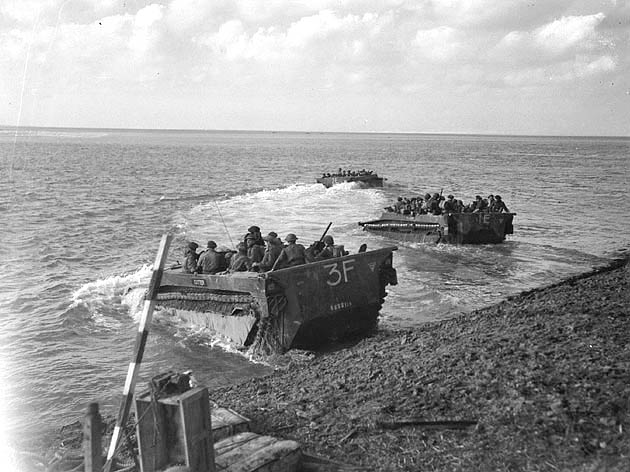
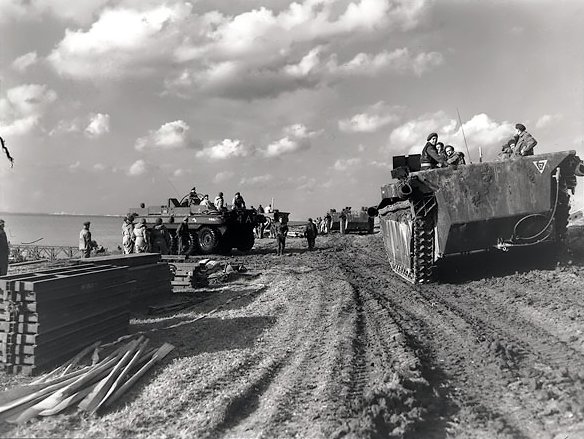
The Canadian 9th Brigade conducted an amphibious operation with the aid of Terrapin (the first use of the vehicle in Europe) and Buffalo amphibious vehicles, crewed by the British 5th Assault Regiment of the Royal Engineers. The brigade planned to cross the mouth of the Braakman Inlet in these vehicles and to land in the vicinity of Hoofdplaat, a tiny hamlet in the rear or coastal side of the pocket, thus exerting pressure from two directions at once. An "after action" report described the scene on the Terneuzen Canal: "As darkness fell only tail lights showed. The locks at Sas Van Gent proved difficult to negotiate, for the Buffaloes were not easily steered when moving slowly. Their aeroplane engines created a sound so like the roar of aircraft that over Flushing the anti-aircraft guns fired sporadically...Because of the damage to the locks near the ferry (at Neuzen) it was necessary to cut ramps in the bank and by-pass the obstacle. Not only was this a slow progress, but many craft were damaged. The decision was therefore taken to postpone the operation for 24 hours". The delay allowed for Ramsay to volunteer the services of Lieutenant-Commander R.D. Franks of the Royal Navy to serve as a pilot, guiding the Buffaloes expertly down the river Scheldt without the Germans noticing. Franks reported: "It was nearly ideal night, calm and quiet with a half moon behind a light cloud, but a bit of haze which restricted visibility to 1.6 km (1 mi) at most. We were quite invisible from the north shore of the Scheldt, where all was quiet [...] Our touchdown was planned to be on either side of a groyne...we were able to identify it and then lie off flicking our lamps to guide the LVT's in. They deployed and thundered past us...I could see through my binoculars the infantry disembark on dry land and move off".
In spite of difficulties in manoeuvring vehicles through the canals and the resulting 24-hour delay, the Germans were taken by surprise and a bridgehead was established. The North Nova Scotia Highlanders landed with no resistance and woke nine sleeping German soldiers at their dug-out, taking them prisoner. The Highland Light Infantry's major problem at the landing site was not the Wehrmacht, but mud. After the initial landing, the Cameron Highlanders and the Stormont, Dundas and Glengarry Highlanders were landed by Franks. Once again, the Germans recovered quickly and counter-attacked with ferocity; however, they were slowly forced back. Upon hearing of the landing at the Braakman Inlet, Model reacted promptly, telling Hitler: "Today, the enemy launched a decision-seeking attack on the Breskens bridgehead". Living up to his reputation as the "Führer's Fireman", Model ordered Eberding to immediately "annihilate" the Highland Brigade.
Starting at daybreak on 10 October, the Highland Brigade came under counter-attack, with the Stormont, Dundas and Glengarry Highlanders, known as the "Glens" in the Canadian Army, spending two days fighting for the village of Hoofdplaat with a loss of 17 dead and 44 wounded. The North Nova Scotia Highlanders took three days to take the village of Driewegen, with the regimental war diary reporting: "The artillery is kept busy and this dyke to dyke fighting is very different to what we have been doing. It appears the enemy are a much better type than we have been running into lately". The Canadian Army was known for the quality of its artillery, which took a heavy toll on the German counter-attacks by day, with the war diary of 15th Field Regiment for 12 October reading: "Today we were the busiest we have been since Cormelles and Falaise pocket days". The Germans' nightly attacks enjoyed more success, with the Highland Light Infantry losing and then retaking the village of Biervliet during a confusing night battle. Canadian Major-General Daniel Spry of the 3rd Division changed the original plan to commit the 8th Brigade in support of the 7th Brigade, and instead sent the 8th Brigade to link up with the 4th Division and then come to the support of the 9th Brigade.
The Canadian 10th Brigade of the 4th Armoured Division crossed the Leopold Canal and advanced at Isabella Polder. Then the 3rd Division's 8th Brigade was called to move south from the coastal side of the pocket. This opened up a land-based supply route into the pocket. Eberding used his reserves in his counter-attacks and reported to the Oberkommando der Wehrmacht that some units of the 64th Division had "been reduced to one third". Between 10 and 15 October, the 64th Division staged a "fighting retreat", as Eberding called it, to a new pocket designed to shorten his lines, since so many of his units were now under-strength. The Canadian Scottish Regiment found the village of Eede empty and abandoned, entered the village and promptly came under heavy artillery bombardment. The Queen's Own Rifles, leading the advance of the 8th Brigade, found the village of IJzendijke "well defended" on 15 October, but abandoned the next day. The Highland Light Infantry and the "Glens" broke through the main German line, but General Spry, unaware of this, ordered a withdrawal, in order to concentrate greater forces.