
Operation Sea Lion, also written as Operation Sealion (German: Unternehmen Seelöwe), was Nazi Germany's code name for their planned invasion of the United Kingdom. It was to have taken place during the Battle of Britain, nine months after the start of the Second World War. Following the armistice with France after the Battle of France, Adolf Hitler, the German Führer and Supreme Commander of the Armed Forces, hoped the British government would accept his offer to end the state of war between the two. He considered invasion to be a last resort, to be used only if all other options had failed.
As a precondition for the invasion of Britain, Hitler demanded both air and naval superiority over the English Channel and the proposed landing sites. The German forces achieved neither at any point of the war. Further, both the German High Command and Hitler himself held serious doubts about the prospects for success. Nevertheless, both the German Army and Navy undertook major preparations for an invasion. These included training troops, developing specialised weapons and equipment, modifying transport vessels and the collection of a large number of river barges and transport ships on the Channel coast. However, in light of mounting Luftwaffe losses in the Battle of Britain and the absence of any sign that the Royal Air Force had been defeated, Hitler postponed Sea Lion indefinitely on 17 September 1940. It was never put into action.
Background
Adolf Hitler hoped for a negotiated peace with the UK and made no preparations for amphibious assault on Britain until the Fall of France. At the time, the only forces with experience and modern equipment for such landings were the Japanese, which they used during the Battle of Wuhan in 1938.

Outbreak of war and fall of Poland
In September 1939, the successful German invasion of Poland infringed on both a French and a British alliance with Poland and both countries declared war on Germany. On 9 October, Hitler's "Directive No. 6 for the Conduct of the War" planned an offensive to defeat these allies and "win as much territory as possible in Holland, Belgium, and northern France to serve as a base for the successful prosecution of the air and sea war against England".
With the prospect of the Channel ports falling under Kriegsmarine (German Navy) control, Grand Admiral (Großadmiral) Erich Raeder (head of the Kriegsmarine) attempted to anticipate the obvious next step that might entail and instructed his operations officer, Kapitän Hansjürgen Reinicke, to draw up a document examining "the possibility of troop landings in England should the future progress of the war make the problem arise". Reinicke spent five days on this study and set forth the following prerequisites:
Eliminating or sealing off Royal Navy forces from the landing and approach areas.
Eliminating the Royal Air Force.
Destroying all Royal Navy units in the coastal zone.
Preventing British submarine action against the landing fleet.
On 22 November 1939, the Head of Luftwaffe (German Air Force) intelligence Joseph "Beppo" Schmid presented his "Proposal for the Conduct of Air Warfare", which argued for a counter to the British blockade and said "Key is to paralyse the British trade" by blocking imports to Britain and attacking seaports. The OKW (Oberkommando der Wehrmacht or "High Command of the Armed Forces") considered the options and Hitler's 29 November "Directive No. 9 – Instructions For Warfare Against The Economy of the Enemy" stated that once the coast had been secured, the Luftwaffe and Kriegsmarine were to blockade UK ports with sea mines, attack shipping and warships, and make air attacks on shore installations and industrial production. This directive remained in force in the first phase of the Battle of Britain.
In December 1939, the German Army issued its own study paper (designated Nordwest) and solicited opinions and input from both the Kriegsmarine and the Luftwaffe. The paper outlined an assault on England's eastern coast between The Wash and the River Thames by troops crossing the North Sea from ports in the Low Countries. It suggested airborne troops as well as seaborne landings of 100,000 infantry in East Anglia, transported by the Kriegsmarine, which was also to prevent Royal Navy ships from getting through the Channel, while the Luftwaffe had to control airspace over the landings. The Kriegsmarine response was focused on pointing out the many difficulties to be surmounted if invading England was to be a viable option. It could not envisage taking on the Royal Navy Home Fleet and said it would take a year to organise shipping for the troops. Reichsmarschall Hermann Göring, head of the Luftwaffe, responded with a single-page letter in which he stated, "[A] combined operation having the objective of landing in England must be rejected. It could only be the final act of an already victorious war against Britain as otherwise the preconditions for success of a combined operation would not be met".
The fall of France
Germany's swift and successful occupation of France and the Low Countries gained control of the Channel coast, facing what Schmid's 1939 report called their "most dangerous enemy". Raeder met Hitler on 21 May 1940 and raised the topic of invasion, but he warned of the risks and expressed a preference for blockade by air, submarines and raiders.
By the end of May, the Kriegsmarine had become even more opposed to invading Britain following its costly victory in Norway; after Operation Weserübung, the Kriegsmarine had only one heavy cruiser, two light cruisers, and four destroyers available for operations. Raeder was strongly opposed to Sea Lion, for over half of the Kriegsmarine surface fleet had been either sunk or badly damaged in Weserübung, and his service was hopelessly outnumbered by the ships of the Royal Navy. British parliamentarians still arguing for peace negotiations were defeated in the May 1940 War Cabinet Crisis, but throughout July the Germans continued with attempts to find a diplomatic solution.
Invasion planning
In a report presented on 30 June, OKW Chief of Staff Alfred Jodl reviewed options to increase pressure on Britain to agree to a negotiated peace, which included a direct invasion on the British Isles or a peripherial strategy against British strongholds in the Mediterranean such as Malta, Gibraltar and the Suez Canal in cooperation with Italy and Spain. The first priority was to eliminate the Royal Air Force and gain air supremacy. Intensified air attacks against shipping and the economy could affect food supplies and civilian morale in the long term. Reprisal attacks of terror bombing had the potential to cause quicker capitulation but the effect on morale was uncertain. Once the Luftwaffe had control of the air and the British economy had been weakened, an invasion would be a last resort or a final strike ("Todesstoss") after the UK had already been practically defeated, but could have a quick result. At a meeting that day, OKH Chief of General Staff Franz Halder heard from Secretary of State Ernst von Weizsäcker that Hitler had turned his attention to Russia. Halder met Admiral Otto Schniewind on 1 July, and they shared views without understanding each other's position. Both thought that air superiority was needed first, and could make the invasion unnecessary. They agreed that minefields and U-boats could limit the threat posed by the Royal Navy; Schniewind emphasised the significance of weather conditions.
On 2 July, the OKW asked the services to start preliminary planning for an invasion, as Hitler had concluded that invasion would be achievable in certain conditions, the first of which was command of the air, and specifically asked the Luftwaffe when this would be achieved. On 4 July, after asking General Erich Marcks to begin planning an attack on Russia, Halder heard from the Luftwaffe that they planned to eliminate the RAF, destroying its aircraft manufacturing and supply systems, with damage to naval forces as a secondary aim. A Luftwaffe report presented to the OKW at a meeting on 11 July said that it would take 14 to 28 days to achieve air superiority. The meeting also heard that Britain was discussing an agreement with Russia. On the same day, Grand Admiral Raeder visited Hitler at the Berghof to persuade him that the best way to pressure the British into a peace agreement would be a siege combining air and submarine attacks. Hitler agreed with him that invasion would be a last resort.
Jodl set out the OKW proposals for the proposed invasion in a memorandum issued on 12 July, which described operation Löwe (Lion) as "a river crossing on a broad front", irritating the Kriegsmarine. On 13 July, Hitler met Field Marshal von Brauchitsch and Halder at Berchtesgaden and they presented detailed plans prepared by the army on the assumption that the navy would provide safe transport. To the surprise of Von Brauchitsch and Halder, and completely at odds with his normal practice, Hitler did not ask any questions about specific operations, had no interest in details, and made no recommendations to improve the plans; instead, he simply told OKW to start preparations.
Directive No. 16: Operation Sea Lion
On 16 July 1940 Hitler issued Führer Directive No. 16, setting in motion preparations for a landing in Britain. He prefaced the order by stating: "As England, despite her hopeless military situation, still shows no signs of willingness to come to terms, I have decided to prepare, and if necessary to carry out, a landing operation against her. This operation aimed to eliminate the English Motherland as a base from which the war against Germany can be continued, and, if necessary, to occupy the country completely." The code name for the invasion was Seelöwe, "Sea Lion".
Hitler's directive set four conditions for the invasion to occur:

The RAF was to be "beaten down in its morale and in fact, that it can no longer display any appreciable aggressive force in opposition to the German crossing".
The English Channel was to be swept of British mines at the crossing points, and the Strait of Dover must be blocked at both ends by German mines.
The coastal zone between occupied France and England must be dominated by heavy artillery.
The Royal Navy must be sufficiently engaged in the North Sea and the Mediterranean so that it could not intervene in the crossing. British home squadrons must be damaged or destroyed by air and torpedo attacks.
This ultimately placed responsibility for Sea Lion's success squarely on the shoulders of Raeder and Göring, neither of whom had the slightest enthusiasm for the venture and, in fact, did little to hide their opposition to it. Nor did Directive 16 provide for a combined operational headquarters, similar to the Allies' creation of the Supreme Headquarters Allied Expeditionary Force (SHAEF) for the later Normandy landings, under which all three service branches (Army, Navy, and Air Force) could work together to plan, co-ordinate, and execute such a complex undertaking.
The invasion was to be on a broad front, from around Ramsgate to beyond the Isle of Wight.
Preparations, including overcoming the RAF, were to be in place by mid August.
Discussion
Grand Admiral Raeder sent a memorandum to OKW on 19 July, complaining about the onus placed on the navy in relation to the army and air force, and stating that the navy would be unable to achieve its objectives.
The first joint services conference on the proposed invasion was held by Hitler in Berlin on 21 July, with Raeder, Brauchitsch, and Luftwaffe Chief of Staff Hans Jeschonnek. Hitler told them that the British had no hope of survival, and ought to negotiate, but were hoping to get Russia to intervene and halt German oil supplies. Invasion was very risky, and he asked them if direct attacks by air and submarine could take effect by mid September. Jeschonnek proposed large bombing attacks so that responding RAF fighters could be shot down. The idea that invasion could be a surprise "river crossing" was dismissed by Raeder, and the navy could not complete its preparations by mid August. Hitler wanted the air attack to commence early in August and, if it succeeded, the invasion was to start around 25 August before weather deteriorated. Hitler's main interest was the question of countering potential Russian intervention. Halder outlined his first thoughts on defeating Russian forces. Detailed plans were to be made to attack the Soviet Union.
Raeder met Hitler on 25 July to report on navy progress: they were not sure if preparations could be completed during August: he was to present plans at a conference on 31 July. On 28 July, he told OKW that ten days would be needed to get the first wave of troops across the Channel, even on a much narrower front. Planning was to resume. In his diary, Halder noted that if what Raeder had said was true, "all previous statements by the navy were so much rubbish and we can throw away the whole plan of invasion". On the next day, Halder dismissed the navy's claims and required a new plan.
The Luftwaffe announced on 29 July that they could begin a major air attack at the start of August, and their intelligence reports gave them confidence of a decisive result. Half of their bombers were to be kept in reserve to support the invasion. At a meeting with the army, the navy proposed delay until May 1941, when the new battleships Bismarck and Tirpitz would be ready. A navy memorandum issued on 30 July said invasion would be vulnerable to the Royal Navy, and autumn weather could prevent necessary maintenance of supplies. The OKW assessed alternatives, including attacking the British in the Mediterranean, and favoured extended operations against England while remaining on good terms with Russia.
At the Berghof conference on 31 July, the Luftwaffe were not represented. Raeder said barge conversions would take until 15 September, leaving the only possible 1940 invasion dates as 22–26 September, when weather was likely to be unsuitable. Landings would have to be on a narrow front and would be better in spring 1941. Hitler wanted the invasion in September as the British army was increasing in strength. After Raeder left, Hitler told von Brauchitsch and Halder that the air attack was to start around 5 August; eight to fourteen days after that, he would decide on the landing operation. London was showing new-found optimism, and he attributed this to their hopes of intervention by Russia, which Germany was to attack in the spring of 1941.
Air and sea warfare against England
On 1 August 1940, through Führer Directive No.17, Hitler instructed intensified air and sea warfare to "establish the necessary conditions for the final conquest of England". From 5 August, subject to weather delays, the Luftwaffe was "to overpower the English Air Force with all the forces at its command, in the shortest possible time." Attacks were then to be made on ports and food stocks, while leaving alone ports to be used in the invasion, and "air attacks on enemy warships and merchant ships may be reduced except where some particularly favourable target happens to present itself." The Luftwaffe was to keep sufficient forces in reserve for the proposed invasion and was not to target civilians without a direct order from Hitler in response to RAF terror bombing. No decision had been reached on the choice between immediate decisive action and a siege. The Germans hoped the air action would force the British to negotiate and make invasion unnecessary.
Land forces
In the Army plan of 25 July 1940, the invasion force was to be organised into two army groups drawn from the 6th Army, the 9th Army and the 16th Army. The first wave of the landing would have consisted of thirteen infantry and mountain divisions, the second wave of eight panzer and motorised infantry divisions and finally, the third wave was formed of six further infantry divisions. The initial assault would have also included two airborne divisions under Luftwaffe command, and the special forces of the Brandenburg Regiment, controlled by the Abwehr.
This initial plan was vetoed by opposition from both the Kriegsmarine and the Luftwaffe, who successfully argued that an amphibious force could only be assured air and naval protection if confined to a narrow front, and that the landing areas should be as far from Royal Navy bases as possible. The definitive order of battle adopted on 30 August 1940 envisaged a first wave of nine divisions from the 9th and 16th armies landing along four stretches of beach – two infantry divisions on beach 'B' between Folkestone and New Romney supported by a special forces company of the Brandenburg Regiment, two infantry divisions on beach 'C' between Rye and Hastings supported by three battalions of submersible/floating tanks, two infantry divisions on beach 'D' between Bexhill and Eastbourne supported by one battalion of submersible/floating tanks and a second company of the Brandenburg Regiment, and three infantry divisions on beach 'E' between Beachy Head and Brighton. A single airborne division would land in Kent north of Hythe; with the objective of seizing the aerodrome at Lympne and bridge-crossings over the Royal Military Canal, and in assisting the ground forces in capturing Folkestone. Folkestone (to the east) and Newhaven (to the west) were the only cross-channel port facilities that would have been accessible to the invasion forces; and much depended on these being captured substantially intact or with the capability of rapid repair; in which case the second wave of eight divisions (including all the motorised and armoured divisions) might be unloaded directly onto their respective quaysides. A further six infantry divisions were allocated to the third wave.
The order of battle defined on 30 August remained as the agreed overall plan but was always considered as potentially subject to change if circumstances demanded it. The Army High Command continued to press for a wider landing area if possible, against the opposition of the Kriegsmarine; in August they had won the concession that, if the opportunity arose, a force might be landed directly from ships onto the seafront at Brighton, perhaps supported by a second airborne force landing on the South Downs. Contrariwise, the Kriegsmarine (fearful of possible fleet action against the invasion forces from Royal Navy ships in Portsmouth) insisted that the divisions enshipped from Cherbourg and Le Havre for landing on beach 'E', might be diverted to any one of the other beaches where sufficient space allowed.
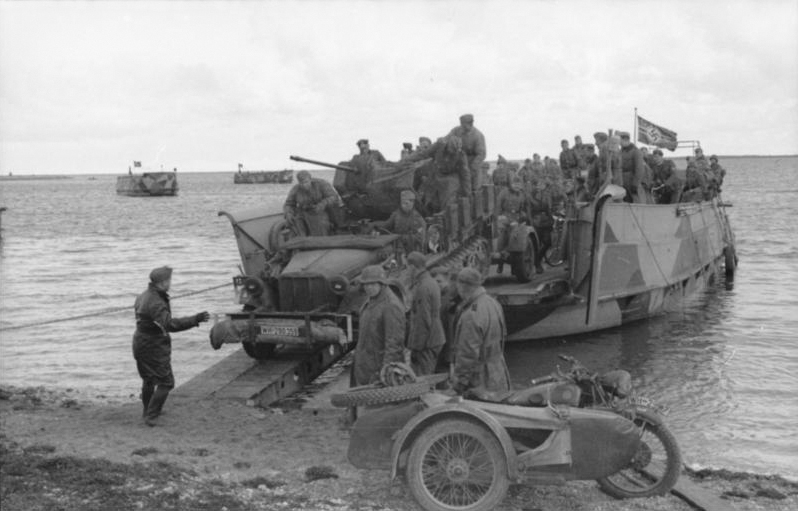
Each of the first wave landing forces was divided into three echelons. The first echelon, carried across the Channel on barges, coasters and small motor launches, would consist of the main infantry assault force. The second echelon, carried across the Channel in larger transport vessels, would consist predominantly of artillery, armoured vehicles and other heavy equipment. The third echelon, carried across the channel on barges, would consist of the vehicles, horses, stores and personnel of the division-level support services. Loading of barges and transports with heavy equipment, vehicles and stores would start in Antwerp nine days before the first day of Operation Sealion ("S-Tag" minus nine); and S-Tag minus eight in Dunkirk, with horses not loaded till S-Tag minus two. All troops would be loaded onto their barges from French or Belgian ports on S-Tag minus two or S-Tag minus one. The first echelon would land on the beaches on S-Tag itself, preferably at daybreak around two hours after high tide. The barges used for the first echelon would be retrieved by tugs on the afternoon of S-Tag, and those still in working order would be drawn up alongside the transport vessels to trans-ship the second echelon overnight, so that much of the second echelon and third echelon could land on S-Tag plus one, with the remainder on S-Tag plus two. The Navy intended that all four invasion fleets would return across the Channel on the night of S-Tag plus two, having been moored for three full days off the South coast of England. The Army had sought to have the third echelon cross in later separate convoys to avoid men and horses having to wait for as long as four days and nights in their barges, but the Kriegsmarine were insistent that they could only protect the four fleets from Royal Navy attack if all vessels crossed the Channel together. A total of 138,000 men would have been landed in the first two days, rising to 248,000 within the first fortnight.
In the summer of 1940, the headquarters staff of the British Army's Commander-in-Chief, Home Forces tended to consider East Anglia and the East coast to be the most likely landing sites for a German invasion force, as this would have offered much greater opportunities to seize ports and natural harbours, and would be further from naval forces at Portsmouth. But then the accumulation of invasion barges in French ports from late August 1940 rather indicated a landing on the South coast. Consequently, the main Home Forces mobile reserve force was held back around London, so as to be able to move forwards to protect the capital, either into Kent or Essex. Hence, Sea Lion landings in Kent and Sussex would have been initially opposed by XII Corps of Eastern Command with three infantry divisions and two independent brigades and V Corps of Southern Command with three infantry divisions. In reserve were two more Corps under GHQ Home Forces; located south of London was the VII Corps with the 1st Canadian Infantry Division, an armoured division and an independent armoured brigade, while north of London was IV Corps with an armoured division, infantry division and independent infantry brigade. See British army anti invasion preparations.
Air power
Airborne forces
The success of the German invasion of Denmark and Norway, on 9 April 1940, had relied extensively on the use of paratroop and glider-borne formations (Fallschirmjäger) to capture key defensive points in advance of the main invasion forces. The same airborne tactics had also been used in support of the invasions of Belgium and the Netherlands on 10 May 1940. However, although spectacular success had been achieved in the airborne assault on Fort Eben-Emael in Belgium, German airborne forces had come close to disaster in their attempt to seize the Dutch government and capital of The Hague. Around 1,300 of the 22nd Air Landing Division had been captured (subsequently shipped to Britain as prisoners of war), around 250 Junkers Ju 52 transport aircraft had been lost, and several hundred elite paratroops and air-landing infantry had been killed or injured. Consequently, even in September 1940 the Luftwaffe had the capacity to provide only around 3,000 airborne troops to participate in the first wave of Operation Sea Lion.
Battle of Britain
The Battle of Britain began in early July 1940 with attacks on shipping and ports in the Kanalkampf, which forced RAF Fighter Command into defensive action. In addition, wider raids gave aircrew experience of day and night navigation and tested the defences. On 13 August, the German Luftwaffe began a series of concentrated aerial attacks (designated Unternehmen Adlerangriff or Operation Eagle Attack) on targets throughout the United Kingdom in an attempt to destroy the RAF and establish air superiority over Great Britain. The change in emphasis of the bombing from RAF bases to bombing London, however, turned Adlerangriff into a short-range strategic bombing operation.
The effect of the switch in strategy is disputed. Some historians argue the change in strategy lost the Luftwaffe the opportunity of winning the air battle or air superiority. Others argue the Luftwaffe achieved little in the air battle and the RAF was not on the verge of collapse, as often claimed. Another perspective has also been put forward, which suggests the Germans could not have gained air superiority before the weather window closed. Others have said that it was unlikely the Luftwaffe would ever have been able to destroy RAF Fighter Command. If British losses became severe, the RAF could simply have withdrawn northward and regrouped. It could then deploy if the Germans launched an invasion. Most historians agree Sea Lion would have failed regardless because of the weakness of the German Kriegsmarine compared to the Royal Navy.
Limitations of the Luftwaffe
The record of the Luftwaffe against naval combat vessels up to that point in the war was poor. In the Norwegian campaign, despite eight weeks of continuous air supremacy, the Luftwaffe sank only two British warships: the light cruiser HMS Curlew and the destroyer HMS Gurkha. The German aircrews were not trained or equipped to attack fast-moving naval targets, particularly agile naval destroyers or motor torpedo boats (MTB). The Luftwaffe also lacked armour-piercing bombs and their only aerial torpedo capability, essential for defeating larger warships, consisted of a small number of slow and vulnerable Heinkel He 115 floatplanes. The Luftwaffe made 21 deliberate attacks on small torpedo boats during the Battle of Britain, sinking none. The British had between 700 and 800 small coastal craft (MTBs, Motor Gun Boats and smaller vessels), making them a critical threat if the Luftwaffe could not deal with the force. Only nine MTBs were lost to air attack out of 115 sunk by various means throughout the Second World War. Only nine destroyers were sunk by air attack in 1940, out of a force of over 100 operating in British waters at the time. Only five were sunk while evacuating Dunkirk, despite large periods of German air superiority, thousands of sorties flown, and hundreds of tons of bombs dropped. The Luftwaffe's record against merchant shipping was also unimpressive: it sank only one in every 100 British vessels passing through British waters in 1940, and most of this total was achieved using mines.
Luftwaffe special equipment
Had an invasion taken place, the Bf 110 equipped Erprobungsgruppe 210 would have dropped Seilbomben just prior to the landings. This was a secret weapon which would have been used to blackout the electricity network in south-east England. The equipment for dropping the wires was fitted to the Bf 110 aeroplanes and tested. It involved dropping extraneous wires across high voltage lines to create short-circuits and was probably as dangerous to the aircraft crews as to the British.
Italian air force
Upon hearing of Hitler's intentions, Italian dictator Benito Mussolini, through his Foreign Minister Count Galeazzo Ciano, quickly offered up to ten divisions and thirty squadrons of Italian aircraft for the proposed invasion. Hitler initially declined any such aid but eventually allowed a small contingent of Italian fighters and bombers, the Italian Air Corps (Corpo Aereo Italiano or CAI), to assist in the Luftwaffe's aerial campaign over Britain in October and November 1940.
Navy
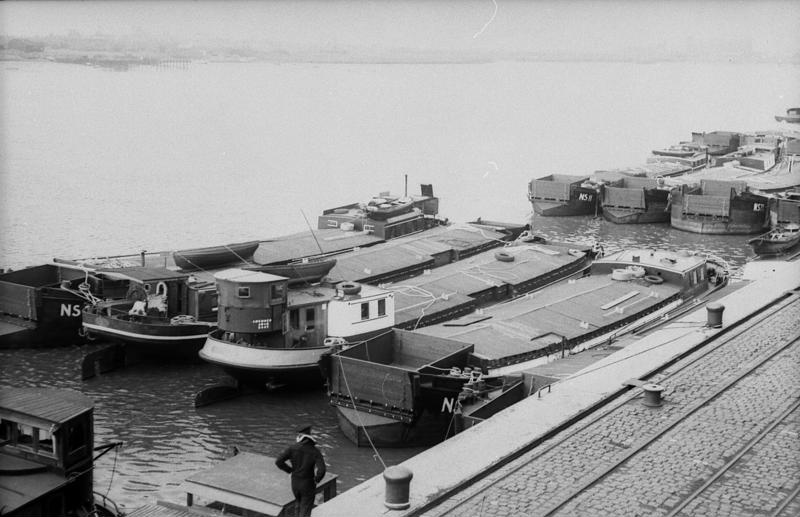
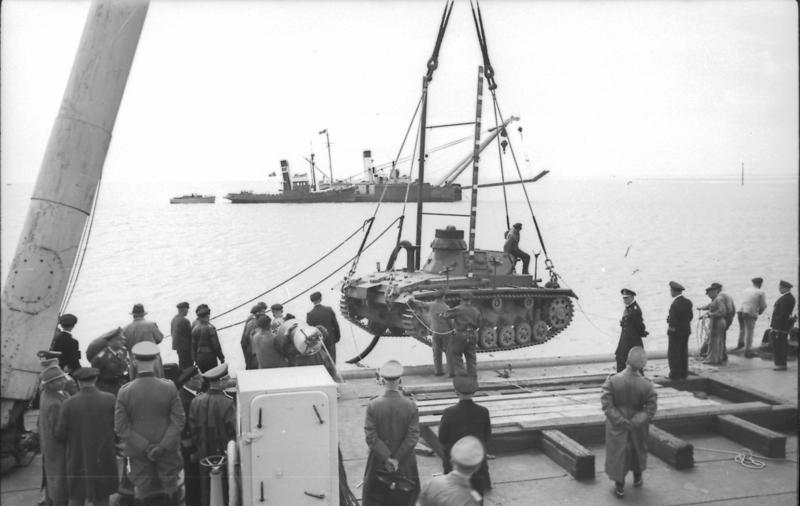
The most daunting problem for Germany in protecting an invasion fleet was the small size of its navy. The Kriegsmarine, already numerically far inferior to Britain's Royal Navy, had lost a sizeable portion of its large modern surface ships in April 1940 during the Norwegian campaign, either as complete losses or due to battle damage. In particular, the loss of two light cruisers and ten destroyers was crippling, as these were the very warships most suited to operating in the Channel narrows where the invasion would likely take place. Most U-boats, the most powerful arm of the Kriegsmarine, were meant for destroying ships, not supporting an invasion.
Although the Royal Navy could not bring the whole of its naval superiority to bear – as most of the fleet was engaged in the Atlantic and Mediterranean, and a substantial proportion had been detached to support Operation Menace against Dakar – the British Home Fleet still had a very large advantage in numbers. It was debatable whether British ships were as vulnerable to enemy air attack as the Germans hoped. During the Dunkirk evacuation, few warships were actually sunk, despite being stationary targets. The overall disparity between the opposing naval forces made the amphibious invasion plan extremely risky, regardless of the outcome in the air. In addition, the Kriegsmarine had allocated its few remaining larger and more modern ships to diversionary operations in the North Sea.
The fleet of defeated France, one of the most powerful and modern in the world, might have tipped the balance against Britain if it had been captured by the Germans. However, the pre-emptive destruction of a large part of the French fleet by the British Attack on Mers-el-Kébir on 3 July 1940 ensured that this could not happen.