
Nikita Sergeyevich Khrushchev (15 April [O.S. 3 April] 1894 – 11 September 1971) was the First Secretary of the Communist Party of the Soviet Union from 1953 to 1964 and the Chairman of the Council of Ministers from 1958 to 1964. As leader of the Soviet Union, he shocked the world by denouncing his predecessor Joseph Stalin, embarking on a campaign of de-Stalinization, and presiding over the Cuban Missile Crisis in 1962.
Born in a village near Kursk, Khrushchev was employed as a metal worker during his youth and was a political commissar in the Russian Civil War. Under the sponsorship of Lazar Kaganovich, he rose through the ranks of the Soviet hierarchy. During Stalin's rule, he actively supported the Great Purge and approved thousands of arrests, and in 1938 was sent to govern the Ukrainian SSR, where he continued the purges. During World War II, Khrushchev was again a commissar, serving as an intermediary between Stalin and his generals. He was also present at the Battle of Stalingrad, a fact in which he took great pride. After the war, Khrushchev returned to Ukraine before eventually being recalled to Moscow as one of Stalin's close advisers.
On 5 March 1953, the death of Stalin triggered a power struggle in which Khrushchev ultimately emerged victorious upon consolidating his authority as First Secretary of the party's Central Committee and eliminating his rival Lavrentiy Beria. On 25 February 1956, at the 20th Party Congress, he delivered the "Secret Speech", which denounced Stalin's purges and ushered in a less repressive era in the Soviet Union. His domestic policies, aimed at bettering the lives of ordinary citizens, were often ineffective, especially in agriculture. Hoping eventually to rely on missiles for national defense, Khrushchev ordered major cuts in conventional forces. Despite such cuts, Khrushchev's time in office saw the tensest years of the Cold War, culminating in the 1962 Cuban Missile Crisis.
As leader of the Soviet Union, Khrushchev enjoyed considerable popularity during the late 1950s due to the successful launching of Sputnik in 1957 as well as favorable outcomes in the 1956 Suez Crisis, 1957 Syrian Crisis, and the 1960 U-2 incident. However, by the early 1960s, Khrushchev's hold on power had been significantly weakened by his domestic policy failures and handling of the Cuban Missile Crisis. As a result, his rivals consolidated enough support among the nomenklatura to oust him from the Soviet leadership on 14 October 1964. Following his forced retirement, Khrushchev spent much of his time composing a series of lengthy memoirs which were smuggled to the West and published in part in 1970. He died the next year in his dacha.
Early life
Nikita Sergeyevich Khrushchev was born on 15 April 1894 in Kalinovka, a Russian village in what is now the Khomutovsky District of Kursk Oblast, near the present Ukrainian border. At the time, Kalinovka was part of Dmitriyevsky Uyezd in the Kursk Governorate of the Russian Empire. His parents, Sergei Khrushchev and Kseniya Khrushcheva were poor Russian peasants, and had a daughter two years Nikita's junior, Irina. Sergei Khrushchev was employed in a number of positions in the Donbas area of far eastern Ukraine, working as a railwayman, as a miner, and laboring in a brick factory. Wages were much higher in the Donbas than in the Kursk region, and Sergei Khrushchev generally left his family in Kalinovka, returning when he had enough money. When Nikita was six or seven, the family moved to Yuzovka (now Donetsk) for about a year before returning to Kalinovka.
Kalinovka was a peasant village; Khrushchev's teacher, Lydia Shevchenko, later stated that she had never seen a village as poor. Nikita worked as a herdsboy from an early age. He was schooled for a total of four years, part in the village school and part under Shevchenko's tutelage in Kalinovka's state school. According to Khrushchev's memoirs, Shevchenko was a freethinker who upset the villagers by not attending church, and when her brother visited, she gave Khrushchev books which had been banned by the Imperial Government. She urged Nikita to seek further education, but family finances did not permit this.

In 1908, Sergei Khrushchev moved to the Donbas city of Yuzovka; fourteen-year-old Nikita followed later that year, while Kseniya Khrushcheva and her daughter came after. Yuzovka, which was renamed Stalino in 1924 and Donetsk in 1961, was at the heart of one of the most industrialized areas of the Russian Empire. After working briefly in other fields, Khrushchev's parents found Nikita a place as a metal fitter's apprentice. Upon completing that apprenticeship, the teenage Khrushchev was hired by a factory. He lost that job when he collected money for the families of the victims of the Lena Goldfields massacre, and was hired to mend underground equipment by a mine in nearby Ruchenkovo, where his father was the union organizer, and he helped distribute copies and organize public readings of Pravda. He later stated that he considered emigrating to the United States for better wages, but did not do so. He later recalled his working days:
I started working as soon as I learned how to walk. Until the age of fifteen, I worked as a shepherd. I tended, as the foreigners say when they use the Russian language, "the little cows," I was a sheepherder, I herded cows for a capitalist, and that was before I was fifteen. After that, I worked at a factory for a German, and I worked in a French-owned mine, I worked at a Belgian-owned chemical factory, and [now] I'm the Prime Minister of the great Soviet state. And I am in no way ashamed of my past because all work is worthy of respect. Work as such cannot be dirty, it is only conscience that can be.
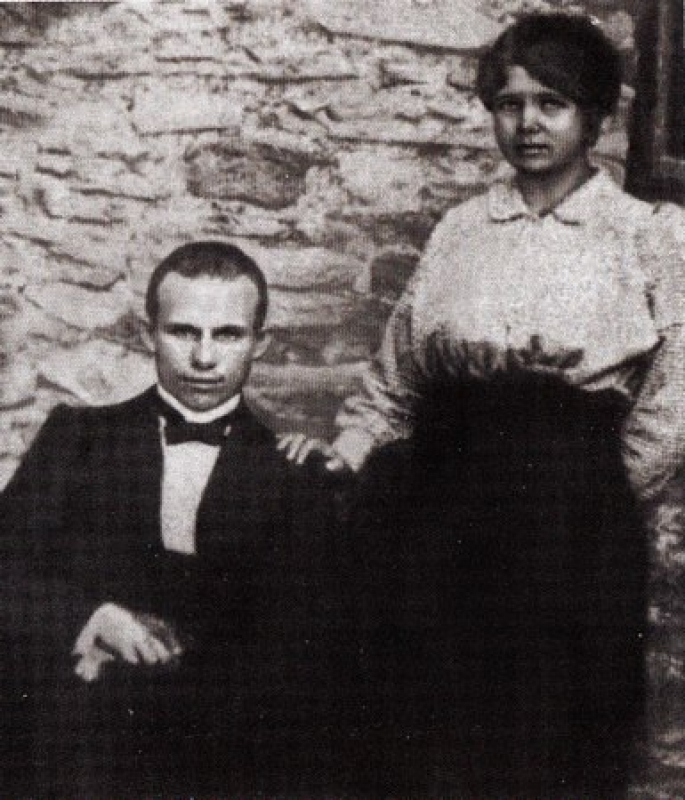
When World War I broke out in 1914, Khrushchev was exempt from conscription because he was a skilled metal worker. He was employed by a workshop that serviced ten mines, and he was involved in several strikes that demanded higher pay, better working conditions, and an end to the war. In 1914, he married Yefrosinia Pisareva, daughter of the lift operator at the Rutchenkovo mine. In 1915, they had a daughter, Yulia, and in 1917, a son, Leonid.

After the abdication of Tsar Nicholas II in 1917, the new Russian Provisional Government in Petrograd had little influence over Ukraine. Khrushchev was elected to the worker's council (or soviet) in Rutchenkovo, and in May he became its chairman. He did not join the Bolsheviks until 1918, a year in which the Russian Civil War, between the Bolsheviks and a coalition of opponents known as the White Army, began in earnest. His biographer, William Taubman, suggests that Khrushchev's delay in affiliating himself with the Bolsheviks was because he felt closer to the Mensheviks who prioritized economic progress, whereas the Bolsheviks sought political power. In his memoirs, Khrushchev indicated that he waited because there were many groups, and it was difficult to keep them all straight.
In March 1918, as the Bolshevik government concluded a separate peace with the Central Powers, the Germans occupied the Donbas and Khrushchev fled to Kalinovka. In late 1918 or early 1919, he was mobilized into the Red Army as a political commissar. The post of political commissar had recently been introduced as the Bolsheviks came to rely less on worker activists and more on military recruits; its functions included the indoctrination of recruits in the tenets of Bolshevism, and promoting troop morale and battle readiness. Beginning as commissar to a construction platoon, Khrushchev rose to become commissar to a construction battalion and was sent from the front for a two-month political course. The young commissar came under fire many times, though many of the war stories he would tell in later life dealt more with cultural awkwardness rather than combat. In 1921, the civil war ended, and Khrushchev was demobilized and assigned as commissar to a labor brigade in the Donbas, where he and his men lived in poor conditions.
The wars had caused widespread devastation and famine, and one of the victims was Khrushchev's wife, Yefrosinia, who died of typhus in Kalinovka while Khrushchev was in the army. The commissar returned for the funeral and, loyal to his Bolshevik principles, refused to allow his wife's coffin to enter the local church. With the only way into the churchyard through the church, he had the coffin lifted and passed over the fence into the burial ground, shocking the village.

Party official
Donbas years
Through the intervention of a friend, Khrushchev was assigned in 1921 as assistant director for political affairs for the Rutchenkovo mine in the Donbas region, where he had previously worked. There were as yet few Bolsheviks in the area. At that time, the movement was split by Lenin's New Economic Policy. While Khrushchev's responsibility lay in political affairs, he involved himself in the practicalities of resuming full production at the mine after the chaos of the war years. He helped restart the machines (key parts and papers had been removed by the pre-Soviet mine-owners) and he wore his old mine outfit for inspection tours.
Khrushchev was highly successful at the Rutchenkovo mine, and in mid-1922 he was offered the directorship of the nearby Pastukhov mine. However, he refused the offer, seeking to be assigned to the newly established technical college (tekhnikum) in Yuzovka, though his superiors were reluctant to let him go. As he had only four years of formal schooling, he applied to the training program (rabfak, short for Рабочий факультет / Rabotchyi Fakultyet, or Worker's Faculty) attached to the tekhnikum that was designed to bring undereducated students to high-school level, a prerequisite for entry into the tekhnikum. While enrolled in the rabfak, Khrushchev continued his work at the Rutchenkovo mine.
One of his teachers later described him as a poor student. He was more successful in advancing in the Communist Party; soon after his admission to the rabfak in August 1922, he was appointed party secretary of the entire tekhnikum, and became a member of the bureau—the governing council—of the party committee for the town of Yuzovka (renamed Stalino in 1924). He briefly joined supporters of Leon Trotsky against those of Joseph Stalin over the question of party democracy. All of these activities left him with little time for his schoolwork, and while he later said he had finished his rabfak studies, it is unclear whether this was true.

According to William Taubman, Khrushchev's studies were aided by Nina Petrovna Kukharchuk, a well-educated Party organizer and daughter of well-to-do Ukrainian peasants. The family was poor, according to Nina's own recollections. The two lived together as husband and wife for the rest of Khrushchev's life, though they never registered their marriage. They had three children together: daughter Rada was born in 1929, son Sergei in 1935, and daughter Elena in 1937.
In mid-1925, Khrushchev was appointed Party secretary of the Petrovo-Marinsky raikom, or district, near Stalino. The raikom was about 1,000 square kilometres (400 sq mi) in area, and Khrushchev was constantly on the move throughout his domain, taking an interest in even minor matters. In late 1925, Khrushchev was elected a non-voting delegate to the 14th Congress of the USSR Communist Party in Moscow.
Kaganovich protégé
Khrushchev met Lazar Kaganovich as early as 1917. In 1925, Kaganovich became Party head in Ukraine and Khrushchev, falling under his patronage, was rapidly promoted. He was appointed second in command of Stalin's party apparatus in late 1926. Within nine months his superior, Konstantin Moiseyenko, was ousted, which, according to Taubman, was due to Khrushchev's instigation. Kaganovich transferred Khrushchev to Kharkov, then the capital of Ukraine, as head of the Organizational Department of the Ukrainian Party's Central Committee. In 1928, Khrushchev was transferred to Kiev, where he served as head of the organizational department, second-in-command of the Party organization there.

In 1929, Khrushchev again sought to further his education, following Kaganovich (now in the Kremlin as a close associate of Stalin) to Moscow and enrolling in the Stalin Industrial Academy. Khrushchev never completed his studies there, but his career in the Party flourished. When the school's Party cell elected a number of rightists to an upcoming district Party conference, the cell was attacked in Pravda. Khrushchev emerged victorious in the ensuing power struggle, becoming Party secretary of the school, arranging for the delegates to be withdrawn, and, afterward, purging the cell of the rightists. Khrushchev rose rapidly through the Party ranks, first becoming Party leader for the Bauman district, site of the academy, before taking the same position in the Krasnopresnensky district, the capital's largest and most important. By 1932, Khrushchev had become second in command, behind Kaganovich, of the Moscow city Party organization, and in 1934, he became Party leader for the city and a member of the Party's Central Committee. Khrushchev attributed his rapid rise to his acquaintance with fellow Academy student Nadezhda Alliluyeva, Stalin's wife. In his memoirs, Khrushchev stated that Alliluyeva spoke well of him to her husband. His biographer, William Tompson, downplays the possibility, stating that Khrushchev was too low in the Party hierarchy to enjoy Stalin's patronage and that if influence was brought to bear on Khrushchev's career at this stage, it was by Kaganovich.
While head of the Moscow city organization, Khrushchev superintended the construction of the Moscow Metro, a highly expensive undertaking, with Kaganovich in overall charge. Faced with an already-announced opening date of 7 November 1934, Khrushchev took considerable risks in the construction and spent much of his time down in the tunnels. When the inevitable accidents did occur, they were depicted as heroic sacrifices in a great cause. The Metro did not open until 1 May 1935, but Khrushchev received the Order of Lenin for his role in its construction. Later that year, he was selected as First Secretary of the Moscow Regional Committee which was responsible for Moscow oblast, a province with a population of 11 million.
Involvement in purges
Stalin's office records show meetings at which Khrushchev was present as early as 1932. The two increasingly built a good relationship. Khrushchev greatly admired the dictator and treasured informal meetings with him and invitations to Stalin's dacha, while Stalin felt warm affection for his young subordinate. Beginning in 1934, Stalin began a campaign of political repression known as the Great Purge, during which many were executed or sent to the Gulag. Central to this campaign were the Moscow Trials, a series of show trials of the purged top leaders of the party and the military. In 1936, as the trials proceeded, Khrushchev expressed his vehement support:
Everyone who rejoices in the successes achieved in our country, the victories of our party led by the great Stalin, will find only one word suitable for the mercenary, fascist dogs of the Trotskyite-Zinovievite gang. That word is execution.
Khrushchev assisted in the purge of many friends and colleagues in the Moscow oblast. Of 38 top Party officials in Moscow city and province, 35 were killed—the three survivors were transferred to other parts of the USSR. Of the 146 Party secretaries of cities and districts outside Moscow city in the province, only 10 survived the purges. In his memoirs, Khrushchev noted that almost everyone who worked with him was arrested. By Party protocol, Khrushchev was required to approve these arrests and did little or nothing to save his friends and colleagues.
Party leaders were given numerical quotas of "enemies" to be turned in and arrested. In June 1937, the Politburo set a quota of 35,000 enemies to be arrested in Moscow province; 5,000 of these were to be executed. In reply, Khrushchev asked that 2,000 wealthy peasants, or kulaks living in Moscow be killed in part fulfillment of the quota. In any event, only two weeks after receiving the order, Khrushchev was able to report to Stalin that 41,305 "criminal and kulak elements" had been arrested. Of the arrestees, according to Khrushchev, 8,500 deserved execution.
Khrushchev had no reason to think himself immune from the purges, and in 1937, confessed his own 1923 dalliance with Trotskyism to Kaganovich, who, according to Khrushchev, "blanched" (for his protégé's sins could affect his own standing) and advised him to tell Stalin. The dictator took the confession in his stride, and, after initially advising Khrushchev to keep it quiet, suggested that Khrushchev tell his tale to the Moscow party conference. Khrushchev did so, to applause, and was immediately reelected to his post. Khrushchev related in his memoirs that he was also denounced by an arrested colleague. Stalin told Khrushchev of the accusation personally. Khrushchev speculated in his memoirs that had Stalin doubted his reaction, he would have been categorized as an enemy of the people then and there. Nonetheless, Khrushchev became a candidate member of the Politburo on 14 January 1938 and a full member in March 1939.
In late 1937, Stalin appointed Khrushchev as head of the Communist Party in Ukraine. Khrushchev left Moscow for Kiev, again the Ukrainian capital, in January 1938. Ukraine had been the site of extensive purges, with the murdered including professors in Stalino whom Khrushchev greatly respected. The high ranks of the Party were not immune; the Central Committee of Ukraine was so devastated that it could not convene a quorum. After Khrushchev's arrival, the pace of arrests accelerated. All but one member of the Ukrainian Politburo Organizational Bureau and Secretariat were arrested. Almost all government officials and Red Army commanders were replaced. During the first few months after Khrushchev's arrival, almost everyone arrested was executed.
Biographer William Taubman suggested that because Khrushchev was again unsuccessfully denounced while in Kiev, he must have known that some of the denunciations were not true and that innocent people were suffering. In 1939, Khrushchev addressed the Fourteenth Ukrainian Party Congress, saying "Comrades, we must unmask and relentlessly destroy all enemies of the people. But we must not allow a single honest Bolshevik to be harmed."
World War II
Invasion of Poland and subsequent occupation
When Soviet troops, pursuant to the Molotov–Ribbentrop Pact, invaded the eastern portion of Poland on 17 September 1939, Khrushchev accompanied the troops at Stalin's direction. A large number of ethnic Ukrainians lived in the invaded area, much of which today forms the western portion of Ukraine. Many inhabitants initially welcomed the invasion, though they hoped that they would eventually become independent. Khrushchev's role was to ensure that the occupied areas voted for union with the USSR. Through a combination of propaganda, deception as to what was being voted for, and outright fraud, the Soviets ensured that the assemblies elected in the new territories would unanimously petition for union with the USSR. When the new assemblies did so, their petitions were granted by the USSR Supreme Soviet, and Western Ukraine became a part of the Ukrainian Soviet Socialist Republic on 1 November 1939. Clumsy actions by the Soviets, such as staffing Western Ukrainian organizations with Eastern Ukrainians, and giving confiscated land to collective farms (kolkhozes) rather than to peasants, soon alienated Western Ukrainians, damaging Khrushchev's efforts to achieve unity.
War against Germany
When Nazi Germany invaded the USSR, in June 1941, Khrushchev was still at his post in Kiev. Stalin appointed him a political commissar, and Khrushchev served on a number of fronts as an intermediary between the local military commanders and the political rulers in Moscow. Stalin used Khrushchev to keep commanders on a tight leash, while the commanders sought to have him influence Stalin.
As the Germans advanced, Khrushchev worked with the military to defend and save Kiev. Handicapped by orders from Stalin that under no circumstances should the city be abandoned, the Red Army was soon encircled by the Germans. While the Germans stated they took 655,000 prisoners, according to the Soviets, 150,541 men out of 677,085 escaped. Primary sources differ on Khrushchev's involvement. According to Marshal Georgy Zhukov, writing some years after Khrushchev fired and disgraced him in 1957, Khrushchev persuaded Stalin not to evacuate troops from Kiev. However, Khrushchev noted in his memoirs that he and Marshal Semyon Budyonny proposed redeploying Soviet forces to avoid the encirclement until Marshal Semyon Timoshenko arrived from Moscow with orders for the troops to hold their positions. Early Khrushchev biographer Mark Frankland suggested that Khrushchev's faith in his leader was first shaken by the Red Army's setbacks. Khrushchev stated in his memoirs:
But let me return to the enemy breakthrough in the Kiev area, the encirclement of our group, and the destruction of the 37th Army. Later, the Fifth Army also perished ... All of this was senseless, and from the military point of view, a display of ignorance, incompetence, and illiteracy. ... There you have the result of not taking a step backward. We were unable to save these troops because we didn't withdraw them, and as a result, we simply lost them. ... And yet it was possible to allow this not to happen.
In 1942, Khrushchev was on the Southwest Front, and he and Timoshenko proposed a massive counteroffensive in the Kharkov area. Stalin approved only part of the plan, but 640,000 Red Army soldiers were involved in the offensive. The Germans, however, had deduced that the Soviets were likely to attack at Kharkov, and set a trap. Beginning on 12 May 1942, the Soviet offensive initially appeared successful, but within five days the Germans had driven deep into the Soviet flanks, and the Red Army troops were in danger of being cut off. Stalin refused to halt the offensive, and the Red Army divisions were soon encircled by the Germans. The USSR lost about 267,000 soldiers, including more than 200,000 captured, and Stalin demoted Timoshenko and recalled Khrushchev to Moscow. While Stalin hinted at arresting and executing Khrushchev, he allowed the commissar to return to the front by sending him to Stalingrad.
Khrushchev reached the Stalingrad Front in August 1942, soon after the start of the battle for the city. His role in the Stalingrad defense was not major—General Vasily Chuikov, who led the city's defense, mentions Khrushchev only briefly in a memoir published while Khrushchev was premier—but to the end of his life, he was proud of his role. Though he visited Stalin in Moscow on occasion, he remained in Stalingrad for much of the battle and was nearly killed at least once. He proposed a counterattack, only to find that Georgy Zhukov and other generals had already planned Operation Uranus, a plan to break out from Soviet positions and encircle and destroy the Germans; it was being kept secret. Before Uranus was launched, Khrushchev spent much time checking on troop readiness and morale, interrogating Nazi prisoners, and recruiting some for propaganda purposes.
Soon after Stalingrad, Khrushchev met with personal tragedy, as his son Leonid, a fighter pilot, was apparently shot down and killed in action on 11 March 1943. The circumstances of Leonid's death remain obscure and controversial, as none of his fellow fliers stated that they witnessed him being shot down, nor was his plane found or body recovered. One theory has Leonid surviving the crash and collaborating with the Germans, and when he was recaptured by the Soviets, Stalin ordering him shot despite Khrushchev pleading for his life. This supposed killing is used to explain why Khrushchev later denounced Stalin. While there is no supporting evidence for this account in Soviet files, some historians allege that Leonid Khrushchev's file was tampered with after the war. In later years, Leonid Khrushchev's wingmate stated that he saw his plane disintegrate, but did not report it. Khrushchev biographer Taubman speculates that this omission was most likely to avoid the possibility of being seen as complicit in the death of the son of a Politburo member. In mid-1943, Leonid's wife, Liuba Khrushcheva, was arrested on accusations of spying and sentenced to five years in a labor camp, and her son (by another relationship), Tolya, was placed in orphanages. Leonid's daughter, Yulia, was raised by Nikita Khrushchev and his wife.
After Uranus forced the Germans into retreat, Khrushchev served on other fronts of the war. He was attached to Soviet troops at the Battle of Kursk, in July 1943, which turned back the last major German offensive on Soviet soil. Khrushchev related that he interrogated an SS defector, learning that the Germans intended an attack—a claim dismissed by his biographer Taubman as "almost certainly exaggerated". He accompanied Soviet troops as they took Kiev in November 1943, entering the shattered city as Soviet forces drove out German troops. As Soviet forces met with greater success, driving the Nazis westwards towards Germany, Nikita Khrushchev became increasingly involved in reconstruction work in Ukraine. He was appointed Premier of the Ukrainian SSR in addition to his earlier party post, one of the rare instances in which the Ukrainian party and civil leader posts were held by one person.
According to Khrushchev biographer William Tompson, it is difficult to assess Khrushchev's war record, since he most often acted as part of a military council, and it is not possible to know the extent to which he influenced decisions. However, Tompson points to the fact that the few mentions of Khrushchev in military memoirs published during the Brezhnev era were generally favorable, at a time when it was "barely possible to mention Khrushchev in print in any context". Tompson suggests that these favorable mentions indicate that military officers held Khrushchev in high regard.
Rise to power
Return to Ukraine
Almost all of Ukraine had been occupied by the Germans, and Khrushchev returned to his domain in late 1943 to find devastation. Ukraine's industry had been destroyed, and agriculture faced critical shortages. Even though millions of Ukrainians had been taken to Germany as workers or prisoners of war, there was insufficient housing for those who remained. One out of every six Ukrainians were killed in World War II.
Khrushchev sought to reconstruct Ukraine and complete the interrupted work of imposing the Soviet system on it, though he hoped that the purges of the 1930s would not recur. As Ukraine was recovered militarily, conscription was imposed; 750,000 men aged between nineteen and fifty were sent to join the Red Army. Other Ukrainians joined partisan forces, seeking an independent Ukraine. Khrushchev rushed from district to district through Ukraine, urging the depleted labor force to greater efforts. He made a short visit to his birthplace of Kalinovka, finding a starving population, with only a third of the men who had joined the Red Army having returned. Khrushchev did what he could to assist his hometown. Despite Khrushchev's efforts, in 1945, Ukrainian industry was at only a quarter of pre-war levels, and the harvest actually dropped from that of 1944, when the entire territory of Ukraine had not yet been retaken.
In an effort to increase agricultural production, the kolkhozes (collective farms) were empowered to expel residents who were not pulling their weight. Kolkhoz leaders used this as an excuse to expel their personal enemies, invalids, and the elderly, sending them to the eastern parts of the Soviet Union. Khrushchev viewed this policy as very effective and recommended its adoption elsewhere to Stalin. He also worked to impose collectivization on Western Ukraine. Lack of resources and armed resistance by partisans slowed the process. The partisans, many of whom fought as the Ukrainian Insurgent Army (UPA), were gradually defeated, as Soviet police and military reported killing 110,825 "bandits" and capturing a quarter million more between 1944 and 1946. About 600,000 Western Ukrainians were arrested between 1944 and 1952, with one-third executed and the remainder imprisoned or exiled to the east.
The war years of 1944 and 1945 had seen poor harvests, and 1946 saw intense drought strike Ukraine and Western Russia. Despite this, collective and state farms were required to turn over 52% of the harvest to the government. The Soviet government sought to collect as much grain as possible to supply communist allies in Eastern Europe. Khrushchev set the quotas at a high level, leading Stalin to expect an unrealistically large quantity of grain from Ukraine. Food was rationed—but non-agricultural rural workers throughout the USSR were given no ration cards. The inevitable starvation was largely confined to remote rural regions and was little noticed outside the USSR. Khrushchev, realizing the desperate situation in late 1946, repeatedly appealed to Stalin for aid, to be met with anger and resistance. When letters to Stalin had no effect, Khrushchev flew to Moscow and made his case in person. Stalin finally gave Ukraine limited food aid, and money to set up free soup kitchens. However, Khrushchev's political standing had been damaged, and in February 1947, Stalin suggested that Lazar Kaganovich be sent to Ukraine to "help" Khrushchev. The following month, the Ukrainian Central Committee removed Khrushchev as party leader in favor of Kaganovich, while retaining him as premier.
Soon after Kaganovich arrived in Kiev, Khrushchev fell ill and was barely seen until September 1947. In his memoirs, Khrushchev indicates he had pneumonia; some biographers have theorized that Khrushchev's illness was entirely political, out of fear that his loss of position was the first step towards downfall and demise. However, Khrushchev's children remembered their father as having been seriously ill. Once Khrushchev was able to get out of bed, he and his family took their first vacation since before the war, to a beachfront resort in Latvia. Khrushchev, though, soon broke the beach routine with duck-hunting trips, and a visit to the new Soviet Kaliningrad, where he toured factories and quarries. By the end of 1947, Kaganovich had been recalled to Moscow and the recovered Khrushchev had been restored to the First Secretaryship. He then resigned the Ukrainian premiership in favor of Demyan Korotchenko, Khrushchev's protégé.
Khrushchev's final years in Ukraine were generally peaceful, with industry recovering, Soviet forces overcoming the partisans, and 1947 and 1948 seeing better-than-expected harvests. Collectivization advanced in Western Ukraine, and Khrushchev implemented more policies that encouraged collectivization and discouraged private farms. These sometimes backfired, however: a tax on private livestock holdings led to peasants slaughtering their stock. With the idea of eliminating differences in attitude between town and countryside and transforming the peasantry into a "rural proletariat", Khrushchev conceived the idea of the "agro-town". Rather than agricultural workers living close to farms, they would live further away in larger towns which would offer municipal services such as utilities and libraries. He completed only one such town before his December 1949 return to Moscow; he dedicated it to Stalin as a 70th birthday present.
In his memoirs, Khrushchev spoke highly of Ukraine:
I'll say that the Ukrainian people treated me well. I recall warmly the years I spent there. This was a period full of responsibilities, but pleasant because it brought satisfaction ... But far be it from me to inflate my significance. The entire Ukrainian people was exerting great efforts ... I attribute Ukraine's successes to the Ukrainian people as a whole. I won't elaborate further on this theme, but in principle, it's very easy to demonstrate. I'm Russian myself, and I don't want to offend the Russians.
Stalin's final years
From mid-December 1949, Khrushchev served as head of the Party in Moscow city and province. His biographer Taubman suggests that Stalin most likely recalled Khrushchev to Moscow to balance the influence of Georgy Malenkov and security chief Lavrentiy Beria, who were widely seen as Stalin's heirs. The aging leader rarely called Politburo meetings. Instead, much of the high-level work of government took place at dinners hosted by Stalin for his inner circle of Beria, Malenkov, Khrushchev, Kaganovich, Kliment Voroshilov, Vyacheslav Molotov, and Nikolai Bulganin. Khrushchev took early naps so that he would not fall asleep in Stalin's presence; he noted in his memoirs, "Things went badly for those who dozed off at Stalin's table."
In 1950, Khrushchev began a large-scale housing program for Moscow. Five- or six-story apartment buildings became ubiquitous throughout the Soviet Union. Khrushchev had prefabricated reinforced concrete used, greatly speeding up construction. These structures were completed at triple the construction rate of Moscow housing from 1946 to 1950, lacked elevators or balconies, and were nicknamed khrushchyovka by the public, but because of their shoddy workmanship sometimes disparagingly called Khrushchoba, combining Khrushchev's name with the Russian word trushchoba, meaning "slum". In 1995, almost 60,000,000 residents of the former Soviet Union still lived in these buildings.
In his new positions, Khrushchev continued his kolkhoz consolidation scheme, which decreased the number of collective farms in Moscow Oblast by about 70%. This resulted in farms that were too large for one chairman to manage effectively. Khrushchev also sought to implement his agro-town proposal, but when his lengthy speech on the subject was published in Pravda in March 1951, Stalin disapproved of it. The periodical quickly published a note stating that Khrushchev's speech was merely a proposal, not policy. In April, the Politburo disavowed the agro-town proposal. Khrushchev feared that Stalin would remove him from office, but the leader mocked Khrushchev, then allowed the episode to pass.
On 1 March 1953, Stalin had a massive stroke. As terrified doctors attempted treatment, Khrushchev and his colleagues engaged in an intense discussion as to the new government. On 5 March, Stalin died.
Khrushchev later reflected on Stalin: