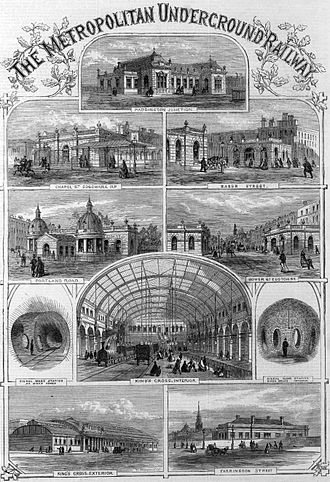
The Metropolitan Railway (also known as the Met) was a passenger and goods railway that served London from 1863 to 1933, its main line heading north-west from the capital's financial heart in the City to what were to become the Middlesex suburbs. Its first line connected the main-line railway termini at Paddington, Euston, and King's Cross to the City. The first section was built beneath the New Road using cut-and-cover between Paddington and King's Cross and in tunnel and cuttings beside Farringdon Road from King's Cross to near Smithfield, near the City. It opened to the public on 10 January 1863 with gas-lit wooden carriages hauled by steam locomotives, the world's first passenger-carrying designated underground railway.
The line was soon extended from both ends, and northwards via a branch from Baker Street. Southern branches, directly served, reached Hammersmith in 1864, Richmond in 1877 and the original completed the Inner Circle in 1884. The most important route was northwest into the Middlesex countryside, stimulating the development of new suburbs. Harrow was reached in 1880, and from 1897, having achieved the early patronage of the Duke of Buckingham and the owners of Waddesdon Manor, services extended for many years to Verney Junction in Buckinghamshire.
Electric traction was introduced in 1905, and by 1907 electric multiple units operated most of the services, though electrification of outlying sections did not occur until decades later. Unlike other railway companies in the London area, the Met developed land for housing, and after World War I promoted housing estates near the railway using the "Metro-land" brand. On 1 July 1933, the Met was amalgamated with the Underground Electric Railways Company of London and the capital's tramway and bus operators to form the London Passenger Transport Board.

Former Met tracks and stations are used by the London Underground's Metropolitan, Circle, District, Hammersmith & City, Piccadilly, Jubilee and Victoria lines, and by Chiltern Railways and Great Northern.
History
Paddington to the City, 1853–1863
Establishment
In the first half of the 19th century the population and physical extent of London grew greatly. The increasing resident population and the development of a commuting population arriving by train each day led to a high level of traffic congestion with huge numbers of carts, cabs, and omnibuses filling the roads and up to 200,000 people entering the City of London, the commercial heart, each day on foot. By 1850 there were seven railway termini around the urban centre of London: London Bridge and Waterloo to the south, Shoreditch and Fenchurch Street to the east, Euston and King's Cross to the north, and Paddington to the west. Only Fenchurch Street station was within the City.
The congested streets and the distance to the City from the stations to the north and west prompted many attempts to get approval from Parliament to build new railway lines into the City. None were successful, and the 1846 Royal Commission on Metropolitan Railway Termini banned construction of new lines or stations in the built-up central area. The concept of an underground railway linking the City with the mainline termini was first proposed in the 1830s. Charles Pearson, Solicitor to the City, was a leading promoter of several schemes and in 1846 proposed a central railway station to be used by multiple railway companies. The scheme was rejected by the 1846 commission, but Pearson returned to the idea in 1852 when he helped set up the City Terminus Company to build a railway from Farringdon to King's Cross. The plan was supported by the City, but the railway companies were not interested and the company struggled to proceed.
The Bayswater, Paddington, and Holborn Bridge Railway Company was established to connect the Great Western Railway's (GWR's) Paddington station to Pearson's route at King's Cross. A bill was published in November 1852 and in January 1853 the directors held their first meeting and appointed John Fowler as its engineer. After successful lobbying, the company secured approval in the North Metropolitan Railway Act 1853 (16 & 17 Vict. c. clxxxvi) under the name of the "North Metropolitan Railway" in mid-1853. The bill submitted by the City Terminus Company was rejected by Parliament, which meant that the North Metropolitan Railway would not be able to reach the City: to overcome this obstacle, the company took over the City Terminus Company and submitted a new bill in November 1853. This dropped the City terminus and extended the route south from Farringdon to the General Post Office in St. Martin's Le Grand. The route at the western end was also altered so that it connected more directly to the GWR station. Permission was sought to connect to the London and North Western Railway (LNWR) at Euston and to the Great Northern Railway (GNR) at King's Cross, the latter by hoists and lifts. The company's name was also to be changed again, to Metropolitan Railway. royal assent was granted to the Metropolitan Railway Act 1854 (17 & 18 Vict. c. ccxxi) on 7 August 1854.
Construction of the railway was estimated to cost £1 million. Initially, with the Crimean War under way, the Met found it hard to raise the capital. While it attempted to raise the funds it presented new bills to Parliament seeking an extension of time to carry out the works. In July 1855, the Metropolitan Railway (Deviation) Act 1855 (18 & 19 Vict. c. cii), which made a direct connection to the GNR at King's Cross, received royal assent. The plan was modified by the Metropolitan Railway (Great Northern Branch and Amendment) Act 1856 (19 & 20 Vict. c. cix) and again later by the Great Northern and Metropolitan Junction Railway Act 1860 (23 & 24 Vict. c. clxviii).
The GWR agreed to contribute £175,000 and a similar sum was promised by the GNR, but sufficient funds to make a start on construction had not been raised by the end of 1857. Costs were reduced by cutting back part of the route at the western end so that it did not connect directly to the GWR station, and by dropping the line south of Farringdon. In 1858, Pearson arranged a deal between the Met and the City of London Corporation whereby the Met bought land it needed around the new Farringdon Road from the City for £179,000 and the City purchased £200,000 worth of shares. The route changes were approved by Parliament in the Metropolitan Railway Act 1859 (22 & 23 Vict. c. xcvii) of August 1859, meaning that the Met finally had the funding to match its obligations and construction could begin.
Construction
Despite concerns about undermining and vibrations causing subsidence of nearby buildings and compensating the thousands of people whose homes were destroyed during the digging of the tunnel, construction began in March 1860. The line was mostly built using the "cut-and-cover" method from Paddington to King's Cross; east of there it continued in a 728 yards (666 m) tunnel under Mount Pleasant, Clerkenwell then followed the culverted River Fleet beside Farringdon Road in an open cutting to near the new meat market at Smithfield.
The trench was 33 feet 6 inches (10.2 m) wide, with brick retaining walls supporting an elliptical brick arch or iron girders spanning 28 feet 6 inches (8.7 m). The tunnels were wider at stations to accommodate the platforms. Most of the excavation work was carried out manually by navvies; a primitive earth-moving conveyor was used to remove excavated soil from the trench.
Within the tunnel, two lines were laid with a 6-foot (1.8 m) gap between. To accommodate both the standard gauge trains of the GNR and the broad gauge trains of the GWR, the track was three-rail dual gauge, the rail nearest the platforms being shared by both gauges. Signalling was on the absolute block method, using electric Spagnoletti block instruments and fixed signals.
Construction was not without incident. In May 1860, a GNR train overshot the platform at King's Cross and fell into the workings. Later that year, a boiler explosion on an engine pulling contractor's wagons killed the driver and his assistant. In May 1861, the excavation collapsed at Euston causing considerable damage to the neighbouring buildings. The final accident occurred in June 1862 when the Fleet sewer burst following a heavy rainstorm and flooded the excavations. The Met and the Metropolitan Board of Works managed to stem and divert the water and the construction was delayed by only a few months.
Trial runs were carried out from November 1861 while construction was still under way. The first trip over the whole line was in May 1862 with William Gladstone among the guests. By the end of 1862, work was complete at a cost of £1.3 million.
In that year, Myles Fenton, then serving as assistant manager of the Lancashire and Yorkshire Railway, was appointed as the first manager of the new company.
Opening
Board of Trade inspections took place in late December 1862 and early January 1863 to approve the railway for opening. After minor signalling changes were made, approval was granted and a few days of operating trials were carried out before the grand opening on 9 January 1863, which included a ceremonial run from Paddington and a large banquet for 600 shareholders and guests at Farringdon. Charles Pearson did not live to see the completion of the project; he died in September 1862.
The 3.75-mile (6 km) railway opened to the public on 10 January 1863, with stations at Paddington (Bishop's Road) (now Paddington), Edgware Road, Baker Street, Portland Road (now Great Portland Street), Gower Street (now Euston Square), King's Cross (now King's Cross St Pancras), and Farringdon Street (now Farringdon). The railway was hailed a success, carrying 38,000 passengers on the opening day, using GNR trains to supplement the service. In the first 12 months 9.5 million passengers were carried and in the second 12 months this increased to 12 million.
The original timetable allowed 18 minutes for the journey. Off-peak service frequency was every 15 minutes, increased to ten minutes during the morning peak and reduced 20 minutes in the early mornings and after 8 pm. From May 1864, workmen's returns were offered on the 5:30 am and 5:40 am services from Paddington at the cost of a single ticket (3d).
The railway was initially worked by GWR broad-gauge Metropolitan Class tank locomotives and rolling stock. Soon after the opening, disagreement arose between the Met and the GWR over the need to increase the frequency, and the GWR withdrew its stock in August 1863. The Met continued operating a reduced service using GNR standard-gauge rolling stock before purchasing its own standard-gauge locomotives from Beyer, Peacock and Company and rolling stock.
The Metropolitan initially ordered 18 tank locomotives, of which a key feature was condensing equipment which prevented most of the steam from escaping while trains were in tunnels; they have been described as "beautiful little engines, painted green and distinguished particularly by their enormous external cylinders." The design proved so successful that eventually 120 were built to provide traction on the Metropolitan, the District Railway (in 1871) and all other 'cut and cover' underground lines. This 4-4-0 tank engine can therefore be considered as the pioneer motive power on London's first underground railway; ultimately, 148 were built between 1864 and 1886 for various railways, and most kept running until electrification in 1905.
In the belief that it would be operated by smokeless locomotives, the line had been built with little ventilation and a long tunnel between Edgware Road and King's Cross. Initially the smoke-filled stations and carriages did not deter passengers and the ventilation was later improved by making an opening in the tunnel between Gower Street and King's Cross and removing glazing in the station roofs. With the problem continuing after the 1880s, conflict arose between the Met, who wished to make more openings in the tunnels, and the local authorities, who argued that these would frighten horses and reduce property values. This led to an 1897 Board of Trade report, which reported that a pharmacist was treating people in distress after having travelled on the railway with his 'Metropolitan Mixture'. The report recommended more openings be authorised but the line was electrified before these were built.
Extensions and the Inner Circle, 1863–1884
Farringdon to Moorgate and the City Widened Lines
With connections to the GWR and GNR under construction and connections to the Midland Railway and London, Chatham and Dover Railway (LC&DR) planned, the Met obtained permission in 1861 and 1864 for two additional tracks from King's Cross to Farringdon Street and a four-track eastward extension to Moorgate. The Met used two tracks: the other two tracks, the City Widened Lines, were used mainly by other railway companies.
A pair of single-track tunnels at King's Cross connecting the GNR to the Met opened on 1 October 1863 when the GNR began running services, the GWR returning the same day with through suburban trains from such places as Windsor. By 1864 the Met had sufficient carriages and locomotives to run its own trains and increase the frequency to six trains an hour.
On 1 January 1866, LC&DR and GNR joint services from Blackfriars Bridge began operating via the Snow Hill tunnel under Smithfield market to Farringdon and northwards to the GNR. The extension to Aldersgate Street and Moorgate Street (now Barbican and Moorgate) had opened on 23 December 1865 and all four tracks were open on 1 March 1866.
The new tracks from King's Cross to Farringdon were first used by a GNR freight train on 27 January 1868. The Midland Railway junction opened on 13 July 1868 when services ran into Moorgate Street before its St Pancras terminus had opened. The line left the main line at St Paul's Road Junction, entering a double-track tunnel and joining the Widened Lines at Midland Junction.
Hammersmith and City Railway
In November 1860, a bill was presented to Parliament, supported by the Met and the GWR, for a railway from the GWR's main line a mile west of Paddington to the developing suburbs of Shepherd's Bush and Hammersmith, with a connection to the West London Railway at Latimer Road. Authorised on 22 July 1861 in the Hammersmith and City Railway Act 1861 (24 & 25 Vict. c. clxiv) as the Hammersmith and City Railway (H&CR), the 2 miles 35 chains (3.9 km) line, constructed on a 20-foot (6.1 m) high viaduct largely across open fields, opened on 13 June 1864 with a broad-gauge GWR service from Farringdon Street, with stations at Notting Hill (now Ladbroke Grove), Shepherd's Bush (replaced by the current Shepherd's Bush Market in 1914) and Hammersmith. The link to the West London Railway opened on 1 July that year, served by a carriage that was attached or detached at Notting Hill for Kensington (Addison Road).
Following an agreement between the Met and the GWR, from 1865 the Met ran a standard-gauge service to Hammersmith and the GWR a broad-gauge service to Kensington. In 1867, the H&CR became jointly owned by the two companies. The GWR began running standard-gauge trains and the broad gauge rail was removed from the H&CR and the Met in 1869. In 1871, two additional tracks parallel to the GWR between Westbourne Park and Paddington were brought into use for the H&CR and in 1878 the flat crossing at Westbourne Park was replaced by a diveunder. In August 1872, the GWR Addison Road service was extended over the District Railway via Earl's Court to Mansion House. This became known as the Middle Circle and ran until January 1905; from 1 July 1900 trains terminated at Earl's Court. Additional stations were opened at Westbourne Park (1866), Latimer Road (1868), Royal Oak (1871), Wood Lane (1908) and Goldhawk Road (1914).
Between 1 October 1877 and 31 December 1906, some services on the H&CR were extended to Richmond over the London and South Western Railway (L&SWR) via its station at Hammersmith (Grove Road).
Inner Circle
The early success of the Met prompted a flurry of applications to Parliament in 1863 for new railways in London, many of them competing for similar routes. To consider the best proposals, the House of Lords established a select committee, which issued a report in July 1863 with a recommendation for an "inner circuit of railway that should abut, if not actually join, nearly all of the principal railway termini in the Metropolis". A number of railway schemes were presented for the 1864 parliamentary session that met the recommendation in varying ways and a joint committee was set up to review the options.
Proposals from the Met to extend south from Paddington to South Kensington and east from Moorgate to Tower Hill were accepted and received royal assent on 29 July 1864 as the Metropolitan Railway (Notting Hill and Brompton Extension) Act 1864 (27 & 28 Vict. c. ccxci) and the Metropolitan Railway (Tower Hill Extension) Act 1864 (27 & 28 Vict. c. cccxv) respectively. To complete the circuit, the committee encouraged the amalgamation of two schemes via different routes between Kensington and the City, and a combined proposal under the name Metropolitan District Railway (commonly known as the District railway) passed into law on the same day in the Metropolitan District Railways Act 1864 (27 & 28 Vict. c. cccxxii). Initially, the District and the Met were closely associated and it was intended that they would soon merge. The Met's chairman and three other directors were on the board of the District, John Fowler was the engineer of both companies and the construction works for all of the extensions were let as a single contract. The District was established as a separate company to enable funds to be raised independently of the Met.
Starting as a branch from Praed Street junction, a short distance east of the Met's Paddington station, the western extension passed through fashionable districts in Bayswater, Notting Hill, and Kensington. Land values here were higher and, unlike the original line, the route did not follow an easy alignment under existing roads. Compensation payments for property were much higher. In Leinster Gardens, Bayswater, a façade of two five-storey houses was built at Nos. 23 and 24 to conceal the gap in a terrace created by the railway passing through. To ensure adequate ventilation, most of the line was in cutting except for a 421-yard (385 m) tunnel under Campden Hill. Construction of the District proceeded in parallel with the work on the Met and it too passed through expensive areas. Construction costs and compensation payments were so high that the cost of the first section of the District from South Kensington to Westminster was £3 million, almost three times as much as the Met's original, longer line.
The first section of the Met extension opened to Brompton (Gloucester Road) (now Gloucester Road) on 1 October 1868, with stations at Paddington (Praed Street) (now Paddington), Bayswater, Notting Hill Gate, and Kensington (High Street) (now High Street Kensington). Three months later, on 24 December 1868, the Met extended eastwards to a shared station at South Kensington and the District opened its line from there to Westminster, with other stations at Sloane Square, Victoria, St James's Park, and Westminster Bridge (now Westminster).
The District also had parliamentary permission to extend westward from Brompton and, on 12 April 1869, it opened a single-track line to West Brompton on the WLR. There were no intermediate stations and at first this service operated as a shuttle from Gloucester Road. By mid-1869 separate tracks had been laid between South Kensington and Brompton and from Kensington (High Street) to a junction with the line to West Brompton. During the night of 5 July 1870 the District secretly built the disputed Cromwell curve connecting Brompton and Kensington (High Street).
East of Westminster, the next section of the District's line ran in the new Victoria Embankment built by the Metropolitan Board of Works along the north bank of the River Thames. The line opened from Westminster to Blackfriars on 30 May 1870 with stations at Charing Cross (now Embankment), The Temple (now Temple) and Blackfriars.
On its opening the Met operated the trains on the District, receiving 55% of the gross receipts for a fixed level of service. Extra trains required by the District were charged for and the District's share of the income dropped to about 40%. The District's level of debt meant that the merger was no longer attractive to the Met and did not proceed, so the Met's directors resigned from the District's board. To improve its finances, the District gave the Met notice to terminate the operating agreement. Struggling under the burden of its very high construction costs, the District was unable to continue with the remainder of the original scheme to reach Tower Hill and made a final extension of its line just one station east from Blackfriars to a previously unplanned City terminus at Mansion House.
On Saturday 1 July 1871, an opening banquet was attended by Prime Minister William Gladstone, who was also a shareholder. The following Monday, Mansion House opened and the District began running its own trains. From this date, the two companies operated a joint Inner Circle service between Mansion House and Moorgate Street via South Kensington and Edgware Road every ten minutes, supplemented by a District service every ten minutes between Mansion House and West Brompton and H&CR and GWR suburban services between Edgware Road and Moorgate Street. The permissions for the railway east of Mansion House were allowed to lapse. At the other end of the line, the District part of South Kensington station opened on 10 July 1871 and Earl's Court station opened on the West Brompton extension on 30 October 1871.
In 1868 and 1869, judgments had been against the Met in a number of hearings, finding financial irregularities such as the company paying a dividend it could not afford and expenses being paid out of the capital account. In 1870, the directors were guilty of a breach of trust and were ordered to compensate the company. All appealed and were allowed, in 1874, to settle for a much lower amount. In October 1872, to restore shareholders' confidence, Edward Watkin was appointed chairman and the directors were replaced. Watkin was an experienced railwayman and already on the board of several railway companies, including the South Eastern Railway (SER), and had an aspiration to construct a line from the north through London to that railway.
Owing to the cost of land purchases, the Met's eastward extension from Moorgate Street was slow to progress and it had to obtain an extension of the Metropolitan Railway (Tower Hill Extension) Act 1864's time limit in the Metropolitan Railway Act 1869 (32 & 33 Vict. c. cxxxvi). The extension was begun in 1873, but after construction exposed burials in the vault of a Roman Catholic chapel, the contractor reported that it was difficult to keep the men at work. The first section opened to the Great Eastern Railway's (GER's) recently opened terminus at Liverpool Street on 1 February 1875. For a short time, while the Met's station was being built, services ran into the GER station via a 3.5-chain (70 m) curve. The Met opened its station later that year on 12 July and the curve was not used again by regular traffic. During the extension of the railway to Aldgate several hundred cartloads of bullocks' horn were discovered in a layer 20 ft (6.1 m) below the surface. A terminus opened at Aldgate on 18 November 1876, initially for a shuttle service to Bishopsgate before all Met and District trains worked through from 4 December.
Conflict between the Met and the District and the expense of construction delayed further progress on the completion of the inner circle. In 1874, frustrated City financiers formed the Metropolitan Inner Circle Completion Railway Company with the aim of finishing the route. This company was supported by the District and obtained authority in the Metropolitan Inner Circle Completion Act 1874 (37 & 38 Vict. c. cxcix) on 7 August 1874. The company struggled to raise the funding and an extension of time was granted in the Metropolitan Inner Circle Completion Railway Act 1876 (39 & 40 Vict. c. ccxxvi). A meeting between the Met and the District was held in 1877 with the Met now wishing to access the SER via the East London Railway (ELR). Both companies promoted and obtained an act of Parliament, the Metropolitan and District Railways (City Lines and Extensions) Act 1879 (42 & 43 Vict. c. cci) for the extension and link to the ELR, the act also ensuring future co-operation by allowing both companies access to the whole circle. A large contribution was made by authorities for substantial road and sewer improvements. In 1882, the Met extended its line from Aldgate to a temporary station at Tower of London. Two contracts to build joint lines were placed, from Mansion House to the Tower in 1882 and from the circle north of Aldgate to Whitechapel with a curve onto the ELR in 1883. From 1 October 1884, the District and the Met began working trains from St Mary's via this curve onto the ELR to the SER's New Cross station. After an official opening ceremony on 17 September and trial running a circular service started on Monday 6 October 1884. On the same day the Met extended some H&CR services over the ELR to New Cross, calling at new joint stations at Aldgate East and St Mary's. Joint stations opened on the circle line at Cannon Street, Eastcheap (Monument from 1 November 1884) and Mark Lane. The Met's Tower of London station closed on 12 October 1884 after the District refused to sell tickets to the station. Initially, the service was eight trains an hour, completing the 13 miles (21 kilometres) circle in 81–84 minutes, but this proved impossible to maintain and so the frequency was reduced to six trains an hour - albeit with an improved timing of 70 minutes - in 1885. Guards were permitted no relief breaks during their shift until September 1885, when they were permitted three 20-minute breaks.
Extension Line, 1868–1899
Baker Street to Harrow
In April 1868, the Metropolitan and St John's Wood Railway (M&SJWR) opened a single-track railway in tunnel to Swiss Cottage from new platforms at Baker Street (called Baker Street East). There were intermediate stations at St John's Wood Road and Marlborough Road, both with crossing loops, and the line was worked by the Met with a train every 20 minutes. A junction was built with the Inner Circle at Baker Street, but there were no through trains after 1869.
The original intention of the M&SJWR was to run to the London and North Western Railway's station at Finchley Road (now Finchley Road & Frognal). Before construction had begun, a branch was proposed from a junction a short distance north of Swiss Cottage station running north for 1.5 kilometres (0.93 mi) across mostly open countryside to Hampstead Village where the station was to be located east of the village centre. The branch was authorised in May 1865. This appeared on some maps. Financial difficulties meant the scope of the line only progressed as far as Swiss Cottage, The branch to Hampstead was cancelled in 1870. A 156 yards (143 m) section of tunnel was built north of Swiss Cottage station for the Hampstead branch most of which was used for the later extension to the north-west. A short length towards Hampstead was unused. This is still visible today when travelling on a southbound Metropolitan line service.
In the early 1870s, passenger numbers were low and the M&SJWR was looking to extend the line to generate new traffic. Recently placed in charge of the Met, Watkin saw this as the priority as the cost of construction would be lower than in built-up areas and fares higher; traffic would also be fed into the Circle. On 21 July 1873, the M&SJWR was given authority in the Metropolitan and Saint John's Wood Railway Act 1873 (36 & 37 Vict. c. ccxlvii) to reach the Middlesex countryside at Neasden, but as the nearest inhabited place to Neasden was Harrow it was decided to build the line 3.5 miles (5.6 km) further to Harrow and permission was granted in the Kingsbury and Harrow Railway Act 1874 (37 & 38 Vict. c. cxlix). To serve the Royal Agricultural Society's 1879 show at Kilburn, a single line to West Hampstead opened on 30 June 1879 with a temporary platform at Finchley Road. Double track and a full service to Willesden Green started on 24 November 1879 with a station at Kilburn & Brondesbury (now Kilburn). The line was extended 5 miles 37.5 chains (8.80 km) to Harrow, the service from Baker Street beginning on 2 August 1880. The intermediate station at Kingsbury Neasden (now Neasden) was opened the same day. Two years later, the single-track tunnel between Baker Street and Swiss Cottage was duplicated and the M&SJWR was absorbed by the Met.
In 1882, the Met moved its carriage works from Edgware Road to Neasden. A locomotive works was opened in 1883 and a gas works in 1884. To accommodate employees moving from London over 100 cottages and ten shops were built for rent. In 1883, a school room and church took over two of the shops; two years later land was given to the Wesleyan Church for a church building and a school for 200 children.
Harrow to Verney Junction, Brill Branch and Wembley Park Station
In 1868, the Duke of Buckingham opened the Aylesbury and Buckingham Railway (A&BR), a 12.75-mile (20.5 km) single track from Aylesbury to a new station at Verney Junction on the Buckinghamshire Railway's Bletchley to Oxford line. At the beginning lukewarm support had been given by the LNWR, which worked the Bletchley to Oxford line, but by the time the line had been built the relationship between the two companies had collapsed. The Wycombe Railway built a single-track railway from Princes Risborough to Aylesbury and when the GWR took over this company it ran shuttles from Princes Risborough through Aylesbury to Quainton Road and from Quainton Road to Verney Junction.
The A&BR had authority for a southern extension to Rickmansworth, connecting with the LNWR's Watford and Rickmansworth Railway. Following discussions between the duke and Watkin it was agreed that this line would be extended south to meet the Met at Harrow and permission for this extension was granted in 1874 and Watkin joined the board of the A&BR in 1875. Money was not found for this scheme and the Met had to return to Parliament to obtain the Rickmansworth Extension Railway Act 1880 (43 & 44 Vict. c. cxxxiv) and Aylesbury and Rickmansworth Railway Act 1881 (44 & 45 Vict. c. cxvii) giving permission for a railway from Harrow to Aylesbury. Pinner was reached in 1885 and an hourly service from Rickmansworth and Northwood to Baker Street started on 1 September 1887. By then raising money was becoming very difficult although there was local support for a station at Chesham. Authorised in 1885, double track from Rickmansworth was laid for 5 miles (8.0 km), then single to Chesham. Services to Chesham calling at Chorley Wood and Chalfont Road (now Chalfont & Latimer) started on 8 July 1889.
The Met took over the A&BR on 1 July 1891 and a temporary platform at Aylesbury opened on 1 September 1892 with trains calling at Amersham, Great Missenden, Wendover and Stoke Mandeville. In 1894, the Met and GWR joint station at Aylesbury opened. Beyond Aylesbury to Verney Junction, the bridges were not strong enough for the Met's locomotives. The GWR refused to help, so locomotives were borrowed from the LNWR until two D Class locomotives were bought. The line was upgraded, doubled and the stations rebuilt to main-line standards, allowing a through Baker Street to Verney Junction service from 1 January 1897, calling at a new station at Waddesdon Manor, a rebuilt Quainton Road, Granborough Road and Winslow Road.
From Quainton Road, the Duke of Buckingham had built a 6.5-mile (10.5 km) branch railway, the Brill Tramway. In 1899, there were four mixed passenger and goods trains each way between Brill and Quainton Road. There were suggestions of the Met buying the line and it took over operations in November 1899, renting the line for £600 a year. The track was relaid and stations rebuilt in 1903. Passenger services were provided by A Class and D Class locomotives and Oldbury rigid eight-wheeled carriages.
In 1893, a new station at Wembley Park was opened, initially used by the Old Westminsters Football Club, but primarily to serve a planned sports, leisure and exhibition centre. A 1,159-foot (353 m) tower (higher than the recently built Eiffel Tower) was planned, but the attraction was not a success and only the 200-foot (61 m) tall first stage was built. The tower became known as "Watkin's Folly" and was dismantled in 1907 after it was found to be tilting.