
Mars Express is a space exploration mission by the European Space Agency (ESA) exploring the planet Mars and its moons since 2003, and the first planetary mission attempted by ESA.
Mars Express consisted of two parts, the Mars Express Orbiter and Beagle 2, a lander designed to perform exobiology and geochemistry research. Although the lander failed to fully deploy after it landed on the Martian surface, the orbiter has been successfully performing scientific measurements since early 2004, namely, high-resolution imaging and mineralogical mapping of the surface, radar sounding of the subsurface structure down to the permafrost, precise determination of the atmospheric circulation and composition, and study of the interaction of the atmosphere with the interplanetary medium.
Due to the valuable science return and the highly flexible mission profile, Mars Express has been granted several mission extensions. The latest was approved on March 7, 2023, consisting of a confirmed operating period until December 31, 2026, and a further provisional extension to December 31, 2028. Arriving at Mars in 2003, 22 years, 6 months and 23 days ago (and counting), it is the second longest surviving, continually active spacecraft in orbit around a planet other than Earth, behind only NASA's still active 2001 Mars Odyssey. It has acted as a central satellite communications node in Mars orbit, conducting radio occultation experiments with the joint ESA and Roscosmos Trace Gas Orbiter, communicating with China's Zhurong rover, and is planned to communicate with Japan's Martian Moons eXploration Phobos sample return.

Name
"Express" in the name originally referred to the speed and efficiency with which the spacecraft was designed and built. However, "Express" also describes the spacecraft's relatively short interplanetary voyage, a result of being launched when the orbits of Earth and Mars brought them closer than they had been in about 60,000 years.
Background
The Mars Express mission is dedicated to the study of the interior, subsurface, surface, atmosphere, and environment of the planet Mars. The spacecraft carried seven scientific instruments, a small lander, a lander relay, and a Visual Monitoring Camera, all designed to contribute to solving the mystery of Mars's missing water.
Some of the instruments on the orbiter, including the camera systems and some spectrometers, reuse designs from the failed launch of the Russian Mars 96 mission in 1996 (European countries had provided much of the instrumentation and financing for that unsuccessful mission). The scientific objectives of the Mars Express represent an attempt to fulfill in part the lost scientific goals of this failed Russian mission, complemented by exobiology research with Beagle-2.
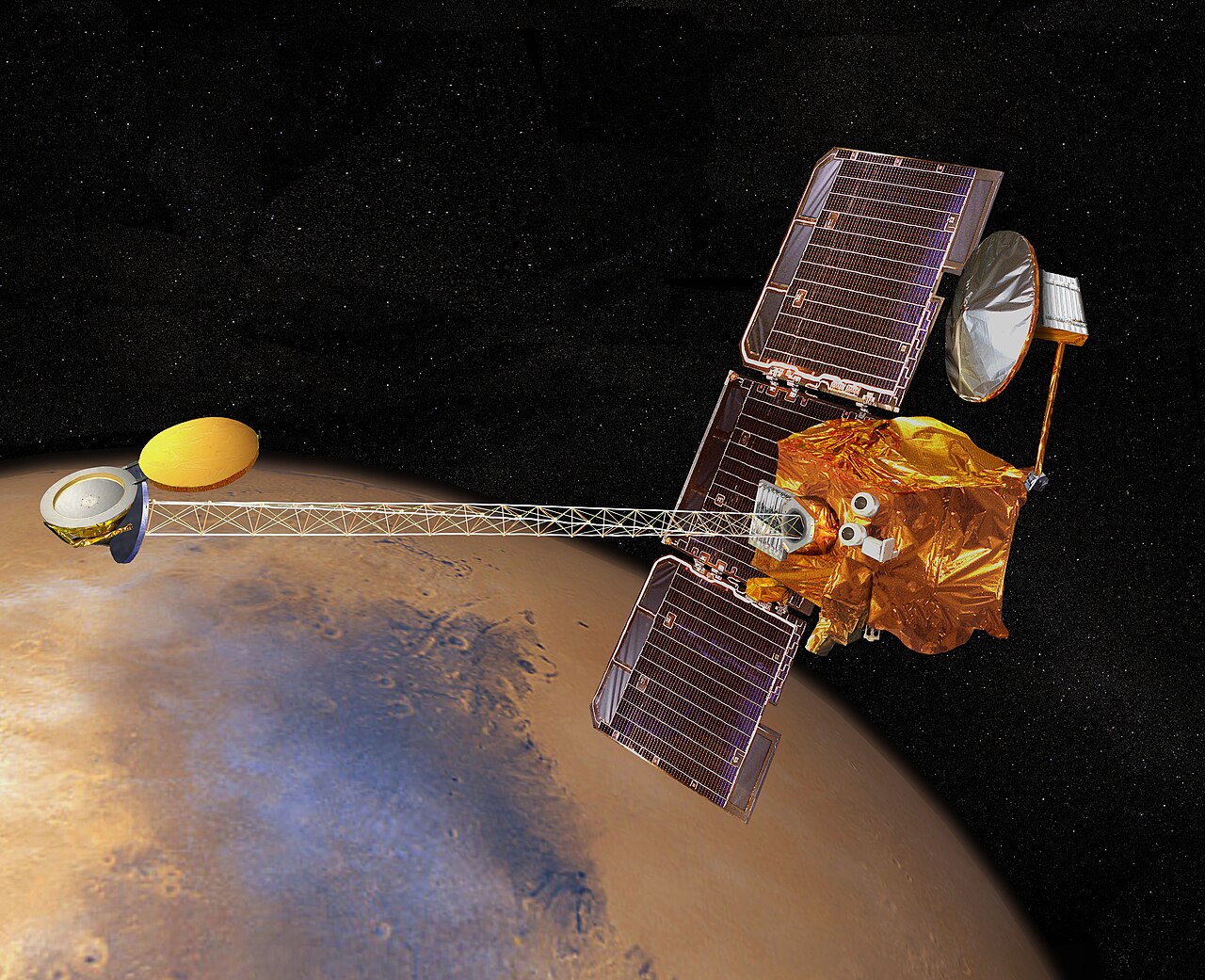
The design of Mars Express is based on ESA's Rosetta mission, on which a considerable sum was spent on development. The same design was also used for ESA's Venus Express mission in order to increase reliability and reduce development cost and time.
The total initial Mars Express budget excluding the lander was €150 million. The prime contractor for the construction of Mars Express orbiter was EADS Astrium Satellites.
Orbiter and subsystems
Structure
The Mars Express orbiter is a cube-shaped spacecraft with two solar panel wings extending from opposite sides. The launch mass of 1223 kg includes a main bus with 113 kg of payload, the 60 kg lander, and 457 kg of propellant. The main body is 1.5 m × 1.8 m × 1.4 m in size, with an aluminium honeycomb structure covered by an aluminium skin. The solar panels measure about 12 m tip-to-tip. Two 20 m long wire dipole antennas extend from opposite side faces perpendicular to the solar panels as part of the radar sounder.

Propulsion
The Soyuz/Fregat launcher provided most of the thrust Mars Express needed to reach Mars. The final stage of the Soyuz, Fregat was jettisoned once the probe was safely on a course for Mars. The spacecraft's on-board means of propulsion was used to slow the probe for Mars orbit insertion and subsequently for orbit corrections.
The body is built around the main propulsion system, which consists of a bipropellant 400 N main engine. The two 267-liter propellant tanks have a total capacity of 595 kg. Approximately 370 kg are needed for the nominal mission. Pressurized helium from a 35-liter tank is used to force fuel into the engine. Trajectory corrections will be made using a set of eight 10 N thrusters, one attached to each corner of the spacecraft bus. The spacecraft configuration is optimized for a Soyuz/Fregat, and was fully compatible with a Delta II launch vehicle.
Power
Spacecraft power is provided by the solar panels which contain 11.42 square meters of silicon cells. The originally planned power was to be 660 W at 1.5 AU but a faulty connection has reduced the amount of power available by 30%, to about 460 W. This loss of power does not significantly affect the science return of the mission. Power is stored in three lithium-ion batteries with a total capacity of 64.8 Ah for use during eclipses. The power is fully regulated at 28 V, and the Terma power module (also used in Rosetta) is redundant. During routine phase, the spacecraft's power consumption is in the range of 450–550 W.
Attitude control - avionics
Attitude control (3-axis stabilization) is achieved using two 3-axis inertial measurement units, a set of two star cameras and two Sun sensors, gyroscopes, accelerometers, and four 12 N·m·s reaction wheels. Pointing accuracy is 0.04 degree with respect to the inertial reference frame and 0.8 degree with respect to the Mars orbital frame. Three on-board systems help Mars Express maintain a very precise pointing accuracy, which is essential to allow the spacecraft to use some of the science instruments.
Communications
The communications subsystem is composed of three antennas: A 1.6 m diameter parabolic dish high-gain antenna and two omnidirectional antennas. The first one provide links (telecommands uplink and telemetry downlink) in both X-band (8.4 GHz) and S-band (2.1 GHz) and is used during nominal science phase around Mars. The low gain antennas are used during launch and early operations to Mars and for eventual contingencies once in orbit. Two Mars lander relay UHF antennas are mounted on the top face for communication with the Beagle 2 or other landers, using a Melacom transceiver.
Earth stations
Although communications with Earth were originally scheduled to take place with the ESA 35-meter wide Ground Station in New Norcia (Australia) New Norcia Station, the mission profile of progressive enhancement and science return flexibility have triggered the use of the ESA ESTRACK Ground Stations in Cebreros Station, Madrid, Spain and Malargüe Station, Argentina. In addition, further agreements with NASA Deep Space Network have made possible the use of American stations for nominal mission planning, thus increasing complexity but with a clear positive impact in scientific returns. This inter-agency cooperation has proven effective, flexible and enriching for both sides. On the technical side, it has been made possible (among other reasons) thanks to the adoption of both Agencies of the Standards for Space Communications defined in CCSDS.

Thermal
Thermal control is maintained through the use of radiators, multi-layer insulation, and actively controlled heaters. The spacecraft must provide a benign environment for the instruments and on-board equipment. Two instruments, PFS and OMEGA, have infrared detectors that need to be kept at very low temperatures (about −180 °C). The sensors on the camera (HRSC) also need to be kept cool. But the rest of the instruments and on-board equipment function best at room temperatures (10–20 °C).
The spacecraft is covered in gold-plated aluminium-tin alloy thermal blankets to maintain a temperature of 10–20 °C inside the spacecraft. The instruments that operate at low temperatures to be kept cold are thermally insulated from this relatively high internal temperature, and emit excess heat into space using attached radiators.
Control unit and data storage
The spacecraft is run by two Control and Data management Units with 12 gigabits of solid state mass memory for storage of data and housekeeping information for transmission. The on-board computers control all aspects of the spacecraft functioning including switching instruments on and off, assessing the spacecraft orientation in space and issuing commands to change it.

Another key aspect of the Mars Express mission is its artificial intelligence tool (MEXAR2). The primary purpose of the AI tool is the scheduling of when to download various parts of the collected scientific data back to Earth, a process which used to take ground controllers a significant amount of time. The new AI tool saves operator time, optimizes bandwidth use on the DSN, prevents data loss, and allows better use of the DSN for other space operations as well. The AI decides how to manage the spacecraft's 12 gigabits of storage memory, when the DSN will be available and not be in use by another mission, how to make the best use of the DSN bandwidth allocated to it, and when the spacecraft will be oriented properly to transmit back to Earth.
Lander
The Beagle 2 lander objectives were to characterize the landing site geology, mineralogy, and geochemistry, the physical properties of the atmosphere and surface layers, collect data on Martian meteorology and climatology, and search for possible signatures of life on Mars. However, the landing attempt was unsuccessful and the lander was declared lost.
A Commission of Inquiry on Beagle 2 identified several possible causes, including airbag problems, severe shocks to the lander's electronics which had not been simulated adequately before launch, and problems with parts of the landing system colliding; but was unable to reach any firm conclusions.
The spacecraft's fate remained a mystery until it was announced in January 2015 that NASA's Mars Reconnaissance Orbiter, using HiRISE, had found the probe intact on the surface of Mars. It was then determined that one of the spacecraft's four solar panels may have only partially opened, possibly blocking the spacecraft's communications. Beagle 2 was the first British and first European probe to achieve a landing on Mars.
Scientific instruments
The scientific objectives of the Mars Express payload are to obtain global high-resolution photo-geology (10 m resolution), mineralogical mapping (100 m resolution) and mapping of the atmospheric composition, study the subsurface structure, the global atmospheric circulation, and the interaction between the atmosphere and the subsurface, and the atmosphere and the interplanetary medium. The total mass budgeted for the science payload is 116 kg. The payload scientific instruments are:
Visible and Infrared Mineralogical Mapping Spectrometer (OMEGA) (Observatoire pour la Minéralogie, l'Eau, les Glaces et l'Activité) – France – Determines mineral composition of the surface up to 100 m resolution. Is mounted inside pointing out the top face. Instrument mass: 28.6 kg
Ultraviolet and Infrared Atmospheric Spectrometer (SPICAM) – France – Assesses elemental composition of the atmosphere. Is mounted inside pointing out the top face. Instrument mass: 4.7 kg
Mars Advanced Sounding Radar Altimeter (MARSIS) – Italy – A radar altimeter used to assess composition of sub-surface aimed at search for frozen water. Is mounted in the body and is nadir pointing, and also incorporates the two 20 m antennas. Instrument mass: 13.7 kg
Planetary Fourier Spectrometer (PFS) – Italy – Makes observations of atmospheric temperature and pressure (observations suspended in September 2005). Is mounted inside pointing out the top face and is currently working. Instrument mass: 30.8 kg
Analyzer of Space Plasmas and Energetic Atoms (ASPERA) – Sweden – Investigates interactions between upper atmosphere and solar wind. Is mounted on the top face. Instrument mass: 7.9 kg
High Resolution Stereo Camera (HRSC) – Germany – Produces color images with up to 2 m resolution. Is mounted inside the spacecraft body, aimed through the top face of the spacecraft, which is nadir pointing during Mars operations. Instrument mass: 20.4 kg
Mars Express Lander Communications (MELACOM) – UK – Allows Mars Express to act as a communication relay for landers on the Martian surface. (Has been used on both Mars Exploration Rovers, and was used to support the landing of NASA's Phoenix mission)
Mars Radio Science Experiment (MaRS) – Uses radio signals to investigate atmosphere, surface, subsurface, gravity and solar corona density during solar conjunctions. It uses the communications subsystem itself.
Visual Monitoring Camera, a small camera to monitor the lander ejection.
Operations of the spacecraft
Operations for Mars Express are carried out by a multinational team of engineers from ESA's Operation Centre (ESOC) in Darmstadt. The team began preparations for the mission about 3 to 4 years prior to the actual launch. This involved preparing the ground segment and the operational procedures for the whole mission.
The Mission Control Team is composed of the Flight Control Team, Flight Dynamics Team, Ground Operations Managers, Software Support and Ground Facilities Engineers. All of these are located at ESOC but there are additionally external teams, such as the Project and Industry Support teams, who designed and built the spacecraft. The Flight Control Team currently consists of:
The Spacecraft Operations Manager
Six Operations Engineers (including three Mission Planners)
One Spacecraft Analyst
Six spacecraft controllers (SpaCons), shared with ExoMars Trace Gas Orbiter, BepiColombo, and Solar Orbiter.
The team build-up, headed by the Spacecraft Operations Manager, started about four years before launch. He was required to recruit a suitable team of engineers that could handle the varying tasks involved in the mission. For Mars Express the engineers came from various other missions. Most of them had been involved with Earth orbiting satellites.
Mission timeline
Mission preparation
In the years preceding the launch of a spacecraft numerous teams of experts distributed over the contributing companies and organisations prepared the space and ground segments. Each of these teams focussed on the area of its responsibility and interfacing as required. A major additional requirement raised for the Launch and Early Orbit Phase (LEOP) and all critical operational phases was that it was not enough merely to interface; the teams had to be integrated into one Mission Control Team. All the different experts had to work together in an operational environment and the interaction and interfaces between all elements of the system (software, hardware and human) had to run smoothly for this to happen:
the flight operations procedures had to be written and validated down to the smallest detail
the control system had to be validated
system Validation Tests (SVTs) with the satellite had to be performed to demonstrate the correct interfacing of the ground and space segments
mission Readiness Test with the Ground Stations had to be performed