
The Manhattan Project was a research and development program undertaken during World War II to produce the first nuclear weapons. It was led by the United States in collaboration with the United Kingdom and Canada. The Manhattan Project employed nearly 130,000 people at its peak and cost nearly US$2 billion (equivalent to about $28 billion in 2024).
From 1942 to 1946, the project was directed by Major General Leslie Groves of the U.S. Army Corps of Engineers. Nuclear physicist J. Robert Oppenheimer was the director of the Los Alamos Laboratory that designed the bombs. The Army program was designated the Manhattan District, as its first headquarters were in Manhattan; the name gradually superseded the official codename, Development of Substitute Materials, for the entire project. The project absorbed its earlier British counterpart, Tube Alloys.
Over 80 percent of project cost was for building and operating the fissile material production plants. The project proposed both highly enriched uranium and plutonium as fuel for nuclear weapons. Enriched uranium was produced at the Clinton Engineer Works in Tennessee. Plutonium was produced in the world's first industrial-scale nuclear reactors at the Hanford Engineer Works in Washington. These sites were supported by dozens of other facilities across Canada, the US and the UK.

The weapons designs were produced at the Los Alamos Laboratory in New Mexico, and resulted in two weapon designs used during the war: Little Boy (enriched uranium gun-type) and Fat Man (plutonium implosion). The Fat Man design was initially a low priority fallback option, as it was complex and required explosive lenses, but in 1944 it was confirmed that plutonium from Hanford was not suitable for a gun-type bomb because of the high proportion of plutonium-240. The first nuclear device ever detonated was an implosion-type bomb during the Trinity test, conducted at White Sands Proving Ground in New Mexico on 16 July 1945. The project was responsible for developing the specific means of delivering the weapons onto military targets, and for the use of the Little Boy and Fat Man bombs in the atomic bombings of Hiroshima and Nagasaki in August 1945.
The project was also charged with gathering intelligence on the German nuclear weapon project. Through Operation Alsos, Manhattan Project personnel served in Europe, sometimes behind enemy lines, where they gathered nuclear materials and documents and rounded up German scientists. Despite the Manhattan Project's own emphasis on security, Soviet atomic spies penetrated the program.
In the immediate postwar years, the Manhattan Project conducted weapons testing at Bikini Atoll as part of Operation Crossroads, developed new weapons, promoted the development of the network of national laboratories, supported medical research into radiology, and laid the foundations for the nuclear navy. It maintained control over American atomic weapons research and production until the formation of the United States Atomic Energy Commission (AEC) in January 1947.

Origins
Uranium Committee
The discovery of nuclear fission by Otto Hahn and Fritz Strassmann in 1938, and its theoretical explanation by Lise Meitner and Otto Frisch, made an atomic bomb using uranium theoretically possible. There were fears that a German atomic bomb project would develop one first. In August 1939, Leo Szilard and Eugene Wigner drafted the Einstein–Szilard letter, which warned of the potential development of "extremely powerful bombs of a new type". It urged the United States to acquire stockpiles of uranium ore and accelerate the research of Enrico Fermi and others into nuclear chain reactions. They had it signed by Albert Einstein and delivered to President Franklin D. Roosevelt.
Roosevelt called on Lyman Briggs to head an Advisory Committee on Uranium; Briggs met with Szilard, Wigner and Edward Teller in October 1939. The committee reported back to Roosevelt in November that uranium "would provide a possible source of bombs with a destructiveness vastly greater than anything now known." In February 1940, the U.S. Navy awarded Columbia University $6,000, most of which Fermi and Szilard spent on graphite. A team of Columbia professors including Fermi, Szilard, Eugene T. Booth and John Dunning created the first nuclear fission reaction in the Americas, verifying the work of Hahn and Strassmann. The same team subsequently built a series of prototype nuclear reactors (or "piles" as Fermi called them) in Pupin Hall at Columbia but were not yet able to achieve a chain reaction.
The work of Briggs' committee was seen as insufficiently urgent by some of the scientists who were familiar with it. Karl T. Compton complained in early 1941:

As I analyze the situation, Briggs, who is by nature slow, conservative, methodical and accustomed to operate at peace-time government bureau tempo, has been following a policy consistent with these qualities and still further inhibited by the requirement of secrecy. . . . Considered as an element of the present war emergency, speed in attaining the objective is certainly more important than excessive secrecy, as would be abundantly evident if the German scientists should actually get some of the applications into use.
When the National Defense Research Committee (NDRC) was formed on 27 June 1940 to coordinate scientific research, the Advisory Committee on Uranium was absorbed into the organization. On 28 June 1941, Roosevelt signed Executive Order 8807, which created the Office of Scientific Research and Development (OSRD), under director Vannevar Bush. The office was empowered to engage in research and large engineering projects, and was immediately converted into the OSRD Section on Uranium. In July 1941, Briggs proposed spending $167,000 on researching uranium, particularly the uranium-235 isotope, and plutonium, which had been isolated for the first time at the University of California in February 1941. The work, however, was still being conducted at a relatively small scale and scope, as Bush and other administrators were still skeptical that the work could achieve quick success.
British intervention
In Britain, Frisch and Rudolf Peierls at the University of Birmingham had made a breakthrough investigating the critical mass of uranium-235 in June 1939. Their calculations indicated that it was within an order of magnitude of 10 kilograms (22 lb), small enough to be carried by contemporary bombers. Their March 1940 Frisch–Peierls memorandum initiated the British atomic bomb project and its MAUD Committee, which unanimously recommended pursuing the development of an atomic bomb. In July 1940, Britain had offered to give the United States access to its research, and the Tizard Mission's John Cockcroft briefed American scientists on British developments. He discovered that the American project was smaller than the British, and not as advanced.

As part of the scientific exchange, the MAUD Committee's findings were conveyed to the United States. One of its members, the Australian physicist Mark Oliphant, flew to the US in late August 1941 and discovered that data provided by the MAUD Committee had not reached key American physicists. Oliphant set out to find out why the committee's findings were apparently being ignored. He met with the Uranium Committee and visited Berkeley, California, where he spoke persuasively to Ernest O. Lawrence. Lawrence was sufficiently impressed to commence his own research into uranium. He in turn spoke to James B. Conant, Arthur H. Compton and George B. Pegram. Oliphant's mission was therefore a success; key American physicists were now aware of the potential power of an atomic bomb.
On 9 October 1941, President Roosevelt approved accelerating the atomic program. He created a Top Policy Group consisting of himself—although he never attended a meeting—Vice President Henry A. Wallace, Vannevar Bush, Conant, Secretary of War Henry L. Stimson, and the Chief of Staff of the Army, General George C. Marshall. Roosevelt chose the Army to run the project rather than the Navy, because the Army had more experience with managing large-scale construction. He agreed to coordinate the effort with the British and on 11 October sent a message to Prime Minister Winston Churchill, suggesting that they correspond on atomic matters. Bush had, by this point, already begun expanding and altering the leadership of the OSRD Section on Uranium, retaining Briggs as chairman but adding and elevating other personnel. The section itself was renamed to Section S-1.
S-1 Committee
The S-1 Committee meeting on 18 December 1941 was "pervaded by an atmosphere of enthusiasm and urgency" in the wake of the attack on Pearl Harbor and the United States declaration of war on Japan and on Germany. Work was proceeding on three techniques for isotope separation: Lawrence and his team at the University of California investigated electromagnetic separation, Eger Murphree and Jesse Wakefield Beams's team looked into gaseous diffusion at Columbia University, and Philip Abelson directed research into thermal diffusion at the Carnegie Institution of Washington and later the Naval Research Laboratory. Murphree was also supervisor of a separation project, directed by Beams, investigating the use of gas centrifuges. Meanwhile, there were two lines of investigation into nuclear reactor technology, with different neutron moderators: Harold Urey researched heavy water reactors at Columbia, while Arthur Compton organized the Metallurgical Laboratory at the University of Chicago in early 1942 to study plutonium and reactors moderated by graphite.
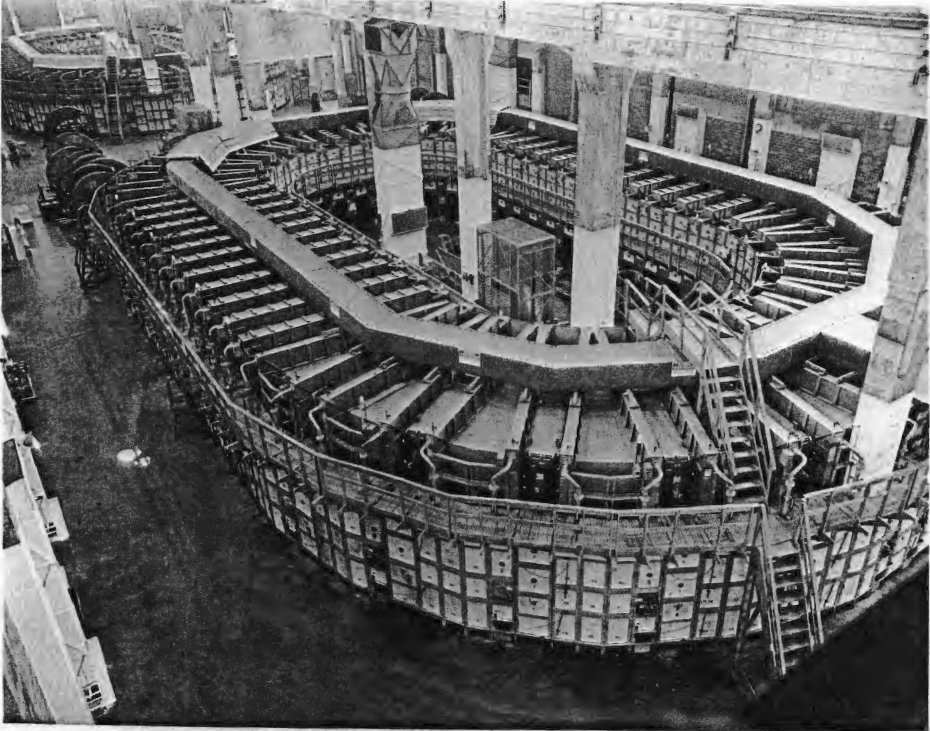
The S-1 Committee recommended pursuing all five technologies simultaneously. This was approved by Bush, Conant, and Brigadier General Wilhelm D. Styer, who had been designated the Army's representative on nuclear matters. Bush and Conant then took the recommendation to the Top Policy Group with a budget proposal for $54 million for construction by the United States Army Corps of Engineers, $31 million for research and development by OSRD and $5 million for contingencies in fiscal year 1943. They cited the fear of a German atomic bomb as a justification. The proposal recommended that new sites for research and production be selected, that production priorities be established, and that the entire project be put under strict security regulations. On 17 June 1942, President Roosevelt approved the recommendations.
Organization
Manhattan District
The Chief of Engineers, Major General Eugene Reybold, selected Colonel James C. Marshall to head the Army's part of the project in June 1942. Marshall created a liaison office in Washington, D.C., but established his temporary headquarters at 270 Broadway in New York, where he could draw on administrative support from the Corps of Engineers' North Atlantic Division. It was close to the Manhattan office of Stone & Webster, the principal project contractor, and to Columbia University. He had permission to draw on his former command, the Syracuse District, for staff, and he started with Lieutenant Colonel Kenneth Nichols, who became his deputy.
Because most of his task involved construction, Marshall worked in cooperation with the head of the Corps of Engineers Construction Division, Major General Thomas M. Robins, and his deputy, Colonel Leslie Groves. Reybold, Somervell, and Styer decided to call the project "Development of Substitute Materials", but Groves felt that this would draw attention. Since engineer districts normally carried the name of the city where they were located, Marshall and Groves agreed to name the Army's component the Manhattan District; Reybold officially created this district on 13 August. Informally, it was known as the Manhattan Engineer District, or MED. Unlike other districts, it had no geographic boundaries, and Marshall had the authority of a division engineer. Development of Substitute Materials remained as the official codename of the project as a whole but was supplanted over time by "Manhattan".
Marshall later conceded that, "I had never heard of atomic fission but I did know that you could not build much of a plant, much less four of them for $90 million." A single TNT plant that Nichols had recently built in Pennsylvania had cost $128 million. Nor were they impressed with estimates to the nearest order of magnitude, which Groves compared with telling a caterer to prepare for between ten and a thousand guests. A survey team from Stone & Webster had already scouted a site for the production plants. The War Production Board recommended sites around Knoxville, Tennessee, an isolated area where the Tennessee Valley Authority could supply ample electric power and the rivers could provide cooling water for the reactors. After examining several sites, the survey team selected one near Elza, Tennessee. Conant advised that it be acquired at once, Styer agreed, but Marshall temporized, awaiting the results of Conant's reactor experiments. Of the prospective processes, only Lawrence's electromagnetic separation appeared sufficiently advanced for construction to commence.
Marshall and Nichols began assembling the necessary resources. The first step was to obtain a high priority rating for the project. The top ratings were AA-1 through AA-4 in descending order, although there was a special AAA rating reserved for emergencies. Ratings AA-1 and AA-2 were for essential weapons and equipment, so Colonel Lucius D. Clay, the deputy chief of staff at Services and Supply for requirements and resources, felt that the highest rating he could assign was AA-3, although he was willing to provide a AAA rating on request for critical materials if the need arose. Nichols and Marshall were disappointed; AA-3 was the same priority as Nichols' TNT plant in Pennsylvania.
Berkeley summer conference
In the spring of 1942, Arthur Compton asked theoretical physicist J. Robert Oppenheimer of the University of California to take over research into fast neutron calculations—key to calculations of critical mass and weapon detonation—from Gregory Breit, who had quit on 18 May 1942 because of concerns over lax operational security. John H. Manley, a physicist at the Metallurgical Laboratory, was assigned to assist Oppenheimer by coordinating experimental physics groups scattered across the country. Oppenheimer and Robert Serber of the University of Illinois examined the problems of neutron diffusion—how neutrons moved in a nuclear chain reaction—and hydrodynamics—how the explosion produced by a chain reaction might behave.
To review this work and the general theory of fission reactions, Oppenheimer and Fermi convened meetings at the University of Chicago in June and at the University of California in July 1942 with theoretical physicists Hans Bethe, John Van Vleck, Edward Teller, Emil Konopinski, Robert Serber, Stan Frankel, and Eldred C. (Carlyle) Nelson, and experimental physicists Emilio Segrè, Felix Bloch, Franco Rasetti, Manley, and Edwin McMillan. They tentatively confirmed that a fission bomb was theoretically possible.
The properties of pure uranium-235 were relatively unknown, as were those of plutonium, which had only been isolated by Glenn Seaborg and his team in February 1941. The scientists at the July 1942 conference envisioned creating plutonium in nuclear reactors where uranium-238 atoms absorbed neutrons that had been emitted from fissioning uranium-235. At this point no reactor had been built, and only tiny quantities of plutonium were available from cyclotrons. Even by December 1943, only two milligrams had been produced. There were many ways of arranging the fissile material into a critical mass. The simplest was shooting a "cylindrical plug" into a sphere of "active material" with a "tamper"—dense material to focus neutrons inward and keep the reacting mass together to increase its efficiency. They also explored designs involving spheroids, a primitive form of "implosion" suggested by Richard C. Tolman, and the possibility of autocatalytic methods to increase the efficiency of the bomb as it exploded.
As the idea of the fission bomb was theoretically settled—at least until more experimental data was available—Edward Teller pushed for discussion of a more powerful bomb: the "super", now usually referred to as a "hydrogen bomb", which would use the force of a detonating fission bomb to ignite a nuclear fusion reaction in deuterium and tritium. Teller proposed scheme after scheme, but Bethe refused each one. The fusion idea was put aside to concentrate on producing fission bombs. Teller raised the speculative possibility that an atomic bomb might "ignite" the atmosphere because of a hypothetical fusion reaction of nitrogen nuclei. Bethe calculated that it was "extremely unlikely". A postwar report co-authored by Teller concluded that "whatever the temperature to which a section of the atmosphere may be heated, no self-propagating chain of nuclear reactions is likely to be started." In Serber's account, Oppenheimer mentioned the possibility of this scenario to Arthur Compton, who "didn't have enough sense to shut up about it. It somehow got into a document that went to Washington" and was "never laid to rest".
Military Policy Committee
Vannevar Bush became dissatisfied with Colonel Marshall's failure to get the project moving forward expeditiously and felt that more aggressive leadership was required. He spoke to Harvey Bundy and Generals Marshall, Somervell, and Styer about his concerns, advocating that the project be placed under a senior policy committee, with a prestigious officer, preferably Styer, as director.
Somervell and Styer selected Groves for the post; General Marshall ordered that he be promoted to brigadier general, as it was felt that the title "general" would hold more sway with the academic scientists working on the project. Groves' orders placed him directly under Somervell rather than Reybold, with Colonel Marshall now answerable to Groves. Groves established his headquarters in Washington, D.C., in the New War Department Building, where Colonel Marshall had his liaison office. He assumed command of the Manhattan Project on 23 September 1942. Later that day, he attended a meeting called by Stimson, which established a Military Policy Committee, responsible to the Top Policy Group, consisting of Bush (with Conant as an alternate), Styer and Rear Admiral William R. Purnell. Tolman and Conant were later appointed as Groves' scientific advisers.
On 19 September, Groves went to Donald Nelson, the chairman of the War Production Board, and asked for broad authority to issue a AAA rating whenever it was required. Nelson initially balked but quickly caved in when Groves threatened to go to the president. Groves promised not to use the AAA rating unless it was necessary. It soon transpired that for the routine requirements of the project the AAA rating was too high but the AA-3 rating was too low. After a long campaign, Groves finally received AA-1 authority on 1 July 1944. According to Groves, "In Washington you became aware of the importance of top priority. Most everything proposed in the Roosevelt administration would have top priority. That would last for about a week or two and then something else would get top priority".
One of Groves' early problems was to find a director for Project Y, the group that would design and build the bomb. The obvious choice was one of the three laboratory heads, Urey, Lawrence, or Arthur Compton, but they could not be spared. Compton recommended Oppenheimer, who was already intimately familiar with the bomb design concepts. However, Oppenheimer had little administrative experience, and, unlike Urey, Lawrence, and Compton, had not won a Nobel Prize, which many scientists felt that the head of such an important laboratory should have. There were also concerns about Oppenheimer's security status, as many of his associates were communists, including his wife, Kitty; his girlfriend, Jean Tatlock; and his brother, Frank. A long conversation in October 1942 convinced Groves and Nichols that Oppenheimer thoroughly understood the issues involved in setting up a laboratory in a remote area and should be appointed as its director. Groves personally waived the security requirements and issued Oppenheimer's clearance on 20 July 1943.
Collaboration with the United Kingdom
The British and Americans exchanged nuclear information but did not initially combine their efforts; in 1940–41 the British project (Tube Alloys) was larger and more advanced. British leadership initially opposed an offer by Bush and Conant in August 1941 to pool the nations' atomic efforts, but the British, who had made significant advances in research early in the war, did not have the resources to carry it into development while devoting a large portion of their economy to the war; Tube Alloys soon fell behind its American counterpart. The roles of the two countries were reversed, and in January 1943 Conant notified the British that they would no longer receive atomic information except in certain areas. The British investigated the possibility of an independent nuclear program but determined that it could not be ready in time to impact the war in Europe.
By March 1943 Conant decided that James Chadwick and one or two other British scientists were important enough that the bomb design team at Los Alamos needed them, despite the risk of revealing weapon design secrets. In August 1943 Churchill and Roosevelt negotiated the Quebec Agreement, which established the Combined Policy Committee to coordinate the efforts of the US and UK; Canada was not a signatory, but the Agreement provided for a Canadian representative on the Combined Policy Committee in view of Canada's contribution to the effort. An agreement between Roosevelt and Churchill known as the Hyde Park Aide-Mémoire, signed in late September 1944, extended the Quebec Agreement to the postwar period and suggested that "when a 'bomb' is finally available, it might perhaps, after mature consideration, be used against the Japanese, who should be warned that this bombardment will be repeated until they surrender".
When cooperation resumed after the Quebec Agreement, the Americans' progress and expenditures amazed the British. Chadwick pressed for British involvement in the Manhattan Project to the fullest extent and abandoned hopes of an independent British project during the war. With Churchill's backing, he attempted to ensure that every request from Groves for assistance was honored. The British Mission that arrived in the United States in December 1943 included Niels Bohr, Otto Frisch, Klaus Fuchs, Rudolf Peierls, and Ernest Titterton. More scientists arrived in early 1944. While those assigned to gaseous diffusion left by the fall of 1944, the thirty-five working under Oliphant with Lawrence at Berkeley were assigned to existing laboratory groups and most stayed until the end of the war. The nineteen sent to Los Alamos also joined existing groups, primarily related to implosion and bomb assembly, but not the plutonium-related ones. The Quebec Agreement specified that nuclear weapons would not be used against another country without the mutual consent of the US and UK. In June 1945, Wilson agreed that the nuclear bombing of Japan would be recorded as a decision of the Combined Policy Committee.
The Combined Policy Committee created the Combined Development Trust in June 1944, with Groves as its chairman, to procure uranium and thorium ores on international markets. The Belgian Congo and Canada held much of the world's uranium outside Eastern Europe, and the Belgian Government in Exile was in London. Britain agreed to give the United States most of the Belgian ore, as it could not use most of the supply without restricted American research. In 1944, the Trust purchased 3,440,000 pounds (1,560,000 kg) of uranium oxide ore from companies operating mines in the Belgian Congo. To avoid briefing US Secretary of the Treasury Henry Morgenthau Jr., a special account not subject to the usual auditing and controls was used to hold Trust monies. Between 1944 and his resignation from the Trust in 1947, Groves deposited a total of $37.5 million.
Groves later said that the British scientists' direct contributions to the Manhattan Project were "helpful but not vital," but "there probably would have been no atomic bomb to drop on Hiroshima" without Britain's (particularly Churchill's) impetus. The British wartime participation was crucial to the success of their independent nuclear weapons program when the McMahon Act of 1946 temporarily ended American nuclear cooperation.
Project sites
Oak Ridge
The day after he took over the project, Groves went to Tennessee with Colonel Marshall to inspect the proposed site there, and Groves was impressed. On 29 September 1942, United States Under Secretary of War Robert P. Patterson authorized the Corps of Engineers to acquire 56,000 acres (23,000 ha) of land by eminent domain at a cost of $3.5 million. An additional 3,000 acres (1,200 ha) was subsequently acquired. About 1,000 families were affected by the order, which came into effect on 7 October. Protests, legal appeals, and a 1943 Congressional inquiry were to no avail. By mid-November U.S. Marshals were posting notices to vacate on farmhouse doors, and construction contractors were moving in. Some families were given two weeks' notice to vacate farms that had been their homes for generations. The ultimate cost of the land acquisition, which was not completed until March 1945, was only about $2.6 million—around $47 an acre. When presented with a proclamation declaring Oak Ridge a total exclusion area that no one could enter without military permission, the governor of Tennessee, Prentice Cooper, angrily tore it up.
Initially known as the Kingston Demolition Range, the site was officially renamed the Clinton Engineer Works (CEW) in early 1943. While Stone & Webster concentrated on the production facilities, the architectural and engineering firm Skidmore, Owings & Merrill developed a residential community for 13,000. The community was located on the slopes of Black Oak Ridge, from which the new town of Oak Ridge got its name. The Army presence at Oak Ridge increased in August 1943 when Nichols replaced Marshall as head of the Manhattan Engineer District. One of his first tasks was to move the district headquarters to Oak Ridge, although the name of the district did not change. In September 1943 the administration of community facilities was outsourced to Turner Construction Company through a subsidiary, the Roane-Anderson Company. Chemical engineers were part of "frantic efforts" to make 10% to 12% enriched uranium 235, with tight security and fast approvals for supplies and materials. The population of Oak Ridge soon expanded well beyond the initial plans, and peaked at 75,000 in May 1945, by which time 82,000 people were employed at the Clinton Engineer Works, and 10,000 by Roane-Anderson.
Los Alamos
The idea of locating Project Y at Oak Ridge was considered, but it was decided that it should be in a remote location. On Oppenheimer's recommendation, the search for a suitable site was narrowed to the vicinity of Albuquerque, New Mexico, where Oppenheimer owned a ranch. On 16 November 1942, Oppenheimer, Groves, Dudley and others toured the vicinity of the Los Alamos Ranch School. Oppenheimer expressed a strong preference for the site, citing its natural beauty, which, it was hoped, would inspire those working on the project. The engineers were concerned about the poor access road, and whether the water supply would be adequate, but otherwise felt that it was ideal.
Patterson approved the acquisition of the site on 25 November 1942, authorizing $440,000 for the purchase of pre-calculated 54,000 acres (22,000 ha), all but 8,900 acres (3,600 ha) of which were already owned by the Federal Government. Secretary of Agriculture Claude R. Wickard granted about 45,000 acres (18,000 ha) of United States Forest Service land to the War Department "for so long as the military necessity continues". Wartime land purchases eventually came to 49,383 acres (19,985 ha), but only $414,971 was spent. Work commenced in December 1942. Groves initially allocated $300,000 for construction, three times Oppenheimer's estimate, but by the time Sundt finished on 30 November 1943, over $7 million had been spent.
During the war, Los Alamos was referred to as "Site Y" or "the Hill". Initially it was to have been a military laboratory with Oppenheimer and other researchers commissioned into the Army, but Robert Bacher and Isidor Rabi balked at the idea and convinced Oppenheimer that other scientists would object. Conant, Groves, and Oppenheimer then devised a compromise whereby the laboratory was operated by the University of California under contract to the War Department. Dorothy McKibbin ran the branch office in Santa Fe, where she met new arrivals and issued them passes.
Chicago
An Army-OSRD council on 25 June 1942 decided to build a pilot plant for plutonium production in the Argonne Forest preserve, southwest of Chicago. This was designated Site A. In July, Nichols arranged for a lease of 1,025 acres (415 ha) from the Cook County Forest Preserve District, and Captain James F. Grafton was appointed Chicago area engineer. It soon became apparent that the scale of operations was too great for the area, and it was decided to build the pilot plant at Oak Ridge and keep a research and testing facility in Chicago.
Delays in establishing the plant at Site A led Arthur Compton to authorize the Metallurgical Laboratory to construct the first nuclear reactor beneath the bleachers of Stagg Field at the University of Chicago. The reactor required an enormous amount of highly purified graphite blocks and uranium in both metallic and powdered oxide forms. At the time, there was a limited source of pure uranium metal; Frank Spedding of Iowa State University was able to produce only two short tons. Three short tons was supplied by Westinghouse Lamp Plant, produced in a rush with makeshift process. A large square balloon was constructed by Goodyear Tire to encase the reactor.
On 2 December 1942, a team led by Enrico Fermi initiated the first artificial self-sustaining nuclear chain reaction in an experimental reactor known as Chicago Pile-1. The point at which a reaction becomes self-sustaining became known as "going critical". Compton reported the success to Conant in Washington, D.C., by a coded phone call, saying, "The Italian navigator [Fermi] has just landed in the new world."
In January 1943, Grafton's successor, Major Arthur V. Peterson, ordered Chicago Pile-1 dismantled and reassembled at the Site A in the forest preserve, as he regarded the operation of a reactor as too hazardous for a densely populated area. Site A continued scientific research as a secret extension of the Metallurgical Laboratory at the university. Chicago Pile-3, the first heavy water reactor, also went critical at this site, on 15 May 1944. After the war, operations at Site A were moved about 6 miles (9.7 km) to DuPage County, the current location of the Argonne National Laboratory.
Hanford
By December 1942 there were concerns that even Oak Ridge was too close to a major population center (Knoxville) in the unlikely event of a major nuclear accident. Groves recruited DuPont in November 1942 to be the prime contractor for the construction of the plutonium production complex. The president of the company, Walter S. Carpenter Jr., wanted no profit of any kind; for legal reasons a nominal fee of one dollar was agreed upon.
DuPont recommended that the site be located far from the existing uranium production facility at Oak Ridge. In December 1942, Groves dispatched Colonel Franklin Matthias and DuPont engineers to scout potential sites. Matthias reported that Hanford Site near Richland, Washington, was "ideal in virtually all respects". It was isolated and near the Columbia River, which could supply sufficient water to cool the reactors. Groves visited the site in January and established the Hanford Engineer Works (HEW), codenamed "Site W".
Under Secretary Patterson gave his approval on 9 February, allocating $5 million for the acquisition of 430,000 acres (170,000 ha). The federal government relocated some 1,500 residents of nearby settlements, as well as the Wanapum and other tribes using the area. A dispute arose with farmers over compensation for crops, which had already been planted. Where schedules allowed, the Army allowed the crops to be harvested, but this was not always possible. The land acquisition process dragged on and was not completed before the end of the Manhattan Project in December 1946.
The dispute did not delay work. Although progress on the reactor design at Metallurgical Laboratory and DuPont was not sufficiently advanced to accurately predict the scope of the project, a start was made in April 1943 on facilities for an estimated 25,000 workers, half of whom were expected to live on-site. By July 1944, some 1,200 buildings had been erected and nearly 51,000 people were living in the construction camp. As area engineer, Matthias exercised overall control of the site. At its peak, the construction camp was the third most populous town in Washington state. Hanford operated a fleet of over 900 buses, more than the city of Chicago. Like Los Alamos and Oak Ridge, Richland was a gated community with restricted access, but it looked more like a typical wartime American boomtown: the military profile was lower, and physical security elements like high fences and guard dogs were less evident.