
Krishna (; Sanskrit: कृष्ण, IAST: Kṛṣṇa Sanskrit: [ˈkr̩ʂɳɐ] ) also known as Govinda, Madhava, Gopala and other names and titles is a major deity in Hinduism. He is worshipped as the eighth avatar of Vishnu and also as the Supreme God in his own right. He is widely revered for his divine qualities of love, compassion, protection and tenderness. Krishna's birthday is celebrated every year by Hindus on Krishna Janmashtami according to the lunisolar Hindu calendar, which falls in late August or early September of the Gregorian calendar.
Krishna is often depicted in dark skin in accordance with meaning of his name, "black" or "dark". The anecdotes and narratives of Krishna's life are known as Krishna Lila. He is a central figure in the Mahabharata, the Bhagavata Purana, the Brahma Vaivarta Purana, and the Bhagavad Gita, and is mentioned in many Hindu philosophical, theological, and mythological texts. These texts describes him as a divine statesman, teacher, savior of dharma, charioteer, and sometimes a cowherd. They portray him in various perspectives: as a god-child, a prankster, a model lover, a divine hero, and the universal supreme being. His iconography reflects these legends and shows him in different stages of his life, such as an infant eating butter, a young boy playing a flute, a handsome youth with Radha or surrounded by female devotees, or a friendly charioteer giving counsel to Arjuna.
Krishna was born in Mathura to Devaki and Vasudeva, but was raised by Nanda and Yashoda in Gokul to escape his maternal uncle, the tyrant king Kamsa. His life as mentioned in texts incorporates highly symbolic miraculous elements; he enchanted the gopis with his divine flute playing, performed the celestial Rasa Lila, and lifted the Govardhan Hill to protect his community from devastating rains. He later defeated Kamsa and restored order in Mathura. He went on to establish the city of Dvaraka and played a central role in the Kurukshetra War, serving as Arjuna’s charioteer and delivering the philosophical teachings of the Bhagavad Gita.

The name and synonyms of Krishna have been traced to 1st millennium BCE literature and cults. In some sub-traditions within Hinduism, like Krishnaism, Krishna is worshipped as the Supreme God and Svayam Bhagavan (God Himself). These sub-traditions arose in the context of the medieval era Bhakti movement. Krishna-related literature has inspired numerous performance arts such as Bharatanatyam, Kathakali, Kuchipudi, Odissi, and Manipuri dance. He is a pan-India god, but is particularly revered in some locations, such as Vrindavan in Uttar Pradesh, Dwarka and Junagadh in Gujarat, the Jagannatha aspect in Odisha, Mayapur in West Bengal, and other places. He is also worshipped in different regional forms across India.
Since the 1960s, the worship of Krishna has also spread to the Western world, largely due to the work of the Bhaktivedanta Swami and his organisation, ISKCON.
Names and epithets
The name "Krishna" originates from the Sanskrit word kṛṣṇa, which means "black", "dark" or "dark blue". The term is also associated with the Krishna Paksha, waning phase of the moon carrying its adjective meaning "darkening". In accordance with the meaning of the name, Krishna murtis are often depicted with black or blue skin.

As a name of Vishnu, Krishna is appears as the 57th name in the Vishnu Sahasranama.
Krishna is also known by various other names, epithets, and titles that reflecting his diverse associations and attributes. Among the most common names are:
Achyuta (Sanskrit: अच्युतcode: san promoted to code: sa ): The infallible one; one who never falls from his divine nature

Ananta (Sanskrit: अनन्तcode: san promoted to code: sa ): The endless or infinite one
Bāl Gopāl (Sanskrit: बाल गोपालcode: san promoted to code: sa ): The child Krishna; protector of cows
Bānke Bihārī (Sanskrit: बाँके बिहारीcode: san promoted to code: sa ): The charming, graceful one who enjoys divine play
Chakrapāṇi (Sanskrit: चक्रपाणिcode: san promoted to code: sa ): One who holds the Sudarshana Chakra (discus)
Dāmodara (Sanskrit: दामोदरcode: san promoted to code: sa ): One who was tied around the waist with a rope
Devakīnandana (Sanskrit: देवकीनन्दनcode: san promoted to code: sa ): Son of Devaki

Dvārakādhīśa (Sanskrit: द्वारकाधीशcode: san promoted to code: sa ): Lord of Dwarka
Ghanashyām (Sanskrit: घनश्यामcode: san promoted to code: sa ): Dark like a rain-filled cloud
Giridhārī (Sanskrit: गिरिधारीcode: san promoted to code: sa ): Lifter of the (Govardhan) mountain

Gopāla (Sanskrit: गोपालcode: san promoted to code: sa ): Protector of cows
Gopīnātha (Sanskrit: गोपीनाथcode: san promoted to code: sa ): Lord of the Gopis
Govinda (Sanskrit: गोविन्दcode: san promoted to code: sa ): One who gives joy to the cows
Hari (Sanskrit: हरिcode: san promoted to code: sa ): The remover of sins and suffering
Jagannātha (Sanskrit: जगन्नाथcode: san promoted to code: sa ): Lord of the universe
Janārdana (Sanskrit: जनार्दनcode: san promoted to code: sa ): One who protects people; one worshipped by devotees
Kanhaiyā (Sanskrit: कन्हैयाcode: san promoted to code: sa ): Beloved young Krishna
Kānha (Sanskrit: कान्हाcode: san promoted to code: sa ): The dark-complexioned beloved one
Keśava (Sanskrit: केशवcode: san promoted to code: sa ): One with beautiful hair; also, slayer of the demon Keshi
Keev (Sanskrit: कीवcode: san promoted to code: sa ): Prankster
Krishna (Sanskrit: कृष्णcode: san promoted to code: sa ): The dark-complexioned one; the all-attractive one
Mādhava (Sanskrit: माधवcode: san promoted to code: sa ): Consort of Lakshmi; sweet and spring-like one
Madhusūdana (Sanskrit: मधुसूदनcode: san promoted to code: sa ): Slayer of the demon Madhu
Manmohana (Sanskrit: मनमोहनcode: san promoted to code: sa ): One who enchants the mind
Mohan (Sanskrit: मोहनcode: san promoted to code: sa ): The charming or enchanting one
Murlīdhara (Sanskrit: मुरलीधरcode: san promoted to code: sa ): Holder of the flute (Murlī)
Nandakumāra (Sanskrit: नन्दकुमारcode: san promoted to code: sa ): Son of Nanda
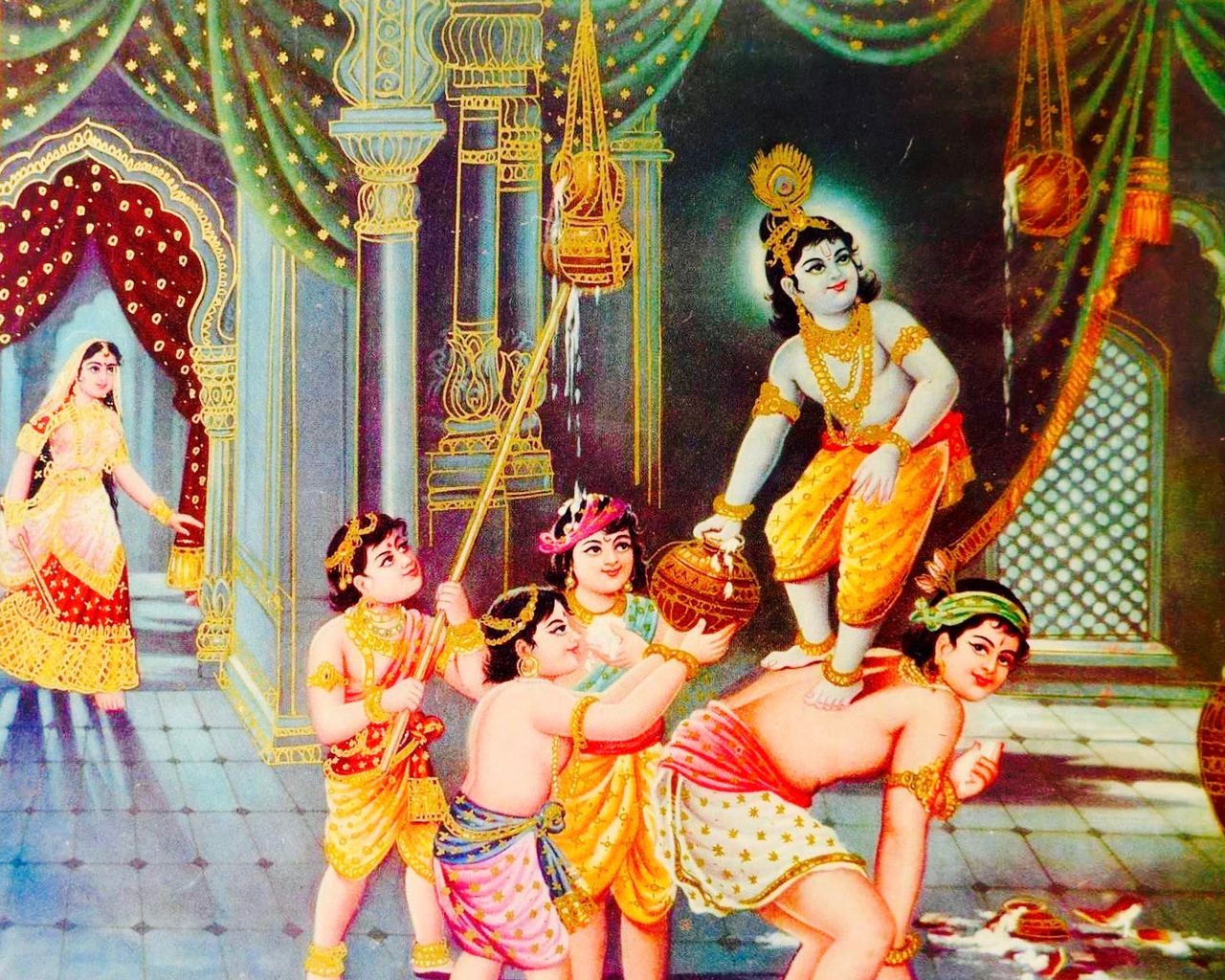
Navanīta Chora (Sanskrit: नवनीत चोरcode: san promoted to code: sa ): Stealer of butter
Parthasārathi (Sanskrit: पार्थसारथिcode: san promoted to code: sa ): Charioteer of Arjuna
Purushottama (Sanskrit: पुरुषोत्तमcode: san promoted to code: sa ): The supreme being; highest among all beings
Rādhāramaṇa (Sanskrit: राधारमणcode: san promoted to code: sa ): Beloved of Radha
Rādhāvallabha (Sanskrit: राधावल्लभcode: san promoted to code: sa ): Dear or beloved of Radha
Ranchhod (Sanskrit: रणछोड़code: san promoted to code: sa ): One who left the battlefield as part of divine strategy
Shyām (Sanskrit: श्यामcode: san promoted to code: sa ): The dark or dusky one
Shyāmsundara (Sanskrit: श्यामसुन्दरcode: san promoted to code: sa ): The beautiful dark-complexioned one
Vāsudeva (Sanskrit: वासुदेवcode: san promoted to code: sa ): Son of Vasudeva (Sanskrit: वसुदेवcode: san promoted to code: sa ) also the indwelling divine presence
Venugopāla (Sanskrit: वेणुगोपालcode: san promoted to code: sa ): Krishna as the flute-playing cowherd
Viṣṇu (Sanskrit: विष्णुcode: san promoted to code: sa ): The all-pervading one
Yādava (Sanskrit: यादवcode: san promoted to code: sa ): Descendant of the Yadu dynasty
Yogeśvara (Sanskrit: योगेश्वरcode: san promoted to code: sa ): Lord of yoga; master of divine wisdom
Certain names of Krishna also hold regional importance such as Jagannatha, associated with the Jagannath Temple, Puri, is a popular manifestation of Krishna in Odisha state and nearby regions of eastern India.
In Hindu tradition, Krishna’s names and epithets signify his qualities, relationships, divine functions, and mythological deeds. The Mahābhārata explains names such as Vāsudeva, Viṣṇu, Madhusūdana, Janārdana, and Puruṣottama by linking them to Krishna’s all-pervading nature, lineage, and slaying of demons, while the Bhāgavata Purāṇa connects names such as Dāmodara and Giridhārī to specific episodes in Krishna’s childhood and Vṛndāvana līlās.
Role and significance in religion
Krishna is the eighth avatar of Vishnu and a major deity in Hinduism. He is worshipped as a full incarnation of Vishnu and Supreme God in his own right. He is also referred as "Swayam Bhagavan" (God Himself) particularly in Krishnaism and Vaishnavism traditions.
He is the god of protection, compassion, tenderness, and love and widely revered among Hindu divinities. He struck down his maternal uncle Kamsa, established the ancient city of Dwarka, and played a pivotal role in Mahabharata epic by fighting for Pandavas and concluding the war.
Krishna is depicted in several Hindu texts including the Mahabharata and the Bhagavata Puran, where he is a central character and preaches many of his philosophical ideas. Bhagavad Gita, part of the epic Mahabharata, serves as an independent spiritual guide. It allegorically raises the ethical and moral dilemmas of human life through the conversation of Krishna and Arjuna during the Kurukshetra War. The text presents answers, addressing the ideological questions on human freedoms, choices, and responsibilities (dharma) towards self and others. These teachings then become a prominent feature of Bhakti movement in medieval India.
Origins and early sources
The tradition of Krishna appears to developed through the amalgamation of several independent deities of ancient India, the earliest attested of which was Vāsudeva. Vāsudeva was a hero-god of the tribe of the Vrishnis, belonging to the Vrishni heroes, whose worship is attested from the 5th–6th centuries BCE in the writings of Pāṇini, and from the 2nd century BCE in epigraphic evidences such as the Heliodorus pillar. Vrishnis were thought to have later merged with the tribe of the Yadavas, whose hero-god was Krishna. Vāsudeva and Krishna subsequently merged into a single deity, who appears in the Mahabharata, and started to be identified with Vishnu in the Mahabharata and the Bhagavad Gita. By the 4th century CE, tradition Gopala-Krishna tradition of the Abhiras, centred on the Krishna's role as protector of cattle, has also been incorporated into the broader Krishna tradition.
Early epigraphic sources
Depiction in coinage (2nd century BCE)
Around 180 BCE, the Indo-Greek king Agathocles issued some coinage (discovered in Ai-Khanoum, Afghanistan) bearing images of deities that are now interpreted as being related to Vaisnava imagery in India. The deities displayed on the coins appear to be Saṃkarṣaṇa-Balarama with attributes consisting of the gada mace and the plow, and Vāsudeva-Krishna with attributes of the shankha (conch) and the sudarshana chakra wheel.