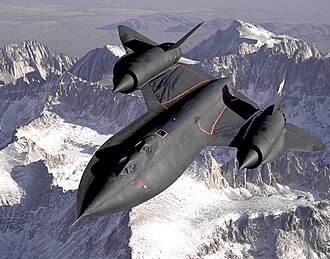
The Lockheed SR-71 "Blackbird" is a retired long-range, high-altitude, Mach 3+ strategic reconnaissance aircraft that was developed and manufactured by the American aerospace company Lockheed Corporation. Its nicknames include "Blackbird" and "Habu".
The SR-71 was developed in the 1960s as a black project by Lockheed's Skunk Works division. American aerospace engineer Clarence "Kelly" Johnson was responsible for many of the SR-71's innovative concepts. Its shape was based on the Lockheed A-12, a pioneer in stealth technology with its reduced radar cross section, but the SR-71 was longer and heavier to carry more fuel and a crew of two in tandem cockpits. The SR-71 was revealed to the public in July 1964 and entered service in the United States Air Force (USAF) in January 1966.
During missions, the SR-71 operated at high speeds and altitudes (Mach 3.2 at 85,000 ft or 26,000 m), allowing it to evade or outrace threats. If a surface-to-air missile launch was detected, the standard evasive action was to accelerate and outpace the missile. Equipment for the plane's aerial reconnaissance missions included signals-intelligence sensors, side-looking airborne radar, and a camera. On average, an SR-71 could fly just once per week because of the lengthy preparations needed. A total of 32 aircraft were built; 12 were lost in accidents, none to enemy action.

From 1968, reconnaissance missions were flown from Kadena AB, Okinawa, first over North Vietnam and Laos during the Vietnam War, and later over North Korea. From 1976, missions were flown from RAF Mildenhall, UK, along the Soviet Union's Baltic and Barents Sea coastlines. Missions were also flown over Cuba, Nicaragua, Libya, and to probe nuclear weapons installations in Israel and South Africa. Unlike previous aircraft that were under the Central Intelligence Agency, SR-71 missions were flown overtly, with USAF markings, and never overflew the Warsaw Pact or China.
In 1974, the SR-71 set the record for the quickest flight between London and New York at 1 hour, 54 minutes and 56 seconds. In 1976, it became the fastest airbreathing manned aircraft, previously held by its predecessor, the closely related Lockheed YF-12. As of 2026, the Blackbird still holds both world records.
In 1989, the USAF retired the SR-71, largely for political reasons, although several were briefly reactivated before their second retirement in 1998. NASA was the final operator of the Blackbird, using it as a research platform, until it was retired again in 1999. Since its retirement, the SR-71's role has been taken up by a combination of reconnaissance satellites and unmanned aerial vehicles (UAVs). As of 2018, Lockheed Martin was developing a proposed UAV successor, the SR-72; however, as of 2026, the design remains a concept.

Development
Background
Lockheed's previous reconnaissance aircraft was the relatively slow U-2, designed for the Central Intelligence Agency (CIA). In late 1957, the CIA approached the defense contractor Lockheed to build an undetectable spy plane. The project, named Archangel, was led by Kelly Johnson, head of Lockheed's Skunk Works unit in Burbank, California. The work on project Archangel began in the second quarter of 1958, with aim of flying higher and faster than the U-2. Of 11 successive designs drafted in a span of 10 months, "A-10" was the front-runner, although its shape made it vulnerable to radar detection. After a meeting with the CIA in March 1959, the design was modified to reduce its radar cross-section by 90%. On 11 February 1960, the CIA approved a US$96 million (~$778 million in 2024) contract for Skunk Works to build a dozen A-12 spy planes. Three months later, the May 1960 downing of Francis Gary Powers's U-2 underscored the need for less vulnerable reconnaissance aircraft.
The A-12 first flew at Groom Lake (Area 51), Nevada, on 25 April 1962. Thirteen were built, plus five more of two variants: three of the YF-12 interceptor prototype and two of the M-21 drone carrier. The aircraft was to be powered by the Pratt & Whitney J58 engine, but J58 development was taking longer than scheduled, so it was initially equipped with the lower-thrust Pratt & Whitney J75 to enable flight testing to begin. The J58s were retrofitted as they became available, and became the standard engine for all subsequent aircraft in the series (A-12, YF-12, M-21), as well as the SR-71. The A-12 flew missions over Vietnam and North Korea before its retirement in 1968. The program's cancellation was announced on 28 December 1966, due both to budget concerns and because of the forthcoming SR-71, a derivative of the A-12.
Designation as SR-71
The SR-71 designation is a continuation of the pre-1962 bomber series; the last aircraft built using the series was the XB-70 Valkyrie. However, a bomber variant of the Blackbird was briefly given the B-71 designator, which was retained when the type was changed to SR-71.

During the later stages of its testing, the B-70 was proposed for a reconnaissance/strike role, with an "RS-70" designation. When the A-12's performance potential was clearly found to be much greater, the USAF ordered a variant of the A-12 in December 1962, which was originally named R-12 by Lockheed. This USAF version was longer and heavier than the original A-12 because it had a longer fuselage to hold more fuel. The R-12 also had a crew of two in tandem cockpits, and reshaped fuselage chines. Reconnaissance equipment included signals intelligence sensors, a side-looking airborne radar, and a photo camera. The CIA's A-12 was a better photo-reconnaissance platform than the USAF's R-12: since the A-12 flew higher and faster, and with only a pilot, it had room to carry a better camera and more instruments. The A-12 flew covert missions while the SR-71 flew overt missions; the latter had USAF markings and pilots carried Geneva Conventions Identification Cards.
During the 1964 campaign, Republican presidential nominee Barry Goldwater repeatedly criticized President Lyndon B. Johnson and his administration for falling behind the Soviet Union in developing new weapons. Johnson decided to counter this criticism by revealing the existence of the YF-12A USAF interceptor, which also served as cover for the still-secret A-12 and the USAF reconnaissance model since July 1964. USAF Chief of Staff General Curtis LeMay preferred the SR (Strategic Reconnaissance) designation and wanted the RS-71 to be named SR-71. Before the July speech, LeMay lobbied to modify Johnson's speech to read "SR-71" instead of "RS-71". The media transcript given to the press at the time still had the earlier RS-71 designation in places, creating the story that the president had misread the aircraft's designation. To conceal the A-12's existence, Johnson referred only to the A-11, while revealing the existence of a high-speed, high-altitude reconnaissance aircraft.
In 1968, Secretary of Defense Robert McNamara canceled the F-12 interceptor program. The specialized tooling used to manufacture both the YF-12 and the SR-71 was also ordered destroyed. Production of the SR-71 totaled 32 aircraft: 29 SR-71As, 2 SR-71Bs, and 1 SR-71C.

Design
Overview
The SR-71 was designed to fly faster than Mach 3 at altitudes above 85,000 ft (26,000 m) with the smallest radar cross-section that Lockheed could achieve, an early attempt at stealth design. Aircraft were painted black to radiate heat more effectively than bare metal, reducing the temperature of the skin and thermal stresses on the airframe. It had tandem cockpits for its crew of two: a pilot and a reconnaissance systems officer who navigated and operated the surveillance systems.
Airframe, canopy, and landing gear
Titanium was used for 85% of the structure, with much of the rest being polymer composite materials. To control costs, Lockheed used a more easily worked titanium alloy, which softened at a lower temperature. The challenges posed led Lockheed to develop new fabrication methods, which have since been used in the manufacture of other aircraft. Lockheed found that washing welded titanium requires distilled water, as the chlorine present in tap water is corrosive; cadmium-plated tools could not be used, as they also caused corrosion. Metallurgical contamination was another problem; at one point, 80% of the delivered titanium for manufacture was rejected on these grounds.
The high temperatures generated in flight required special design and operating techniques. Major sections of the skin of the inboard wings were corrugated, not smooth.

Fuselage panels were manufactured to fit only loosely with the aircraft on the ground. Proper alignment was achieved as the airframe heated up, with thermal expansion of several inches. Because of this, and the lack of a fuel-sealing system that could remain leak-free with the extreme temperature cycles during flight, the aircraft leaked JP-7 fuel on the ground before takeoff, annoying ground crews.
The outer windscreen of the cockpit was made of three layers of glass with cooling sections between them. The ANS navigation window was made of solid quartz and was fused ultrasonically to the titanium frame. The temperature of the exterior of the windscreen could reach 600 °F (320 °C) during a mission.
The Blackbird's tires, manufactured by B.F. Goodrich, contained aluminum and were inflated with nitrogen. They cost $2,300 each and generally required replacing within 20 missions. The Blackbird landed at more than 170 knots (200 mph; 310 km/h) and deployed a drag parachute to reduce landing roll and brake and tire wear.

Shape and threat avoidance
The SR-71 was the second operational aircraft, after the Lockheed A-12, designed to be hard to spot on radar. Early studies in stealth technology indicated that a shape with flattened, tapering sides would reflect most radar energy away from a beam's place of origin, so Lockheed's engineers added chines and canted the vertical control surfaces inward. Special radar-absorbing materials were incorporated into sawtooth-shaped sections of the aircraft's skin. Cesium-based fuel additives were used to somewhat reduce the visibility of exhaust plumes to radar, although exhaust streams remained quite apparent. Ultimately, engineers produced an aircraft with a wing area of about 1,800 sq ft (170 m2) but a radar cross-section (RCS) of around 110 sq ft (10 m2). Johnson later conceded that Soviet radar technology advanced faster than the stealth technology employed against it.
While the SR-71 carried radar countermeasures to evade interception efforts, its greatest protection was its combination of high altitude and very high speed, which made it invulnerable at the time. Along with its low radar cross-section, these qualities gave a very short time for an enemy surface-to-air missile (SAM) site to acquire and track the aircraft on radar. By the time the SAM site could track the SR-71, it was often too late to launch a SAM, and the SR-71 would be out of range before the SAM could catch up to it. If the SAM site could track the SR-71 and fire a SAM in time, the SAM would expend nearly all of the delta-v of its boost and sustainer phases just reaching the SR-71's altitude; at this point, out of thrust, it could do little more than follow its ballistic arc. Merely accelerating would typically be enough for an SR-71 to evade a SAM; changes by the pilots in the SR-71's speed, altitude, and heading were also often enough to spoil any radar lock on the plane by SAM sites or enemy fighters. At sustained speeds of more than Mach 3.2, the plane was faster than the Soviet Union's fastest interceptor, the Mikoyan-Gurevich MiG-25, which also could not reach the SR-71's altitude. No SR-71 was ever shot down.
The SR-71 featured chines, a pair of sharp edges leading aft from either side of the nose along the fuselage. These were not a feature on the early A-3 design; Frank Rodgers, a doctor at the Scientific Engineering Institute, a CIA front organization, discovered that a cross-section of a sphere had a greatly reduced radar reflection, and adapted a cylindrical-shaped fuselage by stretching out the sides of the fuselage. After the advisory panel provisionally selected Convair's FISH design over the A-3 on the basis of RCS, Lockheed adopted chines for its A-4 through A-6 designs.
Aerodynamicists discovered that the chines generated powerful vortices and created additional lift, leading to unexpected aerodynamic performance improvements. For example, they allowed a reduction in the wings' angle of incidence, which added stability and reduced drag at high speeds, allowing more weight to be carried, such as fuel. Landing speeds were also reduced, as the chines' vortices created turbulent flow over the wings at high angles of attack, making it harder to stall. The chines also acted like leading-edge extensions, which increase the agility of fighters such as the F-5, F-16, F/A-18, MiG-29, and Su-27. The addition of chines also allowed the removal of the planned canard foreplanes.
Propulsion system or powerplant
Complete powerplant
The SR-71 used the same powerplant as the A-12 and YF-12. It consists of three main parts: inlet, J58 engine and its nacelle, and ejector nozzle. "Typical for any supersonic powerplant the engine cannot be considered separately from the rest of the powerplant. Rather, it may be regarded as the heat pump in the over-all system of inlet, engine, and nozzle. The net thrust available to propel the aircraft may be to a large extent controlled by the performance of the inlet and nozzle rather than by the physical potentialities of the engine alone." Above Mach 3 in maximum afterburner, the Blackbird's inlet contributed 54% of the thrust; the ejector nozzle, 28.4%; and the engine, 17.6%.
While stationary or at low speeds, flow restrictions in the inlet caused a loss in engine thrust. Thrust was recovered with ram pressure as flight speed increased (uninstalled thrust 34,000 lb (150 kN), installed at zero airspeed 25,500 lb (113 kN) rising through 30,000 lb (130 kN) at 210 knots, unstick speed).
At supersonic speeds, the intake adapts to the engine requirements, allowing some approaching air to flow around the outside of the cowl, causing spillage drag. At low supersonic speeds, more than half of the air was spilled, but this fraction shrank as the aircraft approached the higher speeds where the inlet airflow and engine demand were designed to match. At this speed, the spike shock touched the cowl lip and there was minimal spillage (with its attendant drag), as shown by Campbell. The inlet and engine matching was also shown by Brown, who emphasized the benefit of increased engine airflow at higher Mach numbers that came with the introduction of the bleed bypass cycle. These two authors show the disparity between inlet and engine for the Blackbird in terms of airflow and it is further explained in more general terms by Oates.
Engine operation was adversely affected when operating behind an unstarted inlet. In this condition the inlet behaved like a subsonic inlet design (known as a pitot type) at high supersonic speeds, with very low airflow to the engine. Fuel was automatically diverted, by the fuel derich system, from the combustor to prevent turbine over-temperature.
All three parts were linked by the secondary airflow. The inlet needed the boundary layers removed from its spike and cowl surfaces. The one with the higher pressure recovery, the cowl shock-trap bleed, was chosen as secondary air to ventilate and cool the outside of the engine. It was assisted from the inlet by the pumping action of the engine exhaust in the ejector nozzle, cushioning the engine exhaust as it expanded over a wide range of pressure ratios which increased with flight speed.
Mach 3.2 in a standard day atmosphere was the design point for the aircraft. However, in practice the SR-71 was more efficient at even faster speeds and colder temperatures. The specific range charts showed for a standard day temperature, and a particular weight, that Mach 3.0 cruise used 38,000 lb/h (17,000 kg/h) of fuel. At Mach 3.15 the fuel flow was 36,000 lb/h (16,000 kg/h). Flying in colder temperatures (known as temperature deviations from the standard day) would also reduce the fuel used, e.g. with a 14 °F (−10 °C) temperature the fuel flow was 35,000 lb/h (16,000 kg/h). During one mission, SR-71 pilot Brian Shul flew faster than usual to avoid multiple interception attempts. It was discovered after the flight that this had reduced the fuel consumption. It is possible to match the powerplant for optimum performance at only one ambient temperature because the airflows for a supersonic inlet and engine vary differently with ambient temperature. For an inlet, the airflow varies inversely with the square root of the temperature, and for the engine, it varies with the direct inverse.
Inlet
The engine inlets needed so-called mixed external/internal compression with internal supersonic diffusion since all-external compression used on slower aircraft caused too much drag at Blackbird speeds. Their features included a centerbody or spike, spike boundary-layer bleed slots where normal shock was located, a cowl boundary layer bleed "shock trap" entrance, streamlined bodies known as "mice", forward bypass bleed ports between the "mice", rear bypass ring, louvers on external surface for spike boundary layer overboard, and louvers on external surface for front bypass overboard. Venting this bypass overboard produced high drag: 6,000 lb (27 kN) at cruise with 50% door opening, compared to the total aircraft drag of 14,000 lb (62 kN). Designer David Campbell holds a patent on the inlet's aerodynamic features and functioning, which are explained in the "A-12 Utility Flight Manual" and in a 2014 presentation by Lockheed Technical Fellow Emeritus Tom Anderson.
When an inlet was operating as an efficient supersonic compressor—a status called "started"—supersonic diffusion took place in front of the cowl and internally in a converging passage as far as a terminal shock where the passage area began to increase and subsonic diffusion takes place. An analog control system was designed to hold the terminal shock in position.
But in the early years of operation, the analog computers could not always keep up with rapidly changing inputs from the nose boom. If the duct back pressure became too great and the spike was incorrectly positioned, the shock wave become unstable and would shoot quickly forward to a stable position outside the cowl. This "inlet unstart" would often extinguish the engine's afterburner. The asymmetrical thrust from the other engine would cause the aircraft to yaw violently. SAS, autopilot, and manual control inputs would attempt to regain controlled flight, but extreme yaw would often reduce airflow in the opposite engine and stimulate "sympathetic stalls". This generated a rapid counter-yawing, often coupled with loud "banging" noises, and a rough ride during which crews' helmets would sometimes strike their cockpit canopies. One response to a single unstart was unstarting both inlets to prevent yawing, then restarting them both. After wind-tunnel testing and computer modeling by NASA Dryden test center, Lockheed installed an electronic control to detect unstart conditions and perform this reset action without pilot intervention.
During troubleshooting of the unstart issue, NASA discovered that the vortices from the nose chines were entering the engine and reducing engine efficiency. To fix this, the agency developed a computer to control the engine bypass doors. Beginning in 1980, the analog inlet control system was replaced by a digital system, Digital Automatic Flight and Inlet Control System (DAFICS), which reduced unstarts.
Engine and nacelle
The engine was an extensively re-designed version of the J58-P2, an existing supersonic engine which had run 700 development hours in support of proposals to power various aircraft for the US Navy. Only the compressor and turbine aerodynamics were retained. New design requirements for cruise at Mach 3.2 included:
operating with very high ram temperature air entering the compressor, at 800 °F (430 °C)
a continuous turbine temperature capability 450 °F (250 °C) hotter than previous experience (Pratt & Whitney J75)
continuous use of maximum afterburning
the use of new, more expensive, materials and fluids required to withstand unprecedented high temperatures
The engine was an afterburning turbojet for take-off and transonic flight (bleed bypass closed) and a low bypass augmented turbofan for supersonic acceleration (bleed bypass open). It approximated a ramjet during high speed supersonic cruise (with a pressure loss, compressor to exhaust, of 80% which was typical of a ramjet). It was a low bypass turbofan for subsonic loiter (bleed bypass open).
Analysis of the J58-P2 supersonic performance showed the high compressor inlet temperature would have caused stalling, choking and blade breakages in the compressor as a result of operating at low corrected speeds on the compressor map. These problems were resolved by Pratt & Whitney engineer Robert Abernethy and are explained in his patent, "Recover Bleed Air Turbojet". His solution was to 1) incorporate six air-bleed tubes, prominent on the outside of the engine, to transfer 20% of the compressor air to the afterburner, and 2) to modify the inlet guide vanes with a 2-position, trailing edge flap. The compressor bleed enabled the compressor to operate more efficiently and with the resulting increase in engine airflow matched the inlet design flow with an installed thrust increase of 47%. A continuous turbine temperature of 2,000 °F (1,090 °C) was enabled with air-cooled first stage turbine vane and blades. Continuous operation of maximum afterburning was enabled by passing relatively cool air from the compressor along the inner surface of the duct and nozzle. Ceramic thermal barrier coatings were also used.
The secondary airflow through the nacelle comes from the cowl boundary layer bleed system which is oversized (flows more than boundary layer) to give a high enough pressure recovery to support the ejector pumping action. Additional air comes from the rear bypass doors and, for low speed operation with negligible inlet ram, from suck-in doors by the compressor case.
Ejector nozzle
The nozzle had to operate efficiently over a wide range of pressure ratios: from low with no inlet ram when the aircraft was stationary, to 31 times the external pressure at 80,000 ft (24,000 m). A blow-in door ejector nozzle had been invented by Pratt & Whitney engineer Stuart Hamilton in the late 1950s and described in his patent "Variable Area Exhaust Nozzle". In this description the nozzle is an integral part of the engine (as it was in the contemporary Mach 3 General Electric YJ93. For the Blackbird powerplant, the nozzle was more efficient structurally (lighter) by incorporating it as part of the airframe because it carried fin and wing loads through the ejector shroud. The nozzle used secondary air from two sources: the inlet cowl boundary layer and rear bypass from immediately in front of the compressor. It used external flow on the nacelle through the tertiary blow-in doors until the ram closed them at Mach 1.5, and secondary air alone at higher speeds.
At low flight speeds, the engine exhaust pressure at the primary nozzle exit was greater than ambient, so it tended to over-expand to lower-than-ambient pressure in the shroud, causing impingement shocks. Secondary and blow-in door air surrounding the exhaust cushioned it, preventing over-expansion. As inlet ram pressure increased with flight speed, it closed the blow-in doors, then gradually opened the nozzle flaps until they were fully open at Mach 2.4. The final nozzle area did not increase with further increase in flight speed (for complete expansion to ambient and greater internal thrust) because its external diameter, greater than nacelle diameter would cause too much drag.
Fuel
The SR-71 used JP-7 fuel that was difficult to ignite. To start the engines, triethylborane (TEB), which ignites on contact with air, was injected to produce temperatures high enough to ignite the JP-7. The TEB produced a characteristic green flame, which could often be seen during engine ignition. The fuel was used as a heat sink for the rest of the aircraft to cool the pilot and the electronics. An electric starting system was not possible due to the limited capacity of the cooling system, so the chemical ignition system was used.
On a typical mission, the SR-71 took off with a partial fuel load to reduce stress on the brakes and tires during takeoff and also ensure it could successfully take off should one engine fail. Within 20 seconds, the aircraft traveled 4,500 ft (1,400 m), reached 240 mph (390 km/h), and lifted off. It reached 20,000 ft (6,100 m) of altitude in less than two minutes, and the typical 80,000 ft (24,000 m) cruising altitude in another 17 minutes, having used one third of its fuel. It is a common misconception that the planes refueled shortly after takeoff because the fuel tanks, which formed the outer skin of the aircraft, leaked on the ground. It was not possible to prevent leaks when the aircraft skin was cold and the tanks only sealed when the skin warmed as the aircraft speed increased. The ability of the sealant to prevent leaks was compromised by the expansion and contraction of the skin with each flight. However, the amount of fuel that leaked, measured as drops per minute on the ground from specific locations, was not enough to make refueling necessary.
The SR-71 also required in-flight refueling to replenish fuel during long-duration missions. Supersonic flights generally lasted no more than 90 minutes before the pilot had to find a tanker.
Specialized KC-135Q tankers were required to refuel the SR-71. The KC-135Q had a modified high-speed boom, which would allow refueling of the Blackbird at near the tanker's maximum airspeed. The tanker also had special fuel systems for moving JP-4 (for the KC-135Q itself) and JP-7 (for the SR-71) between different tanks. As an aid to the pilot when refueling, the cockpit was fitted with a peripheral vision horizon display. This unusual instrument projected a barely visible artificial horizon line across the top of the entire instrument panel, which gave the pilot subliminal cues on aircraft attitude. If a KC-135Q was not available any tanker with JP-4 or JP-5 could be used in an emergency to avoid losing the aircraft, but with a Mach 1.5 speed limit.
On hot days, when approaching the maximum fuel load of 80,285 lb (36,415 kg), the left engine had to be run with minimum afterburner to maintain probe contact.