A leap second (sometimes called intercalary second) is a one-second adjustment occasionally applied to Coordinated Universal Time (UTC), to accommodate the difference between International Atomic Time (TAI), as measured precisely by atomic clocks, and observed solar time (UT1), which varies due to irregularities and long-term slowdown in the Earth's rotation.
The UTC time standard, widely used for international timekeeping and as the reference for civil time in most countries, uses TAI and consequently would run ahead of observed solar time unless it is reset to UT1 as needed. The leap second facility exists to provide this adjustment. The leap second was introduced in 1972 (at that time UTC already lagged behind TAI by 10 seconds because of earlier methods of managing the difference). Since then, 27 leap seconds have been added to UTC, with the most recent occurring on December 31, 2016. All have so far been positive leap seconds, adding a second to a UTC day; while a negative leap second is theoretically possible, it has not yet occurred.
Because the Earth's rotational speed varies in response to climatic and geological events, UTC leap seconds are irregularly spaced and not precisely predictable. The decision to insert a leap second is made by the International Earth Rotation and Reference Systems Service (IERS), typically about six months in advance, to ensure that the difference between UTC and UT1 does not exceed ±0.9 seconds.
This practice has proven disruptive, particularly in modern digital systems that require continuous and precise timestamping. Since not all systems implement leap-second adjustments uniformly, some computational, networking, and satellite-based systems may encounter anomalies.
History
In about AD 140, Ptolemy, the Alexandrian astronomer, sexagesimally subdivided both the mean solar day and the true solar day to at least six places after the sexagesimal point, and he used simple fractions of both the equinoctial hour and the seasonal hour, none of which resemble the modern second. Muslim scholars, including al-Biruni in 1000, subdivided the mean solar day into 24 equinoctial hours, each of which was subdivided sexagesimally, that is into the units of minute, second, third, fourth and fifth, creating the modern second as 1⁄60 of 1⁄60 of 1⁄24 = 1⁄86,400 of the mean solar day in the process. With this definition, the second was proposed in 1874 as the base unit of time in the CGS system of units. Soon afterwards Simon Newcomb and others discovered that Earth's rotation period varied irregularly, so in 1952, the International Astronomical Union (IAU) defined the second as a fraction of the sidereal year. In 1955, considering the tropical year to be more fundamental than the sidereal year, the IAU redefined the second as the fraction 1⁄31,556,925.975 of the 1900.0 mean tropical year. In 1956, a slightly more precise value of 1⁄31,556,925.9747 was adopted for the definition of the second by the International Committee for Weights and Measures, and in 1960 by the General Conference on Weights and Measures, becoming a part of the International System of Units (SI).
Reading level
Audio Summary
Played with your browser's voice. Studio-quality audio can be added with a text-to-speech service.
Ask about this article
📝 Quick Quiz1 / 4
What is "Leap second" primarily known for?
Vocix Daily — In Your Inbox
Top stories, deep-dive articles, and "On This Day" history — one crisp digest delivered every morning.
Sources & references
Reference material for this entry is drawn from the open encyclopedic record, including Wikipedia , available under the CC BY-SA 4.0 license. Images are credited individually beside each photo.
Eventually, this definition too was found to be inadequate for precise time measurements, so in 1967, the SI second was again redefined as "the duration of 9,192,631,770 periods of the radiation corresponding to the transition between the two hyperfine levels of the ground state of the cesium 133 atom". That value agreed to 1 part in 1010 with the astronomical (ephemeris) second then in use. It was also close to 1⁄86,400 of the mean solar day as averaged between years 1750 and 1892.
However, for the past several centuries, the length of the mean solar day has been increasing by about 1.4–1.7 ms per century, depending on the averaging time. By 1961, the mean solar day was already a millisecond or two longer than 86400 SI seconds. Therefore, time standards that change the date after precisely 86400 SI seconds, such as the International Atomic Time (TAI), would become increasingly ahead of time standards tied to the mean solar day, such as Universal Time (UT).
When the Coordinated Universal Time (UTC) standard was instituted in 1960, based on atomic clocks, it was felt necessary to maintain agreement with UT, which, until then, had been the reference for broadcast time services. From 1960 to 1971, the rate of UTC atomic clocks was offset from a pure atomic time scale by the BIH to remain synchronized with UT2, a practice known as the "rubber second". The rate of UTC was decided at the start of each year, and was offset from the rate of atomic time by −150 parts per 1010 for 1960–1962, by −130 parts per 1010 for 1962–63, by −150 parts per 1010 again for 1964–65, and by −300 parts per 1010 for 1966–1971. Alongside the shift in rate, an occasional 0.1 s step (0.05 s before 1963) was needed. This predominantly frequency-shifted rate of UTC was broadcast by MSF, WWV, and CHU among other time stations. In 1966, the CCIR approved "stepped atomic time" (SAT), which adjusted atomic time with more frequent 0.2 s adjustments to keep it within 0.1 s of UT2, because it had no rate adjustments. SAT was broadcast by WWVB among other time stations.
In 1972, the leap-second system was introduced so that the UTC seconds could be set exactly equal to the standard SI second, while still maintaining the UTC time of day and changes of UTC date synchronized with those of UT1. By then, the UTC clock was already 10 seconds behind TAI, which had been synchronized with UT1 in 1958, but had been counting true SI seconds since then. After 1972, both clocks have been ticking in SI seconds, so the difference between their displays at any time is 10 seconds plus the total number of leap seconds that have been applied to UTC as of that time; as of 2024, 27 leap seconds have been applied to UTC, so the difference is 10 + 27 = 37 seconds. The most recent leap second was on December 31, 2016.
Leap seconds are irregularly spaced because the Earth's rotation speed changes irregularly. Indeed, the Earth's rotation is quite unpredictable in the long term, which explains why leap seconds are announced only six months in advance.
A mathematical model of the variations in the length of the solar day was developed by F. R. Stephenson and L. V. Morrison, based on records of eclipses for the period 700 BC to 1623, telescopic observations of occultations for the period 1623 until 1967 and atomic clocks thereafter. The model shows a steady increase of the mean solar day by 1.70 ms (±0.05 ms) per century, plus a periodic shift of about 4 ms amplitude and period of about 1,500 yr. Over the last few centuries, rate of lengthening of the mean solar day has been about 1.4 ms per century, being the sum of the periodic component and the overall rate.
The main reason for the slowing down of the Earth's rotation is tidal friction, which alone would lengthen the day by 2.3 ms/century. Other contributing factors are the movement of the Earth's crust relative to its core, changes in mantle convection, and any other events or processes that cause a significant redistribution of mass. These processes change the Earth's moment of inertia, affecting the rate of rotation due to the conservation of angular momentum. Some of these redistributions increase Earth's rotational speed, shorten the solar day and oppose tidal friction. For example, glacial rebound shortens the solar day by 0.6 ms/century and the 2004 Indian Ocean earthquake is thought to have shortened it by 2.68 microseconds.
It is a mistake, however, to consider leap seconds as indicators of a slowing of Earth's rotation rate; they are indicators of the accumulated difference between atomic time and time measured by Earth rotation. The plot at the top of this section shows that in 1972 the average length of day was approximately 86400.003 seconds and in 2016 it was approximately 86400.001 seconds, indicating an overall increase in Earth's rotation rate over that time period. Positive leap seconds were inserted during that time because the annual average length of day remained greater than 86400 SI seconds, not because of any slowing of Earth's rotation rate.
In 2021, it was reported that Earth was spinning faster in 2020 and experienced the 28 shortest days since 1960, each of which lasted less than 86399.999 seconds. This caused engineers worldwide to discuss a negative leap second and other possible timekeeping measures, some of which could eliminate leap seconds. The shortest day ever recorded was 29 June 2022, at 1.59 milliseconds less than 24 hours. In a 2024 paper published in Nature, Duncan Agnew of the Scripps Institution of Oceanography projects that the water from increasing ice cap melting will migrate to the equator and thus cause the rate of rotation to slow down again.
Procedure
The scheduling of leap seconds was initially delegated to the Bureau International de l'Heure (BIH), but passed to the International Earth Rotation and Reference Systems Service (IERS) on 1 January 1988. IERS usually decides to apply a leap second whenever the difference between UTC and UT1 approaches 0.6 s, in order to keep the difference between UTC and UT1 from exceeding 0.9 s.
The UTC standard allows leap seconds to be applied at the end of any UTC month, with first preference to June and December and second preference to March and September. As of May 2023, all of them have been inserted at the end of either 30 June or 31 December. IERS publishes announcements every six months, whether leap seconds are to occur or not, in its "Bulletin C". Such announcements are typically published well in advance of each possible leap second date – usually in early January for 30 June and in early July for 31 December. Some time signal broadcasts give voice announcements of an impending leap second.
Between 1972 and 2020, a leap second has been inserted about every 21 months, on average. However, the spacing is quite irregular and apparently increasing: there were no leap seconds in the six-year interval between 1 January 1999, and 31 December 2004, but there were nine leap seconds in the eight years 1972–1979. Since the introduction of leap seconds, 1972 has been the longest year on record: 366 days, 364 of which were 86,400 seconds long and two of which were 86,401 seconds long, for a total of 31,622,402 seconds.
Unlike leap days, which begin after 28 February, 23:59:59 local time, UTC leap seconds occur simultaneously worldwide; for example, the leap second on 31 December 2005, 23:59:60 UTC was 31 December 2005, 18:59:60 (6:59:60 p.m.) in U.S. Eastern Standard Time and 1 January 2006, 08:59:60 (a.m.) in Japan Standard Time.
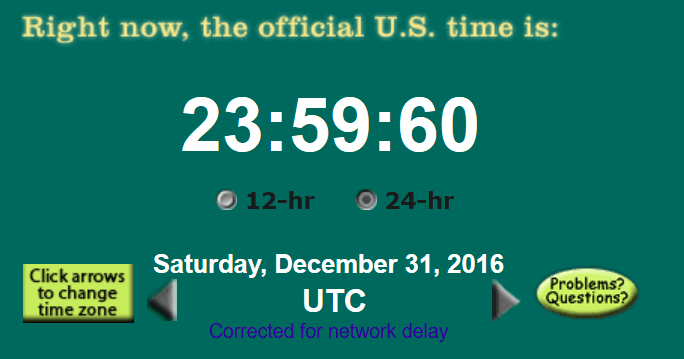
When it is mandated, a positive leap second is inserted between second 23:59:59 of a chosen UTC calendar date and second 00:00:00 of the following date. The definition of UTC states that the last day of December and June are preferred, with the last day of March or September as second preference, and the last day of any other month as third preference. All leap seconds (as of 2019) have been scheduled for either 30 June or 31 December. The extra second is displayed on UTC clocks as 23:59:60. On clocks that display local time tied to UTC, the leap second may be inserted at the end of some other hour (or half-hour or quarter-hour), depending on the local time zone. A negative leap second would suppress second 23:59:59 of the last day of a chosen month so that second 23:59:58 of that date would be followed immediately by second 00:00:00 of the following date. Since the introduction of leap seconds, the mean solar day has outpaced atomic time only for very brief periods and has not triggered a negative leap second.
Recent changes to the Earth's rotation rate have made it more likely that a negative leap second will be required before the abolition of leap seconds in 2035.
Future
The TAI and UT1 time scales are precisely defined, the former by atomic clocks (and thus independent of Earth's rotation) and the latter by astronomical observations (that measure actual planetary rotation and thus the solar time at the IERS Reference Meridian at Greenwich). UTC (on which civil time is usually based) is a compromise, stepping with atomic seconds but periodically reset by a leap second to match UT1.
The irregularity and unpredictability of UTC leap seconds is problematic for several areas, especially computing (see below). With increasing requirements for timestamp accuracy in systems such as process automation and high-frequency trading, this raises a number of issues. Consequently, the long-standing practice of inserting leap seconds is under review by the relevant international standards body.
Elimination proposals
On 5 July 2005, the Head of the Earth Orientation Center of the IERS sent a notice to IERS Bulletins C and D subscribers, soliciting comments on a U.S. proposal before the ITU-R Study Group 7's WP7-A to eliminate leap seconds from the UTC broadcast standard before 2008 (the ITU-R is responsible for the definition of UTC). It was expected to be considered in November 2005, but the discussion has since been postponed. Under the proposal, leap seconds would be technically replaced by leap hours as an attempt to satisfy the legal requirements of several ITU-R member nations that civil time be astronomically tied to the Sun.
A number of objections to the proposal have been raised. P. Kenneth Seidelmann, editor of the Explanatory Supplement to the Astronomical Almanac, wrote a letter lamenting the lack of consistent public information about the proposal and adequate justification. In an op-ed for Science News, Steve Allen of the University of California, Santa Cruz said that the process has a large impact on astronomers.
At the 2014 General Assembly of the International Union of Radio Scientists (URSI), Demetrios Matsakis, the United States Naval Observatory's Chief Scientist for Time Services, presented the reasoning in favor of the redefinition and rebuttals to the arguments made against it. He stressed the practical inability of software programmers to allow for the fact that leap seconds make time appear to go backwards, particularly when most of them do not even know that leap seconds exist. The possibility of leap seconds being a hazard to navigation was presented, as well as the observed effects on commerce.
The United States formulated its position on this matter based upon the advice of the National Telecommunications and Information Administration and the Federal Communications Commission (FCC), which solicited comments from the general public. This position is in favor of the redefinition.
In 2011, Chunhao Han of the Beijing Global Information Center of Application and Exploration said China had not decided what its vote would be in January 2012, but some Chinese scholars consider it important to maintain a link between civil and astronomical time due to Chinese tradition. The 2012 vote was ultimately deferred. At an ITU/BIPM-sponsored workshop on the leap second, Han expressed his personal view in favor of abolishing the leap second, and similar support for the redefinition was again expressed by Han, along with other Chinese timekeeping scientists, at the URSI General Assembly in 2014.
At a special session of the Asia-Pacific Telecommunity meeting on 10 February 2015, Chunhao Han indicated China was now supporting the elimination of future leap seconds, as were all the other presenting national representatives (from Australia, Japan, and the Republic of Korea). At this meeting, Bruce Warrington (NMI, Australia) and Tsukasa Iwama (NICT, Japan) indicated particular concern for the financial markets due to the leap second occurring in the middle of a workday in their part of the world. Subsequent to the CPM15-2 meeting in March/April 2015 the draft gives four methods which the WRC-15 might use to satisfy Resolution 653 from WRC-12.
Arguments against the proposal include the unknown expense of such a major change and the fact that universal time will no longer correspond to mean solar time. It is also answered that two timescales that do not follow leap seconds are already available, International Atomic Time (TAI) and Global Positioning System (GPS) time. Computers, for example, could use these and convert to UTC or local civil time as necessary for output. Inexpensive GPS timing receivers are readily available, and the satellite broadcasts include the necessary information to convert GPS time to UTC. It is also easy to convert GPS time to TAI, as TAI is always exactly 19 seconds ahead of GPS time. Examples of systems based on GPS time include the CDMA digital cellular systems IS-95 and CDMA2000. In general, computer systems use UTC and synchronize their clocks using Network Time Protocol (NTP). Systems that cannot tolerate disruptions caused by leap seconds can base their time on TAI and use Precision Time Protocol. However, the BIPM has pointed out that this proliferation of timescales leads to confusion.
At the 47th meeting of the Civil Global Positioning System Service Interface Committee in Fort Worth, Texas, in September 2007, it was announced that a mailed vote would go out on stopping leap seconds. The plan for the vote was:
April 2008: ITU Working Party 7A will submit to ITU Study Group 7 project recommendation on stopping leap seconds
During 2008, Study Group 7 will conduct a vote through mail among member states
October 2011: The ITU-R released its status paper, Status of Coordinated Universal Time (UTC) study in ITU-R, in preparation for the January 2012 meeting in Geneva; the paper reported that, to date, in response to the UN agency's 2010 and 2011 web-based surveys requesting input on the topic, it had received 16 responses from the 192 Member States with "13 being in favor of change, 3 being contrary."
January 2012: The ITU makes a decision.
In January 2012, rather than decide yes or no per this plan, the ITU decided to postpone a decision on leap seconds to the World Radiocommunication Conference in November 2015. At this conference, it was again decided to continue using leap seconds, pending further study and consideration at the next conference in 2023.
In October 2014, Włodzimierz Lewandowski, chair of the timing subcommittee of the Civil GPS Interface Service Committee and a member of the ESA Navigation Program Board, presented a CGSIC-endorsed resolution to the ITU that supported the redefinition and described leap seconds as a "hazard to navigation".
Some of the objections to the proposed change have been addressed by its supporters. For example, Felicitas Arias, who, as Director of the International Bureau of Weights and Measures (BIPM)'s Time, Frequency, and Gravimetry Department, was responsible for generating UTC, noted in a press release that the drift of about one minute every 60–90 years could be compared to the 16-minute annual variation between true solar time and mean solar time, the one hour offset by use of daylight time, and the several-hours offset in certain geographically extra-large time zones.
Proposed alternatives to the leap second are the leap hour, which requires changes only once every few centuries; and the leap minute, with changes coming every half-century.
Phase-out and future of leap seconds
On 18 November 2022, the General Conference on Weights and Measures (CGPM) passed Resolution 4, directing that the maximum permitted difference between UT1 and UTC be increased "in, or before, 2035." The difference between atomic and astronomical time will be allowed to grow to a larger value yet to be determined. The resolution instructs the CIPM (International Committee for Weights and Measures) to develop, in consultation with the International Telecommunication Union (ITU) and other stakeholders, a plan to implement a new maximum (UT1–UTC) value by 2035 that would ensure UTC continuity for at least a century. The 28th CGPM, scheduled for 2026, is expected to review and potentially approve this new limit. A suggested possible future measure would be to let the discrepancy increase to a full minute, which would take 50 to 100 years, and then have the last minute of the day taking two minutes in a "kind of smear" with no discontinuity. The year 2035 for eliminating leap seconds was chosen considering Russia's request to extend the timeline to 2040, since, unlike the United States's global navigation satellite system, GPS, which does not adjust its time with leap seconds, Russia's system, GLONASS, does adjust its time with leap seconds.
ITU World Radiocommunication Conference 2023 (WRC-23), which was held in Dubai (United Arab Emirates) from 20 November to 15 December 2023 formally recognized the Resolution 4 of the 27th CGPM (2022) which decides that the maximum value for the difference (UT1-UTC) will be increased in, or before, 2035.
Implications and technical debate
Many proponents of the change argue that removing frequent leap seconds will improve the stability and reliability of time dissemination systems (e.g., telecommunications, GNSS, data networks), avoiding the disruptions caused by inserting or removing a second unpredictably.
According to the BIPM resolution text and technical studies, proposed alternative strategies include gradual "smear" adjustments (spreading the additional time over hours or days) or very rare "leap minute" insertions, rather than the current unpredictable leap-second model.
While the focus is on removing frequent leap seconds, the link between UTC and Earth's rotation (UT1) would not be permanently broken: the resolution explicitly preserves that connection, just with a more relaxed bound.
Criticism and counterpoints
Some critics warn that increasing the permissible divergence between UTC and UT1 could, over very long timescales, weaken civil time’s alignment with solar time (i.e., what "noon" feels like vs. real solar noon), though BIPM officials argue that the increase will be gradual and manageable.
Opponents also caution that the "smear second" solution may not be ideal for all systems: the lack of a sudden, well-defined leap makes it harder for some time‑sensitive protocols to maintain compatibility without additional engineering.
Long-term outlook
If implemented as planned, the change would mean no more leap-second insertions for many decades, reducing disruptions in high-precision digital systems.
The new (UT1–UTC) limit is expected to be revisited periodically; the resolution mandates a review mechanism so that the tolerance does not diverge uncontrollably as Earth's rotation evolves.
Problems
Time difference and sequence calculations
To compute the elapsed time in seconds between two given UTC dates requires the consultation of a table of leap seconds, which needs to be updated whenever a new leap second is announced. Since leap seconds are known only 6 months in advance, time intervals for UTC dates further in the future cannot be computed.
Missing announcements
Although BIPM announces a leap second 6 months in advance, most time distribution systems (SNTP, IRIG-B, PTP) announce leap seconds at most 12 hours in advance, sometimes only in the last minute and some even not at all (DNP3).