
On August 9, 2014, 18-year-old Michael Brown was shot and killed by police officer Darren Wilson in Ferguson, Missouri, a suburb of St. Louis.
Brown was accompanied by his 22-year-old male friend Dorian Johnson. Wilson, a white male Ferguson police officer, said that an altercation ensued when Brown attacked him in his police vehicle for control of his service pistol. Johnson claimed that Wilson initiated the confrontation by grabbing Brown by the neck through Wilson's patrol car window, threatening him and then shooting at Brown. At this point, both Wilson and Johnson state that Brown and Johnson fled, with Wilson pursuing Brown shortly thereafter. Wilson stated that Brown then stopped, turned around and charged at him after the short pursuit. Johnson contradicted this account, stating that Brown turned around with his hands raised up after Wilson shot him in the back. According to Johnson, Wilson shot Brown multiple times until Brown fell to the ground. In the entire altercation, Wilson fired a total of twelve bullets, including twice during the struggle in the car. Brown was struck a total of six times, all in the front of his body.
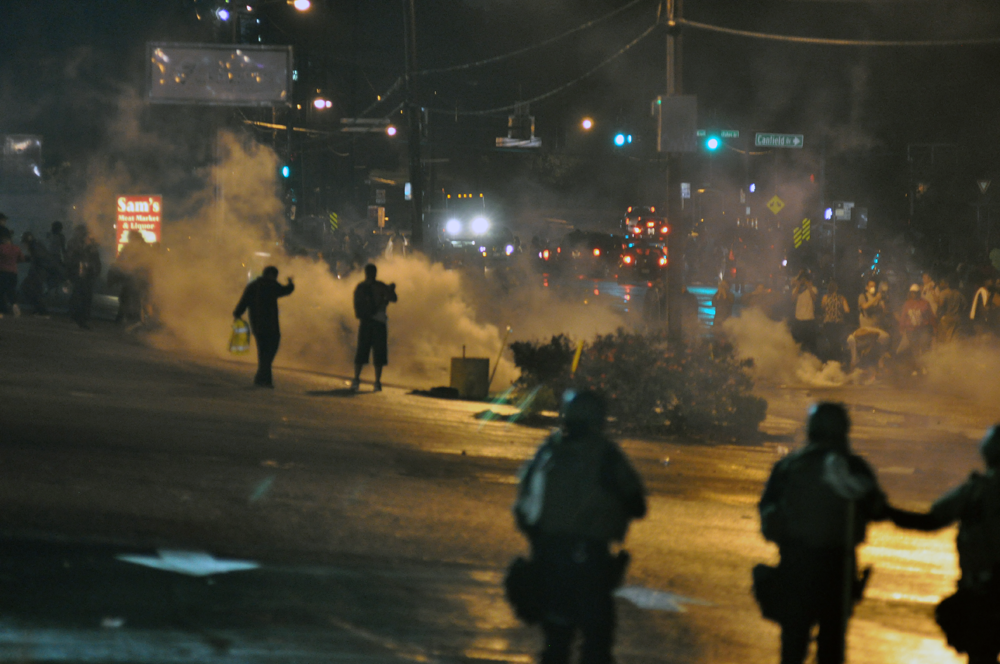
This event ignited unrest in Ferguson. Johnson, and later some other witnesses, claimed Brown had his hands up in surrender or said "don't shoot", which led to protestors using the slogan "Hands up, don't shoot". A subsequent FBI investigation said that there was no evidence that Brown had done so, with the U.S. Department of Justice also acknowledging an official report that no other witnesses credibly backed this claim, with some who contradicted Wilson's story even retracting their initial accounts of what they said they witnessed during the shooting. Peaceful protests and violent riots continued for more than a week in Ferguson; police later established a nightly curfew.
The response of area police agencies in dealing with the protests was strongly criticized by both the media and politicians. Concerns were raised over insensitivity, tactics, and a militarized response.
A grand jury was called and given evidence from Robert McCulloch, the St. Louis County Prosecutor. On November 24, 2014, McCulloch announced the St. Louis County grand jury had decided not to indict Wilson. In March 2015, the U.S. Department of Justice reported the conclusion of its own investigation and cleared Wilson of civil rights violations in the shooting. They concluded that witnesses and forensic evidence supported Wilson's account. The report stated that "multiple credible witnesses corroborate virtually every material aspect of Wilson's account and are consistent with the physical evidence". The U.S. Department of Justice concluded that Wilson shot Brown in self-defense.
In 2020, St. Louis County prosecutor Wesley Bell spent five months reviewing the case with an eye to charge Wilson with either manslaughter or murder. In July, Bell announced Wilson would not be charged.

Background
Michael Orlandus Darrion Brown (May 20, 1996 – August 9, 2014) graduated from Normandy High School in St. Louis County eight days before his death, completing an alternative education program. At the time of his death, he was 18 years old, 6 feet 4 inches (1.93 meters) tall, and weighed 292 pounds (132 kilograms). He was an amateur rap musician who posted his songs on the popular music-sharing site SoundCloud under the handle "Big'Mike." He was two days from starting a training program for heating and air conditioning repair at Vatterott College technical school.
Darren Dean Wilson (born May 14, 1986, in Fort Worth, Texas) is 6 ft 4 in (1.93 m) tall and at the time weighed about 210 lb (95 kg). Wilson's first police job was in the town of Jennings, Missouri, where he began working in 2009. With respect to this job, Wilson said to The New Yorker in 2015, "I'd never been in an area where there was that much poverty."
The police force in Jennings was shut down by the town's city council in March 2011. In October 2011, Wilson began working for the Ferguson Police Department. In February 2013, Wilson won a commendation from the Ferguson Police Department after he apprehended a suspect who was later charged with possession of marijuana with intent to distribute and resisting arrest.
Brown's activities prior to the incident
Surveillance video which was publicly released in the 2017 documentary film Stranger Fruit shows Michael Brown walking into Ferguson Market and Liquor at 1:13 a.m., ten-and-a-half hours before he entered the store for the final time. The footage shows Brown handing a young clerk a brown package, believed by the filmmaker to be marijuana, and then receiving an unpurchased package of cigarillos from the store. After the video was rediscovered and made public in 2017, some, including Brown's family, said they believed Brown had left the package there for safekeeping and later returned to retrieve it. The store owner disputed this through an attorney who dismissed claims that the store traded him "cigarillos for pot." The lawyer claimed "[t]he reason he [Brown] gave it back is he was walking out the door with unpaid merchandise and they [the staff] wanted it back." The store's attorney said the video had been in the hands of Brown's family and law enforcement since the initial investigation, and said the video had been edited to remove the portion where the store clerk returned Brown's package to him. Following this, on March 13, 2017, unedited footage from the store was released by the St. Louis County prosecutor to try to settle questions.
Incident
At 11:47 a.m., Officer Wilson responded to a call about a baby with breathing problems and drove to Glenark Drive in Ferguson, east of Canfield Drive. About three minutes later and several blocks away, Brown was recorded on camera stealing a box of Swisher Sweets cigars and forcefully shoving a Ferguson Market clerk. At 11:53, a police dispatcher reported "stealing in progress" at the Ferguson Market and described the suspect as a black male wearing a white T-shirt running toward QuikTrip. The suspect was reported as having stolen a box of Swisher cigars. Brown and his friend, Dorian Johnson, left the market at about 11:54 a.m. At 11:57, the dispatch described the suspect as wearing a red St. Louis Cardinals hat, a white T-shirt, yellow socks, and khaki shorts, and that he was accompanied by another male. Ferguson Police Chief Thomas Jackson said that the incident with Brown stealing cigars had "nothing to do" with why Brown was stopped by Wilson prior to the shooting, and that the reason Brown and Johnson were stopped was because "they were walking down the middle of the street, blocking traffic."
At 12:00 p.m., Wilson reported he was back in service and radioed units 25 and 22 to ask if they needed his assistance in searching for the suspects. Seven seconds later, an unidentified officer said the suspects had disappeared. Wilson called for backup at 12:02, saying "[Unit] 21. Put me on Canfield with two. And send me another car."

Initial reports of what happened next differed widely among sources and witnesses, particularly with regard to whether Brown was moving towards Wilson when the shots were fired. At noon on August 9, Wilson drove up to Brown and Johnson as they were walking in the middle of Canfield Drive and ordered them to move off the street. Wilson continued driving past the two men, but then backed up and stopped close to them. A struggle took place between Brown and Wilson after Brown reached through the window of Wilson's police SUV, a Chevrolet Tahoe. Wilson was armed with a SIG Sauer P229 pistol, which was fired twice during the struggle from inside the vehicle, with one bullet hitting Brown's right hand. Brown and Johnson fled and Johnson hid behind a car. Wilson got out of the vehicle and pursued Brown. At some point, Wilson fired his pistol again, while facing Brown, and hit him with at least six shots, all in the front of his body. Brown was unarmed and died on the street. Less than 90 seconds passed from the time Wilson encountered Brown to the time of Brown's death.
An unidentified officer arrived on the scene and, 73 seconds after Wilson's call, asked where the second suspect was. Thirty-one seconds later, a supervisor was requested by Unit 25. At 12:07 p.m., an officer on scene radioed to dispatch for more units. Also at 12:07, the St. Louis County police were notified and county officers began arriving on scene at around 12:15 p.m. The St. Louis County detectives were notified at 12:43 p.m. and arrived about 1:30 p.m., with the forensic investigator arriving at about 2:30 p.m.
Police dispatched 12 units to the scene by 1:00 p.m. with another 12, including two canine units, by 2:00 p.m. Gunshots were recorded in Ferguson police logs at 2:11 p.m., and by the ambulance dispatch again at 2:14 p.m., which led to the response of 20 more units from eight different municipal forces in the next 20 minutes. As the situation deteriorated, the police commanders had investigators seek cover and detectives assisted in crowd control. At 2:45, four canine units arrived on scene, and the SWAT team arrived at 3:20 p.m. The medical examiner began his examination of Brown at approximately 3:30 p.m. and concluded about half an hour later, with Brown's body being cleared to be taken to the morgue. At 4:37 p.m., Brown's body was signed in at the morgue by workers.

Investigations
Police
Michael Brown was fatally shot by Officer Wilson at about 12:02 p.m. The Ferguson Police Department was on the scene within minutes, as were crowds of residents, some expressing hostility toward the police. Paramedics covered the body with sheets. About 20 minutes after the shooting, the Ferguson police chief turned over the homicide investigation to the St. Louis County Police Department (SLCPD). The arrival of SLCPD detectives took about 70 minutes, as they were occupied with another crime scene 37 minutes away. On arrival at 1:30 p.m., they put up privacy screens around the body. Their investigation was slowed due to safety concerns regarding the sound of gunfire in the area and some hostile members of the crowd encroaching on the crime scene. An investigator from the St. Louis County Medical Examiner's office arrived at 2:30 p.m. Brown's body was removed at 4:00 p.m. Local residents criticized authorities for leaving Brown's body in the street for four hours in an action seen as demeaning and disrespectful.
Department of Justice
On August 11, 2014, the Federal Bureau of Investigation (FBI) opened a civil rights investigation into the incident. A spokeswoman for the FBI's St. Louis field office said the decision to open an investigation was not motivated by the protests and riots which had ensued. Forty FBI agents went door-to-door looking for potential witnesses who may have had information about the shooting. Additionally, attorneys from the Civil Rights Division and from the United States Attorney's Office were participating in the investigation.
On March 4, 2015, the federal investigation cleared Wilson of civil rights violations in the shooting. The investigation concluded there was no evidence upon which prosecutors could rely to disprove Wilson's asserted belief that he feared for his safety, that witnesses who contradicted Wilson were not credible, that forensic evidence and credible witnesses corroborated Wilson's account, and that the facts did not support the filing of criminal charges against Wilson. Credible witnesses did not support accounts that Brown had his hands up in surrender. He was not shot in the back. Forensic evidence showed he was moving toward Wilson. Numerous witnesses were found to have given accounts of actions they were unable to see from their vantage points, or to be recounting others' accounts.
2020 prosecutor review
A new St. Louis County prosecutor, Wesley Bell, spent five months in 2020 reviewing the case with an eye to charging Wilson with either manslaughter or murder. In July, Bell announced he would not charge Wilson with any crime; Bell said he didn't "have the evidence to ethically bring a charge against Darren Wilson."
Grand jury hearing
The grand jury was made up of members who had been impaneled in May 2014 for a regularly scheduled term, to hear all cases put forward by the prosecuting attorney's office. There were three black jury members (one man and two women) and nine white jury members (six men and three women), an ethnic breakdown that roughly reflects the racial makeup of St. Louis County, which is about 30% black, and 70% white. On August 20, 2014, the grand jury started hearing evidence in the case State of Missouri v. Darren Wilson, in order to decide whether a crime was committed and if there was probable cause to believe Wilson committed it.
There was intense interest focused on the grand jury. Robert P. McCulloch, the elected prosecuting attorney for St. Louis County, was in charge of the prosecution but did not participate in the direct handling of the grand jury hearing. It was handled by two Assistant Prosecuting Attorneys of McCulloch's office: Kathi Alizadeh and Sheila Whirley. McCulloch announced an unusual process: the grand jury would hear all the evidence, the proceedings would be transcribed, and the materials would be made public if the grand jury did not indict.
The grand jury took 25 days, over the span of three months, to hear more than 5,000 pages of testimony from 60 witnesses and then deliberate on whether or not to indict Wilson. Most grand juries complete their work in a matter of days. The grand jury was not sequestered during the process.
On the night of November 24, Prosecutor McCulloch reported in a 20-minute press conference that the grand jury had reached a decision in the case and would not indict Wilson.
Following his announcement, McCulloch released thousands of pages of grand jury documents, with materials published on the internet for public perusal. The documents include transcripts of the proceedings, expert statements, and the testimony of some witnesses. On December 8, more witness interviews and more than 50 brief audio recordings between the police dispatchers and responding police officers were released. On December 13, a third release included the transcripts of witness interviews, including one with Dorian Johnson. A video of the two-hour interview of Johnson by FBI and county police was withheld.
Robert P. McCulloch was the main focus of much of the criticism throughout the process and well into its aftermath. An attorney named Raul Reyes writing an article for CNN characterized McCulloch as not being impartial, as his father was a police officer killed in an incident with a black suspect and other members of his family served with the St. Louis Police Department. A petition calling for McCulloch to recuse himself gained 70,000 signatures. Governor Jay Nixon declined to remove McCulloch and said doing so would potentially jeopardize the prosecution. McCulloch dismissed the claims of bias, and later said he regretted not speaking publicly about his background at the time.
Legal analysts raised concerns over McCulloch's unorthodox approach, saying this process could have influenced the grand jury to decide against indictment and that they were given too much material to assess. The analysts highlighted the significant differences between a typical grand jury proceeding in Missouri and how Wilson's case was handled.
Evidence
Shooting scene
Evidence presented to the grand jury showed that the shooting scene extended approximately 184 feet (56 m) along Canfield Drive, near where it intersects Copper Creek Court. The two-lane street runs east to west, and has sidewalks and curbs on both sides. Immediately prior to the incident, Brown was walking eastbound on Canfield and Officer Wilson was driving westbound. Evidence at the scene was generally clustered around Wilson's patrol SUV on the western side of the scene and near Brown's body, which was in the eastern part of the area.
The 30-foot (9.1 m) western area included Wilson's SUV, which was angled slightly toward the right curb with its left-rear corner on the center line. Evidence included two bracelets, a baseball cap, and two .40 caliber spent casings. One of these casings was found at the western edge of the scene and the other was located near the rear driver's side of the police vehicle. There were two groups of red stains near the driver's side of the vehicle and a left sandal was also located in the vicinity. The right sandal was approximately 44 feet (13 m) east of the western area.
The eastern area, which was approximately 124 feet (38 m) east of the western area, was about 29 feet (8.8 m) wide. Brown's body was situated along the center-line of the road with his head oriented in a westerly direction. The distance from the driver's door of Wilson's SUV to Brown's head was about 153 feet (47 m). Two groups of red stains were located at the extreme eastern edge of the scene, with the furthest under 22 feet (6.7 m) from Brown's feet.
One apparent projectile was found near the body. There were ten spent .40-caliber casings scattered on the south side of the road near Brown's body. The distribution of the casings, combined with most of the casings being east of the body, was consistent with Officer Wilson moving backward while firing. Blood spatter approximately 25 feet (7.6 m) behind Brown's body suggested Brown was moving toward Wilson when Brown was killed.
DNA
Brown's DNA was found on Wilson's gun. His DNA was also found on the left thigh of Officer Wilson's pants and on the inside driver's door handle of Wilson's police SUV, the result of Brown's spilled blood staining Wilson's pants and the door handle. Wilson's DNA was found on Brown's left palm but was not found under Brown's fingernails or on his right hand.
Michael Graham, the St. Louis medical examiner, said blood was found on Wilson's gun and inside the car, and tissue from Brown was found on the exterior of the driver's side of Wilson's vehicle; this evidence was consistent with a struggle at that location. According to Judy Melinek, a San Francisco pathologist who commented on the case as an expert, the official autopsy, which said Brown's hand had foreign matter consistent with a gun discharge on it, supported Wilson's testimony that Brown was reaching for the weapon, or indicated the gun was inches away from Brown's hand when it went off.
According to the detective who performed tests on the gun, he had to decide whether to perform a DNA test or dust for fingerprints, because only one test can be performed without affecting the other. He found the gun stored in an unsealed envelope, contrary to the customary evidence-handling protocol. Documents released after the grand jury proceedings show Wilson washed blood from his hands and checked his own gun into an evidence bag, both actions described by media outlets as unorthodox procedures for such a case.
Autopsies
Three autopsies were performed on Brown's body, with all three noting Brown had been shot at least six times, including twice in the head. He received no shots in his back.
The county autopsy report described gunshot entry and exit wounds to Brown's right arm coming from both the front (ventral, palms facing forward) and the back (dorsal, palms facing backward).
County
The local medical examiner autopsy report released to state prosecutors said Brown was shot in the front part of his body. When Mary Case, the St. Louis County medical examiner, was asked to provide details, she declined to comment further, citing the ongoing investigation into Brown's death. The official county autopsy was later leaked to the St. Louis Post-Dispatch.
The narrative report of investigation from the office of the medical examiner of St. Louis agreed with Wilson's testimony. It noted Brown had sustained multiple gunshot wounds to the head, torso, and right arm, as well as a single gunshot wound to the inside of his right hand near his thumb and palm; it also noted Brown's body had abrasions to the right side of his face and on the back of his left hand.
The autopsy noted the absence of stippling, powder burns around a wound that indicate a shot was fired at a relatively short range. Michael Graham notes gunshot wounds within an inch of the body do not always cause stippling. Microscopic examination of tissue taken from Brown's thumb wound detected the presence of a foreign material consistent with the material which is ejected from a gun while firing. The gunshot wound to the top of Brown's head was consistent with Brown either falling forward or being in a lunging position; the shot was instantly fatal.
A toxicology test performed by a St. Louis University laboratory revealed the presence of THC, the active ingredient in marijuana, in Brown's blood and urine. This indicated he used marijuana within a few hours of his death, but not whether he was impaired when he died.
Independent
At the request of Brown's family, on August 17 a preliminary autopsy was conducted by Michael Baden, a former chief medical examiner for the City of New York (1978–1979). This autopsy was limited because the previous county autopsy had washed, embalmed, and taken evidence off the body.
According to Baden's report, Brown was shot six times into his front: four of the bullets entered his right arm, one entered his right eye on a downward trajectory, and one entered the top of his skull. All of the rounds were fired from a distance of at least one foot. One of the shots shattered Brown's right eye, traveled through his face, then exited his jaw and reentered his collarbone. Brown could have survived the first bullet wounds, but the bullet that entered the top of his head resulted in a fatal injury.
Baden had no access to the clothing of the victim, and had not yet seen the x-rays showing where bullets were in the body. He could not determine if any gunpowder residue was on that clothing. Baden concluded there was too little information to forensically reconstruct the shooting. At least two commentators noted the results of both autopsies contradicted some aspects of some eyewitness accounts, which had reported Wilson shot Brown in the back and that Wilson shot Brown while holding Brown's neck. In later analysis, Baden reclassified one of Brown's chest wounds as an entry wound.
Baden was assisted by Shawn Parcells, who did not have a degree or credentials in medicine or pathology. Thomas Young, former Jackson County Medical Examiner, said Parcells gave out forensic pathology opinions despite not being qualified to do so. Mary Case, who performed the initial autopsy, said Parcells' involvement could cause issues with the second autopsy. Parcells said all he did was assist Baden. In 2021, Parcells was convicted in state court in Kansas of six criminal charges relating to autopsies he illegally performed in that state. In 2022, Parcells was convicted in federal court, also in Kansas, of wire fraud related to performing an autopsy in 2016 based on false credentials.
Federal
Attorney General Eric Holder ordered a third autopsy of Brown's body. Its findings matched the other two autopsies, but its detailed findings were initially withheld from the public due to the ongoing investigation. The federal autopsy report was among a group of documents released by the St. Louis County Prosecutor's Office on December 8, two weeks after the grand jury chose not to indict Wilson.
Audio recording of gunshots
On August 27, CNN released an audio recording purported to contain the sounds of the shooting. The recording was made by an anonymous third-party who happened to be recording a video-text message at the time of the incident. Glide, a video messaging service, confirmed the audio had been recorded on their site at 12:02 p.m. on the day of the shooting. The twelve-second recording contains a series of shots, a short pause, and then a second series of shots.